How to Win at Ping Pong: Tactics That Beat Better Players
You don’t have to out-hit someone to beat them — you have to out-decide them. Win more by placing the ball (corners and their playing elbow), serving with intent (three practised serves beat twenty improvised ones), and identifying their style in the first two minutes, then playing the thing that style hates. Power is the least useful weapon you own.
Most club matches aren’t decided by who has the better forehand. They’re decided by who noticed that the other player can’t handle a short backspin serve — and then served it eleven times.
- →Placement beats power — three targets win more points than any stroke upgrade
- →The playing elbow is the highest-percentage target in the sport
- →Every opponent has a style, and every style has a specific counter
- →Serve is the only shot they can’t influence — waste it and you’ve given away a third of your points
- →Big points reward rehearsed patterns, not inspiration
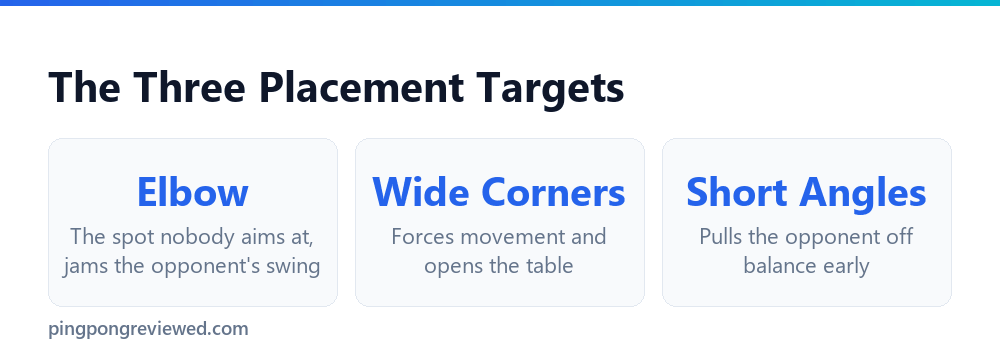
Table of Contents
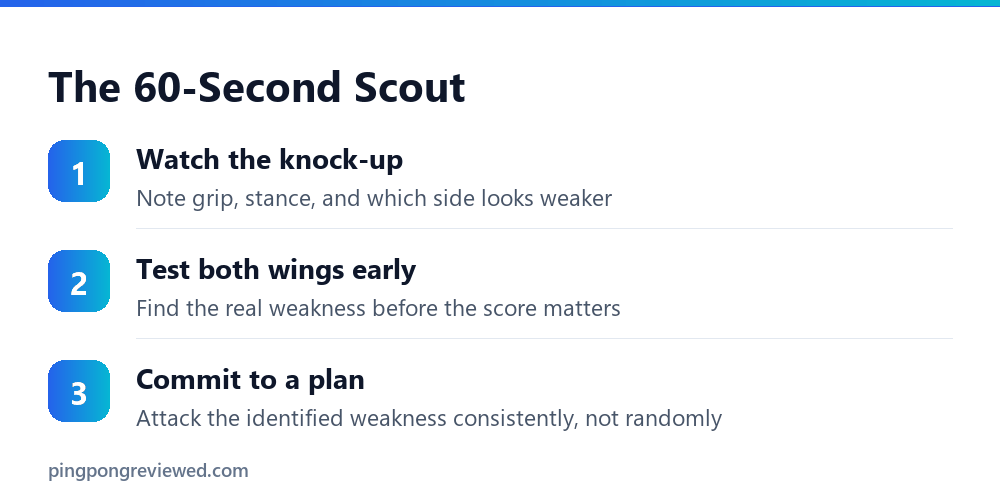
The 60-second scout (do this during the knock-up)
Before the first point you get roughly two minutes at the table. Most players use it to hit balls. Use it to gather four pieces of information instead:
📊 Note: You’re not warming up during the knock-up — you did that beforehand (see our warm-up guide). You’re scouting, and it’s free information your opponent is handing you.
Placement: the three targets
Recreational players aim at ‘the table’. Winning players aim at three specific places, and rotate between them deliberately.
- Longest reach required
- Opens the whole table
- Pulls them out of position
- Sets up the next ball
- Most players’ weaker wing
- Cramped stroke, less power
- The default target at club level
- Repeat until they solve it
- The crossover point
- Forehand or backhand? No time
- Even good players return it weakly
- Almost nobody aims here
Everyone aims at the corners. Almost nobody aims at the elbow — which is exactly why it works.
The elbow target exists because of how nearly everyone holds the paddle. The shakehand grip creates a zone around the playing elbow where neither wing works cleanly — too close for a comfortable forehand, too awkward for a backhand. Your opponent has to choose, and the choosing costs them the fraction of a second they needed.
Depth matters as much as width. Alternating short and long is the oldest point-winning pattern in the sport: a short ball drags them in, and the next deep ball arrives while they’re still leaning forward. Short–short–long wins points at every level from club night to professional.
Beat the style, not the player
This is the section that turns a decent player into a difficult one. Almost every opponent falls into one of five patterns, and each has a specific thing it cannot cope with:
⚠️ Watch out: The most common tactical error is playing your game regardless. If you’re a looper facing a chopper and you keep looping every backspin ball at the same pace, you’re doing exactly what they’ve trained for — thirty of those in a row is their entire strategy. Change the pace or the depth and they’ll break long before you do.
Serve like it decides the match (it does)
You serve roughly half the points in a match, and the serve is the only shot your opponent cannot influence. A player with three practised serves is starting every second point with an advantage. A player who improvises is starting level.
Three serves are enough — genuinely. You don’t need variety, you need reliability plus a rehearsed follow-up for each:
Then practise the follow-up, not just the serve. Serve short backspin, they push, you loop — that’s the single most common point pattern in amateur table tennis and it’s drilled in full in our drills guide. And check your motion is legal, because a serve built on an illegal toss disintegrates the moment you enter a real competition.
Returning serve: the skill nobody practises
Here’s an asymmetry worth exploiting. Almost every club player practises their serve occasionally and their return of serve essentially never — which means half the points in every match are decided by a skill nobody has trained.
Three habits that fix most of it:
- Watch the racket, not the ball. The spin is decided at contact, and by the time you’re reading the ball’s flight you’re already late. Where was the racket travelling as it met the ball — up, down, or across?
- Return long and deep by default. A deep return takes away their third-ball attack. Short returns are for when you’ve read the spin confidently and want to play a touch game.
- Vary where you return to. Players who always return cross-court are readable. Their third-ball attack is already loaded before you touch the ball.
💡 Pro tip: If you can’t read a serve, take the safe option and go deep to their backhand. It’s rarely the winning play and it’s almost never the losing one — and it buys you another look at the same serve, which is how you eventually solve it.
Big points: 9-9 and beyond
Under 11-point scoring, the difference between winning and losing a game is usually one or two points, and they arrive when you’re tightest. This is where matches are actually decided:
- ✓Play your most practised pattern, not your most spectacular
- ✓Serve the serve you’ve drilled a thousand times
- ✓Return deep to their backhand and make them create
- ✓Take the full time between points — one breath, decide, then serve
- ✓Aim bigger margins: two feet inside the line, not two inches
- ✕Try something you’ve never practised
- ✕Go for a winner off a half-chance
- ✕Rush the serve because you’re nervous
- ✕Change your grip pressure — tension is the enemy of touch
- ✕Replay the last point in your head while serving the next
The mental piece is unglamorous but real: the player who tightens up loses. Grip pressure rises, strokes shorten, margins vanish. The counter is a routine — same ball bounce, same breath, same rhythm before every serve. Familiarity is what beats adrenaline, and it’s trainable in exactly the way that ‘try to relax’ isn’t.
When your plan isn’t working
Tactics are only half the skill. The other half is noticing, mid-match, that what you’re doing has stopped working — and most players never do.
The classic pattern: you win the first game with a plan, your opponent adjusts, you lose the next two doing exactly the same thing while getting increasingly frustrated. Good players adjust at 5-2 down; average players adjust after the match, in the car.
A simple checkpoint: at each changeover, ask yourself one question — where are my points coming from, and where am I losing them? Not a full analysis, just the pattern. If your last four lost points were all long rallies, stop extending rallies. If three came off their serve, change your return position or your return target rather than trying to hit the same return better.
And be willing to abandon a plan that was correct. If short backspin worked beautifully in game one and they’ve now solved it, that doesn’t mean it was the wrong read — it means they adjusted and it’s your turn again. Matches at any decent level are a sequence of adjustments, not a single strategy executed well.
⚠️ Watch out: The trap is doubling down. When a tactic stops working, the instinct is to execute it harder — serve the same serve with more spin, hit the same shot with more pace. That’s usually the losing move. If they’ve solved it, more of it just gives them more practice.
The unglamorous multipliers
Tactics sit on top of things that are duller and matter more:
- →Drills — the 70/30 practice system
- →Serving rules — make sure your serve survives a real match
- →Reading spin — the skill behind every good return
- →Common mistakes — find your symptom, fix the cause
Frequently asked questions
What’s the fastest way to win more ping pong games?
Placement. Stop aiming at the table and start aiming at their wide backhand and their playing elbow. It costs nothing, requires no new technique, and works immediately.
How do I beat someone who is better than me?
Find the one thing they don’t like and do it relentlessly — usually short backspin, or attacking their elbow. Better players have better strokes, but their weaknesses are just as specific as anyone’s.
How do I beat a defensive chopper?
Vary pace and depth. Choppers are trained for repetitive attacking, so alternate a strong loop with a sudden drop shot, and attack the ball after their push rather than trying to smash their chop.
What should I do at 9-9?
Your most rehearsed serve, your most rehearsed follow-up, and bigger safety margins. Big points reward preparation, not improvisation.
Is it better to attack or play safe?
At club level, patience wins. Force attacks only off genuinely high balls; push and place the rest. Most recreational points are lost by unforced errors, not won by winners.
How do I stop getting nervous on important points?
Build a between-points routine and use it every time, not just when it matters. Familiarity is what beats adrenaline — deciding to relax has never worked for anyone.
Does aiming at the elbow really work?
Yes, and it’s underused because it looks unspectacular. The shakehand grip creates a genuine dead zone at the playing elbow — your opponent has to choose a wing with no time to choose.

Ping Pong Reviewed is an equipment review site covering table tennis and baseball gear. Specifications are checked against manufacturer listings, and prices against live retail pages, before publication.