Table Tennis Tournament Preparation: Your First Competition Guide
For your first table tennis tournament: change nothing about your equipment, drill your three serves daily for two weeks, and arrive 45 minutes early. Expect a round-robin group first — so one bad match eliminates nothing. The day is roughly 20 minutes of play inside five hours of waiting, and managing that gap is most of the skill.
Search for tournament advice and you get sports-science papers about elite periodisation, which is not much use the week before your first local open. This is the practical version: what to do, what to pack, how the day actually unfolds, and how to handle the nerves that make everyone’s first tournament serve go into the net.
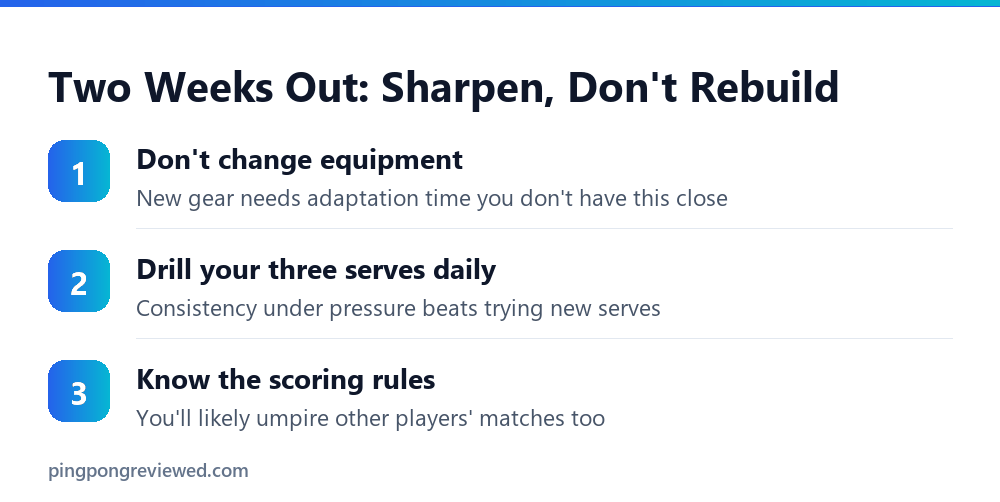
- →Don’t change equipment in the final three weeks — new gear needs adaptation time you don’t have
- →Round-robin groups mean one loss eliminates nobody
- →You’ll umpire other people’s matches — know the scoring rules
- →The real skill is energy management across five hours
- →Everyone’s first tournament heart rate is absurd. It’s not just you
Table of Contents
Two weeks out: sharpen, don’t rebuild
- ✓Drill your three serves ten minutes daily
- ✓Play full-scoring practice matches, 11 points, alternating serves
- ✓Rehearse your serve + third-ball pattern until it’s automatic
- ✓Confirm your serve is legal — umpires call the toss
- ✓Sleep and eat normally; taper hard training in the final three days
- ✕Buy a new paddle, blade or rubber
- ✕Change your grip or rebuild a stroke
- ✕Try a tactical style you’ve never used
- ✕Train to exhaustion the day before
- ✕Watch three hours of professional matches and try to copy them
⚠️ Watch out: New equipment is the classic first-tournament mistake. A fresh rubber plays differently for its first few hours, and a new blade takes weeks to trust. Players buy gear to feel prepared and arrive with equipment they’ve never played a real point on. Whatever you’ve been training with is what you should compete with.
The legal serve point deserves emphasis. Casual play tolerates a serve struck straight from the hand with a screened ball; an umpire does not. If your motion has never been checked, film it from the receiver’s angle this week — most players discover at least one violation, and finding out at 5-5 in your first match is a bad way to learn. Our illegal serves guide covers all seven.
What to pack

How tournament day actually runs
Between matches: where amateurs lose
The five hours between your matches will do more damage to your results than any opponent. Four habits:
- Layer on immediately after each match
- Ten minutes of stillness = cold muscles
- Shadow strokes before your next call
- Cold players lose to worse players
- Bananas, bars, nuts
- Never a heavy lunch mid-event
- Water constantly, not in gulps
- Blood sugar crashes at 3pm are real
- One note per match, not an autopsy
- ‘His serve was short backspin’
- Write it down — memory lies
- Fix it in the next match
- Watch your next opponent play
- Their weak wing is visible from the side
- Free information nobody uses
- See our tactics guide
Tournaments are attrition events. The player who manages the gaps beats the player who only manages the matches.
Choosing the right first tournament
Not all events are equally sensible for a debut, and picking badly is a good way to have a miserable day and never come back.
Look for banded or restricted events. Most local opens run categories by rating, age or experience — ‘Under 1400’, ‘Division 3’, ‘Novice’. Entering the open singles at your first event means playing county-level players in round one, which teaches you nothing except that county-level players are good. A banded event puts you against people at your standard, which is where the actual learning is.
Prefer round-robin over straight knockout. A knockout event can be over in twenty minutes if you lose your first match, after you’ve driven an hour and paid an entry fee. Round-robin groups guarantee you several matches whatever happens — vastly better value and vastly better experience.
Local beats prestigious. Your first tournament should be close to home, small, and cheap. Save the big regional events for when you know how you respond to competition and what your routine looks like.
Go with someone if you can. A club-mate entering the same event transforms the waiting hours, gives you a warm-up partner, and means someone is watching your matches who can tell you afterwards what they saw. It also makes it far more likely you’ll enter a second one.
💡 Pro tip: Go and watch one before you enter. Turn up to a local tournament as a spectator for an hour or two. You’ll see the format, the standard, the etiquette, and the fact that everybody there is entirely ordinary — which removes most of the mystique that makes first tournaments frightening.
Nerves: the honest section
Your first tournament heart rate will be genuinely absurd. Your hands will shake, your first serve will feel like someone else’s, and you’ll wonder why a game you play every week suddenly feels impossible. This is universal and it fades — but three things help immediately.
Routines. Same ball bounce, same breath, same rhythm before every serve, every time. Familiarity is what beats adrenaline — it gives your body a script when your brain has gone quiet. This is why professionals look almost robotic between points.
Process goals. ‘Win’ is not something you control. ‘Get 70% of my serves short’ is. Set two or three process targets before the day and judge yourself on those — you’ll play looser, and you’ll have something honest to take home regardless of results.
Reframing. Nobody remembers your first-tournament results, including you, within a month. What you’re actually there to collect is information — how you handle pressure, which shots survive it, what the standard looks like. Losing 11-3 to someone excellent is a productive afternoon, not a humiliation.
After the tournament
Write down five things while they’re fresh — that evening, not next week:
- What won you points. Which serve, which pattern, which target.
- What lost them. Be specific: ‘couldn’t attack backspin’ beats ‘played badly’.
- Which serve got punished, and by what kind of player.
- Whether your fitness lasted to the fourth match.
- Who to practise with — someone whose style beat you.
That list is your next month of training priorities, and it’s the real prize. One tournament exposes more genuine weaknesses than ten club sessions, because club sessions let you avoid what you’re bad at and a tournament does not.
📊 Note: Most players’ first tournament reveals the same thing: their technique is fine and their match discipline isn’t. Serving randomly, attacking hopeless balls, no plan at 9-9. All of that is fixable in weeks — which is why the second tournament almost always goes dramatically better than the first.
- →Warm-up routine — and how to use the two-minute knock-up
- →Serving rules — check your motion before an umpire does
- →Match tactics — scouting, placement and big points
- →Complete rules — you’ll be umpiring, so know them
Frequently asked questions
How early should I arrive at a table tennis tournament?
Forty-five minutes before your first match. That gives you time to find the venue, check in, warm up properly off the table, and settle — rather than starting your first match cold and flustered.
What happens if I lose my first match?
Almost certainly nothing. Local tournaments use round-robin groups, so you’ll play everyone in your group regardless. One loss rarely eliminates anyone.
Do I need to be a certain standard to enter?
Most local opens have banded or seeded events specifically so beginners play beginners. Check the entry categories — there’s usually one for you.
Will I have to umpire?
Yes, in most group formats — players score each other’s matches. Learn the scoring and serving rules beforehand; it takes ten minutes and saves real embarrassment.
What should I eat during a tournament?
Small and often. Bananas, granola bars, nuts. A big meal mid-event will sit heavily through your next match, and skipping food entirely produces a 3pm collapse.
Can I change my paddle during the event?
Only if it’s genuinely damaged, and you may need to show the umpire. Which is exactly why you bring a backup — and why you don’t experiment with new equipment beforehand.
How do I stop being nervous?
You don’t eliminate it, you give it somewhere to go: a fixed between-points routine, process goals rather than outcome goals, and the knowledge that everyone in the room had a first tournament too.
How much does a local tournament cost to enter?
Typically a modest entry fee per event, often with a small discount for entering several. The real costs are travel and the day itself. Many players enter two events (singles plus doubles or a banded category) to make the trip worthwhile — and doubles is a genuinely good first competitive experience because the pressure is shared.
Should I enter doubles as well?
If you can find a partner, yes. Doubles halves the nerves, gives you more matches for the same trip, and the rotation rules are best learned in a real event rather than theory. Just agree with your partner beforehand who tracks the serving order — that’s where most first-time doubles pairs come unstuck.
What do I do if I’m drawn against someone much better?
Play your patterns and collect information. Trying to beat a far stronger player by hitting harder produces a 11-1 loss and no learning; playing your own game properly against them shows you exactly which of your shots survive real pressure. That’s worth more than the scoreline suggests.

Ping Pong Reviewed is an equipment review site covering table tennis and baseball gear. Specifications are checked against manufacturer listings, and prices against live retail pages, before publication.