
Minimum Room Size for a Ping Pong Table (By How You Play)
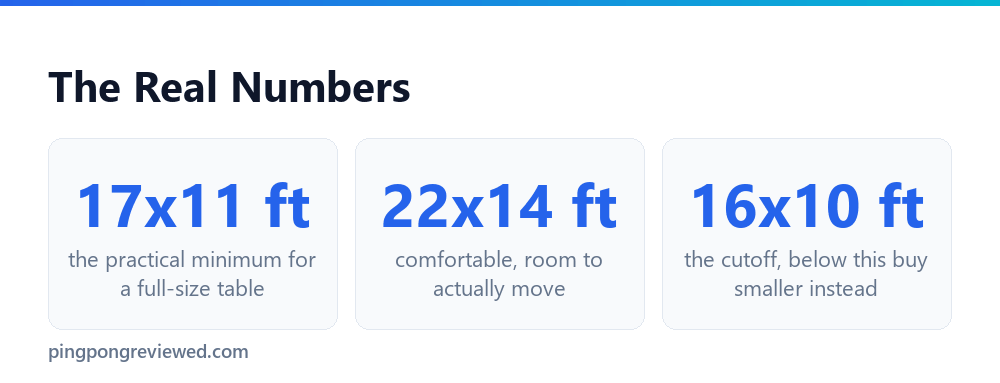
The practical minimum for a full-size table is 17 × 11 ft (5.2 × 3.4 m) — that’s 9 ft of table plus about 4 ft behind each end and 3 ft of total side clearance. 22 × 14 ft is comfortable. Below 16 × 10 ft, buy a smaller table instead: a full-size table in a room that can’t hold it becomes an expensive laundry shelf.
The table is 9 × 5 feet and that number is useless on its own, because nobody plays inside the table’s footprint. You play in the space around it — and that space is what decides whether the purchase is a joy or a regret you trip over for six years.
- →17 × 11 ft is the practical minimum, not the target
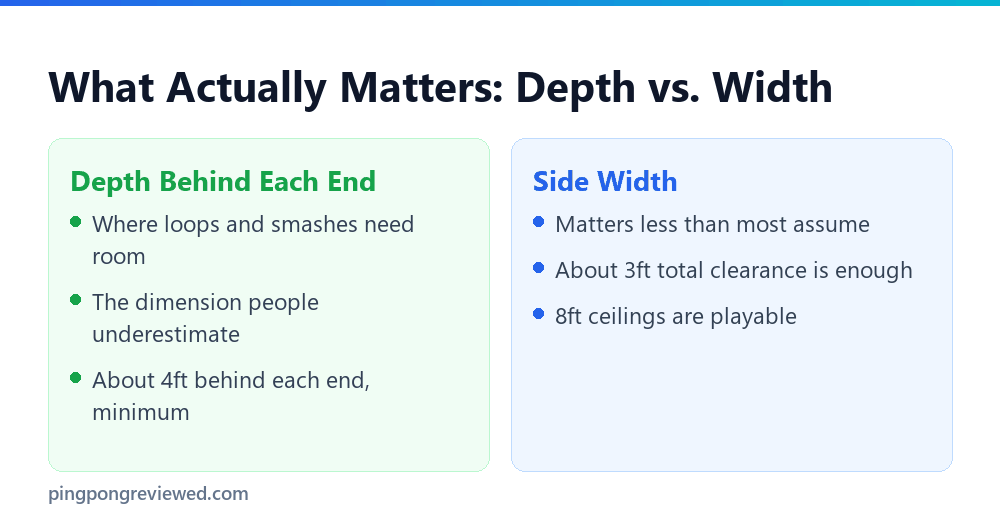
- →Depth behind the ends matters far more than width
- →Ceiling height matters less than most people fear — 8 ft is playable
- →Measure the doorway before you order anything
- →A folding table in playback mode needs only about 11 × 11 ft
Table of Contents
Room size by how you’ll actually play
The arithmetic is simple once you see it: 9 feet of table, roughly 4 feet behind each end for a player to stand and swing, and about 3 feet of side clearance in total. That’s 17 × 11, and it genuinely is a minimum — at that size you can rally and enjoy yourself, but you cannot back up to loop, and a deep ball will pin you against a wall.
Depth beats width, every time
If your room is awkward and you can only find extra space in one direction, put it behind the ends.
Width is nice. Depth is the game.
Every attacking stroke in table tennis involves stepping back to create room. A loop needs space to drop the racket below the ball and swing up through it. A defensive chop is played several metres back by definition. A player with an extra foot behind them has options that a player against a wall simply doesn’t have.
Width, by contrast, mostly affects your ability to chase wide balls — and at recreational level, most balls aren’t that wide. Given a choice between 17 × 13 and 20 × 11, take the deeper room without hesitating.
Ceiling height: less critical than you think
This worries people more than it should. 8 ft works for casual play; 9–10 ft is comfortable; clubs prefer higher for lobbing. If your basement is 7’6″, you can still play perfectly good table tennis — you simply agree in advance that defensive lobbing is off the menu, and honestly most recreational players never lob anyway.
What matters more than the raw height is what’s hanging from it. Ductwork, beams, pipes and light fixtures are invisible until a ball finds them, and a low-hanging pendant light directly over one end of the table will be destroyed within a month. Look up before you measure the floor.
💡 Pro tip: Lighting is the ceiling issue nobody plans for. A single central light throws shadows across half the table and makes a white ball hard to track against a dark background. Two diffused sources either side of the table, or a bright even ceiling fixture, transforms the playing experience — and it’s cheap compared to the table.
The rooms people actually have
- The most common home for a table
- Comfortably above the minimum
- Watch damp and temperature swings
- Consider an outdoor table if unheated
- Room to genuinely train
- Space for footwork drills
- The realistic dream setup
- Still check the door width
- Floor area is normally fine
- Check support columns
- Check ceiling height and ducts
- Damp is the long-term enemy
- Not for full-size
- This is midsize territory
- See our midsize guide
- Don’t force it
⚠️ Watch out: The garage caveat that costs people tables: an indoor table in an unheated, humid garage will warp over a few seasons — the MDF-based top absorbs moisture and never fully recovers. If your garage swings between freezing and baking, buy a weatherproof outdoor table even though it lives indoors. The surface doesn’t care about the weather and it’ll outlive three indoor tops.
How to measure your room properly
📊 Note: A table that won’t fit through the basement door is a table you assemble in the basement — permanently. Several manufacturers now publish folded dimensions specifically because this is such a common and expensive mistake.
When the answer is ‘not enough room’
Three honest options, in the order most people should consider them:
The room’s other qualities (not just its size)
Two rooms with identical dimensions can play completely differently, and the differences are worth knowing before you commit.
Flooring. Concrete is hard on knees and ankles over a long session, and it’s unforgiving when you dive. Carpet is kind to joints but slows footwork and eats balls under its edges. The best compromise for a garage or basement is interlocking foam or rubber mats over concrete — cheap, easy to lay, and they transform an hour of play into something your knees forgive you for.
Background. This one genuinely surprises people. A white ball against a white wall is hard to track, and a window directly behind one end of the table means one player is looking into glare while the other isn’t. Professional venues use dark blue surrounds for exactly this reason. You don’t need surrounds at home, but a dark backdrop behind each end — even a curtain or a sheet — measurably improves how easily you see the ball.
Ball retrieval. A room full of stored boxes, bikes and shelving means every missed ball becomes a thirty-second search. It sounds trivial until you’ve done it forty times in an evening. Clearing the floor around the playing area is free, takes an afternoon, and does more for your enjoyment than most equipment upgrades.
Temperature. Cold air makes the ball fly slightly slower and rubber less grippy, and cold muscles are how people pull things. An unheated garage in winter is playable but you’ll want a proper warm-up and a layer to keep on for the first ten minutes.
What about outdoors?
Space is rarely the constraint outdoors — weather is. A table tennis ball weighs 2.7 grams, which means even a light breeze turns rallies into a lottery and makes any serious play impossible.
For garden play you want a genuine outdoor table with a weatherproof composite top. An indoor table left outside for one rainy night is finished — the core swells, the surface bubbles, and no amount of drying brings it back. The trade-off is that outdoor surfaces give up a small amount of bounce quality for durability, which is a bargain if the alternative is no table at all.
- →Official table dimensions — and why top thickness matters most
- →Midsize tables — the 13 × 9 ft option
- →Table reviews — thickness listed for every model
- →Outdoor tables — if the garden is your space
Frequently asked questions
What is the minimum room size for a ping pong table?
About 17 × 11 ft (5.2 × 3.4 m) for a full-size table — 9 ft of table plus roughly 4 ft behind each end and 3 ft of total side clearance. 16 × 10 ft is playable for casual family games but genuinely cramped.
Can a ping pong table fit in a single garage?
Usually yes — a standard single-car garage is around 20 × 12 ft, comfortably above the minimum once the car is out. Watch for temperature swings and damp, which warp indoor tables over time.
How much space do I need behind the table?
4 ft absolute minimum, 5–6 ft for comfort, 8+ ft for training. Depth behind the ends is the single biggest factor in how playable a room feels.
What ceiling height do I need?
8 ft works for casual play, 9–10 ft is comfortable. Low ceilings simply rule out defensive lobbing. Check for ducts, beams and light fixtures before you check the height.
Can I fit a table in a 12 × 12 room?
Not a full-size one — you’d be serving from against the wall. A midsize table fits that space with clearance to spare and is far more likely to actually get used.
How much room does playback mode need?
Roughly 11 × 11 ft. Folding one half of the table vertical lets you practise solo in a space that can’t host two players — which is why folding tables outsell fixed ones so heavily.
Will a folded table fit through my door?
Measure it. A folded full-size table is about 5 ft wide and 5–6 ft tall, and stairwell corners are where they get stuck. This is the most expensive measurement people forget to take.

Ping Pong Reviewed is an equipment review site covering table tennis and baseball gear. Specifications are checked against manufacturer listings, and prices against live retail pages, before publication.