Table Tennis Mistakes: Find Your Symptom, Fix the Real Cause
Quick Answer: The mistakes that hold most players back, in the order worth fixing them: a wrong or shifting grip, hitting with the arm instead of the legs and hips, standing too tall, ignoring the incoming spin, and never moving your feet. None require talent to fix. All of them require noticing — which is what this page is for.
Here’s the thing about mistake lists: they’re all correct and mostly useless. You read twelve things you’re doing wrong, feel briefly enlightened, then walk to a table and fix none of them, because you can’t hold twelve corrections in your head while a ball is coming at you.
So this one is organised differently. Start with the symptom you actually notice — ‘my ball keeps going long’, ‘I miss easy balls’ — and work backward to the cause. Then fix them in an order that works, one at a time, because that’s the only way anyone has ever fixed anything.
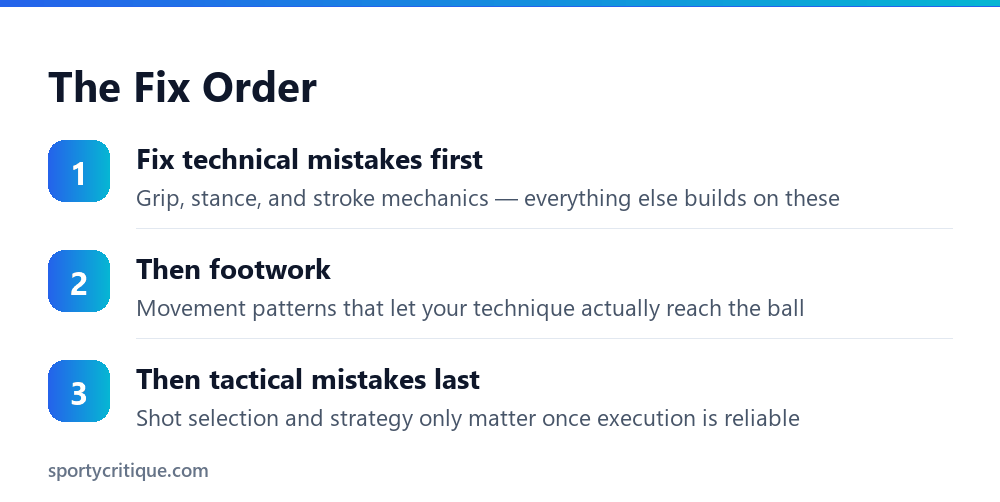
Table of Contents
Start here: what’s actually going wrong?
Find your symptom. The cause is usually not what you think it is.
| What you notice | The likely cause | Where to fix it |
|---|---|---|
| Ball flies long, off the end | Hitting flat with no topspin — or looping a topspin ball with a backspin technique | Learn to brush |
| Ball hits the net constantly | Attacking backspin with a closed racket, or smashing balls below net height | The height rule |
| No power despite huge effort | Arm-only swinging — no legs, no hips | The power chain, below |
| Sore elbow or shoulder after sessions | Same: arm-only, plus a death grip | Grip pressure + the power chain |
| You miss easy balls | Late, reaching, no footwork — you’re arriving after the ball | Feet, below |
| Their serve destroys you | Not reading spin before it arrives | Watch the paddle, not the ball |
| Good in drills, bad in matches | You’ve drilled shots, not decisions | Tactics + random drills |
| Weak backhand | Index finger creeping onto the rubber; avoidance | Grip + volume |
| You plateau for years | All matches, no drills | The 70/30 rule |
Notice how many symptoms trace back to two roots: the grip and the power chain. That’s not a coincidence, and it’s why the fix order below starts where it does.
The fix order (you can only fix one thing at a time)
⚠️ Do not try to fix five things at once. It’s the single most common self-coaching error — you read a list, resolve to correct everything, and end up thinking so hard mid-rally that you play worse than when you were blissfully wrong. Pick one. Give it two weeks. Then pick the next.
The order matters because these things stack — a fix further down the list won’t hold if something above it is still broken:
| Order | Fix | Why it’s here | Time to embed |
|---|---|---|---|
| 1 | Grip | Everything else is built on it. A shifting grip makes every other correction unstable | 1–2 weeks |
| 2 | Stance & knee bend | You cannot use your legs if they’re straight | 1 week |
| 3 | The power chain (legs→hips→arm) | Fixes power, spin, and your sore elbow at once | 4–8 weeks |
| 4 | Reading spin | Now you know which stroke to make | Ongoing, forever |
| 5 | Footwork & recovery | The hardest and the highest ceiling | Months |
| 6 | Tactics | Only worth it once the strokes are reliable | Ongoing |
The technical mistakes
1. A wrong or shifting grip
The foundation of every other error. Pick shakehand, hold it correctly, and — crucially — stop adjusting it mid-rally. The specific sub-error to check for: your index finger creeping up onto the rubber face, where it blocks your backhand contact zone. Check it between points for a week; you’ll be surprised how often it has migrated. Full breakdown in our grip guide.
2. Playing with your arm
This is the big one, and it’s worth being blunt: if your arm aches after a session, you are hitting with your arm, and your ceiling is low. Power in table tennis comes from the ground up — legs push, hips rotate, shoulders follow, the arm delivers, the wrist snaps. The arm is the last link in a chain, not the engine.
Players fight this for years because arm-swinging works at first. Against a beginner, a hard arm-swing wins points. Against anyone decent, it produces slow balls with no spin from a player who’s exhausted by game three.
3. Standing tall
Knees bent, weight on the balls of your feet, chest slightly forward, always. A straight-legged player has nowhere to push from, can’t move sideways quickly, and can’t get under a low ball. It’s also exhausting to fix — a proper stance is a sustained semi-squat, which is precisely why people don’t hold it.
4. Hitting everything flat
Modern table tennis is spin. A flat hit has no margin: it either clears the net or it doesn’t, with nothing bringing it down onto the table. Learning to brush is the single biggest jump most players make.
5. Ignoring the incoming spin
Push a topspin ball and it flies long. Drive a backspin ball and it hits the net. Both feel like your mistake and both are actually a reading failure — the information was there, in your opponent’s paddle motion, before the ball arrived. Watch the paddle at contact, not the ball in flight. By the time you’re watching the ball, the decision is already late.
6. Backhand stance
A specific one worth knowing: beginners often stand with the right foot well forward when playing backhands (for right-handers). That closes your body and kills the rotation the stroke needs. Feet should be roughly square to the table, or with the right foot slightly back — the opposite of the instinct.
The footwork mistakes
Footwork is the most overlooked area in the sport, and the mistakes are consistent:
- Rooted in one spot. Reaching with the arm instead of moving the feet. It limits both your reach and — because a reaching stroke has no body behind it — your quality. Move first, swing second, always.
- No recovery to ready position. You hit, you admire, the next ball arrives while you’re still standing where you finished. Recovery isn’t optional; it’s part of the stroke.
- Crossing over for everything. Small shuffle steps for most balls; crossover only when the ball is genuinely out of reach. Crossing over feels faster and leaves you off balance.
- Standing too close to the table. Crowded strokes have no power. Give yourself room to swing.
The tactical mistakes
| Mistake | What it costs | Instead |
|---|---|---|
| Serving as a formality | The one shot nobody can influence, wasted | Three practised serves beat twenty lazy ones |
| Returning everything to the middle | Free comfortable balls for your opponent | Corners and the elbow — the transition point |
| Attacking every ball | Unforced errors at 4-4 | Force attacks off high balls; push and place the rest |
| No plan at 9-9 | Improvising the most important point | Your best serve, your rehearsed follow-up |
| Playing their game | You lose on their terms | Read the style, adjust — see tactics |
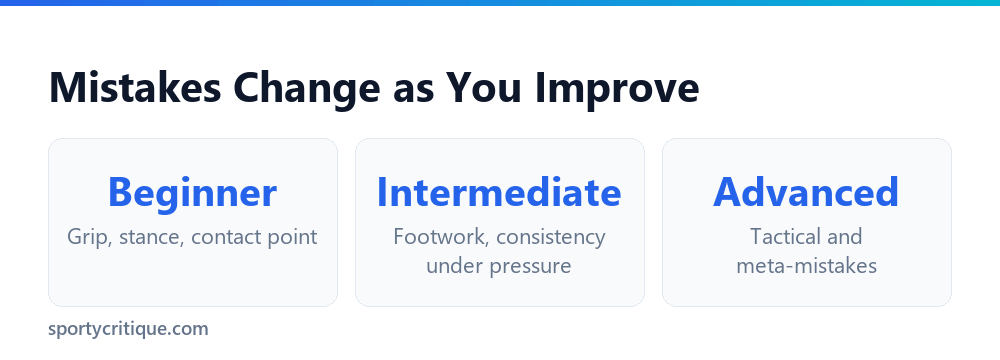
Your mistakes change as you improve
Almost every list on this topic is a beginner list, which means once you’re past a certain point it stops describing you — and you conclude you’ve fixed everything. You haven’t; the mistakes simply changed shape.
| Level | The mistakes that define you | The one to work on |
|---|---|---|
| Beginner | Grip, arm-only, standing tall, flat hitting, no footwork | Grip |
| Improver | Reading spin, recovery, over-attacking, no serve variety | Reading spin |
| Intermediate | Poor shot selection, weak-side avoidance, no tactical plan, drilling only strengths | Tactics + your weak wing |
| Advanced | Predictable patterns, mental collapse on big points, equipment fiddling instead of training | Match psychology |
That last row is real. Advanced players’ most expensive mistake is changing equipment instead of changing habits — a new rubber every three months, endlessly chasing a feeling that better training would deliver for free. If you’ve bought three paddles this year and your ranking hasn’t moved, that’s the mistake.
The meta-mistakes (the expensive ones)
These aren’t technical. They’re how you spend your time, and they cost more than every stroke error combined.
Only playing matches, never drilling. Matches test skills; drills build them. If your entire table time is games, your current level is roughly your permanent level. The honest target is 70% drills — the drills guide covers what to actually do with that time.
Practising only your strengths. It’s fun and it’s worthless. Your backhand doesn’t improve by avoiding it, and matches will find it whether you’ve trained it or not. Give your weakest shot the first fifteen minutes of every session, when you’re fresh and patient rather than tired and annoyed.
Blaming equipment too early — or too late. A $200 carbon blade won’t fix your technique. But a warped $5 paddle with dead rubber genuinely does cap you, and playing on one for two years while insisting equipment doesn’t matter is its own kind of stubbornness. Mid-tier gear from our paddle guide is the honest middle.
Never reviewing your matches. The players who improve fastest are the ones who can tell you why they lost — not ‘he was better’, but ‘his short serve to my backhand won him six points and I never adjusted’. That’s a fixable problem. ‘He was better’ isn’t.
Why these mistakes survive for years
It’s worth understanding the mechanism, because ‘just fix it’ has never worked for anyone and there’s a reason.
Every one of these mistakes works at first. That’s the trap in a single sentence. Arm-swinging beats beginners. A panhandle-ish grip handles gentle rallies fine. Standing tall is comfortable and you still win. Flat hitting is satisfying and lands often enough at slow speeds. The mistake isn’t punished when you make it — it’s punished eighteen months later, against someone better, by which point it’s automatic and invisible to you.
And matches actively protect them. This is the cruel part. In a match you unconsciously steer play toward what works, which means you use your strengths and avoid your weaknesses. Ten years of that and your backhand is exactly as bad as it was in month three — you’ve simply become world-class at not needing it. The mistake never got exposed because you built a whole game around hiding it.
Then there’s the improvement dip. Fixing a real habit makes you temporarily worse. You lose to people you used to beat. That’s not a sign the fix is wrong — it’s a sign it’s real, because your old automatic thing is being replaced by a new deliberate thing, and deliberate is always slower than automatic. Most people quit exactly here, conclude the change didn’t suit them, and revert. The players who improve are the ones who expected the dip and sat through it.
This is why the fix order matters more than the list. One change, two weeks, through the dip, then the next. Anyone can do that. Almost nobody does.
The one-week fix plan
💡 Pick one item from the fix order table. Spend one week’s sessions on it alone — not fixing it during matches, but drilling it deliberately. Grip and stance changes pay off within days. The power chain takes a month. Then move down the list.
And measure it honestly. ‘My loop is better’ is a feeling. ’18 out of 20 loops landed, up from 11′ is information. Count things; the counting is what turns practice into progress.
Frequently asked questions
What’s the single most common table tennis mistake?
Hitting with the arm instead of the legs and hips. It’s the root of weak shots, no spin, sore elbows, and the ceiling most players never get past.
Why does my ball always go long?
Almost always because you’re hitting flat with no topspin — there’s nothing bringing the ball down. Learn to brush the ball rather than strike it.
How do I fix my grip after years of playing wrong?
Two genuinely awkward weeks. Reset consciously between every point, and accept that you’ll lose to people you used to beat during that period. Everyone who’s done it says the same thing: they wish they’d done it sooner.
Why am I good in practice and bad in matches?
Because you’ve drilled shots, not decisions. Practice feeds are predictable; matches aren’t. Add random drills where you don’t know what’s coming — it’s the bridge between the two.
Should I fix technique or tactics first?
Technique, and it isn’t close. Tactics are choices between shots you can reliably make — if the shots aren’t reliable, the tactics are theoretical.
Is it too late to fix bad habits?
No, but be realistic: a habit you’ve built over ten years takes months, not days, and it gets worse before better. The people who never fix them are the ones who quit during the ‘worse’ phase.

Ping Pong Reviewed is an equipment review site covering table tennis and baseball gear. Specifications are checked against manufacturer listings, and prices against live retail pages, before publication.