Junior Table Tennis Table Size: What to Buy for Kids
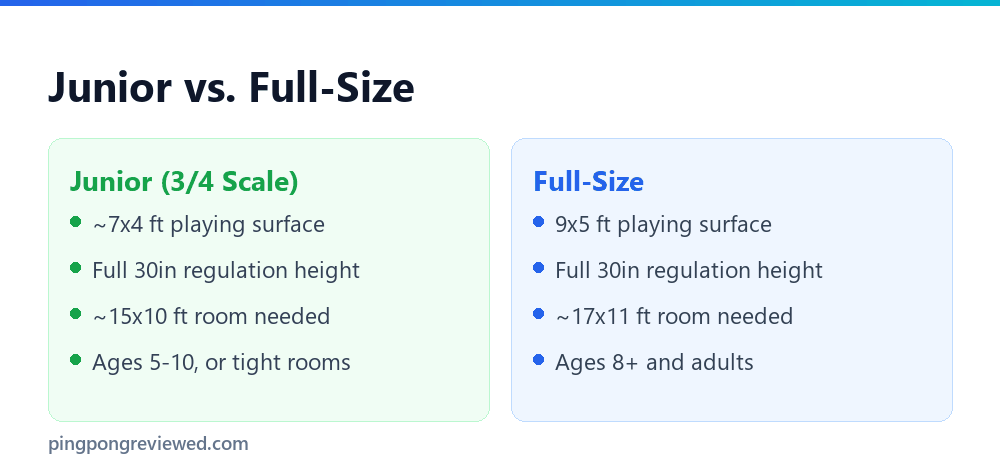
A junior table tennis table is three-quarter scale — roughly 7 × 4 ft (213 × 122 cm) — at the full official 30-inch height. It needs about 15 × 10 ft of room. The height staying regulation is the whole point: it’s what makes a junior table a genuine training tool rather than a toy your child has to unlearn.
Buying a table for a child produces one specific worry: will a smaller table teach them bad habits? The answer depends entirely on one specification, and it isn’t the one most parents check.
- →~7 × 4 ft at 30 inches — three-quarter scale, full height
- →Needs about 15 × 10 ft of room
- →Best for ages roughly 5–10, or tight rooms
- →Buy junior when the room is the constraint, not the child
- →Kids adapt to a full-size table far faster than parents expect
Table of Contents

Junior vs the other classes
The specification that actually matters
Here’s the asymmetry every parent should understand before buying anything.
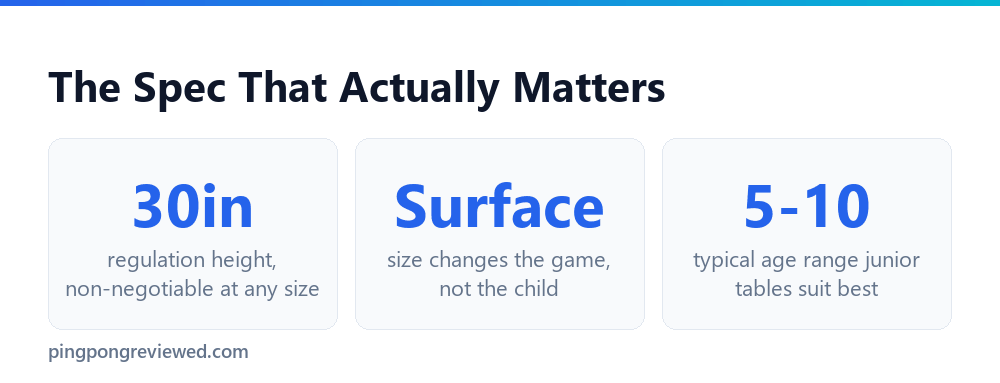
Shrinking the surface changes the game. Shrinking the height changes the child.
A smaller playing surface alters the geometry — serves that would be long stay on, there’s less room for spin to work, and depth judgment doesn’t develop. That’s a genuine limitation, and it disappears the moment they play on a real table.
A lowered height is different in kind. Every stroke a player learns is calibrated to where the ball sits relative to their body. Learn on a 24-inch table for two years and you’ve grooved a contact point that doesn’t exist anywhere in the actual sport — and every stroke needs rebuilding from scratch when they move up.
⚠️ Watch out: This is the trap in the cheap end of the market. Many products sold as ‘kids’ table tennis tables’ lower the height along with the surface, because it looks proportionate and costs less to build. Reputable junior tables never do. If a listing doesn’t state 30 inches / 76 cm, assume it’s been lowered — and if your child might keep playing, that’s a reason to look elsewhere.
What to buy, by age
- It’s about hitting a ball
- Not table tennis yet
- Cheap, and that’s correct
- Nothing to unlearn at this age
- Full height, manageable width
- The sweet spot for junior
- Real rallies become possible
- Strokes start forming here
- Junior only if the room decides
- Kids adapt faster than parents expect
- Depth judgment starts developing
- The long-term purchase
- Clubs and schools all use 9 × 5
- Friends’ houses too
- Anything smaller now holds them back
- See official dimensions
The age bands are guidance, not rules — a tall eight-year-old who plays constantly is better served by a full-size table than a small ten-year-old who plays occasionally. Height and enthusiasm matter more than the birthday.
Junior or full-size? The honest decision
This is the question the whole purchase turns on, and the answer is more clear-cut than most buying guides admit.
- ✓Buy junior when the ROOM is the constraint
- ✓Buy junior for genuine portability needs
- ✓Buy full-size if you have 17 × 11 ft, even for a six-year-old
- ✓Consider a folding full-size — playback mode needs only ~11 × 11 ft
- ✓Check the height spec before anything else
- ✕Buy junior because the child is small — they grow within two seasons
- ✕Assume a smaller table is ‘easier’ for them to learn on
- ✕Buy a lowered-height table to save money
- ✕Force a full-size table into a room that can’t take it
- ✕Forget that friends and clubs all play on 9 × 5
Buy junior when the room says so. A 7 × 4 table plays properly in about 15 × 10 ft — spaces a full-size table genuinely cannot serve, as our room size guide lays out. That’s a legitimate and common reason.
Buy full-size when the room allows it, even for a young child. They’ll grow into it within two seasons, resale value is better, there’s no second purchase, and — crucially — it’s the table everyone else plays on. A child who only plays at home on a junior table gets a small shock at their first club session; one who plays at home on a full-size table doesn’t.
What to check on any kids’ table
📊 Note: Pair it with light 3-star training balls and a short-handled beginner paddle — our beginner paddle picks cover the control-first options. And teach the grip properly from day one; it costs nothing when there are no habits to unlearn.
The part that matters more than the table
A table is only useful if it gets used, and the most common outcome for a children’s table tennis table is enthusiastic use for three weeks followed by years as a surface for laundry. A few things genuinely change that.
Put it somewhere they pass. A table in a spare room behind a closed door gets played on when someone organises a session. A table in the garage they walk through, or the basement where the TV is, gets played on because it’s there and there’s five minutes before dinner. Location beats specification for actual usage.
Leave it set up if you possibly can. The five minutes of unfolding a table is enough friction to prevent most spontaneous games. If the space allows a permanently-erected table, that alone probably doubles how often it gets used.
Play with them, badly, at their level. Children quit games they always lose. Rallying cooperatively — counting how many shots you can keep going together rather than playing points — is far more engaging for a beginner than being beaten 11-2 by a parent who’s holding back unconvincingly. Competitive scoring can arrive once they can actually rally.
Get a second paddle that isn’t awful. Kids notice when their paddle is the bad one. Two decent matched paddles cost less than most people spend on the net upgrade, and they remove an entire category of complaint from the equation.
💡 Pro tip: The multi-ball trick for young kids: stand at one end with a box of balls and feed them one at a time, gently, to the same spot. They get thirty contacts a minute instead of three, they succeed constantly, and it’s the single fastest way to get a child from ‘can’t hit it’ to ‘can rally’. It’s also exactly what coaches do — see our drills guide.
How long will they use it?
Worth thinking about before you spend, because the answer changes the maths.
A junior table typically serves a child for three to five years — roughly ages five to nine or ten — after which it becomes limiting for anyone still interested in the sport. That’s a decent run, and junior tables hold resale value reasonably well because every parent faces the same problem in turn.
A full-size table, by contrast, is a purchase that never expires. The same table serves a six-year-old, the fifteen-year-old they become, and the adults in the house throughout. If you have the room, that’s the better economics as well as the better equipment — which is why the room, not the child, should drive the decision.
The one exception worth flagging: if a child shows genuine sustained interest, moving them to a full-size table sooner rather than later is the single most useful equipment decision you can make. Depth judgment, footwork over distance and the short game all need a real table to develop, and those are precisely the skills that separate club players from home players.
- →Official table dimensions — the full-size specs and thickness explained
- →Midsize tables — the smaller 6 × 3 ft class
- →Room size guide — what each class actually needs
- →Table reviews — including folding full-size options
Frequently asked questions
What size is a junior table tennis table?
Roughly 7 × 4 ft (213 × 122 cm) at the official 30-inch height — three-quarter scale in the playing surface with the height unchanged. Models vary slightly, but that’s the class.
How much room does a junior table need?
About 15 × 10 ft to play comfortably, compared with 17 × 11 ft for a full-size table and 13 × 9 ft for a midsize one.
Should the height be lower for children?
No. Quality junior tables keep the official 30-inch height precisely so that strokes learned on them transfer to a real table. Lowered-height tables teach a contact point that doesn’t exist in the sport.
At what age should a child move to a full-size table?
Around 8–11 if the room allows, and earlier if they’re showing serious interest. Kids adapt to the extra length far faster than parents expect.
Is a junior table better than a midsize one for kids?
Junior is closer to the real game — an extra foot of length starts to introduce depth judgment. Midsize wins on room requirements. Both are fine provided the height is regulation.
Are junior tables worth the money?
If the room can’t take a full-size table, genuinely yes — they play properly and resale is reasonable. If you have 17 × 11 ft available, a folding full-size table is the better long-term buy.
Can adults play on a junior table?
Yes, and it’s decent fun — rallies are faster and more reflexive. What you lose is the depth, spin and short-game dimensions, so it’s a casual proposition rather than a training one.
Do schools and clubs use junior tables?
Almost never for actual play — schools and clubs run full-size tables because that’s what competition uses, and children play on them from a young age perfectly happily. Junior tables are a home solution to a home problem (limited space), not a coaching standard. It’s worth knowing, because a child who only ever plays at home on a junior table will find their first club session slightly disorienting.
What if my child loses interest after a few months?
Extremely common, and not a reason to avoid buying — but it is a reason to buy sensibly. A mid-priced junior or folding full-size table holds resale value reasonably well, whereas a cheap lowered-height novelty is worth nothing second-hand. Buying something decent and reselling it costs less than buying something poor and keeping it.

Ping Pong Reviewed is an equipment review site covering table tennis and baseball gear. Specifications are checked against manufacturer listings, and prices against live retail pages, before publication.