
Table Tennis Warm Up: The 10-Minute Routine
Quick Answer: A proper table tennis warm-up is 10 minutes in three parts: 3 minutes raising your heart rate, 3–4 minutes of dynamic mobility for the joints this sport actually stresses (shoulders, wrists, hips), and 3 minutes of progressive hitting. Save static stretching for after you play. And if you only have two minutes at the table before a match, there’s a specific way to spend them — most people waste it.
Nobody pulls a muscle playing casual ping pong. Until they do — and then it’s a shoulder that hurts for six weeks, or an elbow that never quite goes away, and they discover the sport is more physical than it looks from the sofa.
Table tennis is explosive in short bursts: lunges, rotations, and several hundred rapid wrist and shoulder movements per session. A focused ten minutes prepares exactly those structures — and measurably sharpens the first twenty minutes of play, which is when most casual matches are actually decided.
Table of Contents
What this sport does to your body
Generic warm-ups exist because most sports stress the same things. Table tennis doesn’t — its injury profile is unusual and specific, and knowing it tells you exactly what to warm up.
| Body part | What the sport does to it | Warm-up priority |
|---|---|---|
| Shoulder | Hundreds of rapid rotations; the loop and smash both load it hard | Highest |
| Wrist & forearm | Every serve and every brush contact — more load than players realise | Highest |
| Lower back | Constant rotation from a semi-crouched stance | High |
| Knees & hips | Lunges, sudden direction changes, sustained bent-knee stance | High |
| Elbow | Repetitive strain — the classic overuse casualty | Moderate (technique matters more) |
| Eyes | Tracking a 40mm ball at 60–80ms reaction windows | Genuinely — see below |
The pattern: it’s a rotation-and-repetition sport, not an impact sport. That means your warm-up should prioritise range of motion in rotating joints over anything that looks like a gym session. Which is precisely why the jog-and-touch-your-toes routine most people default to misses the point — it warms your legs for running, which is not what you’re about to do.
The most common table tennis complaints — shoulder impingement, tennis elbow, wrist strain, lower-back tightness — are overwhelmingly cold-start and overuse injuries. Both are preventable. We cover the full picture in our ping pong injuries guide.
The 10-minute routine
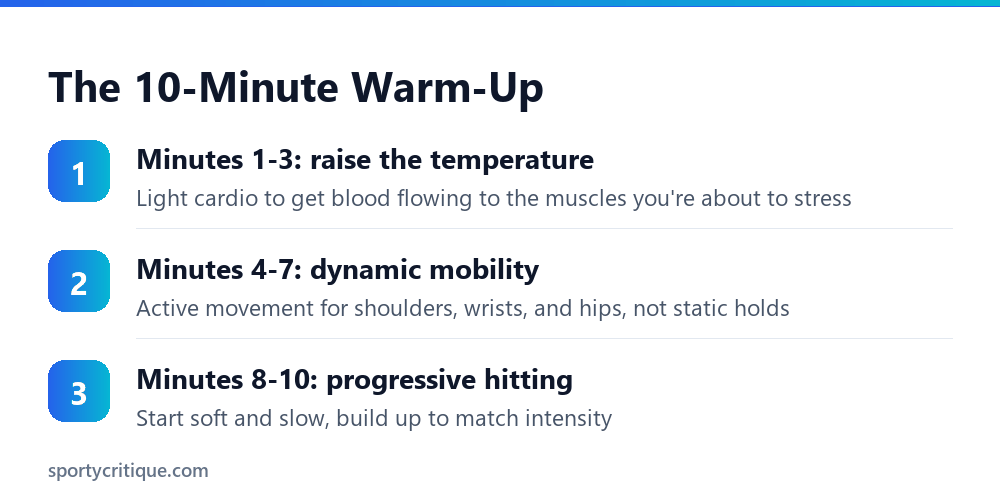
Minutes 1–3: raise the temperature
The goal is literally to make your muscles warmer — warm tissue is more elastic and tears less. Anything that raises your heart rate works, but sport-specific movement works better:
- 60 seconds light jogging on the spot or jumping jacks
- 30 seconds side shuffles in your playing stance — this is the actual footwork pattern of the sport, so you’re warming the exact muscles you’ll use
- 30 seconds high knees
- 30 seconds butt kicks
- 30 seconds shadow footwork — move to the corners of an imaginary table
Minutes 4–7: dynamic mobility (the part that matters)
⚠️ Dynamic, not static. Static stretching — holding a position for 30 seconds — before explosive activity can temporarily reduce power output and does little for injury prevention. Movement-based mobility is what prepares joints. Save the long holds for after you play, when they genuinely help.
| Exercise | How | Prepares |
|---|---|---|
| Arm circles | 10 forward, 10 backward, small building to large | Shoulder capsule |
| Paddle figure-eights | Hold your paddle, trace slow figure-eights | The exact loop and smash path |
| Trunk twists | 15 each side, hips leading the shoulders | The loop’s power source |
| Wrist circles + rocks | 20 seconds each direction, then gentle flexor/extensor rocks | The most under-warmed joint in the sport |
| Walking lunges with rotation | 6 per leg, twisting toward the front knee | Knees, hips, and the rotation together |
| Leg swings | 10 each leg, front-back then side-side | Hip range for lunging |
The paddle figure-eight is the one to not skip. It’s the only exercise here that traces the actual movement path of your two biggest strokes, under a light load, at a controlled speed. Thirty seconds of it does more for your shoulder than two minutes of arm circles.
Minutes 8–10: progressive hitting
- 2 minutes easy forehand-to-forehand at half speed. Half speed genuinely — not your version of half speed.
- 1 minute backhand-to-backhand.
- 30 seconds alternating, building toward normal pace.
This last phase is doing two jobs: finishing the physical warm-up under sport-specific load, and — more importantly — calibrating your eyes and timing to today’s conditions. Which brings us to the section nobody writes.
The two-minute knock-up: how to actually spend it
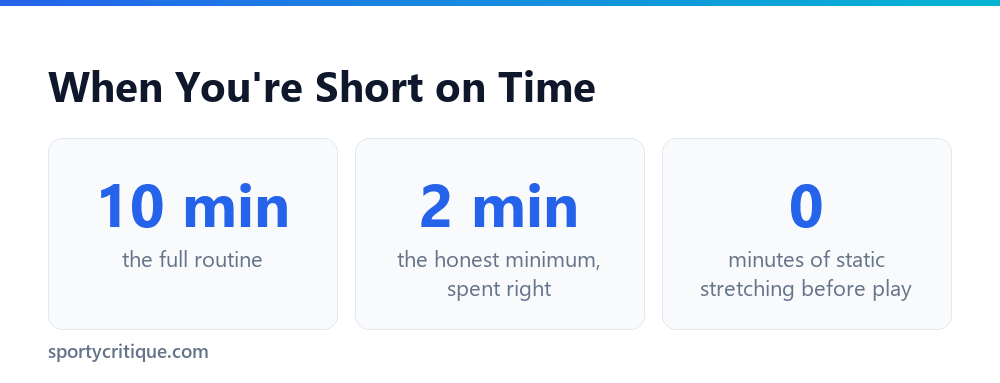
In a tournament or league match you get roughly two minutes at the table with your opponent before play starts. Beginners use it to hit balls. Good players use it to gather information, and the difference shows up in the first game.
Here’s what those two minutes are actually for:
| Seconds | Do this | Why |
|---|---|---|
| 0–30 | Forehand-to-forehand, medium pace | Test this table’s bounce and this hall’s lighting and background |
| 30–60 | Backhand-to-backhand | Same, other wing — and watch how theirs looks |
| 60–90 | Ask to test a few of your key shots | Groove the one shot you most need today |
| 90–120 | Let them show you their game | Free scouting — they’ll show you their favourite shot |
What you’re gathering: Is their backhand weaker than their forehand? (Feed one ball there and watch.) Do they lift backspin confidently? How do they stand — flat-footed or loaded? Every one of those answers is worth a point or two in the first game, and it’s free.
⚠️ Do your real warm-up before this. Two minutes at the table is not a warm-up — it’s a calibration and a scouting session. Players who treat the knock-up as their entire preparation are cold at 0-0, which is exactly when a match’s momentum gets set. Arrive early, warm up off the table, then use the two minutes for what they’re for.
Warming up your eyes (yes, genuinely)
This sounds absurd until you look at the numbers. A smash arrives in roughly 60–80 milliseconds — faster than human visual reaction time, which is around 200ms. Elite players don’t see the ball and react; they read the opponent’s body and paddle before contact and are already moving. (More of those figures are in our statistics page.)
Your visual system is doing the hardest work in the sport, and it also needs a moment to adapt — to the hall’s lighting, the background behind your opponent, the ball’s colour against it. That’s a genuine part of what the first two minutes of hitting achieves, and it’s why a player can feel oddly blind for the first few points in an unfamiliar venue.
Two things that help: focus shifting (hold a finger at arm’s length, focus on it, then on something across the room, back and forth for 20 seconds) and simply hitting for a minute longer than feels necessary in a new venue. It’s not superstition — you’re letting your eyes calibrate.
Match warm-up vs training warm-up (they’re different)
Almost nobody distinguishes these, and they have genuinely different goals.
Before training, you’re preparing to work. The session itself will build intensity gradually, so your warm-up only needs to get you safely into the first drill. Ten minutes, moderate, and you’re done — the first block of consistency drills finishes the job.
Before a match, you’re preparing to compete from the first point. There’s no gentle first drill; there’s 0–0 in a game to 11, and losing the first three points in an 11-point game means you’re already a third of the way to losing it. That means your match warm-up has to be longer and it has to reach match intensity before you start — including a few points played at full pace against someone, if you can find anyone.
The practical version: for a match, arrive 30 minutes early. Ten minutes of the routine above, ten minutes of hitting with a practice partner including some serve practice, five minutes of played points, then your two-minute knock-up with the opponent. Players who do this win first games. Players who arrive five minutes early lose them and spend the rest of the match chasing.
This is also why the 11-point format changed warm-up culture. Under the old 21-point system you could genuinely play yourself into a match — there was room to be cold for five points. There isn’t any more. The scoring change made preparation part of the sport, which is covered in our rules guide.
When you have no time (the honest version)
Reality: you arrived late, the table’s booked for an hour, and your partner is waiting. Nobody does ten minutes.
The 3-minute emergency version, in priority order:
- 30 seconds arm circles and paddle figure-eights — the shoulder is what you’re protecting.
- 20 seconds wrist circles. Non-negotiable; the wrist takes more load than anyone expects.
- 20 seconds trunk twists.
- 2 minutes of deliberately slow hitting before you play a point.
That covers roughly 80% of the injury risk for 30% of the time. It’s not ideal — but ‘I had no time so I did nothing’ is how people get hurt, and three minutes is always available.
💡 The over-30 note: if you’re past about 30, the warm-up stops being optional and the emergency version stops being enough. Tissue elasticity declines, recovery slows, and the cold-start injuries that a 20-year-old shrugs off take weeks. The five minutes you’d save by skipping it costs you six weeks of elbow rehab, roughly once.
The two-minute cool-down
Now static stretching earns its keep — after play, when your tissue is warm and you’re trying to restore range rather than generate power:
- Forearm flexors and extensors — 30 seconds each. Arm straight, palm up, gently pull the fingers back; then palm down, gently pull the hand down. This is the single best insurance against tennis elbow.
- Cross-body shoulder stretch — 30 seconds each side.
- Hamstrings and hip flexors — 30 seconds each; a bent-knee sport tightens both.
- Gentle spinal rotation — 20 seconds each way.
Players who cool down consistently report less next-day stiffness — which means more sessions per week, which improves your game faster than any paddle upgrade ever will. That’s the whole argument: the cool-down isn’t about today’s session, it’s about being able to play again on Thursday.
Frequently asked questions
How long should I warm up for table tennis?
10 minutes for a normal session — 3 cardio, 4 dynamic mobility, 3 progressive hitting. Three minutes minimum if you’re pressed, prioritising shoulders and wrists.
Should I stretch before playing table tennis?
Not statically. Dynamic mobility before, static stretching after. Long static holds before explosive activity can temporarily reduce power and don’t prevent injury the way people assume.
Is the two-minute knock-up enough?
No — it’s calibration and scouting, not a warm-up. Do your real warm-up off the table first, then use those two minutes to read the table, the light and your opponent.
Why do my wrists hurt after playing?
Either an under-warmed wrist or a grip that’s too tight throughout the rally (see our grip guide). Twenty seconds of wrist circles beforehand and a looser hold fixes most of it.
Do I need to warm up for casual basement play?
Three minutes, yes — especially the shoulder and wrist. Casual play is where people get hurt precisely because nobody treats it as sport.
What’s the single most important warm-up exercise?
Paddle figure-eights. It traces the exact path of your loop and smash under light load, and it’s the only exercise here that’s specific to what you’re about to do.
Should I warm up differently in a cold hall?
Yes — add time, don’t add intensity. Cold air means your tissue takes genuinely longer to reach working temperature, and the ball also behaves differently (it flies slightly slower and the rubber is less grippy until it warms). Keep a layer on through the early part of your warm-up and take it off once you’re sweating rather than starting cold in a t-shirt because that’s what you’ll play in.
Does warming up actually improve performance, or just prevent injury?
Both, and the performance part is the one people underrate. Warm muscle contracts faster, your joints have their full range available, and — critically for this sport — your visual system has calibrated to the hall. The first twenty minutes of a session is where a warmed-up player has the biggest edge, which in an 11-point format is the difference between winning the first game and chasing the match.

Ping Pong Reviewed is an equipment review site covering table tennis and baseball gear. Specifications are checked against manufacturer listings, and prices against live retail pages, before publication.