
Fan Zhendong: The Grand Slam and the Rankings Walkout
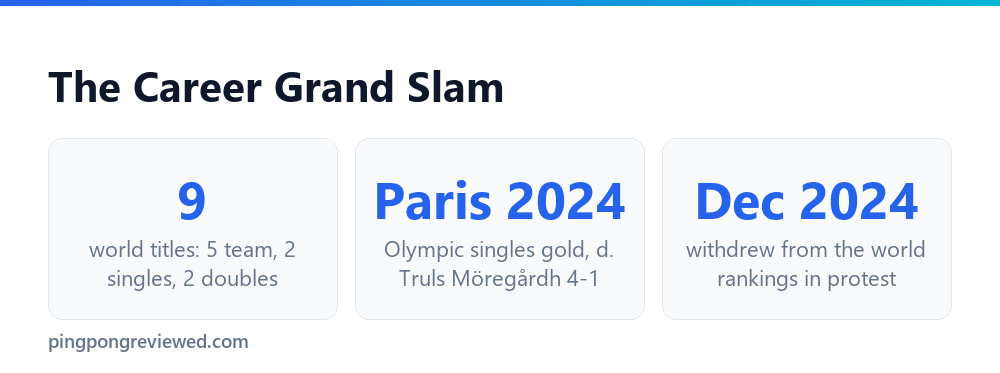
Fan Zhendong completed table tennis’s career Grand Slam at Paris 2024, beating Truls Möregårdh 4–1 for Olympic singles gold to add to two World Championship titles and four World Cups — nine world titles in all. Months later he withdrew from the world rankings entirely in protest at WTT’s mandatory-participation rules, becoming the rare athlete to challenge his sport’s governance from the very top.
Most great players are defined by what they won. Fan Zhendong is increasingly defined by what he did after winning everything — which makes him the most interesting figure in table tennis right now, and not only for his backhand.
- →Career Grand Slam completed at Paris 2024 — Olympics, Worlds, World Cup
- →9 world titles: 5 team, 2 singles (2021, 2023), 2 doubles
- →Arguably the most feared backhand in the sport’s history
- →Left the ITTF world rankings in December 2024 over WTT’s fine system
- →Has not retired — he simply stepped outside the ranking structure
Table of Contents

Career at a glance
The playing style: pressure as a philosophy
Fan’s game is built on a two-winged looping attack with almost no transition time between them. He plays close to the table, takes the ball early, and gives opponents nothing — not a weak wing to attack, not a moment to reset, not a rally that slows down.
Where Ma Long dismantles opponents with placement and patience, Fan simply removes their time.
The signature is the backhand, delivered with a compact, wrist-heavy swing that generates absurd power from almost no backswing. It’s arguably the most feared single stroke of his era, and it’s the reason he can stand at the table against players who’d prefer to push him back — he counter-loops from a position most players would block from.
For amateur players, he’s the reference point for the modern loop-driven game, but with an important caveat: his power comes from legs and hip rotation, not from the arm speed it appears to come from on television. Copying the visible part of a Fan Zhendong backhand without the invisible part produces a sore elbow and nothing else.
Equipment
Fan spent most of his early career on a Stiga blade before Butterfly signed him and built the Fan Zhendong ALC and Super ALC blade line to his specifications — a genuine signature product rather than a rebadge.
Like virtually every Chinese national team player, his forehand runs a DHS Hurricane rubber — the tacky, spin-first Chinese style — paired with a faster tensor-style backhand. That hybrid is the CNT signature setup, and it’s copied worldwide by players who mostly can’t generate the forehand power it demands. Our brands guide explains the tacky-versus-tensor divide, and the premium equipment breakdown covers what setups at this level actually cost.
⚠️ Watch out: Don’t buy his equipment expecting his results. National-team Hurricane rubbers are hand-selected sheets made to tighter tolerances than anything on a shop shelf, and they’re designed to be activated by a stroke very few players possess. Copying a professional’s setup is the most reliably disappointing purchase in table tennis.
December 2024: walking away from the rankings
Months after the greatest achievement of his career, Fan did something almost unheard of for a reigning Olympic champion: he withdrew from the ITTF world rankings entirely.
The trigger was a WTT rule requiring players to compete in a mandatory schedule of events — with fines of US$5,000 for top-20 players who skipped tournaments to play elsewhere. Fan, ranked sixth in the world at the time, removed his name rather than accept the system.
Crucially, this was not retirement. Fan made clear he intended to keep competing and contributing to the sport; he continued playing domestically in China’s Super League. What he stepped away from was the ranking structure and the obligations attached to it.
The immediate consequence was administrative but symbolically enormous: when the ITTF published its first world ranking of the new year, the names of Fan Zhendong, Ma Long and Chen Meng were simply absent from a list they had collectively dominated for a decade. Three of the sport’s most decorated players, gone from the rankings not through injury or retirement but by choice.
It’s difficult to overstate how unusual this is. Athletes at the very top rarely challenge the structures that made them, because they have the most to lose. Fan, Chen Meng and Ma Long between them hold a substantial share of the sport’s Olympic and world titles — when players of that stature walk away from a ranking system, the sport has to listen. Whatever happens next, the episode has already reshaped the conversation about player workload in professional table tennis.
What it takes to be China’s number one
To understand Fan’s career you have to understand the system that produced it, because his hardest matches were never in finals.
Chinese national team selection is harder than winning most international titles. The country’s domestic depth is such that players ranked outside China’s own top ten would be national champions almost anywhere else. Fan joined the senior team in 2013 at sixteen — the youngest member — which meant beating an entire generation of players who never got to compete internationally at all.
The system also creates a peculiar pressure that Western athletes rarely face: losing is not treated as a normal part of sport. With 37 of 42 Olympic golds and near-total historical dominance, the expectation isn’t to win — it’s to never lose. A silver medal is scrutinised. A semi-final exit is a story. Fan’s own 2021 Olympic final defeat to Ma Long was, by any objective standard, a magnificent achievement for a 24-year-old; it was received in China as a failure to be corrected.
That context matters for the rankings walkout too. When Fan cited psychological pressure as part of his reasoning, he wasn’t describing tournament nerves — he was describing a decade inside a system where the only acceptable outcome is victory, layered on top of a governing body’s mandatory schedule and fines. Read that way, the decision looks less like a protest and more like self-preservation.
It also explains the depth of his Grand Slam. Winning Olympic gold from within the Chinese system means having already beaten the four or five best players in the world repeatedly, in domestic selection, before ever reaching the tournament. The numbers behind China’s dominance make the point plainly — the internal competition genuinely is the hardest part.

Where he sits in the sport’s history
Fan is the bridge between two eras. He spent a decade chasing the Ma Long generation, absorbing genuine heartbreak along the way — including a 2021 Olympic singles final loss to Ma himself — before finally defining the sport’s power ceiling on his own terms.
- Youngest on the national team at 16
- World No. 1 for years
- World Cups and team golds
- But not the Olympic singles
- World champion 2021 and 2023
- Paris 2024 Olympic gold
- Career Grand Slam complete
- Every title the sport offers
- Outside the world rankings
- Still competing domestically
- Governance question unresolved
- Career not over
For context on how hard the Grand Slam is: winning Olympic, World Championship and World Cup singles titles has been achieved by a single-digit number of players in the sport’s entire history. And Fan achieved it inside a system — Chinese table tennis — that has won 37 of the 42 Olympic golds ever awarded, meaning his hardest opponents were always his own teammates. Those numbers are in our statistics page, and the story of how China came to dominate is in our history of table tennis.
- →The forehand loop — the stroke his game is built on
- →Statistics and records — China’s dominance in numbers
- →History of table tennis — how the modern game emerged
- →Equipment brands — the DHS/Butterfly hybrid setups pros use
Frequently asked questions
Has Fan Zhendong retired?
No. He withdrew from the ITTF world rankings in December 2024 in protest at WTT’s mandatory-participation rules and their associated fines, but he explicitly stated this wasn’t retirement and continued competing, including in China’s domestic Super League.
Why did Fan Zhendong leave the world rankings?
WTT introduced rules requiring players to compete in a mandatory schedule of events, with fines of US$5,000 for top-20 players who skipped tournaments. Fan, then ranked sixth, withdrew rather than accept those terms. Chen Meng and Ma Long made similar moves.
What is Fan Zhendong’s biggest achievement?
Winning Olympic singles gold at Paris 2024, which completed his career Grand Slam — the Olympic, World Championship and World Cup singles titles, achieved by very few players in the sport’s history.
How many world titles does Fan Zhendong have?
Nine across all events: five team titles, two singles (2021 and 2023) and two doubles. He also has four World Cup singles titles.
What equipment does Fan Zhendong use?
A Butterfly blade built to his specifications (the Fan Zhendong ALC/Super ALC line), with a DHS Hurricane rubber on the forehand and a faster tensor rubber on the backhand — the standard Chinese national team hybrid.
Is Fan Zhendong better than Ma Long?
Different players from overlapping eras. Ma Long has more Olympic singles gold and a longer peak; Fan has the more feared backhand and completed his own Grand Slam. Chinese fans have argued about this for a decade and will continue to.
What makes his backhand so good?
Compact technique and timing rather than raw strength — he takes the ball early with almost no backswing, generating power from hip rotation and wrist. It lets him counter-attack from positions where most players can only block.
What can an amateur actually learn from watching him?
Two things, and neither is the backhand itself. First, how early he takes the ball — most club players let it drop and lose all the pressure that early contact creates. Second, how little his upper body moves: the power comes from underneath, and his shoulders stay remarkably quiet. Watching the legs rather than the racket is far more instructive than trying to copy the stroke.
Will his ranking be restored?
Unresolved as of 2026. WTT modified aspects of the mandatory-participation rules following the walkouts, and China’s table tennis leadership publicly backed the players — but no restoration has been confirmed. Since ranking points are earned through participation, a return would in practice mean re-entering the tournament system rather than a simple administrative reinstatement.

Ping Pong Reviewed is an equipment review site covering table tennis and baseball gear. Specifications are checked against manufacturer listings, and prices against live retail pages, before publication.