Health Benefits of Ping Pong, With Real Sources (2026)
Ping pong genuinely is good for you, but the health claims made for it online range from well-documented to entirely invented, and the two are rarely distinguished. This guide separates them: every specific research claim below is tied to a named, findable study, general exercise-science points are presented as the established consensus they are, and where a popular claim has no evidence behind it, that is said plainly rather than repeated.
Table of Contents
Cardiovascular Fitness
Ping pong is a genuine moderate-intensity aerobic activity. The widely used Compendium of Physical Activities, the standard reference exercise scientists use to classify activity intensity, places competitive table tennis around 4 METs, roughly comparable to a brisk walk or doubles tennis. Sustained rallies raise your heart rate meaningfully, and regular play contributes to the same general cardiovascular benefits as other moderate aerobic exercise: improved heart and lung efficiency over time with consistent practice. That’s a real, well-established exercise-science point, not specific to ping pong, but genuinely true of it as one moderate-intensity activity among several.
What actually varies is intensity within the sport itself, more than most people expect going in. A slow, casual rally between beginners sits well below that 4 MET reference point, closer to a leisurely walk, while a fast, competitive match with real footwork and extended rallies pushes noticeably higher. This is worth knowing if you’re taking up the sport specifically for cardiovascular benefit: casual recreational play alone may not be enough intensity to meet general moderate-activity exercise guidelines, while regular competitive or club-level play more reliably does.
Hand-Eye Coordination and Reflexes
Table tennis demands constant, fast visual tracking paired with an immediate physical response, arguably more so than most racket sports given how little time you have between shots at a competitive pace. This kind of reactive, open-skill exercise, meaning the situation changes unpredictably rather than following a fixed pattern like running a set distance, is generally considered more demanding on reaction time and coordination than closed-skill exercise, a distinction sports scientists use regularly when comparing activity types.
This carries over into everyday coordination in a way that’s easy to underestimate. Reaction-time and hand-eye coordination gains from open-skill sports like table tennis generally transfer at least partially to other tasks that demand fast visual-motor response, which is part of why table tennis specifically gets used in some occupational therapy and rehabilitation settings for patients recovering coordination after an injury or stroke, alongside more traditional therapy exercises rather than replacing them.
Brain Activation and Cognitive Function: What the Research Actually Shows
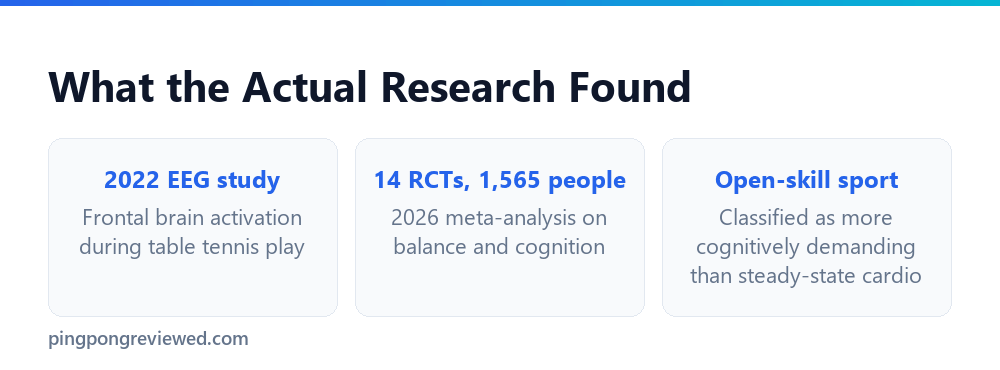
A 2022 EEG study by Visser, Büchel, Lehmann and colleagues, published in Experimental Brain Research, found that continuous table tennis play was associated with increased processing in frontal brain areas compared with cycling — consistent with the idea that an unpredictable, reactive sport demands more real-time cognitive processing than steady, predictable exercise. That is worth naming precisely, because this particular benefit is usually cited on health sites as a vague “study from Japanese scholars” with no researchers, journal or year attached, which makes it impossible to check.
Separately, a 2026 meta-analysis published in the journal Sports synthesized 14 randomized controlled trials covering 1,565 participants and found table tennis interventions were associated with improvements in balance and cognitive function, particularly relevant for older adults. Meta-analyses of multiple trials carry more weight than any single study, which is part of why we’re citing it specifically rather than a single smaller study.
What we won’t claim: that ping pong prevents dementia, cures cognitive decline, or is a substitute for medical care. The honest summary of the actual research is that table tennis appears to be a genuinely engaging cognitive and physical activity, particularly promising for older adults as one part of a broader active lifestyle, not a proven medical intervention on its own.
Balance and Core Strength
The constant lateral movement and weight-shifting table tennis demands works your core and lower-body stabilizing muscles in a way that’s genuinely comparable to dedicated balance training, which lines up with the balance improvements found in the 2026 meta-analysis referenced above. This is part of why table tennis specifically gets recommended in some fall-prevention and healthy-aging contexts for older adults, alongside more traditional balance exercises.
The core engagement specifically comes from the rotational and lateral component of a proper stroke, not just standing and reaching for the ball. Players with genuinely poor footwork tend to rely more on arm reach and less on hip and core rotation, which both limits shot power and reduces the core-strengthening benefit of play. This is one of several reasons coaches emphasize footwork fundamentals early rather than treating them as an advanced-only skill.
Lower Injury Risk Than High-Impact Sports
Table tennis involves far less joint-jarring impact than running, basketball, or other sports built around repeated hard landings, which makes it a genuinely reasonable option for people managing joint sensitivity who still want meaningful cardiovascular and coordination benefits. It’s not injury-free, quick lateral movements can still strain an ankle or knee without proper footwear and warm-up, which is why our table tennis shoe guide covers footwear built specifically for this kind of lateral movement.
A brief warm-up genuinely reduces this risk, and it doesn’t need to be elaborate: a few minutes of light movement and some easy practice shots before playing at full pace covers most of the benefit. This matters more than it might seem for a sport that looks low-intensity from the outside, since the sudden direction changes involved are exactly the kind of movement that catches cold, unwarmed muscles and joints off guard.
Social and Accessibility Benefits
Table tennis has a genuinely low barrier to entry compared to many sports: minimal equipment, playable across a wide age range in the same session, and commonly available at community centers and clubs, covered in more depth in our guide to finding or starting a ping pong club. The social structure of regular club or casual play, seeing the same people consistently, contributes to the kind of ongoing social engagement generally associated with better long-term wellbeing, a well-established point in exercise psychology broadly rather than something specific to table tennis alone.
How the Claims on This Page Are Sourced
Every specific research claim on this page is tied to a named, findable study or meta-analysis rather than a vague “studies show” attribution. General exercise-science points — aerobic benefit from moderate-intensity activity, lower joint impact than high-impact sports — are presented as the established consensus they are, without a citation each, the same way nobody cites a study for the claim that walking is good exercise. Two claims that circulate widely about ping pong are absent here deliberately: a supposed “sexual improvement” benefit, which has no supporting evidence at all, and the unattributed “Japanese scholars” brain study, which is superseded above by the actual published research.
Frequently Asked Questions
Does ping pong actually keep you fit?
Yes, as a genuine moderate-intensity aerobic activity, roughly comparable to a brisk walk or doubles tennis on standard exercise-intensity scales, when played regularly and at a reasonably active pace.
Is there real research on ping pong and brain health?
Yes — a 2022 EEG study (Visser et al., Experimental Brain Research) found increased frontal brain activation during table tennis compared to cycling, and a 2026 meta-analysis of 14 trials found associated improvements in balance and cognitive function.
Can ping pong help prevent cognitive decline?
The research is promising but not conclusive enough to call it prevention — studies show associated improvements in cognitive function and balance, particularly in older adults, but table tennis isn’t a proven standalone treatment for cognitive decline or dementia.
Is ping pong good exercise for older adults?
Yes, particularly because of its lower joint impact compared to high-impact sports and the balance benefits found in recent research, alongside its genuinely accessible, social structure at most clubs.
How much ping pong do you need to play to see benefits?
There’s no single proven threshold specific to table tennis alone. General exercise guidelines recommend at least 150 minutes of moderate-intensity activity weekly, which regular table tennis play can reasonably contribute to.
Does ping pong burn a lot of calories?
It burns a meaningful amount as a moderate-intensity activity, though the exact number depends heavily on your body weight, play intensity, and session length, so we won’t state a single flat calorie figure as if it applies to everyone equally.
Is ping pong good for rehabilitation after an injury?
It’s used in some occupational therapy and rehabilitation settings specifically for coordination recovery, alongside traditional therapy exercises rather than replacing them. Always follow your own care provider’s specific guidance rather than starting any new activity unsupervised during recovery.
Does warming up before playing actually matter?
Yes, more than casual players often assume — the sudden lateral direction changes central to table tennis are exactly the kind of movement that strains cold, unwarmed joints and muscles. A few minutes of light movement before full-pace play meaningfully reduces that risk.
As an Amazon Associate, we earn from qualifying purchases through links on this page.

Ping Pong Reviewed is an equipment review site covering table tennis and baseball gear. Specifications are checked against manufacturer listings, and prices against live retail pages, before publication.