How to Play Ping Pong: A Real Beginner’s Guide (2026)
This is a straightforward beginner’s guide to how to play ping pong, covering equipment, the objective, scoring, serving and basic technique, in that order. It assumes you have never played and skips the history and the improvement tips that most introductions front-load, on the grounds that neither helps you get through your first game.
One more thing worth clearing up before diving in: “ping pong” and “table tennis” refer to the same sport. “Ping pong” was the original casual name from when the game first became popular in England; “table tennis” became the more formal term used once the sport organized around official rules and international competition. You’ll see both terms used interchangeably throughout this guide and across the sport generally, and neither one is more correct than the other.
What You Actually Need to Start
- A table — regulation size or a smaller midsize table for limited space; our full table buying guide covers verified options.
- Paddles — one per player; our beginner paddle guide covers budget-friendly complete paddles.
- Balls — 40mm regulation size; our balls guide covers verified picks across brands.
- A net — clamps onto most tables; our net buying guide covers both screw-clamp and retractable styles.
The Objective, In Plain Terms
Two players (or two teams of two in doubles) hit a ball back and forth over the net, trying to make a shot the opponent can’t legally return. You win a point when your opponent fails to return the ball, hits it out of bounds, into the net, or commits a fault. Games are played to 11 points, win by 2, and a match is typically decided over a set number of games, best-of-5 for most casual and club-level play. This wasn’t always the scoring format, table tennis was played to 21 points before a 2001 rule change; our full explainer on that history covers it in more depth if you’re curious.
Doubles play adds one specific twist worth knowing about even if you’re starting with singles: partners must return the ball alternately, you can’t hit two shots in a row for your team, and serves must go diagonally from the right half of the server’s side to the right half of the receiver’s side, a stricter placement requirement than singles serving has. If you’re planning to play doubles regularly, it’s worth practicing that alternating pattern deliberately early on, since it genuinely changes footwork and positioning compared to singles.
Serving Basics
Serving is the one part of the game with the most specific rules attached, and it’s worth learning correctly from the start rather than picking up bad habits. The ball must rest on an open palm, get tossed at least 16cm straight up without spin, and stay visible to your opponent throughout. You get 2 consecutive serves before it switches to your opponent, except at 10-10, where it alternates every point. Our full serve rules guide covers the complete details, including the distinction between a serve that is illegal and one that is merely a let — a difference most beginner guides skip entirely and one that decides a surprising number of casual arguments.
A serve that clips the net on its way over but still lands legally in your opponent’s court is called a let, and it’s simply replayed with no penalty, not a fault. This is one of the most commonly misunderstood rules among newer players, and getting it right from the start avoids a genuinely common source of confusion during casual games about whether to keep playing or stop and redo the point.
Playing Out a Rally
- Let the ball bounce once on your side before returning it — hitting it before the bounce (a volley) is a fault, except on the serve.
- Return it so it clears the net and lands on your opponent’s side, or you lose the point.
- Keep track of the score out loud, calling your own score first, then your opponent’s, standard etiquette in both casual and competitive play.
- Switch sides after each game, and at the midpoint of the deciding game in a match, to keep lighting and background conditions fair.
Faults, the ways you can lose a point beyond simply missing the ball, are worth knowing explicitly rather than discovering them mid-game. Touching the table with your free hand during play, moving the table itself, or having the ball touch anything other than your paddle before crossing the net all count as faults and hand the point to your opponent. None of these come up constantly in casual play, but knowing them upfront prevents genuine confusion the first time one actually happens.
Two Shots to Learn First
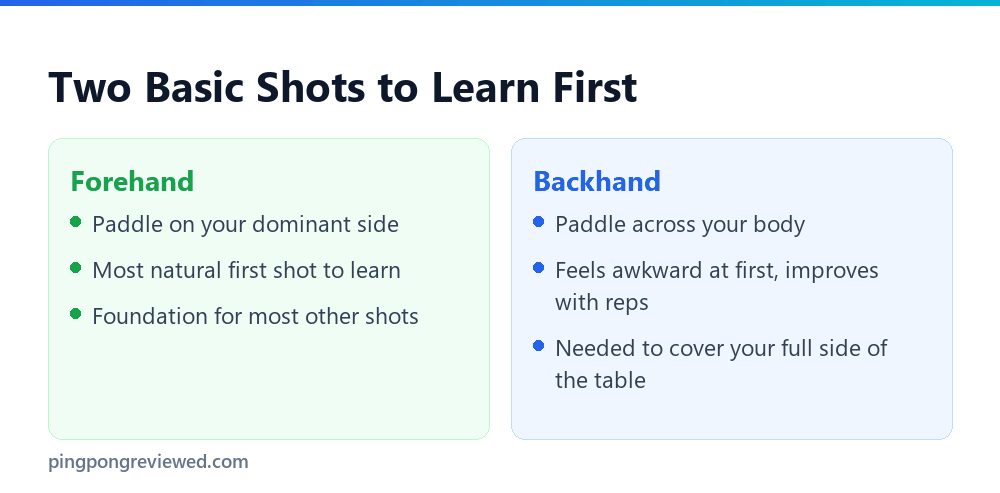
Forehand and backhand are the two foundational strokes you’ll use for the overwhelming majority of shots as a beginner. Forehand, paddle on your dominant side, generally feels more natural first and is where most new players start building consistency. Backhand, paddle across your body toward your non-dominant side, feels genuinely awkward initially but is necessary since you can’t reach every shot with forehand alone. Spend early practice sessions on both rather than avoiding backhand because it feels harder, since that avoidance just delays a skill you’ll need regardless.
Spin is worth understanding conceptually early even if you can’t execute it well yet: angling your paddle face and brushing the ball rather than hitting it flat imparts spin that changes how the ball bounces off your opponent’s paddle. It’s an advanced skill to execute well, but recognizing when your opponent is applying spin to your returns is a beginner-relevant skill in its own right, since misreading spin is one of the most common reasons beginners miss returns that looked easy.
Footwork gets overlooked by a lot of beginners focused entirely on the paddle and swing, but it’s arguably just as important. Staying on the balls of your feet, knees slightly bent, ready to move laterally in either direction, sets up every other shot you’ll try to make. A player with mediocre paddle technique but genuinely good footwork will often outperform someone with a prettier swing who’s stuck flat-footed reacting a half-second too late to every wide shot.
What You Need to Start
Table tennis has a low equipment barrier, and it is worth being clear about the minimum before anyone spends more than they need to.
You need a table with a net, a bat, and balls. That is genuinely all. A pre-made bat is entirely adequate to learn on, and the distinction between a very cheap bat and a decent one matters far more than the distinction between a decent one and an expensive one at this stage.
- Bat: a pre-assembled one from a recognised brand. Avoid the very cheapest sets, where the rubber has almost no grip and makes learning spin genuinely harder.
- Balls: a pack of training-grade balls. You will lose and damage them, so buy more than feels necessary.
- Table: the expensive item, and the one worth delaying if you have access to one at a club or community centre.
- Shoes: not essential at first, but a proper indoor court shoe is the upgrade that most changes how you move once you are playing regularly.
Everything else, dedicated blades, individual rubber sheets, robots, nets, cases, is for later and is covered elsewhere on this site. Buying deep into equipment before you know what your game looks like is the most common way new players spend money without improving.
The Shots Beyond Forehand and Backhand
Beginner guides usually stop at forehand and backhand, which are sides of the body rather than shots. These are the actual strokes worth knowing by name, roughly in the order they become useful.
- Push. A controlled, backspin-carrying shot played close to the table, usually against backspin. The first genuinely tactical shot most players learn, and the safest return to an unreadable serve.
- Block. Meeting an attacking ball with a closed racket face and little swing, using the opponent’s pace. The cheapest way to stay in rallies against harder hitters.
- Drive. A flat, medium-paced attacking stroke. The foundation of attacking play and the stroke most beginner practice is built around.
- Loop. A heavy topspin stroke produced by brushing up the back of the ball. The main attacking weapon in the modern game and the shot that takes longest to make reliable.
- Smash. A flat, hard finishing shot against a high ball. Satisfying, situational, and frequently attempted at the wrong moment.
- Chop. A heavy backspin defensive stroke played away from the table. A specialist stroke rather than a beginner one.
If you learn these in order, push and block first, then drive, then loop, you build a game that can stay in rallies before it tries to win them, which is the sequence that produces results fastest at club level.
Playing Doubles
Doubles has two rules that make it genuinely different rather than just singles with more people, and casual players frequently play without either.
First, partners must alternate shots strictly. You play a ball, your partner plays the next, regardless of where it lands. This makes doubles as much a movement problem as a hitting one, since two people have to share one side of the table without obstructing each other.
Second, service must be diagonal, from the server’s right half-court to the receiver’s right half-court, which is why doubles tables have a centre line marked. That line has no function in singles at all.
Serving order rotates so that everyone serves and receives in turn. Our doubles rules guide covers the rotation in full, including how it behaves at deuce, which is where most confusion arises.
Your First Games: What to Expect
The gap between understanding the rules and playing a game that feels like table tennis is mostly about consistency, and it closes faster than most beginners expect.
Early rallies are short, and that is normal. The goal in the first few sessions is not to win points but to extend rallies, and a useful early target is simply to see how many consecutive returns you and your opponent can manage together. Cooperative rallying builds the timing that competitive play then uses.
Expect to be beaten by spin before you can produce it. A serve you cannot read will send your return into the net or off the end for a while, and the fix is to watch the server’s bat rather than to swing harder.
Most importantly, resist the urge to hit hard. Almost every beginner’s instinct is to swing at the ball, and almost every beginner improves fastest by doing the opposite: slowing down, making contact cleanly, and prioritising getting the ball on the table over anything else.
Beginner Mistakes That Are Easy to Fix
- Standing too close to the table. Leaves no room to swing and no time to react. A step back solves more early problems than any technical change.
- Not returning to a ready position. Most beginners remain where their last shot left them, which guarantees being out of position for the next.
- Swinging with the arm only. Power and consistency come from the legs and trunk rotating, with the arm finishing the motion.
- Watching the ball instead of the opponent’s bat. By the time the ball tells you what spin it has, it is nearly on you.
- Trying to win every point outright. Consistency wins far more recreational points than winners do.
None of these require coaching to correct, and each is worth more at the beginner stage than learning an additional stroke would be.
Etiquette and How Games Are Actually Run
A few conventions are worth knowing before playing anyone outside your household, since they are universal enough that not knowing them marks you out immediately.
- Call the score before each serve, server’s score first. This prevents the majority of scoring disputes.
- Return the ball to the server between points rather than leaving them to fetch it.
- Apologise for a net or edge ball that wins you a point. A raised hand is the standard gesture.
- Wait for the point to finish before walking behind an adjacent table in a club.
- Knock bats or shake hands at the end of a match, depending on local convention.
On format, a game is to 11 points, win by 2. Matches are usually best of five or best of seven games. Players change ends between games, and in the deciding game they change ends again when the first player reaches 5 points, which balances any advantage from lighting or background on one side.
Where to Go Next
Once you can rally consistently and know the basic rules, the question becomes what to work on rather than what to learn, and it is easy to lose momentum at that point.
The highest-value next steps for most new players are, in order: developing one reliable spin serve, learning to read incoming spin off the opponent’s bat, and building consistent footwork so you arrive at the ball in position rather than reaching for it. Those three do more than any additional stroke would.
Beyond that, playing a wider range of opponents matters more than additional solo practice. Our guides on improving, on drills, and on finding a club cover each of these in more detail, and a club in particular tends to accelerate everything else.
The Short Version
Table tennis is simple to start and takes very little equipment. A table, a bat, and balls will do, and a modest pre-made bat is entirely adequate until you know what your game looks like.
A game is to 11, win by 2, with service alternating every 2 points and every point at deuce. Serve by tossing the ball at least 16cm from an open palm and striking it on the way down, keeping it visible to your opponent.
Beyond that, the fastest early progress comes from consistency rather than power: extend rallies, watch your opponent’s bat rather than the ball, return to a ready position after every shot, and resist the urge to swing hard. Almost everything else on this site builds on those four habits, and none of them require buying anything or booking a coach to start working on today.
Frequently Asked Questions
What are the basic rules of ping pong?
Games are played to 11 points, win by 2. Serve alternates every 2 points, every single point once the score reaches 10-10. The ball must bounce once on your side before you return it, and must clear the net and land on your opponent’s side of the table.
How do I serve legally in ping pong?
Rest the ball on an open palm, toss it at least 16cm straight up without any finger spin, and keep it visible to your opponent throughout. Our full serve rules guide covers every requirement in complete detail.
What equipment do I need to start playing?
A table, one paddle per player, 40mm balls, and a net. Our equipment guides cover verified, genuinely beginner-friendly picks for each of these individually.
Is ping pong hard to learn as a total beginner?
The basics, rallying casually and understanding scoring, are genuinely approachable within a single first session for most people. Advanced spin control and consistent competitive play take much longer to develop properly, the same as any racket sport worth taking seriously.
Where did ping pong originally come from?
England, in the late 19th century, originally played informally as a parlor game before gradually becoming the standardized, internationally competitive sport known today as table tennis.
What’s the difference between ping pong and table tennis?
None functionally — “ping pong” was the original casual name, and “table tennis” became the more formal term used in official and international competition. Both refer to the same sport.
How long does it take to get reasonably decent at ping pong?
Genuinely comfortable, consistent rallying comes within a few weeks of regular practice for most people. Real competitive competence, consistent spin control and shot placement, typically takes months to years of dedicated practice, similar to most racket sports.
Can I play ping pong alone to practice?
Yes — a rebound net or a playback-mode table lets you practice returns solo, and some players also practice basic swing mechanics against a flat wall, though a wall doesn’t replicate actual table bounce and spin the way a proper practice setup genuinely does.
What’s the most common mistake beginners actually make?
Gripping the paddle too tightly, which restricts wrist flexibility and reduces both control and spin potential. A relaxed, controlled grip generally produces better results than a tense, forceful one, even though tension feels intuitively like it should help.
As an Amazon Associate, we earn from qualifying purchases through links on this page.

Ping Pong Reviewed is an equipment review site covering table tennis and baseball gear. Specifications are checked against manufacturer listings, and prices against live retail pages, before publication.