Midsize Ping Pong Table Dimensions: Exact Sizes & Who They Fit

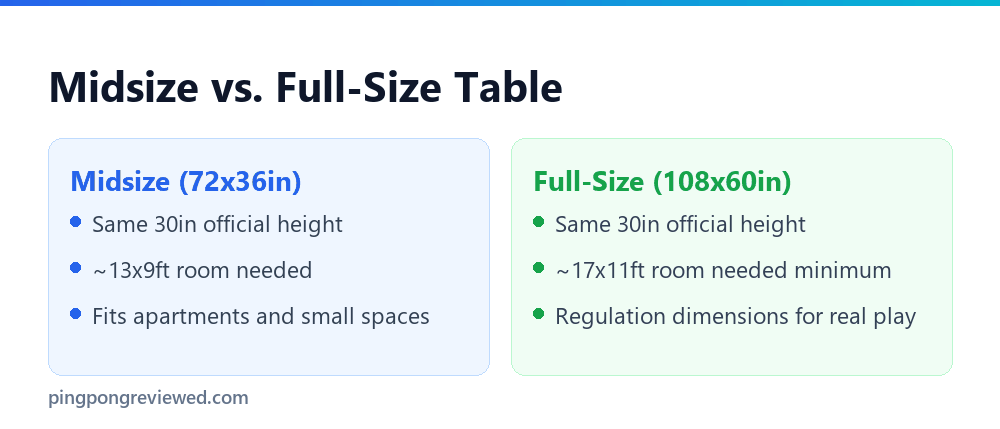
A midsize ping pong table measures roughly 6 ft × 3 ft (183 × 91.5 cm) at the official 30-inch height — about two-thirds of a regulation table. It needs around 13 × 9 ft of room versus the 17 × 11 ft a full-size table demands, and most fold flat for storage. The height staying official is the detail that makes it worth buying.
Midsize is the class that turned apartments, offices and awkward basements into places you can actually rally. It’s also the class most misunderstood — people assume ‘smaller table’ means ‘toy’, and for the cheap ones they’re right. For the good ones they’re completely wrong, and the difference is one specification.
- →~6 × 3 ft at 30 inches high — width and length shrink, height doesn’t
- →Needs about 13 × 9 ft of room, versus 17 × 11 for full-size
- →Official height means strokes transfer to a real table
- →Best for apartments, offices, kids and gifts
- →Wrong for anyone training seriously — the geometry changes
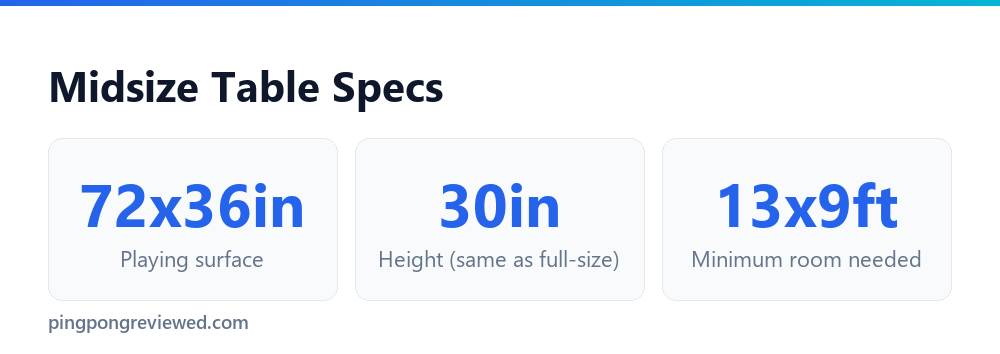
Table of Contents
The exact dimensions
The height and the net are regulation. That single fact is what separates a real midsize table from a toy.
Why the height matters more than the length
Here’s the thing that determines whether a small table is worth owning. Every stroke you learn is calibrated to the table’s height — where your contact point sits relative to your body, how far you bend, how the ball behaves at net level.
Shrink the playing surface and you change the geometry of the game: serves that would be long stay on, loops land differently, and depth judgment doesn’t transfer. That’s a genuine limitation, but it’s a limitation of scale rather than a corruption of technique.
Shrink the height and something worse happens: you learn strokes at the wrong body position. A child who spends two years on a 24-inch table has grooved a contact point that doesn’t exist on a real table, and every stroke needs rebuilding. That’s why quality midsize and junior tables always keep the official 76 cm height, and why the cheap ‘kids tables’ that lower it are worse than useless for anyone who might keep playing.
⚠️ Watch out: Check the height spec before you buy anything described as ‘midsize’ or ‘compact’. If the listing doesn’t state it, assume it’s been lowered — reputable manufacturers advertise official height precisely because it’s the thing that separates them from toys. A 6 × 3 ft table at 24 inches is a novelty; the same table at 30 inches is genuinely useful equipment.
The space you actually save
A midsize table plays comfortably in about 13 × 9 ft and survives in less. Compare that to the 17 × 11 ft a full table demands — covered in our room size guide — and you can see why the class exists.
- Midsize: yes
- Full-size: no
- The classic use case
- Fold it away between sessions
- Midsize: usually
- Move a coffee table, play
- Fold flat, slide behind a sofa
- The whole reason the class sells
- Midsize: yes
- Full-size becomes a fire-exit problem
- Height means real rallies
- Popular for a reason
The storage story is half the purchase. Most midsize tables fold flat to a few inches and slide under a bed, behind a door or into a cupboard. That’s not a minor convenience — it’s the difference between a table that gets set up for an hour on a Tuesday evening and a table that dominates a room permanently and therefore never gets bought.
Who should buy midsize
- ✓Apartment and small-home players — the obvious case
- ✓Families with kids aged 5–10 (though compare junior tables)
- ✓Offices and break rooms
- ✓Gift buyers — best delight-per-dollar in the sport
- ✓Anyone whose alternative is no table at all
- ✕Anyone training for club or league play
- ✕Players working on loops and depth control
- ✕Households that genuinely have 17 × 11 ft available
- ✕Anyone expecting serves and spin to behave normally
- ✕Buyers who’ll be frustrated by a shortened game
The honest line: if you have the room for a folding full-size table, buy that instead. A budget full-size table often costs similar to a premium midsize, plays the real game, and gives you playback mode — which needs only about 11 × 11 ft anyway. Midsize is the right answer when the room genuinely says no, not when you’re economising.
How a midsize table actually plays
Different, and mostly in ways that are fun rather than frustrating.
Rallies get faster. Two-thirds the length means the ball reaches you sooner, so exchanges become sharp and reflexive. It’s genuinely good reaction training and it’s why office games get competitive so quickly.
Serves change completely. A serve that would be long on a full table stays on a midsize one, which means the short game barely exists and the tactical serving layer flattens out. Whether that’s a loss depends entirely on whether you were using it.
Spin matters less. A heavy loop needs distance to arc and dip — over six feet there’s barely time for the topspin to bring the ball down. Flat, fast hitting becomes the dominant style, which is closer to how table tennis played before the 1950s than how it plays now.
Where midsize sits among the compact options
‘Small table’ covers at least four genuinely different products, and shops use the terms loosely enough that buyers routinely order the wrong one. Here’s the actual landscape:
Conversion tops deserve a specific warning here, because they’re often cross-shopped against midsize tables and they solve a completely different problem. A conversion top gives you a full-size 9 × 5 ft playing surface laid on your pool or dining table — so you need the full 17 × 11 ft of room, you just don’t need to store a table.
The catch is height. The top sits at whatever your host table’s height is plus its own thickness, and pool tables typically stand at 31–32 inches. That puts the playing surface a couple of inches above regulation, which is fine for fun and mildly wrong for developing strokes. If you own a pool table and have the room, it’s a genuinely good option; if you’re choosing it to save space, you’ve misunderstood what it does.
Mini and tabletop sets — the 3–5 ft versions that clamp onto a dining table — are honestly sold as toys and they’re perfectly good at that. They’re excellent for toddlers, travel and offices with no floor space at all. Nobody should expect stroke development from them, and nobody selling them seriously claims otherwise.
What to check before you buy
📊 Note: Pair it with proper 3-star balls rather than the ones in the box. Cheap balls are out of round and bounce inconsistently, and on a shorter table with faster exchanges you notice that far more than you would on a full-size one.
- →Full-size dimensions — the official specs and why thickness matters
- →Room size guide — what each table class needs
- →Junior tables — the 3/4-scale alternative
- →Table reviews — including folding full-size options
Frequently asked questions
What size is a midsize ping pong table?
Roughly 72 × 36 inches (183 × 91.5 cm) at the official 30-inch height — about two-thirds of a full-size table in length and three-fifths in width. Models vary a little, but that’s the class.
How much room does a midsize table need?
About 13 × 9 ft to play comfortably, versus 17 × 11 ft for full-size. That difference is exactly why the category exists.
Is a midsize table good for beginners?
For learning strokes and having fun, yes — the official height and net mean nothing needs unlearning. Move to full-size as soon as space allows if you’re aiming at club play.
What’s the difference between midsize and junior tables?
Junior tables are 3/4 scale (about 7 × 4 ft); midsize are roughly 2/3 (6 × 3 ft). Junior plays closer to the real game; midsize fits smaller rooms. Both should keep official height.
Do normal rules apply on a midsize table?
Yes — same scoring and serving rules, just less real estate. Rallies get quicker and the short game largely disappears.
Can adults enjoy a midsize table?
Genuinely, yes. Rallies are fast and reflexive, and office and apartment games get seriously competitive. What you lose is the depth and spin dimension, not the fun.
Should I buy midsize or a folding full-size table?
If you have 17 × 11 ft, buy the full-size — a budget full-size often costs similar to a premium midsize and plays the real game. Midsize is for when the room genuinely can’t take it.
How much do midsize tables cost?
Most sit between about $100 and $300, which overlaps awkwardly with budget full-size tables. That overlap is the decision point: at the top of the midsize range you’re paying full-size money for a smaller table, so it’s only worth it if the room genuinely can’t take the bigger one. At the bottom of the range, check the height spec carefully — that’s where the toys hide.
Can two adults play properly on a midsize table?
Yes, and it’s more fun than people expect. The rallies are fast and reflexive rather than tactical, so it plays a bit like a different sport — closer to a reaction game than a spin game. What you won’t get is meaningful loop rallies or a short game, because there simply isn’t enough table for either.
Will a midsize table help my kid learn properly?
Provided it’s at the official 30-inch height, yes — the contact point and body position are correct, so nothing needs unlearning later. A junior table at 7 × 4 ft is even better if the room allows, because the extra length starts to introduce depth judgment. What matters most is that they’re playing at all.

Ping Pong Reviewed is an equipment review site covering table tennis and baseball gear. Specifications are checked against manufacturer listings, and prices against live retail pages, before publication.