Table Tennis Brands: Who’s Actually Best at What

Quick Answer: No brand is best at everything. Butterfly owns the premium rubber market (46.9% of players at the 2021 World Championships used their rubbers) and charges for it. DHS makes the tacky rubbers China’s national team runs on. Stiga makes superb wooden blades and the beginner paddles you’ll find in every shop. Nittaku makes the balls. Pick by what you need, not by what a champion endorses.
Every table tennis brand sells everything, and every brand’s marketing says the same things. So this is the honest map: what each one is genuinely best at, what the equipment actually costs, the technical divide that explains the whole landscape, and why ‘what the pros use’ is a less useful guide than you’d think.

Table of Contents
The brand-by-specialty map
| Brand | Origin | Genuinely best at | Price tier |
|---|---|---|---|
| Butterfly | Japan | Premium rubbers (Tenergy, Dignics) & pro blades | $$$$ |
| DHS | China | Tacky rubbers (Hurricane), pro tables, balls | $–$$$ |
| Stiga | Sweden | Wooden blades; beginner-to-intermediate pre-mades | $$–$$$ |
| JOOLA | Germany/USA | Home & mid-range tables, recreational paddles | $$ |
| Nittaku | Japan | Balls — the tournament standard | $$$ |
| Donic | Germany | All-round rubbers & blades, strong value | $$–$$$ |
| Tibhar | France/Germany | Rubbers (Evolution series) | $$–$$$ |
| Yasaka | Sweden/Japan | Classic rubbers (Mark V) & blades | $$ |
| Xiom | South Korea | Modern tensor rubbers | $$–$$$ |
| Killerspin | USA | Recreational paddles & sets, gifting | $$ |
| Palio | China | Budget custom setups for beginners | $ |
| Cornilleau | France | Outdoor tables — the category leader | $$$ |

The technical divide that explains everything
Here’s the thing that organises the entire brand landscape, and almost no brand guide mentions it. There are two completely different philosophies of how a rubber should generate spin, and every brand sits on one side or the other.
| Chinese (tacky) | European/Japanese (tensor) | |
|---|---|---|
| Who | DHS Hurricane, Palio, most Chinese rubber | Butterfly Tenergy/Dignics, Xiom, Tibhar, Donic |
| Topsheet | Sticky — a ball genuinely adheres to it | Grippy but not tacky |
| Sponge | Hard, dense | Springy, pre-tensioned (‘tensor’) |
| Spin comes from | Grip — the surface holds the ball and drags it | Catapult — the sponge compresses and flings |
| Needs | Big, fast, full strokes to activate | Less power — the rubber contributes |
| Feels | Dead if you’re not strong enough; devastating if you are | Lively, forgiving, faster to learn |
| Suits | Trained players with full-body technique | Almost everyone else |
This is why you’ll see Chinese professionals playing a DHS Hurricane forehand with a tensor backhand — they want maximum grip and control on the wing they can generate huge power with, and catapult help on the wing where the stroke is shorter. That hybrid setup is the signature of the Chinese national team, and it’s copied worldwide by players who mostly can’t generate the forehand power it requires.
⚠️ This is the most expensive mistake in table tennis equipment. A club player buys a Hurricane because their idol uses one, and discovers it feels like hitting with a plank. That’s not a defect — the rubber is designed to be activated by a stroke they don’t yet have. The rubber isn’t dead; their swing is. Tensor rubber does more of the work, which is exactly why beginners should be on it.
The three that matter most
Butterfly: the premium standard
For players looking at entry-level competition Butterfly gear, read our hands-on review of the Butterfly 401 Racket.
Japanese, founded in 1950, and the closest thing the sport has to a default at the top. Butterfly’s reputation rests almost entirely on rubber chemistry — the Tenergy line, and later Dignics, genuinely changed what a rubber could do, using tensioned sponge technology that stores and returns energy in a way older rubbers couldn’t. When nearly half the field at a World Championship is on your rubber, that’s not marketing.
Their blades are excellent and expensive, typically carbon-composite builds engineered for speed. Their pricing is unapologetic — you’re paying for genuine R&D, genuine consistency, and a substantial brand premium on top. The honest summary: Butterfly is worth it when you’re good enough to feel the difference, and a waste of money before that. Most players buy it about three years too early.
DHS: China’s engine
Double Happiness Shanghai, and the equipment behind the most dominant national program in any Olympic sport. DHS’s signature is the Hurricane rubber family — tacky, hard-sponged, and utterly unforgiving of a lazy stroke. It’s the physical expression of a coaching philosophy: the rubber refuses to help you, so your technique has to be complete.
DHS also makes the tables used at the highest level and excellent 3-star balls at sane prices. Their weakness for Western buyers is the range itself — the naming and numbering is genuinely confusing, with commercial, provincial and national versions of the same rubber at wildly different hardnesses, and ‘boosted’ versions that professionals use but which sit awkwardly against equipment rules. Buying DHS well requires research; buying it badly means an expensive plank.
Stiga: the honest value
Comparing popular Stiga pre-assembled rackets? See our direct head-to-head on the STIGA Pro Carbon.
Swedish, and the brand most people’s first real paddle carries. Stiga’s genuine claim is wooden blades — they make some of the best all-wood blades on the market, with a flexibility that suits developing players far better than carbon does. A flexible wooden blade gives you dwell time, and dwell time is where a beginner learns to brush the ball.
They also own beginner-to-intermediate retail in North America, which cuts both ways: the pre-made paddles at the supermarket end of their range are ordinary, and their presence there means serious players sometimes dismiss the brand entirely. That’s a mistake. A Stiga blade with good rubber is a legitimate club setup at roughly half a Butterfly price — and for the specific job of teaching someone to loop, arguably better.
What the pros use — and why that’s a bad shopping guide
At world level, equipment is basically a two-brand contest: 46.9% of players at the 2021 World Championships used Butterfly rubbers, and most of the rest were on DHS or the European tensor brands. Non-Chinese stars overwhelmingly play Butterfly; China’s team runs DHS forehands.
Nittaku wins a quieter contest entirely: its Premium 40+ is the ball serious tournaments reach for, which is why it tops our ball reviews. Balls are the one category where the professional choice is the right consumer choice, because a good ball behaves the same in anyone’s hands.
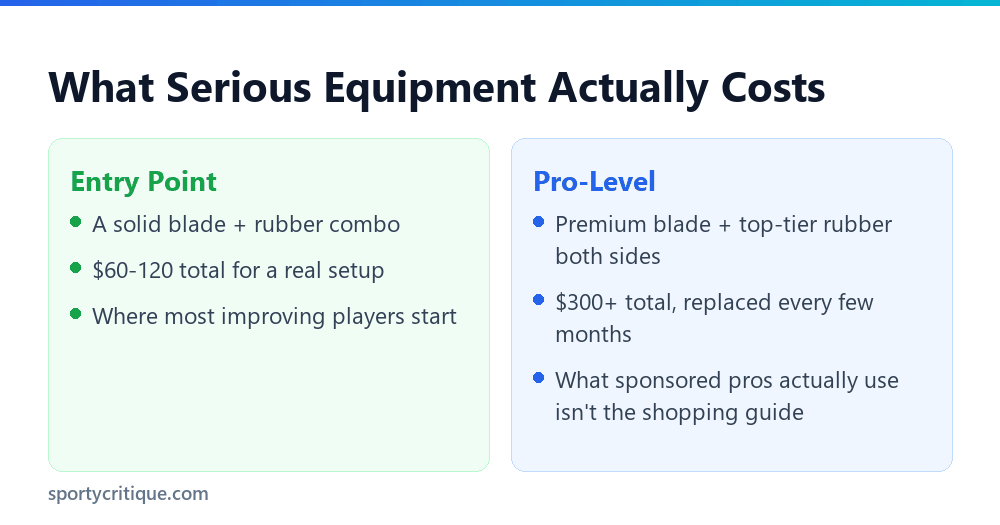
⚠️ But remember what a sponsorship is. Professional players are paid to use their equipment. That doesn’t mean the equipment is bad — you don’t win a World Championship on gear that doesn’t work — but it does mean ‘Ma Long uses X’ tells you about a contract as much as about a product. And crucially, pros often use custom or hand-selected versions of retail products: matched blade weights, boosted rubbers, sheets picked from batches. The thing in the shop is not always the thing on the table.
The useful version of the question isn’t ‘what do pros use’ — it’s ‘what do good coaches put beginners on’. And the answer to that is remarkably consistent: a flexible wooden blade and a forgiving tensor rubber, from Stiga, Yasaka, Donic or Palio. None of it is glamorous. All of it works.
What it actually costs
If you wonder how high brand price tags climb, read our breakdown of The Most Expensive Ping Pong Paddles.
| Component | Butterfly | Stiga | Budget (Palio/Yasaka) |
|---|---|---|---|
| Rubber sheet | $55–95 | $30–60 | $10–25 |
| Blade | $80–350 | $40–160 | $20–50 |
| Complete setup | $190–540 | $100–280 | $40–100 |
Look at those numbers honestly. A Butterfly setup can cost five times a competent budget one — and the difference in the hands of a player who hasn’t mastered the loop is somewhere between marginal and negative, because premium rubbers are faster and less forgiving. Stiga generally offers similar technology and playing character for meaningfully less, which is why they own the beginner-to-intermediate retail market.
Where the money genuinely buys something: flagship rubbers for advanced players (Tenergy and Dignics really are different products, not just expensive ones), and consistency — premium blades are matched for weight and balance within tight tolerances, and the rejects become cheaper models. Our expensive paddles breakdown covers exactly what you’re paying for.
Which brand should you actually buy?
| You are | Buy | Why |
|---|---|---|
| Total beginner | Stiga, JOOLA or Killerspin pre-made | Forgiving, cheap, available everywhere — see our beginner guide |
| Improving club player | Stiga/Yasaka/Donic blade + Donic/Tibhar/Xiom rubbers | 80% of Butterfly performance at half the price |
| Advanced attacker | Butterfly or DHS flagship rubbers | Now the cost earns its keep |
| Buying balls | Nittaku or DHS 3-star | The one category where the pro choice is your choice |
| Buying an indoor table | JOOLA or Stiga | Best value at 19mm+ — table reviews |
| Buying an outdoor table | Cornilleau | They own this category and it isn’t close — outdoor guide |
| Buying a robot | iPong, Newgy, Butterfly Amicus | Different market entirely — robot reviews |
The specialists worth knowing
Beyond the big three, several brands own a niche so completely that they’re the obvious answer inside it — and knowing which is which saves you from paying a generalist premium for something a specialist does better.
Nittaku makes balls, and the sport quietly agrees they make the best ones. Their Premium 40+ is what serious tournaments use. They make blades too, and good ones, but nobody thinks of them that way — which is a rare case of a brand being defined by its smallest, cheapest product.
Cornilleau has spent decades on outdoor tables and it shows in the details nobody else bothers with: resin surfaces that genuinely survive rain, frames that don’t rust into a monument, and locking mechanisms that still work after two winters. If you’re buying an outdoor table, this is the one category where the specialist premium is unambiguously worth it.
Xiom and Tibhar are the tensor-rubber specialists most people haven’t heard of, and they’re where a lot of value hides. Xiom’s Vega series and Tibhar’s Evolution line are genuinely competitive with Butterfly’s mid-range at meaningfully lower prices — they simply lack the marketing budget and the champion endorsements.
Palio occupies a strange, useful corner: cheap Chinese rubber and pre-made paddles that vastly outperform their price for one specific job — teaching a beginner to brush the ball. The Palio Expert series is a genuine coach’s recommendation, not a compromise.
Yasaka is the veteran: Mark V has been in production for decades and remains a completely legitimate all-round rubber. It’s not exciting and it doesn’t need to be — plenty of good club players have used nothing else for twenty years.
Brand myths worth ignoring
‘Butterfly makes you better.’ Equipment amplifies technique; it doesn’t install it. A Tenergy sheet on a player with an arm-only swing produces faster mistakes, not better play. Fix the technique first — it’s free.
‘Chinese rubber is only for pros.’ Half right. Flagship Hurricane needs a serious stroke, yes — but cheap Chinese rubber is genuinely excellent for learning spin, precisely because it’s tacky and slow. You have to brush properly to get anything out of it, which is exactly the habit you want to build. Palio’s budget sheets are a beginner’s friend for this reason.
‘All balls are the same.’ Three minutes with a 1-star ball and a Nittaku 3-star ends this theory permanently. Cheap balls are out of round, inconsistent in weight, and crack. It’s the smallest-cost, highest-impact upgrade in the sport.
‘Brand X blades are all fast.’ Every brand makes blades across the whole speed spectrum. ‘Stiga is slow’ or ‘Butterfly is fast’ are statements about specific models people happened to try, generalised into folklore. Read the model’s specs, ignore the logo.
‘You should buy the brand your coach uses.’ Your coach’s setup suits your coach’s game. What matters is the characteristics — flexible or stiff, tacky or tensor — matched to your level and style, and those exist at every brand.
Frequently asked questions
Is Butterfly better than Stiga?
For flagship rubbers at advanced level, yes — Butterfly’s Tenergy and Dignics are genuinely category-leading. For blades, wooden ones especially, Stiga is superb and considerably cheaper. For a beginner, Stiga is the better buy by a distance.
What brand do professionals use?
Butterfly dominates — 46.9% of players at the 2021 Worlds used their rubbers — with China’s team on DHS forehands. But they’re paid to, and they often use hand-selected versions. It’s not the shopping guide it appears to be.
What’s the difference between Chinese and European rubbers?
Chinese rubbers are tacky with hard sponge — spin comes from grip and needs a big stroke to activate. European/Japanese tensors are springy — spin comes from catapult and needs less power. Beginners should be on tensor.
What’s the best budget brand?
Palio for custom setups, Stiga for pre-mades, Yasaka for classic all-round rubbers. All three punch far above their price.
Does the brand of ball matter?
More than any other single item. Nittaku Premium 40+ and DHS 3-star are the standards; cheap balls are out of round and will teach you wrong timing.
Which brand for an outdoor table?
Cornilleau, and it isn’t a close contest — they’ve specialised in weatherproof tables for decades and it shows.
🏓 Which Table Tennis Brand Matches Your Playing Style?
Butterfly leads in high-tension rubbers, Stiga dominates all-wood blade control, and DHS produces China’s signature tacky topsheets. Find the brand and model built for your grip and budget:

Ping Pong Reviewed is an equipment review site covering table tennis and baseball gear. Specifications are checked against manufacturer listings, and prices against live retail pages, before publication.