Best Ping Pong Paddle: 8 Verified Picks by Skill Level (2026)

Matching a paddle to your actual skill level matters far more than chasing a single “best overall” pick, because the qualities that make a paddle good for an improving player actively work against a beginner. Below are eight paddles organised by level rather than ranked in one undifferentiated list, each checked against a live listing for stock, current price and a description that matches what is actually being sold.
Table of Contents
What Actually Matters When Buying a Paddle
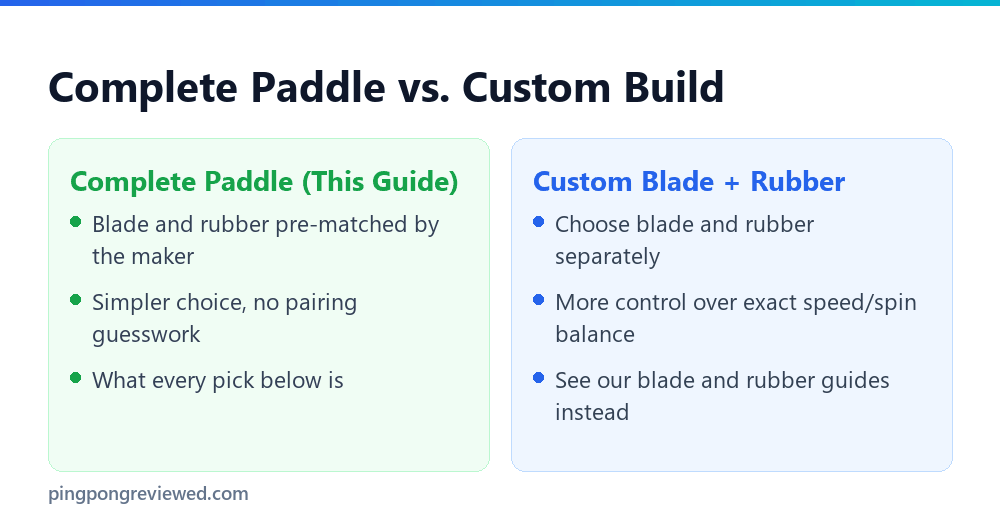
Complete Paddle vs. Custom Build
Every paddle in this guide is a complete, pre-assembled racket — blade and rubber already matched by the manufacturer. That’s the right starting point for the vast majority of players. Once you’re advanced enough to have strong opinions about a specific rubber’s tackiness or a blade’s exact speed rating, our pairing guide covers building a custom setup from separate components instead.
ITTF Approval
An ITTF-approved rubber has passed the international federation’s testing for thickness and composition standards. This matters if you play sanctioned club or tournament matches; it’s a nice-to-have, not a requirement, for casual and recreational play.
Grip Style
Shakehand (holding the handle like a handshake) is the more common grip worldwide and is what every paddle in this guide is built around by default. Penhold (gripping like a pen) is less common in Western play. If you use penhold, check each listing’s handle shape before you buy.
Speed, Spin, and Control Ratings
Manufacturers typically rate paddles on all three: speed (how fast the ball comes off the rubber), spin (how much rotation you can generate), and control (how forgiving off-center contact is). These three generally trade off against each other — a paddle built for maximum speed sacrifices some control, and vice versa.
Beginner Tier
A genuine beginner paddle has one job: stay forgiving enough that inconsistent contact and an unrefined stroke don’t turn every rally into a string of misses. That means prioritizing control over raw speed or spin ceiling, even though those specs look less exciting on a product listing.
1. Palio Expert 3.0 — Best Beginner Paddle
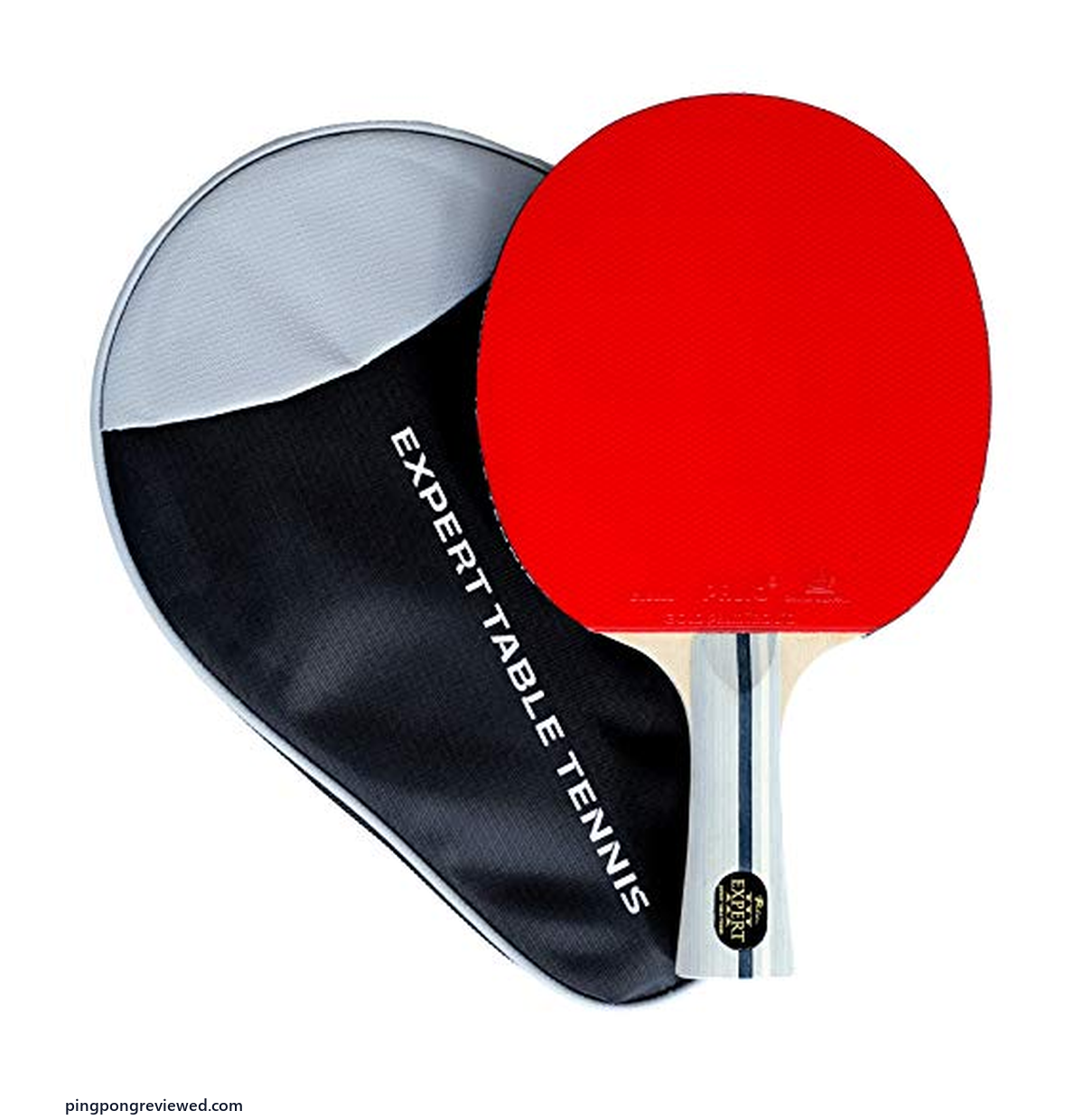
Palio Expert 3.0 Table Tennis Racket & Case, $39.99, is ITTF-approved despite its beginner-friendly price, and its listing is aimed at beginners. Comes with a carrying case, a small but genuinely useful detail for a first paddle.
Who it’s for: someone who has never played competitively and wants a paddle that won’t punish early mistakes while basic footwork, grip, and contact timing are still developing.
All-Round / Budget Intermediate
This tier is for a player who has outgrown a pure beginner paddle’s ceiling but isn’t ready to commit to a style-specific advanced racket yet — something that performs reasonably well across speed, spin, and control rather than maxing out any single spec.
2. STIGA Evolution — Rated 96, 94 and 90 by STIGA
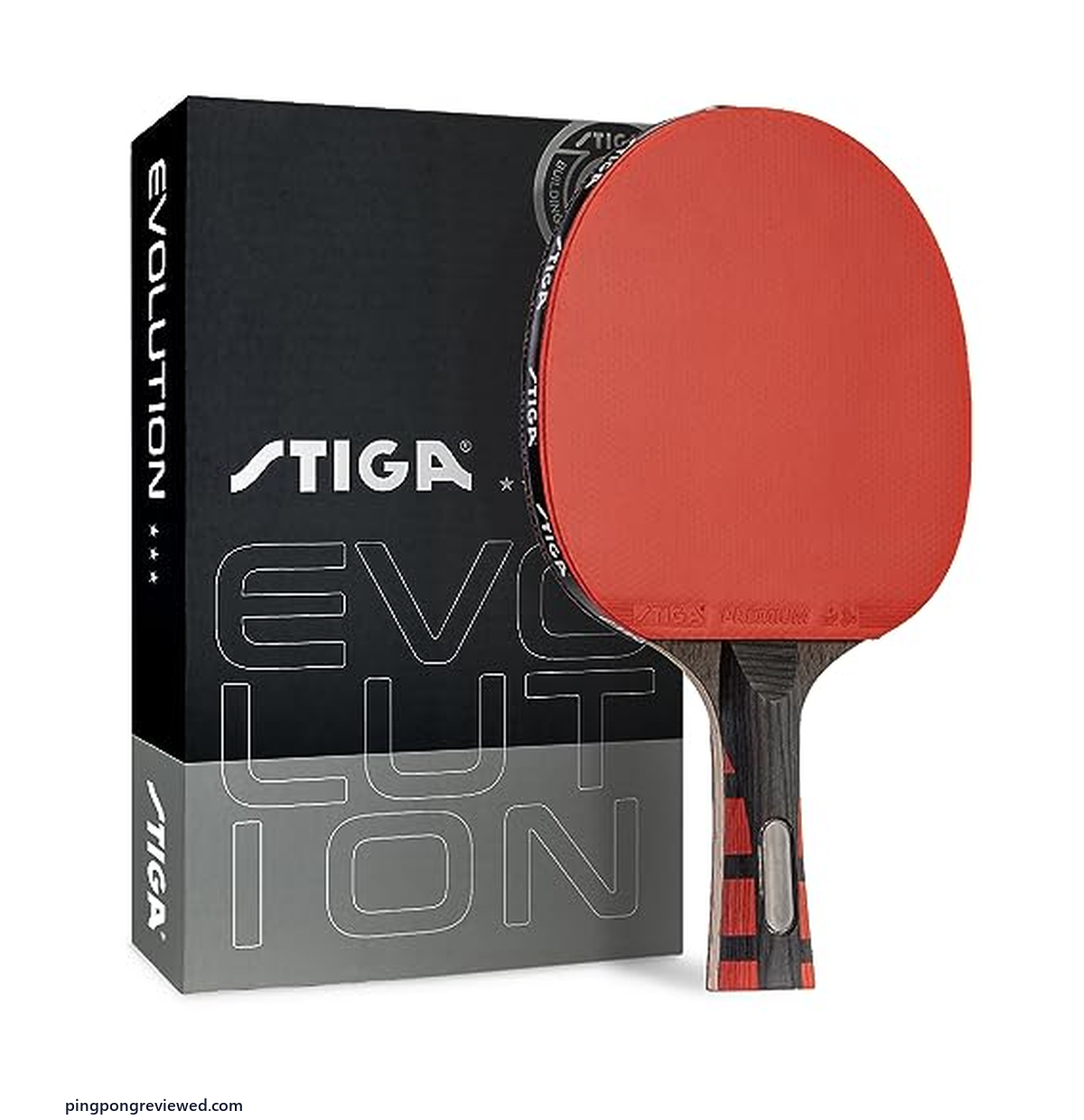
STIGA Evolution Table Tennis Racket, $59.99 on Amazon on October 1, 2026 ($69.99 on STIGA’s US site), is a 6-ply blade with a 2 mm sponge. STIGA rates it Speed 96, Spin 94 and Control 90 with no stated scale, lists it at 159 g and calls it tournament-level. See our STIGA Evolution review.
Who it’s for, per STIGA: a performance racket, which STIGA’s US site says is generally designed for players who have developed their technique.
Intermediate Tier
Once footwork and basic strokes are consistent, an intermediate paddle can start rewarding real technique rather than just forgiving its absence. This is also where playing style starts to genuinely matter in paddle choice, not just skill level.
3. Palio Master 3.0 — Best Intermediate
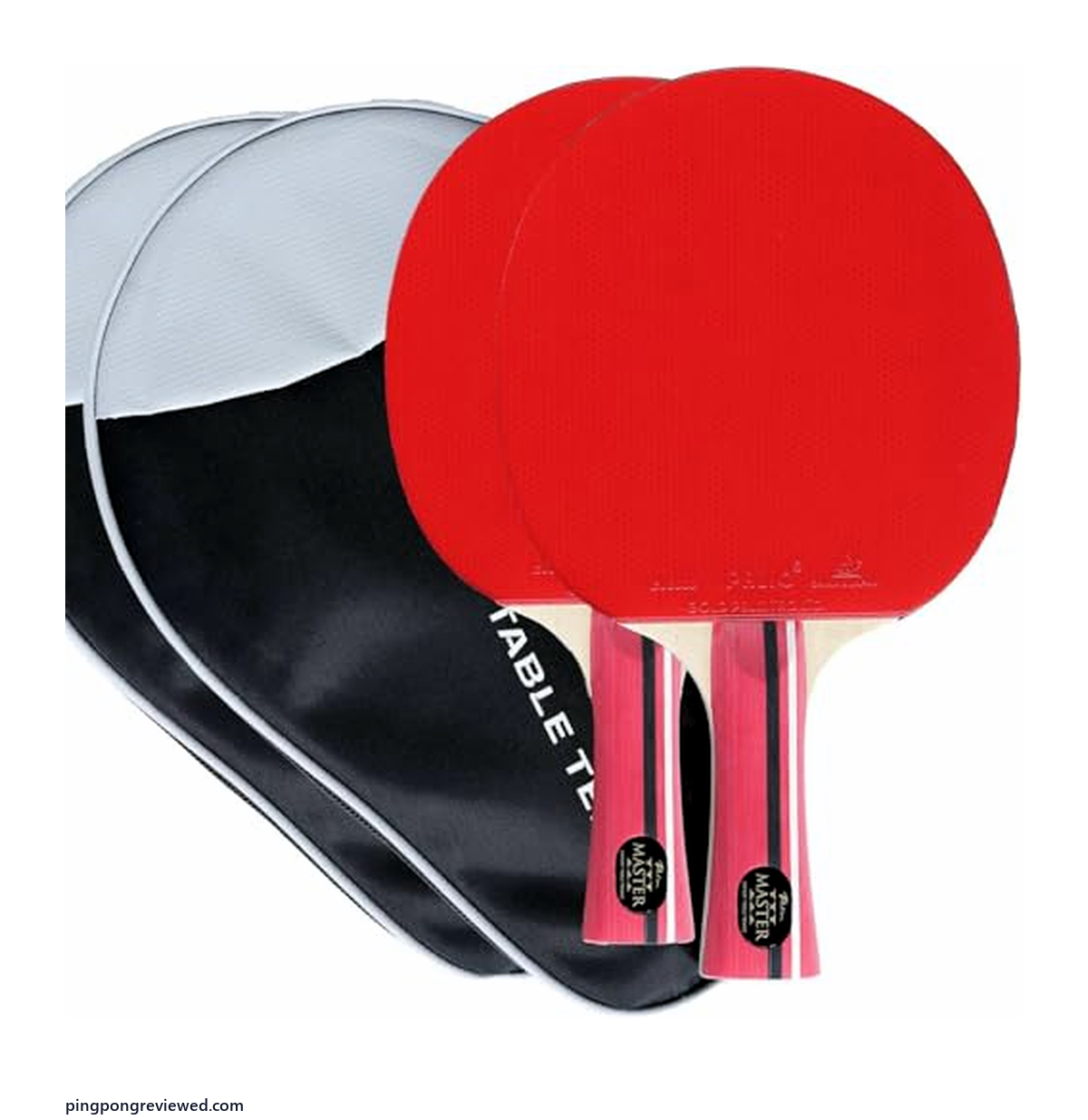
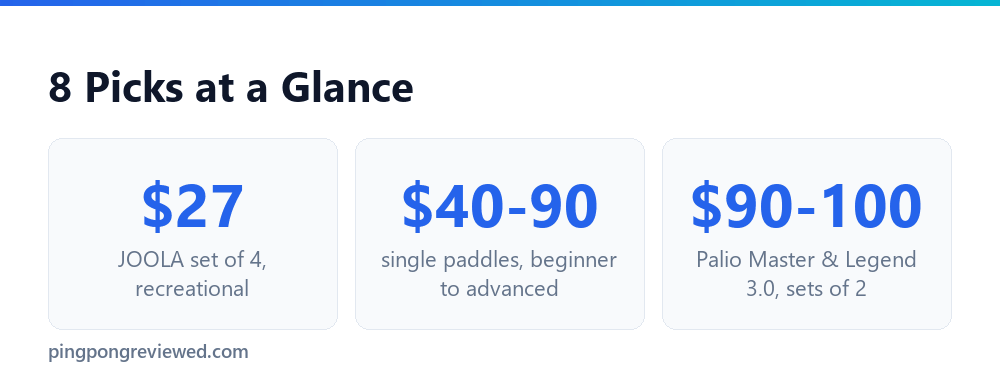
Palio Master 3.0 Table Tennis Bat & Case (Set of 2 Rackets), $89.99 for the pair (about $45 each), is ITTF-approved and built for all-round speed, spin, and control at an intermediate level. It is the natural next step up from the Expert 3.0 once your technique has outgrown a pure beginner paddle. Only need one racket? Palio also sells a single Master 3.0 at $49.99, though stock on that listing was low when we checked on September 29.
Who it’s for: a player with consistent basic strokes who wants a genuine performance upgrade without yet specializing into a single playing style.
4. DHS Hurricane 3 Paddle — Best Chinese-Style Spin
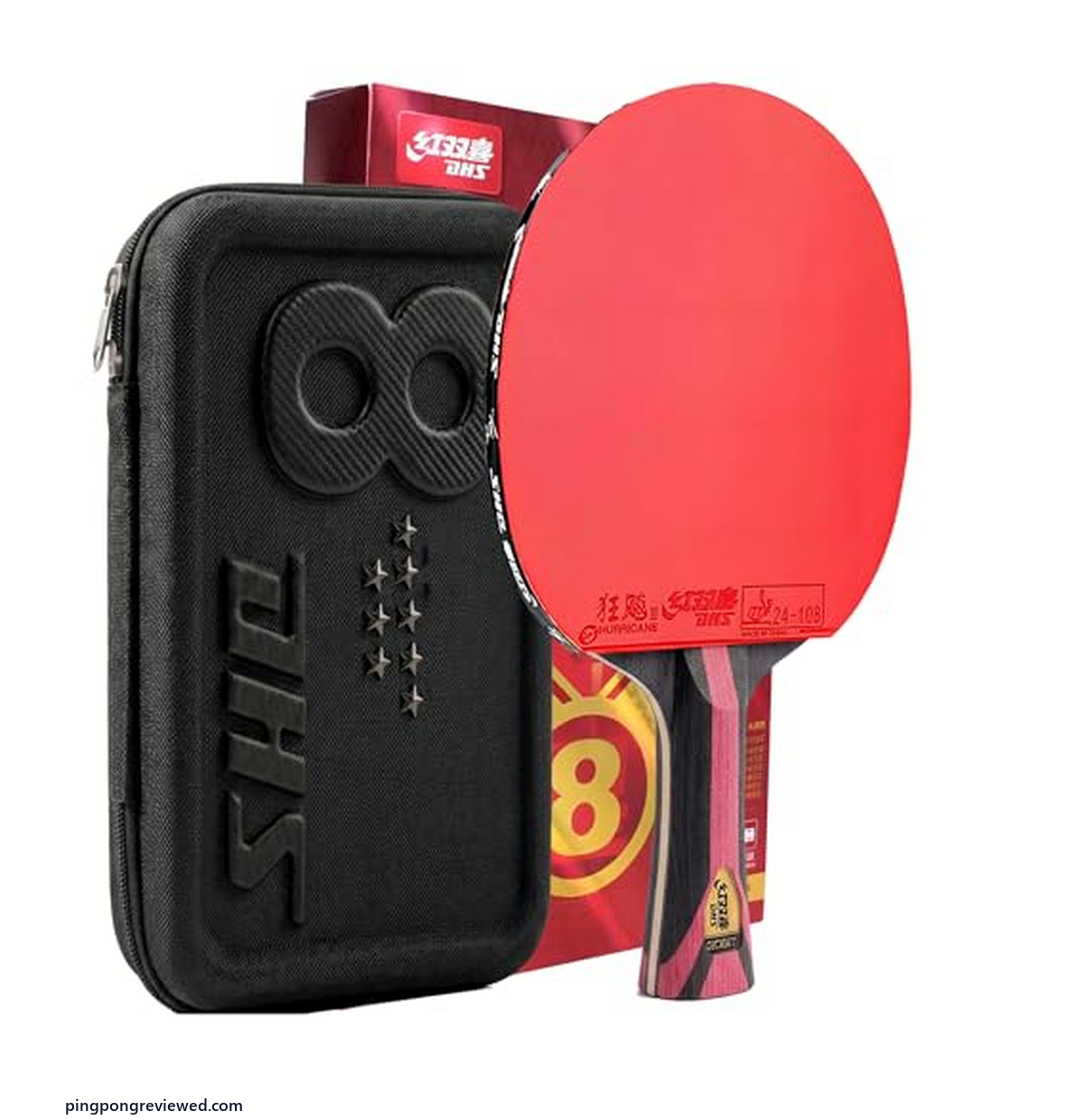
DHS Ping Pong Paddle with Hurricane 3 Rubber, $88.98, pairs a Hurricane 3 rubber (the rubber family covered in our Chinese rubber guide) on a complete, ready-to-play racket. Built for advanced offensive loop play; the listing describes tacky rubbers, so expect a different feel from the other paddles in this tier.
Who it’s for: a player who has specifically started developing a loop-heavy, spin-first game and wants equipment that matches that style rather than a generic all-rounder.
Advanced Tier
Advanced paddles trade forgiveness for ceiling — more speed, more spin potential, more responsiveness to a well-executed shot, and correspondingly less patience for a poorly-timed one. None of these three are a good first paddle, but each rewards a specific, already-developed playing style.
5. STIGA Pro Carbon — Rated 99 for Speed by STIGA
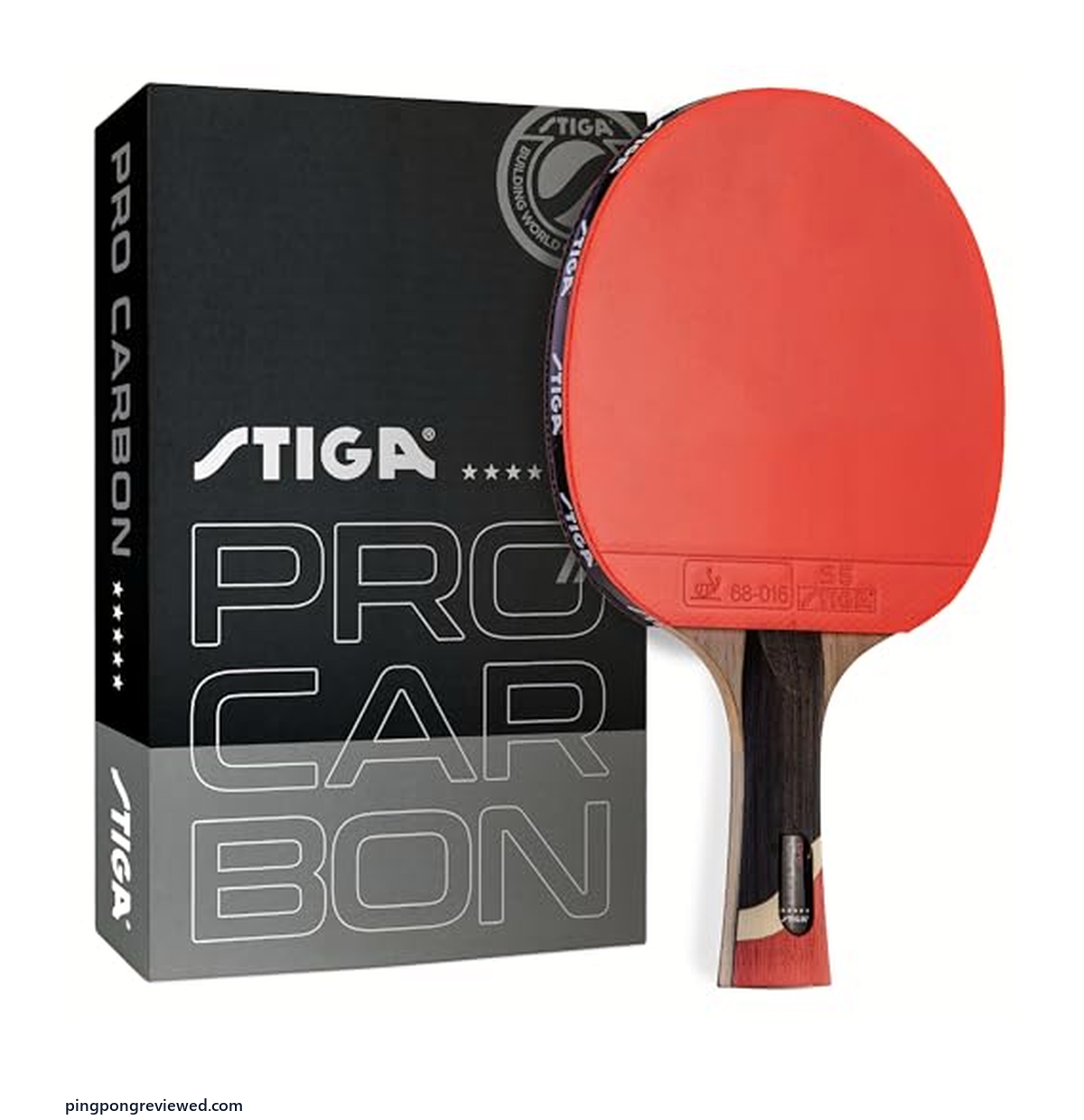
STIGA Pro Carbon Performance-Level Table Tennis Racket, $79.99, adds two layers of carbon fiber to the blade. STIGA rates it Speed 99, Spin 100 and Control 80, and markets it for tournament play. STIGA lists it at 159 g, and STIGA’s US site lists $79.99. See our STIGA Pro Carbon review.
Who it’s for, per STIGA: STIGA’s US site says performance rackets are generally designed for players who have developed their technique.
6. Killerspin JET600 Spin N2 — Spin-Oriented Pick
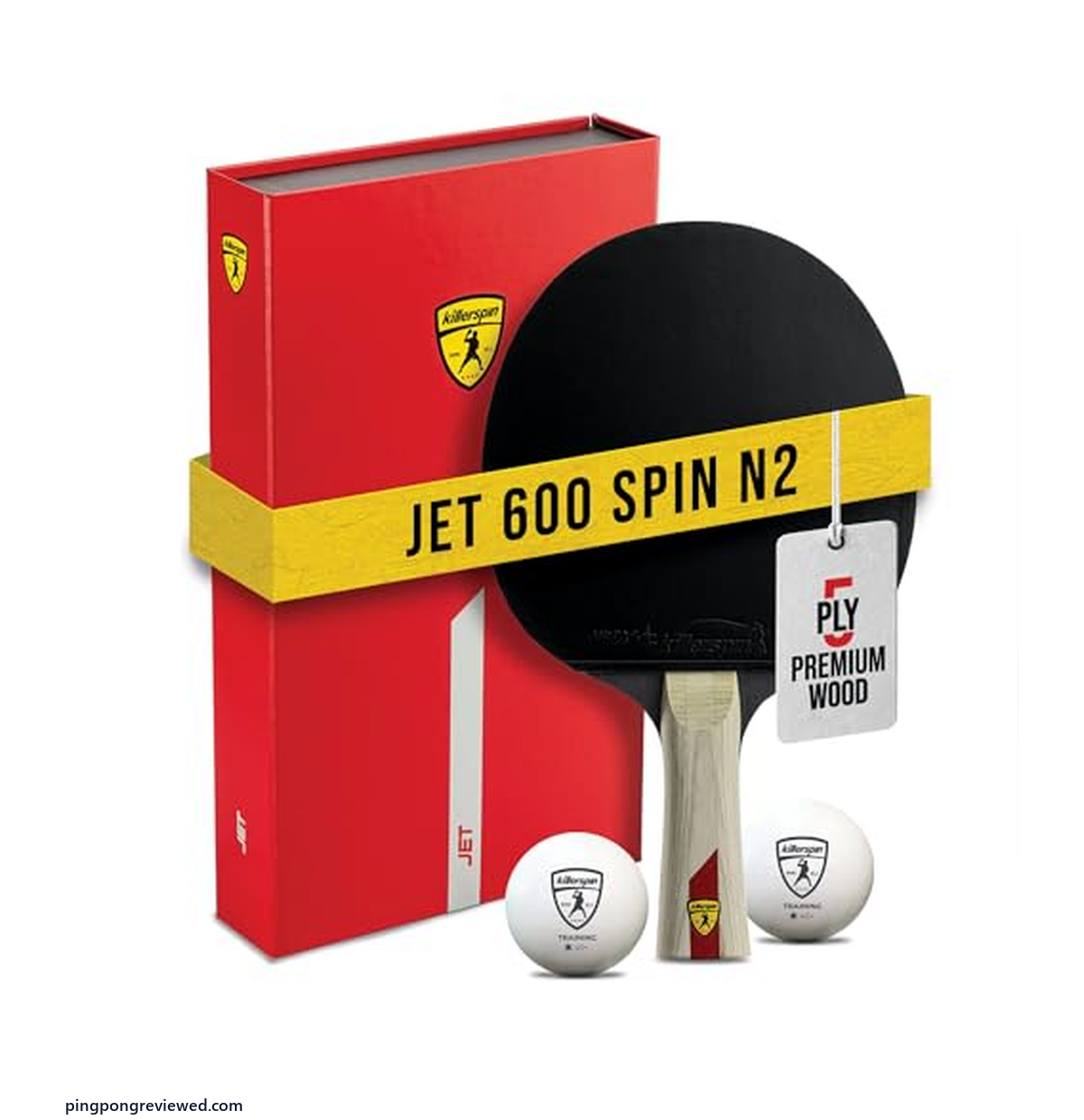
Killerspin Jet 600 Spin N2 Ping Pong Racket, $89.99, uses Nitrx-4Z rubber on a 5-ply wood blade and is listed as an advanced racket.
Who it’s for: a player who wants a spin-oriented racket and is comparing it with the DHS Hurricane 3 pick above.
7. Palio Legend 3.0 — Best Advanced
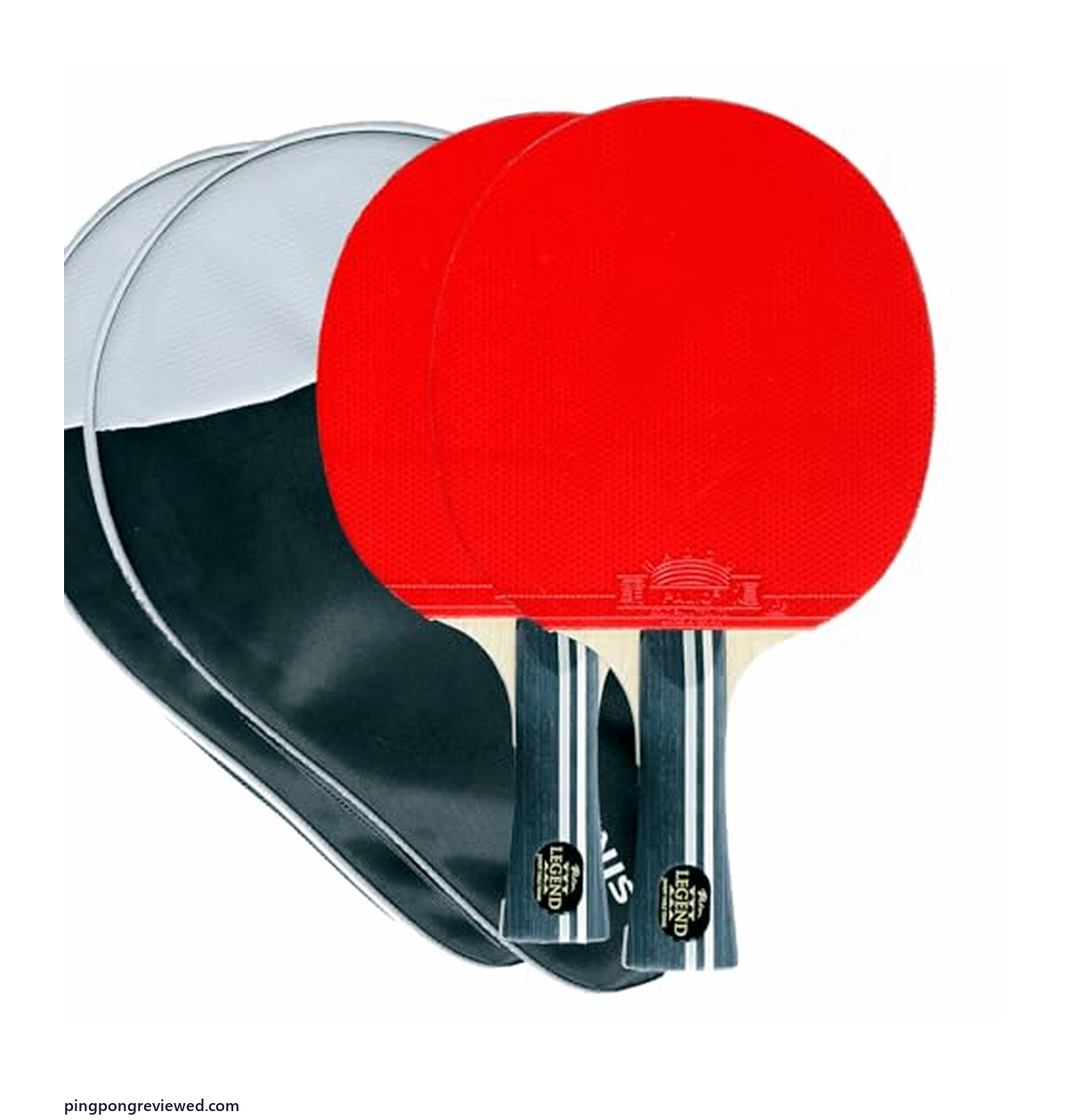
Palio Legend 3.0 Table Tennis Racket & Case (Set of 2 Rackets), $99.99 for the pair (about $50 each), is ITTF-approved and built for maximum power, speed, and spin once your technique can control what the paddle delivers. It is not a first paddle. It is one to grow into. A single Legend 3.0 is also listed at $54.99.
Who it’s for: an advanced player who has already worked through the intermediate tier and wants the fastest of the Palio 3.0 paddles in this guide (its listing rates speed 10/10) rather than another incremental upgrade.
Recreational / Family Set
Not every buyer is shopping for a competitive upgrade path — sometimes the actual need is one purchase that lets a whole household play casually without anyone needing to think about speed ratings or ITTF approval.
8. JOOLA Family Premium Set of 4 — Best Recreational Set
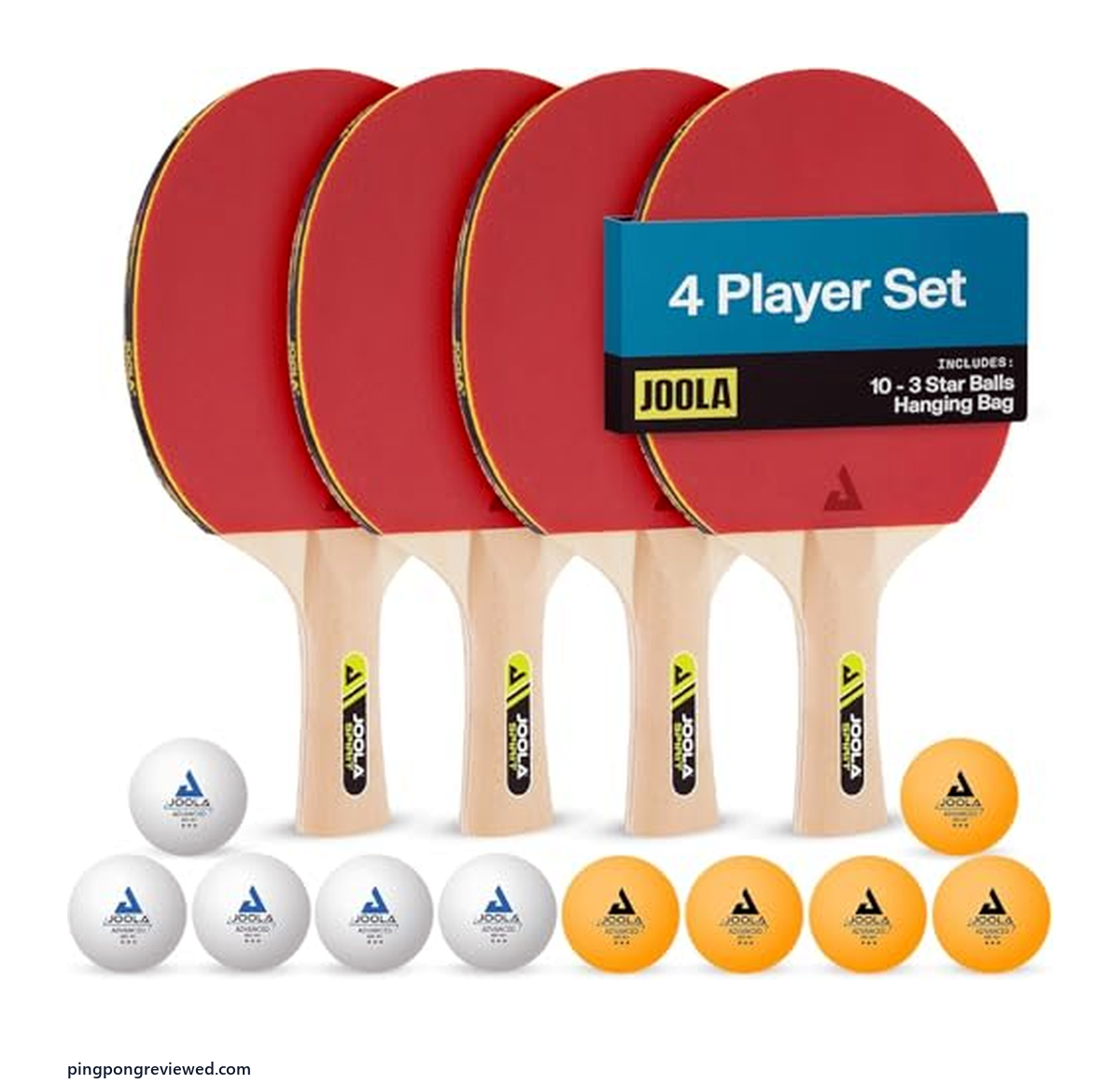
JOOLA Family Premium Ping Pong Paddles Set of 4, $26.99, includes 4 paddles, 10 training balls, and a storage case — a genuine all-in-one purchase for a household that wants to play casually rather than optimize any single player’s technique.
Who it’s for: a family or shared space where multiple people of varying skill and commitment levels will use the same paddles casually, not a dedicated single-player upgrade path.
Matching a Paddle to Your Playing Style
Offensive / Looping Style
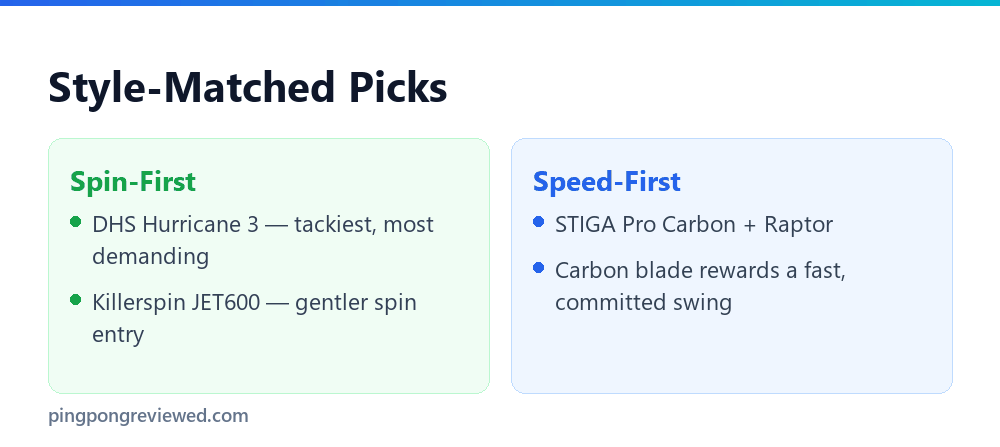
Built around heavy topspin and aggressive attacking shots. The DHS Hurricane 3 and Killerspin JET600 are the two spin-oriented picks in this guide.
All-Round Style
Balances offense and defense depending on the situation, common at intermediate and advanced club level rather than pure beginner or elite play. We haven’t tested the STIGA Evolution or the Palio Master 3.0, so we can’t confirm which style they suit. STIGA lists the Evolution at Speed 96, Spin 94 and Control 90, with no stated scale.
Speed / Attacking Style
Prioritizes pace and flat hitting power over heavy spin generation. STIGA rates the Pro Carbon at Speed 99, Spin 100 and Control 80, with no stated scale, and describes a blade with two carbon layers.
Why Style Matters More at Higher Tiers
A beginner or all-round paddle doesn’t need to match a specific style since technique isn’t developed enough yet to have a clear one. By the advanced tier, though, a mismatched paddle — a speed-focused racket in the hands of a spin-first player, or vice versa — actively works against the player’s actual game rather than just being a mild inconvenience.
Blade Construction and Ply Count, Explained
All-Wood vs. Carbon-Reinforced Blades
An all-wood blade (typically 5 or 7 plies of wood layered and pressed together) is the traditional construction, offering a softer, more controllable feel. STIGA says the two carbon layers in the Pro Carbon improve rigidity and response, which results in increased speed and power.
Why Ply Count Matters
More plies generally means a stiffer, faster blade; fewer plies means more flex and control. Ply count is worth checking alongside the marketing language.
Handle Shape
Flared handles (wider at the base, narrower where you grip) are the most common shape across the paddles in this guide and offer the most stable grip for a shakehand hold. Straight handles, less common here, give more flexibility in exactly where you position your hand — a preference some intermediate and advanced players develop over time rather than something beginners need to worry about upfront.
A Reasonable Upgrade Path
- Just starting out: Palio Expert 3.0 — forgiving, ITTF-approved, cheap enough that outgrowing it in a year doesn’t sting.
- Technique developing: STIGA Evolution or Palio Master 3.0 — STIGA lists the Evolution as a performance racket, so see its review for the maker’s own wording.
- Committed to a style: DHS Hurricane 3 for spin-first loop play, Killerspin JET600 as a second spin-oriented option, or STIGA Pro Carbon (STIGA’s own figures: Speed 99, Spin 100, Control 80).
- Serious, consistent play: Palio Legend 3.0 — only once your stroke is consistent enough to actually control what a top-tier paddle delivers.
There’s no fixed timeline for moving through these tiers — some players progress in months, others take years, and plenty of recreational players are perfectly happy staying on a beginner or all-round paddle indefinitely. Upgrade when your current paddle feels like it’s holding your technique back, not on a schedule.
Keeping a Paddle Playing Like New
Rubber is the part of a paddle that actually determines most of your spin and speed, and it degrades faster than the blade underneath it regardless of how well-built the paddle is:
- Clean after every session. Dust and skin oil build up on the rubber surface and measurably reduce grip within just a few sessions if left unaddressed.
- Use a dedicated rubber cleaner, not household cleaning products, which can degrade the rubber’s surface chemistry over time.
- Store with a protective sheet over the rubber when the paddle isn’t in use, especially in a bag alongside other hard equipment.
- Replace the rubber when it loses grip. Guides suggest anywhere from a few months to a year depending on how often you play, and the blade usually outlasts the rubber.
None of the 8 paddles in this guide need special maintenance beyond this — they’re complete, pre-assembled rackets, so there’s no separate mounting or gluing process to worry about the way there is with a custom blade-and-rubber build.
Common Mistakes When Choosing a Paddle
- Buying for aspirational skill, not current skill. An advanced paddle in beginner hands punishes inconsistency rather than helping fix it — buy for where your technique actually is today.
- Assuming higher price always means better fit. The priciest listing in this guide (the Palio Legend 3.0 set of 2) is a poor choice for a beginner, and the cheapest complete paddle (JOOLA family set) is a poor choice for someone chasing competitive improvement — price and fit are separate questions.
- Ignoring playing style at the advanced tier. A speed-focused paddle in the hands of a spin-first player (or vice versa) actively works against that player’s actual game, not just a minor mismatch.
- Skipping ITTF-approval checks for competitive players. If you plan to play sanctioned club or tournament matches, confirm approval explicitly rather than assuming a “tournament-grade” label guarantees it.
- Neglecting rubber maintenance and replacement. Even the best paddle in this guide loses most of its performance edge within months if the rubber isn’t cleaned and eventually replaced.
How We Verified These Picks
Each of the eight picks above was checked individually against its live Amazon listing — confirming it is actually in stock, that the price cited is current, and that the product description matches what is being sold under that ASIN. ITTF-approval claims on this page come from each manufacturer’s own listing, not from a “tournament-grade” marketing label. To check a specific rubber yourself, the ITTF publishes its equipment database.
This matters because it’s a real, recurring problem across product-roundup content generally: listings get discontinued, ASINs get reassigned to different products, and marketing copy sometimes overstates what a product actually is. Checking every product individually, rather than trusting a previously-published list, is the only way to catch that before recommending something a reader can’t actually buy.
What a Paddle Is Actually Made Of
Every paddle is three components, and knowing which does what makes the differences between models legible rather than mysterious.
The blade is the wooden core, usually five to seven plies, sometimes with a composite layer. It determines the paddle’s underlying speed and how much feedback reaches your hand on contact.
The sponge sits between blade and surface. Its thickness and hardness govern how much energy is stored and returned, which is most of what separates a controlled paddle from a fast one.
The topsheet is the rubber playing surface, carrying the pimples inward on inverted rubber. Its grip is what generates spin, and it is the component that wears out.
On a pre-made paddle these are chosen for you and glued together, which is the whole appeal, one purchase and no assembly. On a custom build you choose each separately. Neither route is categorically better; they suit different stages, which the next section covers.
Blade Construction Inside a Pre-Made Paddle
Pre-made paddles rarely publish blade details, which is unfortunate because the blade sets the ceiling on what the paddle can do. Where the information is available, a few properties are worth reading.
Ply count is the number of laminated wood layers, usually five to seven. Five-ply constructions tend to be more flexible and controlled; seven-ply tends to be stiffer and faster. More plies is not better, it is different.
Composite layers, usually carbon or a carbon blend, add stiffness and enlarge the sweet spot, meaning off-centre contacts behave more like centred ones. They also reduce the feedback that reaches your hand, which is a genuine cost for touch play. Our carbon blade guide covers the trade-off in detail.
For most pre-made buyers the practical implication is simple: an all-wood construction is the more forgiving choice while technique is developing, and composite becomes worth having once mishits under pressure are costing you points rather than inconsistency generally.
Pre-Made or Custom: The Real Trade-Off
This is the central decision on this page, and it is decided by where you are rather than by which is better in the abstract.
Pre-made paddles arrive ready to play, cost less than an equivalent-quality custom build, and require no gluing or component knowledge. Their limitation is that when the rubber wears out, which it will, you either replace the whole paddle or learn to re-rubber it anyway.
Custom builds let you match blade and rubber to your own game and replace rubber independently as it wears, which is more economical over time since the blade lasts for years. The cost is a higher up-front total, the need to glue, and a genuine requirement to know what you want.
- Buy pre-made if you are learning, play occasionally, are buying for someone else, or cannot yet name what you would change about your current paddle.
- Build custom if you play regularly, can describe a specific limitation, and expect to replace rubber more than once.
- The middle path that most players actually take is a good pre-made paddle first, then a custom build once the game has taken shape and the limitations are nameable.
One thing worth stating plainly: a quality pre-made paddle is not a toy. The gap between a cheap bundled bat and a decent pre-made one is far larger than the gap between a decent pre-made one and an entry-level custom build.
Speed, Spin and Control Ratings, and What They Are Worth
Pre-made paddles are almost universally sold with three numbers for speed, spin and control, and those numbers are worth considerably less than their prominence suggests.
They are manufacturer-assigned and not standardised, which means a spin rating of 9 from one brand and a 9 from another are not measurements of the same property on the same scale. Comparing across brands using them is close to meaningless.
Within a single brand’s range they are more useful, because the same internal method produced all of them. If a manufacturer rates one of its own paddles faster than another, that ordering genuinely tells you something.
Note also that the three figures trade off against each other by construction. Control is largely the inverse of speed, so a paddle rated highly for both is describing a compromise rather than an achievement. The more informative question is which of the three the paddle prioritises, and whether that matches what you need.
Rubber Surfaces and Why Almost Every Paddle Uses Inverted
Nearly every paddle sold uses inverted rubber on both sides, and since that is what you will be buying, it is worth knowing what the alternatives are and why they are not the default.
- Inverted (pimples-in): a smooth playing surface with the pimples facing inward against the sponge. Maximum spin generation, and the right choice for the overwhelming majority of players.
- Short pips: stubby pimples facing outward. Generates less spin but is less affected by incoming spin, which suits close-to-table blockers who want predictable returns.
- Long pips: long thin pimples that buckle on contact and reverse incoming spin rather than gripping it. A specialist defensive surface with its own technique.
- Anti-spin: smooth but deliberately low-friction, neutralising spin without reversing it. Genuinely niche.
The reason inverted dominates is that modern table tennis is built on spin, and inverted rubber generates the most of it. The alternatives exist to disrupt opponents who rely on reading spin, which is a specialised tactic rather than a general approach.
If you are buying your first serious paddle, buy inverted on both sides without hesitation. Pips and anti-spin are worth exploring only after your game has taken a shape that specifically calls for them, and our defensive rubber guide covers that case.
Sponge Thickness and What It Changes
Sponge thickness is one of the few specifications that is directly comparable across brands, since it is a physical measurement rather than a rating, which makes it unusually useful.
- Thin, roughly 1.5mm and below: minimum energy return, maximum control. Suits players prioritising placement and touch, and defensive styles.
- Medium, around 1.8 to 2.0mm: the sensible default for developing and club players, and the right answer when you are unsure.
- Maximum, around 2.1mm and above: most speed and spin potential, least forgiving of imperfect contact.
The instinct is to assume thicker is better because it sounds like more of everything. In practice the extra speed is easy to acquire later and the control you gave up is what a developing player actually needs, so medium is usually the better buy well past the beginner stage.
Note that combined rubber and sponge thickness is capped under the rules, so a listing advertising maximum thickness means at or near that legal ceiling rather than an open-ended figure. This is why thickness options cluster in such a narrow band across every brand you compare.
Weight and Balance
Paddle weight is quoted inconsistently and matters more than its prominence in listings suggests, particularly across a long session.
A heavier paddle carries more momentum into the ball and feels more stable against pace, which suits bigger strokes played away from the table. A lighter one is quicker to move into position and less tiring, which suits fast close-to-table exchanges and blocking.
Balance matters alongside total weight. A head-heavy paddle feels powerful through a full stroke and slower to reposition; a handle-heavy one feels quicker and less solid on contact. Neither is correct in the abstract, and it is one of the properties least visible online and most obvious the moment you hold one.
For most buyers the practical guidance is to avoid the extremes. Very heavy paddles tire the forearm and encourage the tight grip that reduces spin and touch; very light ones can feel unstable against a hard-hit ball. Something in the middle is forgiving of not yet knowing your preference.
ITTF Approval and the Two-Colour Rule
Two regulatory points matter if there is any chance you will play in organised competition, and they are easy to satisfy at the point of purchase and awkward to fix afterwards.
ITTF approval means the rubber has been tested against specifications and appears on the approved list, and sanctioned competition requires it. Approved rubber carries the ITTF logo on the sheet. Plenty of moderately priced paddles use approved rubber; plenty of unbranded ones do not.
The two-colour rule requires the two sides of the paddle to be clearly different colours so opponents can see which surface struck the ball. For many years this meant one red and one black side, and the rules have since been broadened to allow black on one side with a choice of several distinct colours on the other. Two sides the same colour is not legal.
Neither is enforced in recreational play, and neither costs anything to comply with when buying anyway. If there is even a possibility of entering a club event, buying compliant equipment from the outset avoids discovering the problem at a tournament desk.
Matching a Paddle to Your Stage
Paddle selection changes meaningfully as a player develops, and buying ahead of your stage is the single most common way this purchase goes wrong.
Complete beginner. Prioritise control over everything. A slower paddle keeps the ball on the table, which is what allows rallies to develop, and rallies are how technique is built. Speed at this stage produces errors, not winners.
Improving player rallying consistently. Now spin generation matters, and a paddle with a grippier surface earns its place. Still avoid the fastest options, since consistency is usually the binding constraint rather than pace.
Club-level player. Match the paddle to your style, attacking, all-round or defensive, rather than to a general quality tier. This is also the point at which a custom build starts making sense, because you can name what you want.
Advanced player. Almost always a custom build, with blade and each rubber chosen separately and frequently differing between forehand and backhand.
The recurring error is a player at the second stage buying equipment suited to the fourth. Fast, high-throw setups demand stroke mechanics that are still being built, and they punish the inconsistency that is exactly what the player is trying to eliminate.
Choosing by How You Actually Play
Once past the beginner stage, style is a more useful filter than skill level, because two players of identical standard playing different games want genuinely different equipment.
- Close-to-table attacker. You take the ball early and play fast, flat exchanges. A quicker-activating surface and lower throw suits this, since very high-throw rubber sends early-contact balls long.
- Looper away from the table. You step back and play heavy topspin. Higher throw and a firmer sponge reward the full stroke and give net margin on the arc.
- All-round control player. You place the ball and wait for errors. A controlled mid-tier setup does more for you than anything faster, and this covers a large share of club players.
- Blocker. You absorb pace and redirect it. Lower throw and moderate speed keep blocks low; a high-catapult setup makes blocking harder rather than easier.
- Defender or chopper. A separate category with its own equipment logic entirely, covered in our defensive rubber guide.
If you cannot place yourself in one of these, that is genuinely informative rather than a failure. It usually means your game is still forming, and the right answer is a controlled all-round setup that lets you develop in any direction rather than one that commits you early to a style you have not chosen yet.
What Each Price Tier Buys
Paddle pricing spans a very wide range, and the returns are distinctly non-linear, which is worth understanding before assuming that spending more is straightforwardly better.
The bundled-set tier, meaning the bats that come free with a table or in a cheap multi-bat pack, uses rubber with very little grip. These make learning spin genuinely harder, and they are the one tier worth actively avoiding rather than merely outgrowing.
The entry tier of genuine paddles uses real rubber over a functional blade, and this is where most beginners should start. The jump in playability from a bundled bat is the largest single improvement available in the whole category, and it costs very little.
The mid tier adds better rubber grip, a more considered blade, and usually ITTF-approved surfaces. This is where most club players sit, and where the value is best for anyone playing weekly.
The premium pre-made tier approaches custom-build quality in a finished package. It is a legitimate choice for players who want the performance without the assembly, though at this price a custom build usually gives more for the money.
The pattern matches other equipment categories: the first step up delivers most of the available improvement, and each subsequent step delivers refinement that matters increasingly only to players who can access it.
Multi-Paddle Sets and When They Make Sense
Sets containing two or four paddles plus balls, sometimes with a net, are a large share of what is sold, and they suit a specific situation rather than being a general-purpose purchase.
They make sense when you need several usable bats at once and nobody involved is developing seriously: a family table, a workplace break room, a holiday home, or somewhere bats get lost and borrowed. In that context, four adequate paddles for the price of one good one is genuinely the right trade.
They do not make sense as a way of buying yourself a paddle. The individual bats in a set are priced by quantity, which means each one sits at or below the entry tier, and the rubber grip is almost always the component sacrificed to hit the price. If one of the players involved is trying to improve, buying them a single decent paddle alongside the set is a considerably better use of exactly the same money than spreading it across four bats nobody is happy with.
A reasonable middle path for a household is a set for guests plus one better paddle kept aside for whoever plays most. That avoids both the problem of having only one usable bat and the problem of everyone playing on equipment that makes spin impossible.
If you do buy a set, check what the balls are. Sets frequently include a small number of low-grade balls, and since balls are inexpensive and get lost quickly, buying a proper tube of training balls separately is worth doing at the same time. It is a very small addition to the order that prevents the common and faintly absurd situation of a brand new table sitting unused because the three balls that came with it have all disappeared under the sofa within the first fortnight of owning it.
A Sensible Upgrade Path
Players frequently ask what to buy next without a clear sense of the sequence, and following one avoids most of the expensive detours.
- Start with a genuine entry-tier paddle, not a bundled set bat. This single step is the largest improvement available in the category.
- Stay there until you can name a limitation. Not “I want to improve” but something specific, such as openings against backspin dropping into the net.
- Move to a mid-tier pre-made or a first custom build once the limitation is nameable and your strokes are reasonably consistent.
- Change one component at a time thereafter, usually the forehand rubber first, since that stroke generates the racket speed harder rubber requires.
- Consider the blade last, because it is the most expensive and least reversible change, and rubber differences are frequently mistaken for blade differences.
The reason to follow a sequence rather than buying the best-reviewed option available is that equipment choices interact. Changing several things at once leaves you unable to attribute any result, which means you learn nothing about what suits you and are no better placed for the next decision.
It is also worth saying plainly that most players below advanced level are not held back by their paddle. If you are choosing between a more expensive paddle and coaching or more table time, the second wins comfortably and it is not close.
Warranties and Returns
Warranty and return terms vary by seller, so read them before you buy.
Rubber wear is typically not covered by warranties, while manufacturing defects often are, but check the seller’s terms.
Returns policies matter more than warranties here, because the main risk is a paddle that turns out not to suit you rather than one that fails. Check whether a retailer accepts returns on a paddle that has been used, since many do not once it has touched a ball, and that is precisely the moment at which you actually learn whether it suits you or not. Reading the policy before ordering is a two-minute job that occasionally saves the whole cost of the paddle.
This asymmetry is a further argument for handling a paddle in person where possible, and for buying conservatively when you cannot. A slightly slower paddle than you might have chosen is a recoverable error; a much faster one you cannot return is not.
If you are ordering online and are genuinely unsure between two options, ordering the more controlled of the two is the better gamble. A paddle that turns out slower than ideal still lets you play every shot, just with less free pace, whereas one that is too fast makes basic consistency difficult and tends to sit unused while you go back to whatever you had before.
Handle Shape and Grip Style
Handle shape gets far less attention than surface specifications and has a more immediate effect on whether a paddle feels usable.
- Flared: widens at the base, the most common shakehand shape, and the most secure since the flare prevents the hand sliding.
- Straight: uniform width, favoured by players who rotate the paddle in hand.
- Anatomic: contoured to the palm, comfortable for some hands and awkward for others.
- Penhold: a short handle for the penhold grip, which is a different way of holding the paddle entirely rather than a handle preference.
If you have not compared shapes, doing so at a club is worth more than any description. Handle preference is individual, invisible in photographs, and unlike rubber it cannot be changed later without replacing the paddle.
Grip pressure matters as much as shape and is covered in our grip guide. In short, holding too tightly locks the wrist and reduces both spin and touch, and it is one of the most common faults in recreational play.
Where to Buy, and Spotting Fakes
Where you buy matters more than it does for most sporting goods, because marketplace listings are sometimes mislabeled.
Specialist table tennis retailers are the safest route and frequently the most useful, since staff can answer questions that listings cannot and stock is genuine. General marketplaces are cheaper and more variable, and the risk rises sharply with unfamiliar sellers.
The warning signs are consistent. A price substantially below the general market for a premium brand is a warning rather than a bargain. Generic stock photography rather than images of the actual item is a warning. Packaging or logo details that differ subtly from official product images are a warning, and counterfeits can differ in exactly those small details.
A counterfeit paddle is worse than a cheap one, because it plays nothing like the model whose reviews persuaded you to buy it, which makes every piece of research you did useless. At the entry and mid tiers the problem is far less common, since there is little margin in faking inexpensive equipment.
How to Judge a New Paddle Fairly
First impressions of a new paddle are systematically misleading, and knowing that prevents a good purchase being abandoned early.
A new paddle feels different from what you are used to, and different reads as better or worse depending mostly on expectation. Faster equipment in particular feels exciting in the first session and problematic across a match, because casual hitting rewards pace while competitive play rewards control.
Give any new paddle several sessions and test specific shots rather than general feel. Serve and see whether the spin you intended arrives. Push and see whether the ball stays low. Open against backspin and see whether it clears. Block a fast ball and see whether it stays on the table. Those are answerable questions in a way that “does it feel good” is not.
Expect your serve and short game to be the last things to return, since those depend most on fine calibration to the surface. A player judging a paddle on their serve in week one is judging unfamiliarity rather than the equipment.
Six Ways This Purchase Goes Wrong
- Buying by speed rating. The fastest paddle in a range is not the best one, and for most buyers it is actively the wrong one.
- Copying a professional’s setup. Professional equipment is chosen for strokes most players cannot reproduce, and in slower hands a very fast setup produces less rather than more.
- Buying a multi-bat set for the bats. Sets are priced for the quantity, and the individual bats are almost always the lowest tier available.
- Treating the paddle as the reason for losing. Below advanced level, technique is nearly always the binding constraint, and new equipment produces a brief feeling of change rather than a change in results.
- Ignoring handle shape. The specification that most affects whether a paddle feels right, and the one that cannot be adjusted afterwards.
- Buying two identical colours when replacing rubber, which makes the paddle illegal for organised play.
The common thread is buying a specification rather than a match. The best paddle for you is the one suited to your stroke speed, your style and your stage, and that is frequently neither the most expensive nor the most highly rated option available.
Paddles for Children
Buying for a child has slightly different priorities, and the common instinct to buy the cheapest available is worth resisting for a specific reason.
A bundled-set bat with almost no rubber grip makes spin nearly impossible to produce or feel, which means a child learning on one cannot develop the fundamental skill the sport is built on. They will conclude the game is about hitting hard, because that is the only thing the equipment permits.
A modest entry-tier paddle with real rubber costs very little more and changes what is learnable. This is one of the clearest cases in the sport where equipment genuinely limits development rather than merely constraining performance.
Beyond that, prioritise a lighter paddle and a handle that suits a smaller hand. Some manufacturers make junior-sized paddles with shorter handles, which are worth seeking out for younger children, since an adult handle in a small hand encourages a compensating grip that has to be unlearned later.
Buying for Someone Else
A large share of paddle purchases are gifts, and the buyer frequently knows less about the recipient’s game than the recipient does, which changes what the safe choice is.
Default to control over speed. A controlled paddle is pleasant for a beginner and perfectly usable for an experienced player, whereas a very fast one is unusable for the former and merely acceptable for the latter. The asymmetry makes the controlled option the lower-risk gift by a clear margin.
Default to a flared handle unless you know otherwise, since it is the most common shape and the most universally comfortable. Avoid penhold handles unless you know the recipient plays penhold, because a penhold paddle is close to unusable with a shakehand grip.
A decent entry or mid-tier paddle with a case and a tube of training balls is a better gift than a single more expensive paddle, since the accessories are things recipients rarely buy themselves and always end up needing.
What to Buy Alongside It
A paddle on its own is an incomplete purchase, and the additions are inexpensive relative to it while addressing things that otherwise degrade the experience.
- A case. Protects the rubber from dust, light and knocks, and is the single highest-return accessory for extending a paddle’s usable life.
- Training balls in quantity. Cheap, and the most under-bought item in the sport. Running out mid-practice is what stops sessions.
- A cleaning sponge or dedicated cleaner, since wiping after sessions genuinely extends rubber life.
- Protective film if you play infrequently, since oxidation rather than wear is what ends rubber life for occasional players.
- Court shoes, once you are playing regularly. Not a paddle accessory as such, but the equipment purchase that most changes how you move to the ball.
If the budget is constrained, the case and the balls are the two that change the most for the least money, and both are worth buying at the same time as the paddle rather than later.
Making a Paddle Last
The rubber on a paddle is a consumable and the blade underneath is not, which means most of what shortens a paddle’s life is avoidable surface damage rather than genuine wear.
- Wipe the surface after each session with a clean damp sponge. Dust embeds in the rubber and abrades it during play, and this takes seconds.
- Use a case. It blocks the light that drives oxidation, keeps dust off, and prevents the knocks that chip blade edges.
- Keep it away from heat and sun. A paddle left in a car or near a radiator ages dramatically faster, and that damage is not recoverable.
- Consider protective film if you play infrequently, since for occasional players oxidation rather than wear is what ends a rubber’s life.
- Never use household cleaners or solvents, which are not formulated for rubber compounds and cause permanent damage.
Know what end of life looks like so you replace at the right point. A surface that no longer grips under a dragged thumb, a visible shine where the matte finish has polished away, and serves producing less spin at the same stroke speed all indicate the rubber is finished. Playing on dead rubber is one of the most common invisible handicaps in recreational play.
How Long a Paddle Lasts
The blade and the rubber have completely different lifespans, and conflating them is why players either replace paddles too often or keep playing on dead surfaces for far too long.
The rubber is a consumable. For a player training regularly, a few months is typical; for a casual player, the rubber frequently ages out through oxidation before it wears out through use. Either way, replacement should be triggered by the grip tests described above rather than by a date on a calendar.
The blade underneath is not a consumable and can last many years through several rubber changes. Blades fail from specific damage, edge chips, delamination, or veneer tearing during rubber removal, rather than from gradual wear, which means most blade replacements are avoidable with a case and careful handling.
This asymmetry is the strongest practical argument for treating a decent paddle as re-rubberable rather than disposable once it reaches a certain quality. Below that point, replacing the whole paddle is genuinely more sensible, since two sheets of rubber can exceed what the paddle originally cost.
When the Rubber Wears Out
This is the moment that decides whether a pre-made paddle was a one-off purchase or the start of a longer relationship with your equipment, and it arrives sooner than most buyers expect.
On an inexpensive pre-made paddle, replacing the whole thing is frequently the sensible answer, since two sheets of decent rubber can cost more than the paddle did. On a better pre-made paddle with a blade worth keeping, re-rubbering is both cheaper and an upgrade, because you can choose better rubber than it shipped with.
Re-rubbering is straightforward and covered in our glue and rubber replacement guides. The main caution is removing the old rubber carefully, peeling slowly at a shallow angle, since tearing the blade’s surface veneer is the one mistake that genuinely ruins a paddle.
Many players discover at this point that they have effectively become custom builders, since choosing replacement rubber is the same decision as choosing rubber for a bare blade. That is a natural progression rather than a complication, and it is the usual route by which players move from pre-made to custom without ever consciously deciding to.
Questions Buyers Ask
Does an expensive paddle make you better? No. It removes a ceiling if you have reached one. Below advanced level most players have not, and technique is the binding constraint.
How often should the rubber be replaced? Every few months for a regular player, considerably less for a casual one. Replace by the grip test rather than by a date.
Can I use one side for forehand and one for backhand? Yes, and most players past the beginner stage eventually use different rubber on each side for exactly that reason.
Are the ratings on the packaging useful? Only within one brand’s range. Across brands they are not comparable.
Do I need an ITTF-approved paddle? Only for sanctioned competition. It costs nothing extra to have one, so buying compliant is sensible if there is any chance you will compete.
The Short Version
Buy for control rather than speed unless you can specifically name why you need more pace. Medium sponge thickness, inverted rubber on both sides, and a flared handle is the right answer for a large majority of buyers, and it stays the right answer for longer than most people expect.
Ignore cross-brand speed and spin ratings, since they are not measured on a common scale. Pay attention instead to sponge thickness, which is comparable, and to whether the rubber is ITTF-approved if competition is even a possibility.
Start pre-made, move to a custom build when you can describe what you would change, and in the meantime spend the difference on balls, a case and table time, all of which do more for most players’ results than a paddle upgrade would.
Frequently Asked Questions
What is the best ping pong paddle overall?
It depends on skill level more than any single ‘best’ answer — the Palio Master 3.0 offers the strongest balance of price and genuine all-round performance for most intermediate players, while beginners are better served by the more forgiving Palio Expert 3.0.
Do ping pong paddles actually make a difference?
Yes, meaningfully, once your technique is consistent enough to notice it. A beginner with inconsistent contact won’t feel much difference between paddles; an intermediate or advanced player will notice speed, spin, and control differences immediately.
What is the best ping pong rubber?
That depends on playing style rather than a single answer — see our dedicated rubber guides (competition, practice, and Chinese-brand specific) for verified picks broken down by use case.
Why are ping pong paddles two different colors?
ITTF rules require one black side and one clearly different side, red or since October 2021 pink, purple, green or blue, so opponents can visually distinguish which side of the paddle just struck the ball, since different rubber types on each side can produce noticeably different spin.
Should a beginner buy an expensive paddle?
No — a beginner paddle’s job is being forgiving and affordable while basic technique develops. An expensive, speed- or spin-focused paddle actually punishes inconsistent beginner contact more than it helps.
What’s the difference between the Palio Expert, Master, and Legend?
They form a genuine skill-tier ladder within one brand — Expert 3.0 for beginners, Master 3.0 for intermediate players, and Legend 3.0 for advanced players who want maximum power and spin. All three are ITTF-approved, so the differences come down to speed/spin/control tuning rather than legality for competitive play.
Is a carbon fiber blade worth the extra cost?
Only once your technique can actually use the extra speed and stiffness it provides. STIGA classes the Pro Carbon as a performance racket, which its US site says is generally designed for players who have developed their technique.
How is the DHS Hurricane 3 paddle different from the other picks?
It uses a DHS Hurricane 3 rubber, and its listing describes tacky rubbers. Tacky Chinese-style sheets are usually described as needing a fuller stroke, so it suits players already comfortable with spin-heavy offensive play.
Can I use the same paddle for both singles and doubles?
Yes — none of the paddle specs in this guide change between singles and doubles play. The rules that differ between the two formats (serving diagonally, alternating shots) don’t require different equipment.
Do these paddles come pre-glued and ready to play?
Yes — every paddle in this guide is a complete, pre-assembled racket with the rubber already mounted to the blade. Nothing further needs to be assembled before your first session.
As an Amazon Associate, we earn from qualifying purchases through links on this page.

Ping Pong Reviewed is an equipment review site covering table tennis and baseball gear. Specifications are checked against manufacturer listings, and prices against live retail pages, before publication.