15 Table Tennis Games for Students: PE & Club Activities
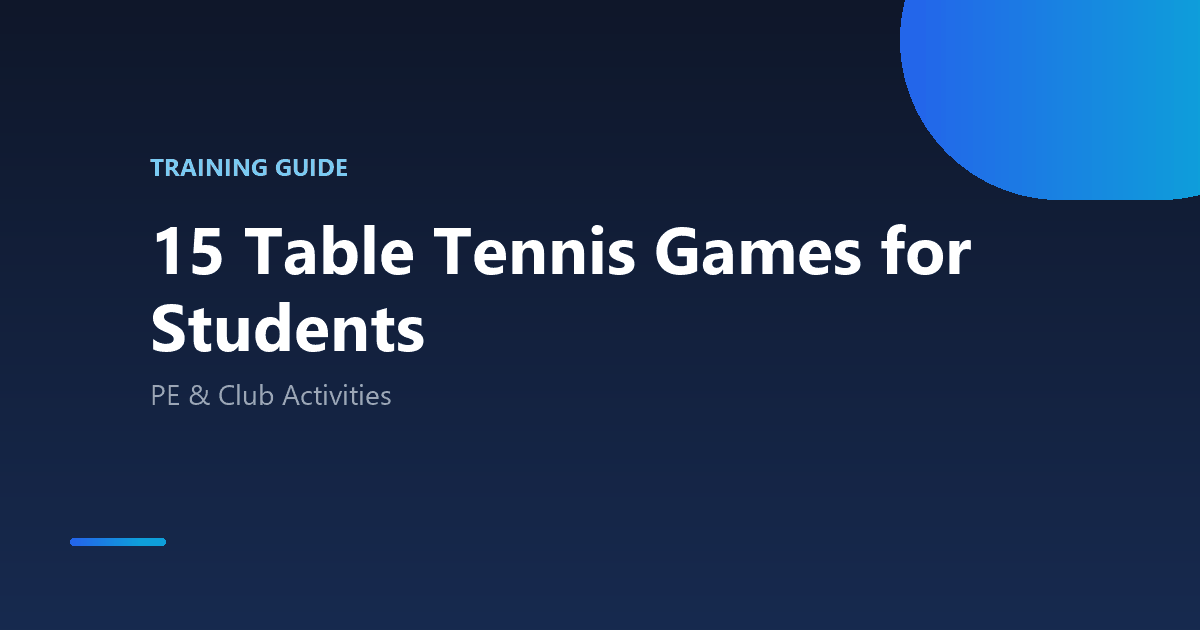
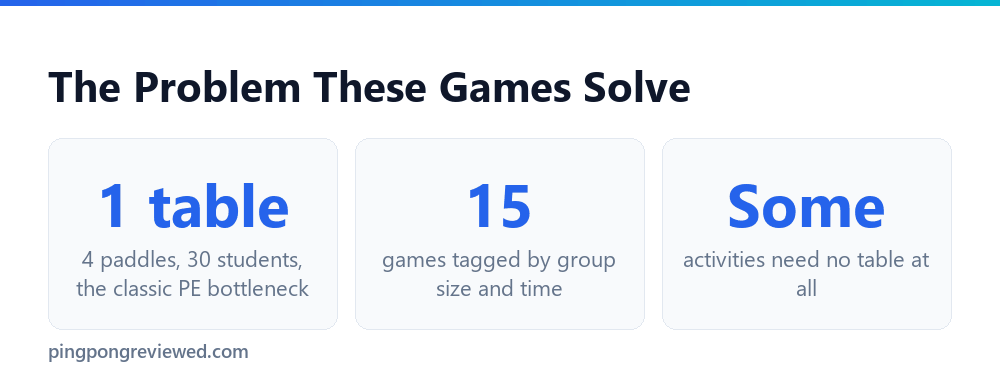
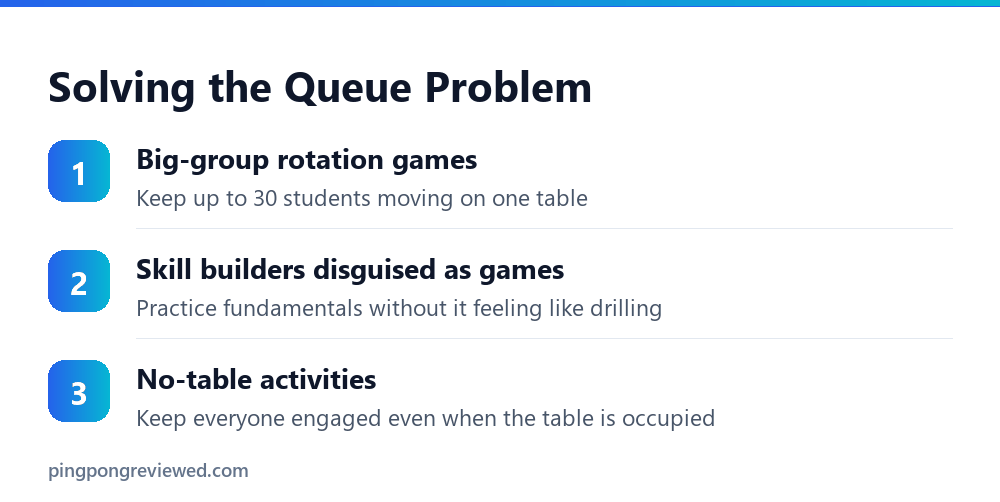
The problem with table tennis in schools is arithmetic: one table, four paddles, thirty students. These fifteen games solve it — rotation games that keep everyone moving, skill-builders disguised as fun, and activities that need no table at all. Each is tagged by group size and time so you can pick one in ten seconds.
Table tennis is a brilliant school sport — cheap, indoor, weather-proof, and genuinely accessible to children who don’t enjoy contact sports. It also has a queueing problem that can leave twenty-six kids standing still while four play, which is how a good activity becomes a bad lesson.
- →Rotation games solve the queue — up to 30 students on one table
- →Several activities need no table at all
- →Skill drills work better when they’re disguised as games
- →Buy bulk balls — children destroy them, and that’s fine
- →Ability-mixing formats keep everyone competitive
Table of Contents
The quick-pick table
Big-group rotation games (the crowd solvers)
The measure of a school table tennis lesson isn’t how well the best player plays. It’s how few children are standing still.
Skill builders disguised as games
📊 Note: The skill-builders work because children don’t experience them as drills. Nobody enjoys ‘practise your serve for ten minutes’; everybody enjoys knocking cups off a table. The learning is identical — see our drills guide for the adult versions of the same ideas.
Formats for a full lesson or club session
- Stations by ability level
- Win = move up a table
- Lose = move down
- Self-sorting, endlessly replayable
- Stronger players start 0–5 down
- Or play non-dominant hand
- Keeps everyone competitive
- Removes the demoralising blowout
- Station 1: rally count
- Station 2: target serves
- Station 3: rules quiz
- Combined team scores
- The finale everyone remembers
- Anyone taking 3 points wins glory
- Queue up, one at a time
- Costs you nothing but dignity
The handicap format deserves particular attention in a school context, because mixed ability is the single hardest thing about teaching this sport. A confident player who has a table at home will beat a complete beginner 11-0 without trying, and that experience teaches the beginner only that they’re bad at table tennis. Starting the stronger player at 0–5, or requiring them to play left-handed, produces close games — and close games are what make children want to come back.
Practical notes for teachers
- ✓Buy balls in bulk — 100+ at a time, they’re consumable
- ✓Use identical basic paddles to prevent ‘his is better’ arguments
- ✓Start every session with a 2-minute warm-up — wrists and shoulders
- ✓Teach the shakehand grip in week one
- ✓Have a no-table activity ready for when the queue backs up
- ✕Buy one expensive paddle and share it
- ✕Let students play points before they can rally
- ✕Run knockout formats — the weakest players get eliminated first
- ✕Ignore the grip — bad habits form in weeks and last decades
- ✕Assume the confident players are the ones who need attention
On equipment: cheap and identical beats good and varied in a school setting. A class set of basic paddles removes an entire category of dispute, and children genuinely cannot tell the difference at this stage. Save the decent equipment for a club team. Bulk training balls from our ball guide are the right call — expect to lose and crush a steady percentage of them, and budget accordingly rather than being annoyed by it.
⚠️ Watch out: Watch the grip from day one. The ‘panhandle’ grip — holding the paddle like a frying pan — feels natural to children and works fine for gentle rallies, which is exactly why it sticks. It then caps their backhand permanently. Thirty seconds of correction per child in week one saves them years, and it’s the single highest-value thing a PE teacher can do in this sport.
A six-week progression that actually builds skills
Individual games are useful; a sequence is better. If you have a half-term of lessons, this order takes a class from ‘can’t hit it’ to ‘can play a real game’ without anyone getting bored or left behind.
The most commonly skipped step is week two. There’s enormous temptation to start playing points immediately because it feels like the real thing — but a class that can’t rally will play points consisting of one serve and one miss, repeatedly, learning nothing and enjoying it less. Cooperative rallying — ‘how many can we do together?’ — is the single best activity for a beginner class, because it removes the adversarial element while building the exact skill that makes the sport fun.
Week six matters for a different reason. A competitive finish gives the unit a shape and a memory, and the handicap format means the child who arrived unable to hold a paddle correctly has a genuine chance of winning something. That’s the outcome worth engineering — not identifying the best player, but sending thirty children home thinking they might play again.
Why table tennis works so well in schools
Worth having these arguments ready if you’re making the case for equipment budget or curriculum time.
It’s genuinely inclusive. Table tennis has no height requirement, no contact, and no need for athletic confidence to start. Children who dread rugby or basketball frequently discover they’re good at it — and being good at a sport, any sport, changes how a child sees themselves in PE.
It’s cheap per student-hour. One table serves a class for years. The consumables are balls at pennies each. Compared with almost any team sport’s kit and pitch requirements, the cost per child is trivial.
It’s weather-proof and space-efficient. A table needs about 17 × 11 ft — our room size guide has the details — which means a corner of a hall, not a field. Lessons never get cancelled.
The cognitive load is real. Hand-eye coordination, split-second decision-making and spatial prediction under time pressure — this is a sport where children are solving problems at speed, and it’s one of very few where an eighty-year-old and an eight-year-old can genuinely play together. Some of the participation and health figures worth quoting in a funding request are in our statistics page.
- →The grip — teach this correctly in week one
- →The rules — for the quiz station and for settling arguments
- →Drills guide — the adult versions of these games
- →Ball guide — bulk training balls that still bounce true
Frequently asked questions
How do you teach table tennis to 30 students with one table?
Rotation games. Around the World and King of the Table both scale to a full class on a single table, and the no-table activities (balloon table tennis, paddle-balance relays, wall rallies) run simultaneously so nobody stands still.
What age can children start playing table tennis?
Around 5–6 for basic rallying, provided the table is the right height. Balloon versions work from about 4. What matters most is the table’s height being regulation — see our junior table guide.
How do you handle mixed abilities in one class?
Handicap scoring — stronger players start 0–5 down or play with their non-dominant hand — and ladder formats where students self-sort into ability-matched stations. Both produce close games, which is what keeps beginners engaged.
What equipment does a school actually need?
One table, a class set of identical basic paddles, and balls in bulk. Cheap and uniform beats good and varied at this level — it removes arguments and children can’t tell the difference yet.
How long should a school table tennis session be?
Activities of 10–15 minutes each work best, rotated within a lesson. Attention drops sharply after that, and rotating formats keeps the energy up better than one long game.
Can these games be used for a club or holiday camp?
Yes — the rotation formats and the TT triathlon in particular are built for large groups over longer sessions, and the handicap tournament works well as a camp finale.
What’s the single most important thing to teach first?
The grip. It takes thirty seconds per child, it’s the foundation of every stroke they’ll ever play, and correcting it later takes weeks of frustration.
How do you stop students hitting the ball as hard as possible?
Score it out of the game. Add a rule that a point only counts if the rally reached four shots, or run placement-based games like cup knockdown where power actively hurts accuracy. Children smash because smashing is the most obviously fun thing available — give them something more fun that requires control and the behaviour changes without a lecture.

Ping Pong Reviewed is an equipment review site covering table tennis and baseball gear. Specifications are checked against manufacturer listings, and prices against live retail pages, before publication.