Table Tennis vs Ping Pong: Is There Actually a Difference?
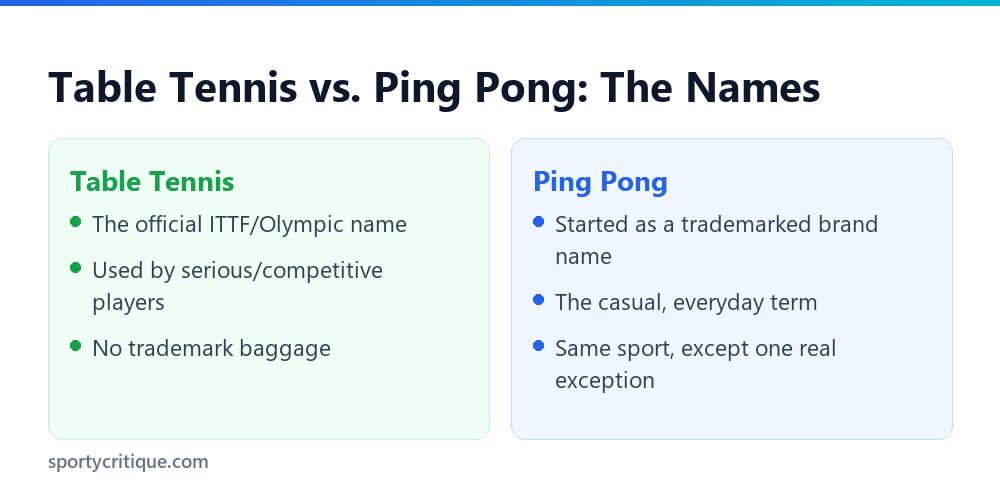
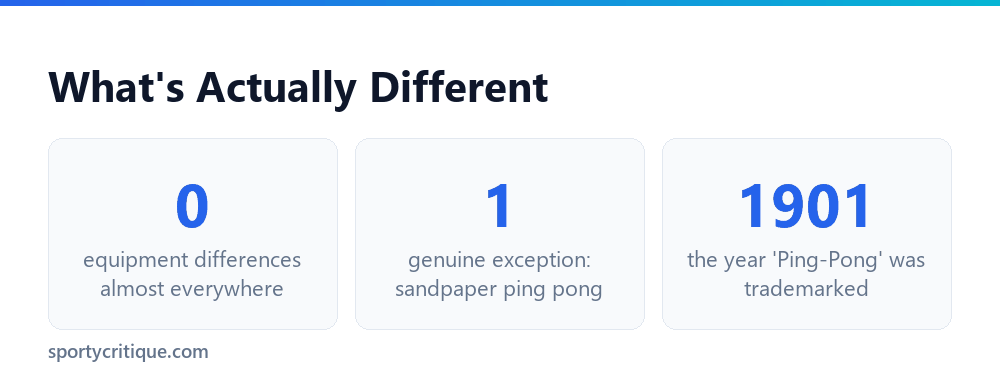
They’re the same sport — same table, same ball, same rules. ‘Table tennis’ is the official name used by the ITTF and the Olympics; ‘ping pong’ started as a trademarked brand name and became the casual term. But the two words have drifted apart, and in one specific corner of the sport they now describe genuinely different games played with different equipment.
This is the question every newcomer asks and every club player answers slightly differently — usually with a small, unmistakable note of snobbery. Here’s the actual answer, including the part where the distinction is real.
- →Same sport, two names — ‘ping pong’ was a trademark, which is why the official name is table tennis
- →The words signal register: serious players say table tennis, recreational players say ping pong
- →The real exception: sandpaper ‘ping pong’ is a separate competitive discipline
- →Equipment is identical everywhere except that sandpaper format
- →Neither word is wrong — but which one you use tells people something
Table of Contents

Where the two names came from
The game emerged in 1880s England as an after-dinner parlour amusement — books propped up for a net, cigar-box lids for bats, rounded champagne corks for balls. It was sold commercially under a small flood of onomatopoeic names: Gossima, Whiff-Waff, Flim-Flam.
Then in 1901 the games manufacturer J. Jaques & Son trademarked ‘Ping-Pong’ — imitating the sound of the ball — and licensed it to Parker Brothers in the United States. The name was catchy, it spread everywhere, and crucially it was owned.
The popular name won the public and lost the paperwork. That single commercial fact is why the sport is officially called table tennis.
When players and clubs began organising in the 1920s, they couldn’t legally use the trademarked name — so they standardised on the generic descriptor. The International Table Tennis Federation formed in 1926 under that name and has kept it ever since. The full story, including the 1901 celluloid ball that made the sport possible, is in our history of table tennis.
What the two words actually signal
Functionally the sport is identical either way — 11-point games, the same 9 × 5 ft table, the same 40mm ball. What differs is register, and it’s remarkably consistent across the English-speaking world.
The practical guidance: say ‘ping pong’ with friends and ‘table tennis’ at a club, and don’t be precious about either. Players who correct casual usage are doing the sport no favours — the recreational game is where almost everyone starts, including every professional who ever lived.
The one place the difference is real: sandpaper ping pong
Here’s the genuine exception, and it’s the reason a blanket ‘they’re the same thing’ answer is incomplete.
The World Championship of Ping Pong is a professional competition played with standardised sandpaper paddles — no sponge, no engineered rubbers, identical equipment issued to every player. In that context, ‘ping pong’ and ‘table tennis’ aren’t synonyms at all. They’re two separate competitive disciplines.
- Sponge + engineered topsheets
- Enormous spin available
- Equipment differentiates players
- Short, explosive rallies
- No sponge at all
- Very little spin possible
- Equipment identical for all
- Long rallies, touch and placement
The effect of removing sponge is dramatic. Without it there’s almost no dwell time, so the loop — the stroke modern table tennis is built on — barely functions. Rallies get longer, placement matters more than spin, and matches look closer to how the sport played in the 1940s before sponge rubber arrived.
Which is precisely the appeal. Standardising the equipment removes the arms race entirely: nobody wins because they can afford a $105 rubber, and viewers can follow rallies that don’t end in three shots. It’s a deliberate throwback, and it’s genuinely entertaining to watch.
📊 Note: This is the one context where correcting the terminology is fair. If someone says ‘ping pong’ at the World Championship of Ping Pong, they mean the sandpaper format specifically — not table tennis played casually.
Does the equipment differ?
For everyone outside sandpaper tournaments: no. The same paddles, the same 40mm balls, the same tables, the same nets. A ‘ping pong table‘ and a ‘table tennis table’ are the identical product with different marketing copy.
The real equipment divide has nothing to do with the naming and everything to do with intent:
That last row is why the two words feel like they describe different things. Someone playing on a 12mm table with 1-star balls genuinely is having a different experience from someone on a 25mm table with a custom setup — but they’re playing the same sport with different equipment quality, exactly like a park footballer and a professional.
Why the sport has an image problem
The naming split matters more than it should, because it maps onto a genuine reputational divide the sport has never resolved.
Almost everyone’s first encounter with table tennis is a wobbly table in a basement, garage or student common room, played with warped paddles and a dented ball, usually while holding a drink. That’s a perfectly nice way to spend an evening — and it’s also completely unrepresentative of the sport at any competitive level, which is fast enough that the ball crosses the table in under a tenth of a second and spins at over 100 revolutions per second.
So the sport carries two identities simultaneously: a party game and one of the most physically demanding racket sports in existence. No other sport has quite this problem. Nobody watches Wimbledon and thinks of the tennis they played on holiday; the gap between casual and elite tennis is obvious on sight. In table tennis the gap is invisible, because the equipment looks identical and the table is the same size.
That’s what’s really being signalled when a club player says ‘table tennis’ with slight emphasis. They’re not correcting your vocabulary — they’re trying to move you away from the basement image toward the sport they actually play. It’s understandable. It’s also a losing battle, and the better response is simply to show people a real rally.
What the rest of the world calls it
The English naming quirk doesn’t travel. Most languages simply use a descriptive term and never had the trademark problem at all.
- China: pīngpāng qiú (乒乓球) — literally ‘ping pong ball’, and completely neutral. The world’s dominant table tennis nation calls it ping pong.
- Germany: Tischtennis — table tennis, straightforwardly.
- France: tennis de table, though ping-pong is used casually.
- Japan: takkyū (卓球) — ‘table ball’.
- Spain: tenis de mesa or ping-pong.
The Chinese case is the one that should end the snobbery permanently. The nation that has won 37 of the 42 Olympic gold medals in the sport uses the onomatopoeic name as its standard term. If it’s good enough there, it’s good enough for your basement.
So which should you say?
- ✓Say ‘table tennis’ at a club, in a league, or when discussing equipment
- ✓Say ‘ping pong’ with friends, at a bar, or when nobody’s competing
- ✓Use ‘ping pong’ if it’s what your audience uses — clarity beats correctness
- ✓Reserve the distinction for sandpaper events, where it’s genuinely meaningful
- ✕Correct someone mid-game — nobody has ever enjoyed this
- ✕Assume ‘ping pong’ means the speaker isn’t serious
- ✕Believe one word describes a different sport (outside sandpaper)
- ✕Use ‘ping pong’ when buying competition equipment — you’ll get recreational results
💡 Pro tip: If you’re buying: search both terms. Retailers tag products inconsistently, and the same table can be listed as a ‘ping pong table’ in one shop and a ‘table tennis table’ in another at a different price. The word in the listing tells you about the retailer’s target market, not about the product.
- →The complete rules — same for both names
- →The full history — trademark, sponge revolution, ping-pong diplomacy
- →Statistics and records — the numbers behind the sport
- →How to hold the paddle — where playing it properly starts
Frequently asked questions
Is ping pong the same as table tennis?
Yes — same sport, same rules, same equipment. ‘Table tennis’ is the official name; ‘ping pong’ was a 1901 trademark that became the everyday term. The only genuine exception is sandpaper ping pong, a separate competitive format.
Why is it called ping pong?
It imitates the sound of the ball. J. Jaques & Son trademarked the name in 1901 and licensed it to Parker Brothers — which is exactly why the sport’s governing bodies had to use ‘table tennis’ instead.
Which name is correct?
Both. ‘Table tennis’ is formal and official; ‘ping pong’ is the everyday term used by most of the world, including China. Neither is a mistake.
Is ping pong an Olympic sport?
Table tennis has been Olympic since Seoul 1988 — same sport, official name. It’s covered in our Olympic guide.
What is sandpaper ping pong?
A professional format played with standardised sandpaper paddles — no sponge, minimal spin, longer rallies. It’s the one context where ‘ping pong’ means something genuinely different from table tennis.
Do I need different equipment for ping pong vs table tennis?
No. The difference in practice is recreational gear versus competition gear — pre-made paddles and 1-star balls versus custom setups and 3-star balls — and that’s a choice about seriousness, not about which name you use.
Why do serious players insist on ‘table tennis’?
Partly professional identity, partly a wish to distance the competitive sport from its basement-novelty image. It’s understandable, and it’s also a losing battle — the informal name has a century of momentum and China’s blessing.
Is ‘whiff-waff’ a real name for it?
Genuinely, yes — it was one of several commercial names sold in 1890s England alongside Gossima and Flim-Flam, before Ping-Pong won the market. It resurfaced in public memory when Boris Johnson referenced it during the 2008 Olympic handover, on the grounds that the sport was invented on English dining tables. He was right about the origin, if not about much else.
Does the name affect what rules we play by?
Not at all — but the setting often does. Casual games (which people tend to call ping pong) frequently use house conventions: playing to 21, serving out of the hand, or requiring diagonal serves in singles. None of those are the actual rules. If you’re moving from basement games to a club, expect the rules to tighten considerably, and see our complete rules guide for what changes.
🏓 Casual Ping Pong Paddle or Competition Table Tennis Racket?
The real dividing line between ‘ping pong’ and ‘table tennis’ comes down to ITTF rubber certification and sponge elasticity. Find a tournament-legal racket without paying pro-circuit prices:

Ping Pong Reviewed is an equipment review site covering table tennis and baseball gear. Specifications are checked against manufacturer listings, and prices against live retail pages, before publication.