Best Ping Pong Paddle for Beginners: 6 Picks by Use (2026)
The best ping pong paddle for beginners depends on what you need. Going by price, contents and each maker’s wording, we checked six on October 1, 2026: the JOOLA Omega Control ($19.95, one paddle, no balls), the JOOLA Family Premium set ($26.99, four rackets), the STIGA Performance 4-Player Set ($28.99, four rackets and six balls), the Butterfly Bty 302 FL ($34.49, listed by Butterfly for beginning-level players), the Palio Expert 3.0 ($39.99, called a beginner’s bat by Palio) and the STIGA Pro Carbon ($69.99, which STIGA places in its performance class). We haven’t tested any of them, so these are picks by price, contents and maker positioning, not by feel.
Most beginner paddle lists have the same problem. They tend to leave out the boring facts, like whether balls are included, whether the rubber can ever be replaced, or whether a name still exists.
This guide goes the other way. We checked live Amazon data, manufacturer pages and the ITTF’s published rules on October 1, 2026, and we write down what we found. We haven’t played with these paddles, so you won’t find opinions about feel. You’ll find prices, what’s in the box, what the labels and ratings mean, and the status of paddles that appear on other lists.
If you’d rather answer two questions and get a match, try our paddle selector quiz. For a wider range by skill level, our best ping pong paddle guide covers eight paddles.
- →Six paddles, $19.95 to $69.99 on Amazon on October 1, 2026.
- →The two four-racket sets cost about $6.75 (JOOLA) and $7.25 (STIGA) per racket. Check what is in each box before you compare them.
- →Butterfly lists the 302 FL for beginning-level players and Palio’s own site calls the Expert 3.0 a beginner’s bat. STIGA places the Pro Carbon in its performance class.
- →We found the ITTF authorizing rubber coverings and no approval list for complete rackets. The Laws allow a racket of any size, shape or weight.
- →Speed, spin and control ratings are each maker’s own scale. Don’t compare them across brands.
- →We could not verify a finished junior paddle to recommend. Butterfly’s two junior blades need rubber added, and its finished junior racket was $170.97 and shown as coming soon.
Table of Contents
Best ping pong paddle for beginners: six picks by use
Different buyers need different things, so we sorted the picks by situation. Each row points to a full section below. Only two of the six, the Butterfly 302 FL and the Palio Expert 3.0, carry a beginner statement from the maker, and we say so in each section.
⚡ Quick Picks: Best Beginner Ping Pong Paddles At-A-Glance
Palio Expert 3.0
Real ITTF CJ8000 rubbers with tacky grip. Best spin & control balance for beginners.
Check Amazon →JOOLA Omega Control
Only $19.95. High forgiveness, lightweight design, and great ball contact for casual starters.
Check Amazon →JOOLA Family Set
Includes 4 paddles + 10 balls for $26.99 (~$6.75/racket). Perfect for game room basements.
Check Amazon →STIGA Pro Carbon
High-performance 7-ply carbon blade. For ambitious beginners transitioning to club play.
Check Amazon →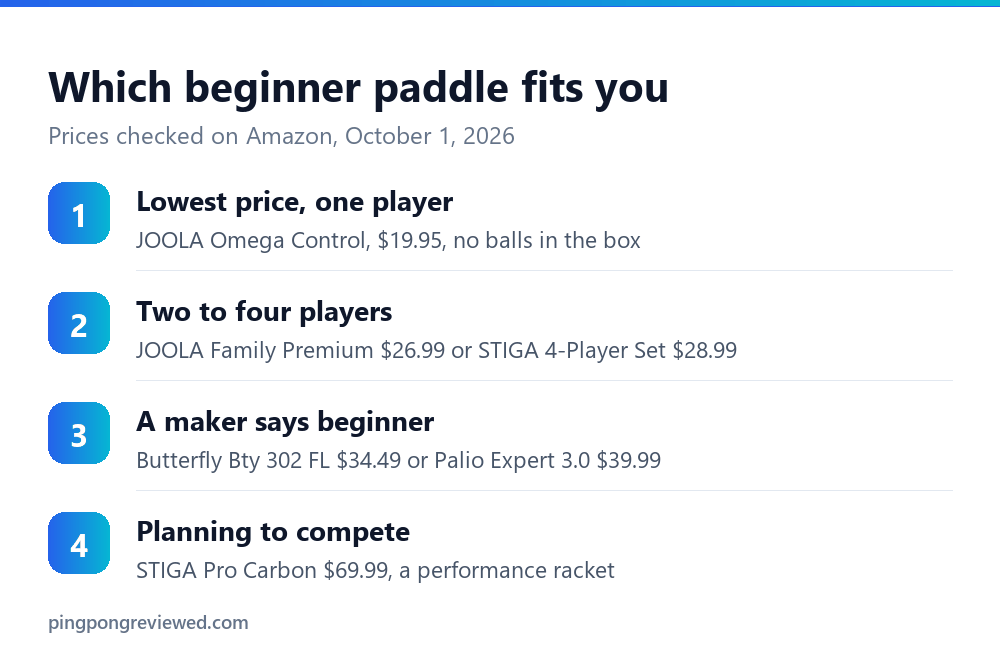
The six at a glance
1. JOOLA Omega Control: the lowest price for one player
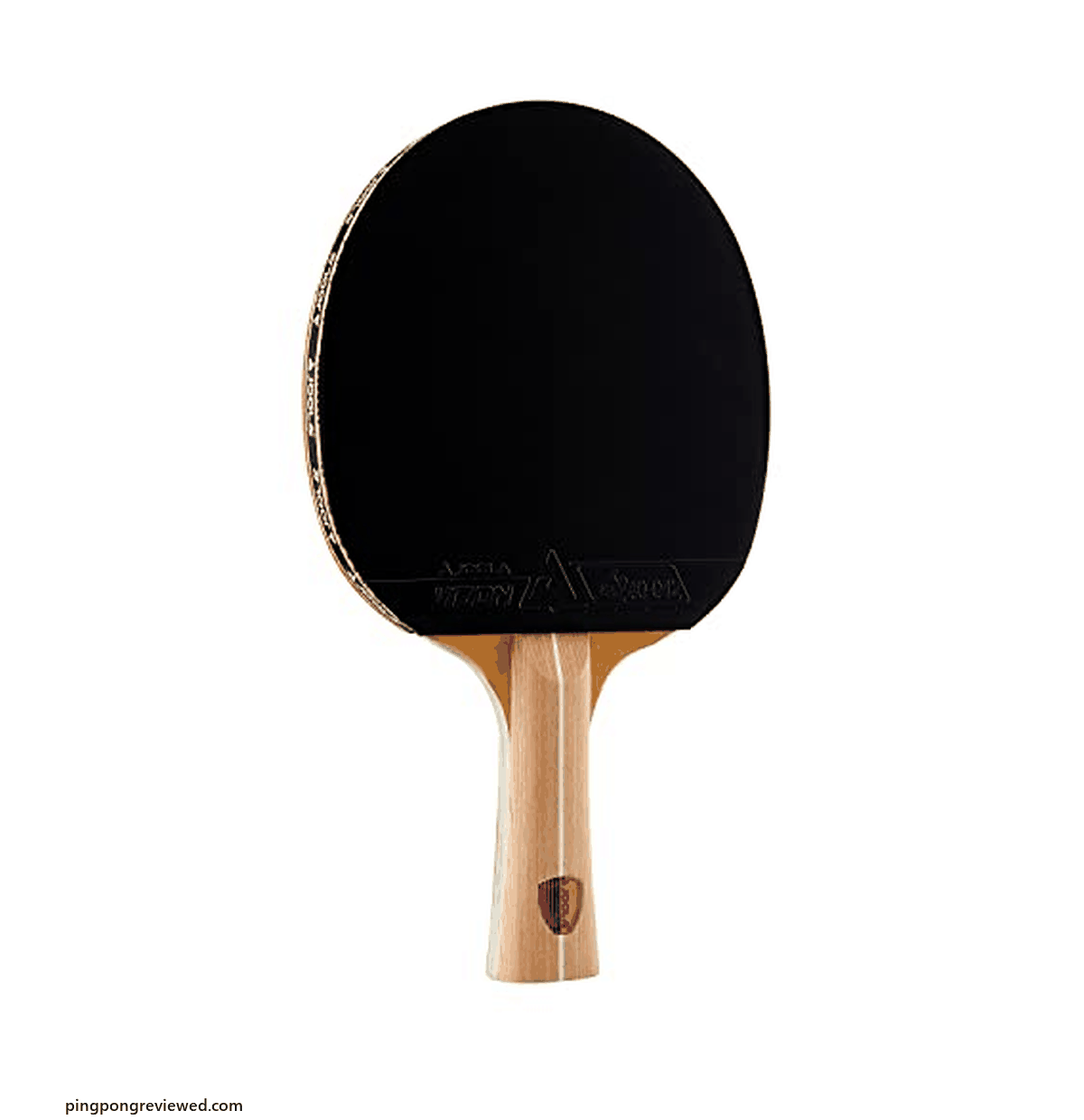
JOOLA Omega Control was $19.95 on both Amazon and JOOLA’s own site on October 1, and Amazon showed it in stock. It’s a single paddle. Amazon’s listing says it does not come with balls, so you’ll need to buy those separately.
JOOLA’s site describes the blade as 5-ply real wood and the rubber as pips-in JOOLA Vizon with a 1.8 mm sponge. Amazon’s bullets say it provides steady control at a slower speed. The January 3, 2026 list of authorized coverings includes JOOLA Vizon in black and red, though that list covers rubbers, not complete rackets.
⚠️ Watch out: The Amazon listing’s title calls this a tournament performance paddle for advanced training. That doesn’t match a beginner label, and JOOLA doesn’t call it a beginner paddle. We picked it for the price and the control emphasis in the listing, which is our judgment, not a maker recommendation.
The ratings show how scales differ. JOOLA’s site lists Speed 75, Spin 75 and Control 97. The Amazon listing for the same paddle lists Speed 4, Spin 7 and Control 8 on a 1 to 10 scale. Don’t compare either set with another brand’s numbers.
2. JOOLA Family Premium set: four rackets and ten balls
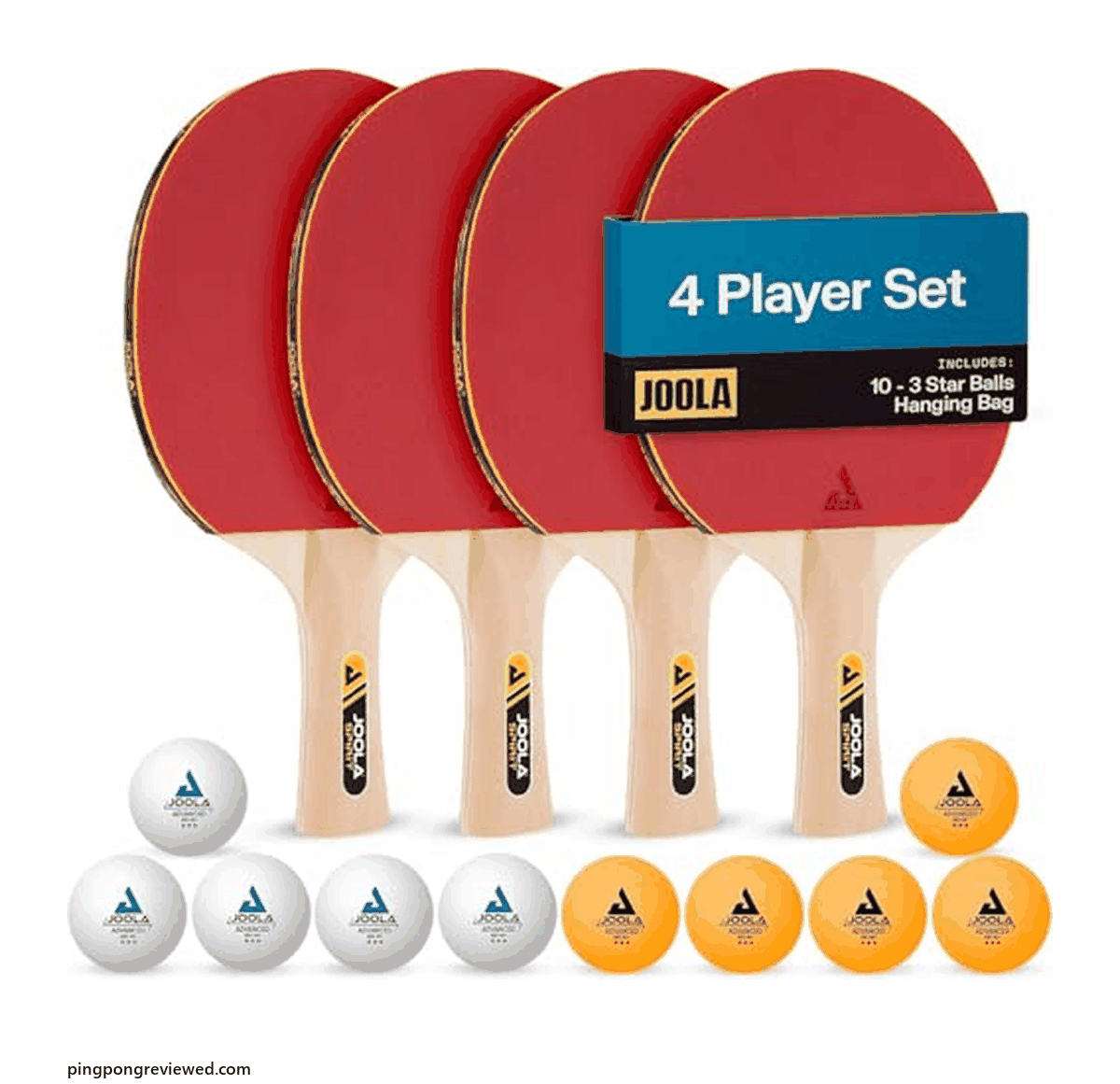
JOOLA Family Premium Ping Pong Paddles Set of 4 was $26.99 on Amazon on October 1, shipped and sold by Amazon.com and in stock. The listing says it includes four Spirit Training paddles, five white and five orange 40 mm balls, and a carrying case. That works out to about $6.75 per paddle.
Amazon’s bullets describe a 5-ply wood blade with a flared handle, pips-in rubber with sponge, and ratings of Speed 60, Spin 75 and Control 90. The ratings appear on Amazon’s listing only. We didn’t find them on JOOLA’s site.
⚠️ Watch out: We could not match this listing to a page on joola.com. JOOLA’s closest page, the Family Table Tennis Rackets & Balls Set, is $29.95 and describes a straight handle and one-star balls, while Amazon’s listing says flared handle and three-star balls. They may be different versions, so we only describe what Amazon’s listing says. We also found no ITTF authorization for this set’s rubber, so don’t read anything into the word “regulation” in the title.
3. STIGA Performance 4-Player Set: four rackets for one price
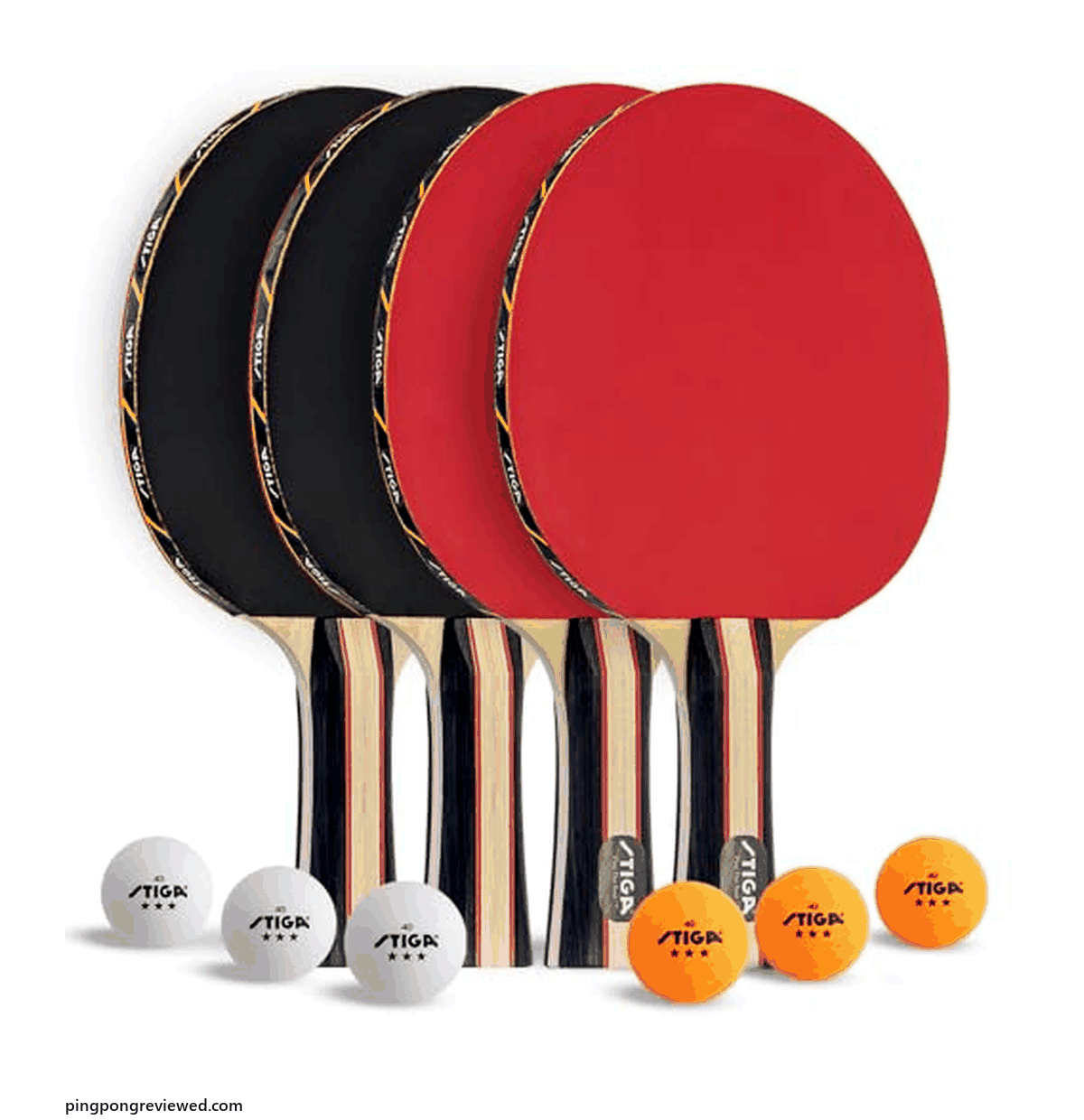
STIGA Performance 4-Player Set was $28.99 on Amazon on October 1, sold by Amazon.com and in stock. The listing says it includes four rackets and six three-star, 40 mm balls (orange and white).
Amazon’s listing for the set describes a solid wood flared handle, a 5-ply blade, smooth inverted rubber and a 1.5 mm sponge. It calls the set USATT approved and made for amateur players. The ITTF wording in the listing is about the balls, not the rackets.
The math is simple. Four rackets for $28.99 comes to about $7.25 each. If several people will play, a set is the lowest cost per paddle in this guide. If you only need one paddle, you’re paying for rackets you won’t use. Between the two sets, STIGA’s costs about 50 cents more per racket and includes four fewer balls, but the descriptions differ, so compare the contents above rather than the price alone.
4. Butterfly Bty 302 FL: the one with a beginner statement
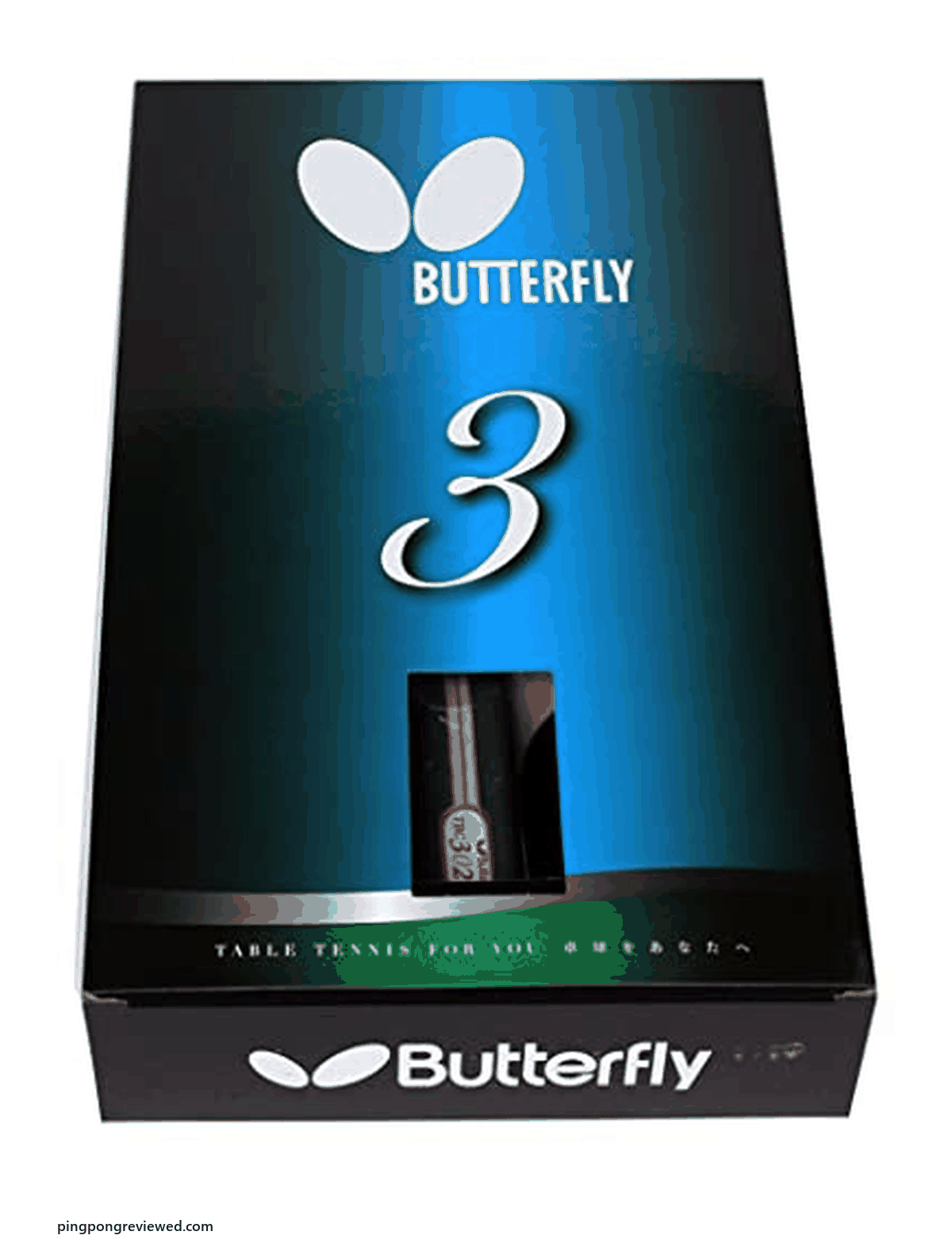
Butterfly B302FL was $34.49 on Amazon, where the seller showed as Bowmar Sports, and also $34.49 on Butterfly’s own shop, where it showed 176 in stock on October 1. Butterfly’s page says “Recommended For Beginning Level Players” and describes medium speed and spin.
Butterfly lists a 5-ply blade, Yuki rubber with a 2.1 mm sponge on both sides, a flared handle, a gift box set with a free racket case, and International Table Tennis Federation approval. Amazon’s listing says the rubbers are red and black, although its title says “Smooth & Pips-Out” while Butterfly’s page names Yuki on both sides. We followed Butterfly’s page.
There’s one catch, and it’s in Butterfly’s own words. Like most recreational rackets, the page says, this one is assembled with glue meant to keep the rubber attached for the life of the racket. Butterfly points buyers who want replaceable rubber to its Pro-Line models. See Butterfly’s page for the details.
5. Palio Expert 3.0: a step up with a beginner label from the maker
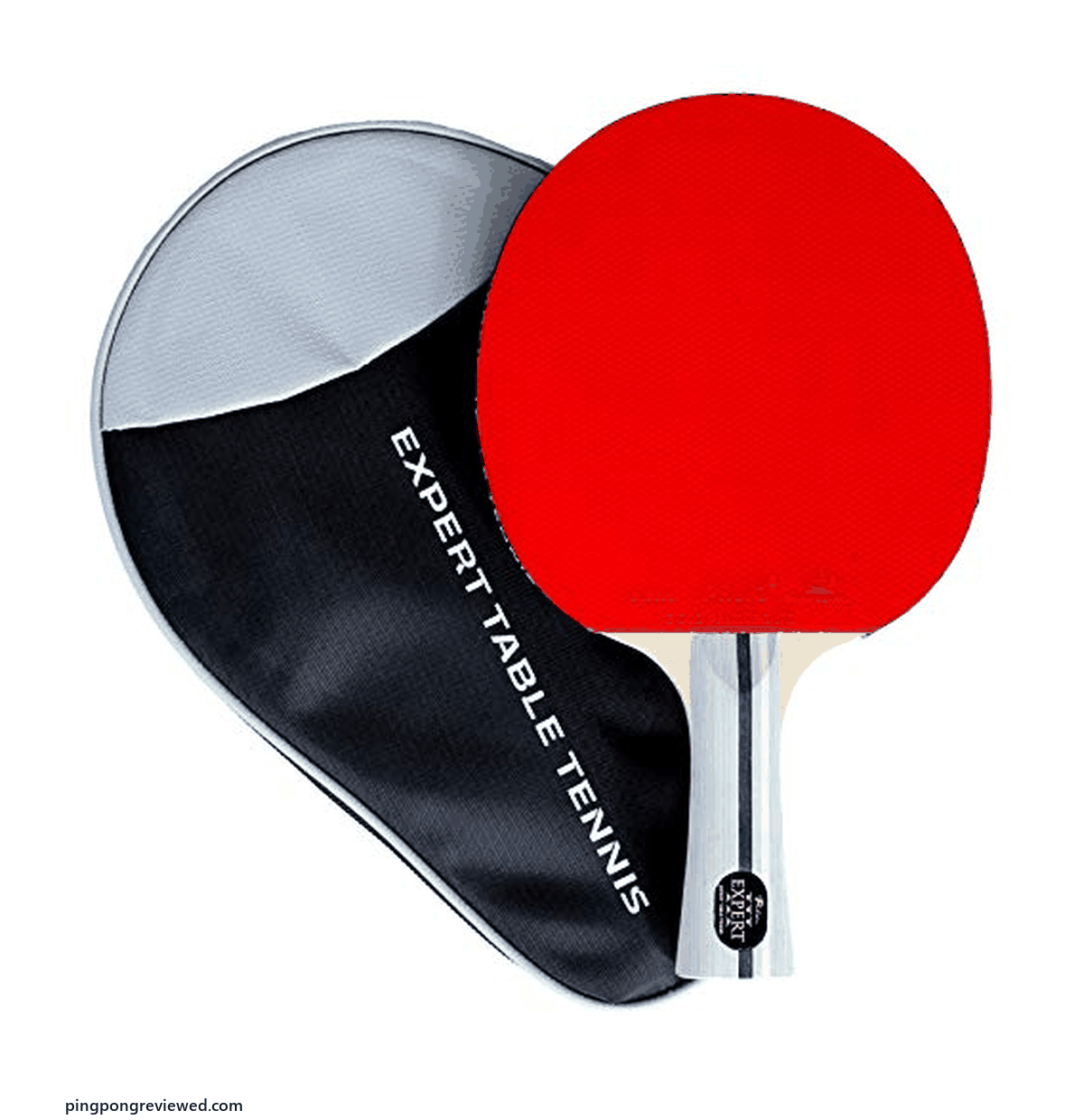
Palio Expert 3.0 (single racket) was $39.99 on Amazon on October 1 and in stock. Amazon showed the seller as TT Trading Co US. Palio’s page says Expert Table Tennis is the sole licensed seller of the product, and we did not work out how the two relate.
Palio’s page calls it the “third edition of the highly popular beginner’s bat” and says it uses the ITTF approved Palio CJ8000 rubbers, an all wood blade, an updated flared handle and a free case. The page gives ratings of Speed 6, Spin 9 and Control 10 out of 10, and Amazon’s listing repeats them. These are the maker’s own numbers.
On the rubber claim: the January 3, 2026 list of authorized coverings, as hosted by the French federation, includes a Palio CJ8000 pips-in covering in black and red. That list covers rubbers, not complete rackets, so it supports the rubber statement and nothing more. Palio’s FAQ says its ETT rubbers are designed to detach and that it avoids cementing them down permanently, and its premade vs custom page lists the Expert among the starter bats in that range, with the freedom to keep the blade and replace the rubbers later. Those are Expert Table Tennis’s statements, and Amazon showed a different seller, so we haven’t confirmed the Amazon unit is handled the same way.
The same FAQ says those rubbers are exclusive to the ETT range and aren’t sold separately, and it warns that an edge might come loose after heavy use, so ask what replacement you’d actually buy before you count on it.
⚠️ Watch out: Amazon’s bullet text for this listing also says “ideal for mastering advanced techniques” while the title says for beginners. Palio’s own page uses the beginner wording, which is why we list it here.
6. STIGA Pro Carbon: a paddle to grow into, not a starter
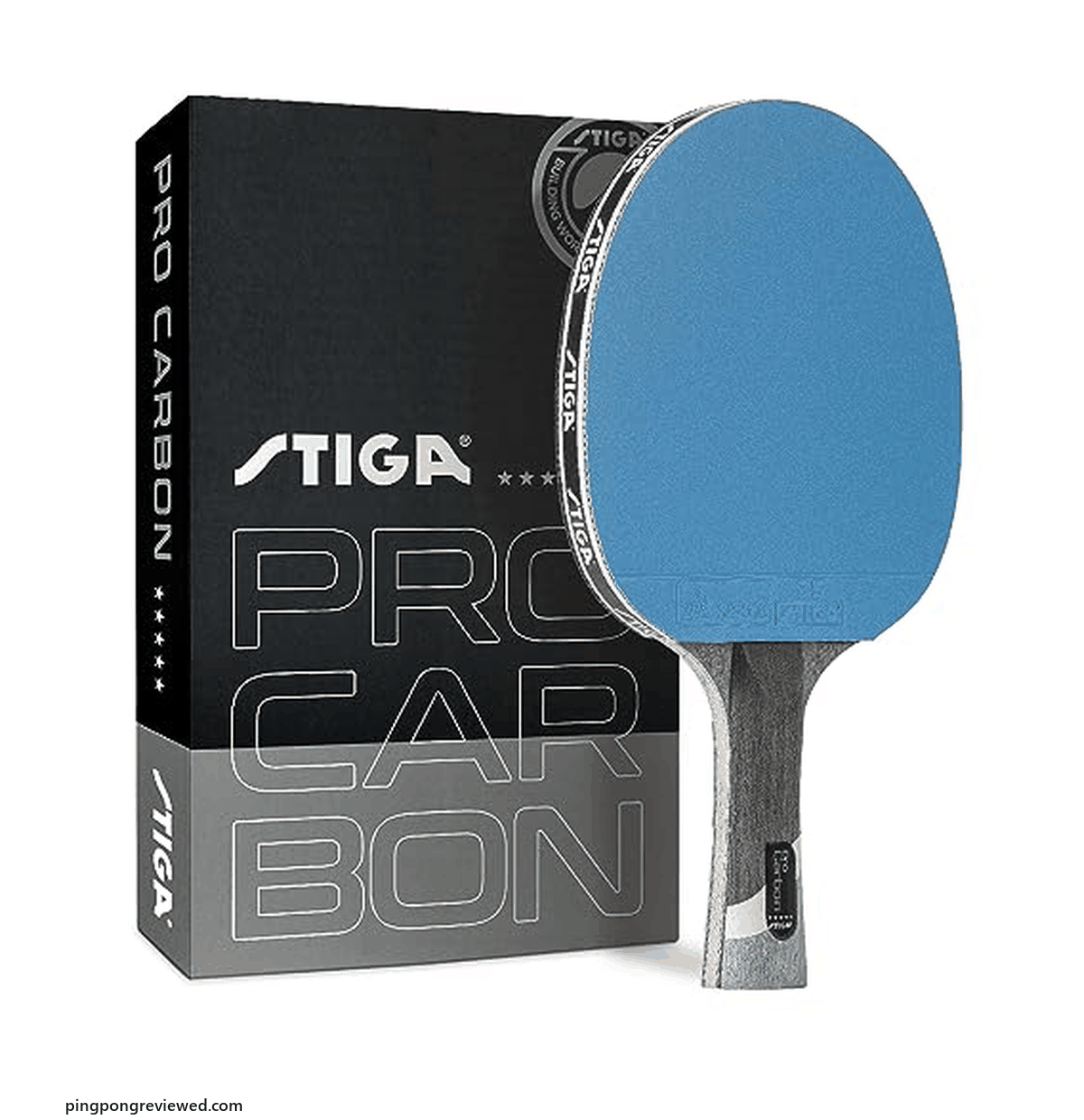
STIGA Pro Carbon was $69.99 on Amazon on October 1, sold by Amazon.com and in stock. STIGA’s own US page lists the Red and Blue Pro Carbon at $79.99. We can’t tell you why the Amazon price is lower, so we don’t call it a discount.
STIGA’s page describes a 7-ply blade with five layers of balsa and two of carbon fiber, a 2 mm sponge, and ITTF approved smooth inverted S5 rubber. It lists ratings of Speed 99, Spin 100 and Control 80, and states no scale for them. The Amazon listing says Control 79, which doesn’t match STIGA’s 80.
⚠️ Watch out: STIGA does not call this a beginner racket. Its US page title says “for Advanced Tournament Play” and the racket sits in the Performance Rackets class. We include it because many beginner lists do and some buyers want a single paddle to keep for years. It’s a judgment call, not a recommendation. STIGA’s US page doesn’t say whether the rubber can be replaced, and the list of authorized coverings has an S5 entry for STIGA but no entry named Pro Carbon, so we can’t confirm that the rubber on this racket is that exact listed S5.
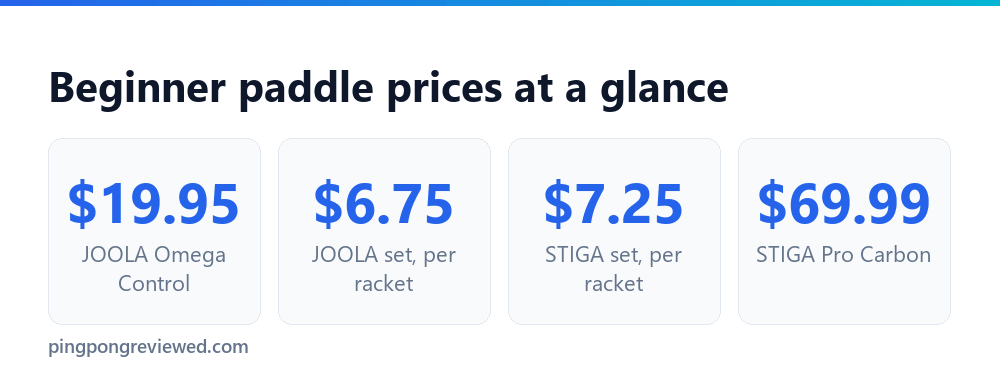
Best ping pong paddle for beginners by price
Price is the first filter for most buyers, so here are the six sorted into bands. These are our groupings of the October 1 prices, not maker categories.
If you’re deciding between bands, the contents matter more than the number. A $27 set and a $20 single paddle are different purchases, and a $70 racket isn’t a better starter just because it costs more. STIGA’s star-system guide says more stars means a more advanced and faster racket with less control.
Set or single: which beginner ping pong paddle?
The answer comes from the contents, not from the brands. The STIGA and JOOLA Family sets give you four rackets and balls. The others give you one racket each, and the Butterfly and Palio list a case.
Think about who is playing. For two or more people who each need a paddle, a set is the lowest cost per racket in this guide. For one person, a single paddle avoids paying for extras. And if you want a single paddle but also need balls, add them to the JOOLA Omega Control’s price, because Amazon’s listing says it doesn’t include any. Our paddle sets guide compares nine sets by contents and cost per racket.
What a ping pong paddle is made of
Every paddle has three parts that matter when you buy: the blade, the rubber and the handle. The blade is the wooden base. Table Tennis England puts it simply: the blade is the bat without the rubber. The rubber is the covering glued to each side, usually a layer of sponge under a rubber sheet. The handle is the part you hold.
The ITTF Laws set only a few limits, and they’re looser than most buyers expect. We read them in the ITTF Statutes 2026, effective January 1, 2026.
The Laws also say the covering must be used without any physical, chemical or other treatment. That is a rule for competitions, but it’s a good reason to leave tuning liquids alone until you know you’ll compete.
Speed, spin and control ratings, explained
Almost every listing shows three numbers. They are real, but they only mean something inside one brand’s system. Here is how each maker describes its own scale, as we found it on October 1, 2026.
No maker we read says its scale matches anyone else’s. So a Control 97 from JOOLA and a Control 10 from Palio can’t be compared, and a Control 79 on one listing and 80 on the maker’s page for the same STIGA racket shows how loose the numbers can be. The sensible use of ratings is to compare two paddles from the same brand. For a beginner, the makers that discuss it say the same thing in different words: Killerspin says beginner paddles prioritize control over speed, and STIGA says a faster racket comes with less control. For each maker’s scale in detail, see our racket ratings explained guide.
Weight, size and handle: what the makers say
There’s no official answer, because the Laws allow any size, shape or weight. What we have are maker statements. STIGA’s blade guide groups blades into low weight (75 to 85 g), mid weight (80 to 90 g) and high weight (85 to 95 g), with a note dated July 2022, and advises choosing one you can swing comfortably.
On handles, Butterfly says the choice is strictly a personal preference, and calls flared the most popular style and anatomic the second most popular. STIGA names three handle shapes: classic or straight, master or concave, and the penhold. Killerspin describes flared as wider at the base, straight as a consistent width, and says most players use the shakehand grip. Our weight and handle guide goes through the published weights and handle names.
Five of the six are described as flared: the Omega Control (Amazon’s title), the STIGA set (Amazon), the Butterfly 302 FL, the Palio Expert 3.0 and the STIGA Pro Carbon (STIGA’s page). Amazon says flared for the JOOLA Family set but JOOLA’s similar set page says straight, so treat that one as unclear. If you hold the paddle like a pen, check the handle shape before you buy. Our grip guide explains both grips.
What about kids?
This is the topic where we found the least solid ground. We could not find junior racket sizing guidance from the ITTF or USATT, and we could not find a finished junior paddle from STIGA, JOOLA or Killerspin with a stated age range. We are not recommending one of the six for a child.
What exists: Butterfly sells two junior blades. Its Timo Boll J FL is described as developed for players aged 4 to 9, and its Timo Boll TJ FL as recommended for athletes aged 10 to 13. Both are blades only, so you’d add rubber. On October 1, 2026 the J FL was $69.99 and out of stock with an estimated arrival of October 9, and the TJ FL was $104.99 and in stock. See Butterfly’s J FL page and TJ FL page.
Butterfly also lists a finished junior-sized racket, the Timo Boll TJ Pro-Line racket, which it says is ideal for kids or players with smaller hands. It was $170.97 and shown as coming soon on October 1, well above beginner pricing. Butterfly’s TJ FL page also calls that blade a model for advanced players. JOOLA’s 2021 guide mentions junior models that are smaller in the handle and lighter, and JOOLA’s German site lists a Team Junior racket with an extra small children’s handle and no stated age range, which Amazon Germany was selling into the US at $24.88 on October 1.
Several recreational sets say they suit children. Amazon’s JOOLA Family listing says “for kids and adults”, for example, and Killerspin describes its 2X Impact as ideal for beginners, kids and recreational players. Those are marketing statements, not sizing guidance. If a child is young, look at the handle size and the age wording before you pay. Our kids’ paddle guide lists the junior options we could verify.
Ready-made or custom: and can you swap the rubber later?
A ready-made paddle comes with the rubber already attached. A custom paddle is a blade you pick plus two rubbers you pick, glued on separately. Makers and federations are split on what a beginner should do.
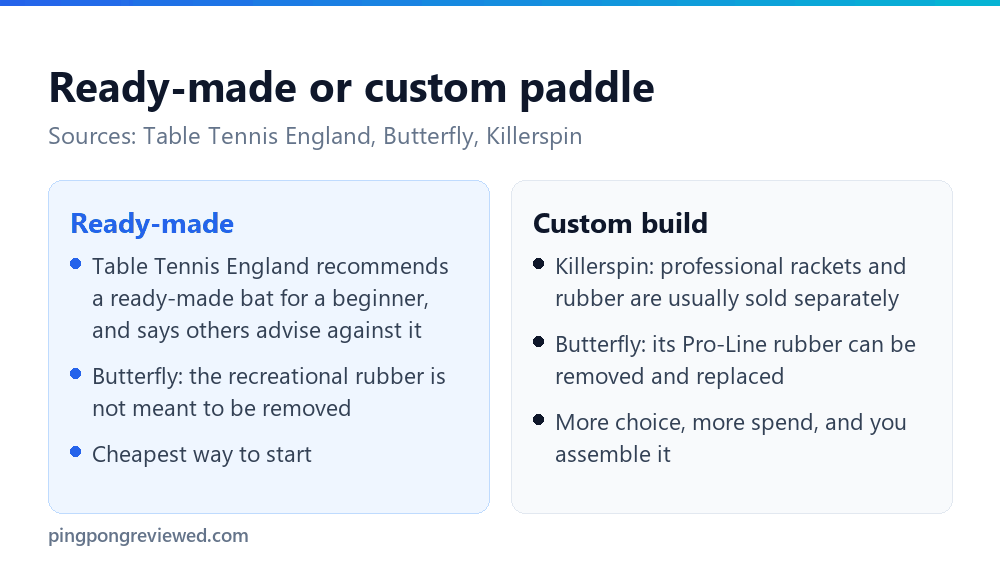
Two quotes sum up the maker view. Butterfly’s FAQ says the rubber on its recreational rackets is not meant to be removed, and that when it needs replacing it’s time to buy a new racket. STIGA’s star-system guide says that when you’re ready to take the next step from its five-star racket, the pre-glued system is a great choice, and that gluing the racket yourself offers more choice. Table Tennis England recommends beginners choose a ready-made bat, although it says others would advise against it, and suggests an all-round blade with reverse rubber and 1.5 mm sponge.
For our six: Butterfly says the 302 FL’s rubber is glued for good. Palio says its ETT rubbers are designed to detach, and its range page lists the Expert 3.0’s family among them. For the STIGA and JOOLA paddles we found no statement either way, so assume the rubber is permanent. If you already know you’ll want to change rubbers, skip all six and look at custom builds, which we compare in our main paddle guide.
How long the rubber lasts and how to look after it
Makers give guidelines, not promises. STIGA’s rubber guide says the number of days you play per week is how many times to change the rubber per year, and says to replace it after about two years regardless. Butterfly’s FAQ says to replace pimples-in rubber when its surface loses its grip, or goes whitish. Killerspin says it can be weeks or months and depends on many factors, including how often and how hard you play and how dusty the room is.
On care, STIGA and Butterfly both say to clean the rubber after each use. STIGA also says to avoid extreme temperatures and to protect rubber from dust, moisture and sunlight, and Table Tennis England says to keep the bat out of direct sunlight and high temperatures. Our paddle cleaning guide covers the how-to.
For a glued-on recreational paddle, the practical meaning is that when the rubber wears out, you replace the paddle. That’s a cost to plan for, and a reason a $20 or $27 paddle can be reasonable.
What “ITTF approved” means on a listing
You’ll see these words everywhere. They don’t always mean what buyers think. The ITTF authorizes racket coverings, meaning rubbers, and its Regulation 3.2.1 says a covering used in competition shall be currently authorized by the ITTF, with the ITTF logo and brand visible. We found no ITTF approval for complete rackets. The Butterfly page for the 302 FL says the racket is International Table Tennis Federation Approved, and the Palio page says the CJ8000 rubbers are ITTF approved. Those are maker statements about specific rubber.
Megaspin, a retailer, says most recreational rackets don’t comply with official ITTF regulations, either because both rubber sheets are the same color or because the rubber isn’t approved for competition. In other words, approval is about specific rubber sheets and colors, not about how well a paddle is built. Amazon’s listing for the STIGA set uses the ITTF name for the balls, and JOOLA’s and Amazon’s text for the Omega Control doesn’t state an approval. For the details, read our guide to checking ITTF approval.
The two-color rule, and who it applies to
The ITTF Laws say the covering must be matt, black on one side, and a bright color clearly distinguishable from black and from the color of the ball on the other. That’s why paddles have two colors. The Laws don’t list the colors, but the list of authorized coverings uses a key of red, black, green, blue, pink and violet.
The Butterfly 302 FL’s Amazon listing says its Yuki rubbers are red and black. Butterfly’s Yuki appears on the list in black and red, as hosted by the French federation in its January 3, 2026 edition. That’s consistent, though we can’t tell you how an organizer would treat a specific racket.
Who has to follow the rule? The ITTF’s Regulations for International Competitions say the laws and regulations are presumed to apply unless variations are agreed in advance or made clear in the published rules. That covers international competitions. For anything else, check the event’s own rules.
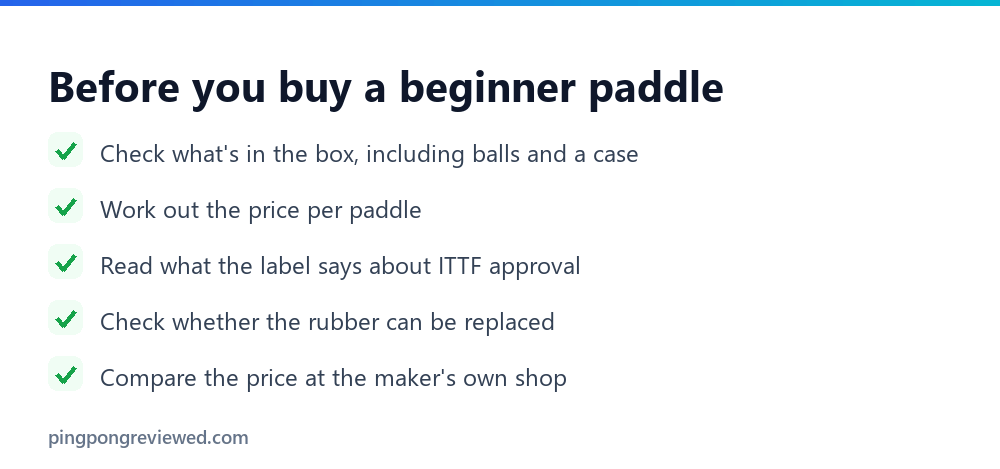
How to read a beginner paddle listing
Listings pack a lot of labels into a few lines. Here is what each one tells you, using the paddles above as examples.
Notice how much of this is the maker describing itself. That isn’t a flaw. It just means the labels are a starting point for questions, not a verdict.
What to be careful about
We found no maker or federation source that lists a fixed set of bad paddles, so this isn’t a blacklist. These are the cautions the sources do support.
One more caution, about our own list: three of the six have labels that conflict with how we group them. The Omega Control’s title says tournament, the JOOLA set’s says advanced, and the Pro Carbon is a performance racket by STIGA’s own classification. We still think the grouping is fair because we explain each one, but read the section for any paddle before you buy.
Other paddles you may see on beginner lists
Beginner lists often include names that are hard to find. Here is what we found for five of them on October 1, 2026. Each row says where we looked.
The pattern is that availability depends on who you ask. A product can be sold by its maker, listed as discontinued by a retailer, and shown at a high price by a marketplace seller, all at once. That’s why we always say where we looked and when.
How we checked these picks
We checked Amazon’s product data for price, stock, seller, title and features on October 1, 2026. We read the makers’ own pages where they exist, including JOOLA, Butterfly, STIGA, Palio and Killerspin. We read the ITTF’s Laws and a copy of its list of authorized coverings for the rules, plus buying guides from STIGA, Butterfly, Killerspin and Table Tennis England for the explanations.
We did not play with any paddle, so we don’t describe how they feel. We don’t quote star ratings or review counts. Prices and stock change, so treat the numbers as a snapshot.
What to do after a starter paddle
Once you know you’re staying with the sport, the next step is a paddle with rubber you can replace. Our best paddle guide covers eight options by skill level, and our grip guide explains shakehand and penhold. For tournament prep, start with our first competition guide.
Frequently asked questions
What is the best ping pong paddle for beginners?
We can’t rank paddles by how they play, because we haven’t tested them. Going by price, contents and each maker’s own wording, we checked six on October 1, 2026: the JOOLA Omega Control ($19.95), the JOOLA Family Premium set ($26.99), the STIGA Performance 4-Player Set ($28.99), the Butterfly Bty 302 FL ($34.49), the Palio Expert 3.0 ($39.99) and the STIGA Pro Carbon ($69.99). Butterfly lists the 302 FL as recommended for beginning-level players and Palio’s own page calls the Expert 3.0 a beginner’s bat.
Should a beginner buy a set or a single paddle?
A set makes sense if several people will play. The STIGA set works out to about $7.25 per racket and includes six balls, and the JOOLA Family Premium set to about $6.75 per racket and lists ten balls and a case. A single paddle makes sense if you only need one and want to choose it yourself.
Do I need an ITTF-approved paddle as a beginner?
Not for casual play. We found the ITTF authorizing rubber coverings and found no approval list for complete rackets, and the rule that a covering must be authorized sits in the regulations for competitions. Megaspin says most recreational rackets don’t meet official ITTF regulations. If you plan to enter sanctioned events, check the event’s own rules and the current list of authorized coverings.
Why are ping pong paddles two different colors?
The ITTF Laws require the racket covering to be matt, black on one side, and a bright color clearly distinguishable from black and from the color of the ball on the other.
What do the speed, spin and control ratings mean?
They are each maker’s own numbers. STIGA’s blade guide says its speed and control figures are estimated, Butterfly says its values are relative and come from its own tests, and Killerspin rates on a scale of 1 to 10. We found no maker that says its scale matches another brand’s, so compare ratings within one brand only.
How heavy should a beginner paddle be?
The ITTF Laws allow a racket of any size, shape or weight, so there is no official target. STIGA’s blade guide groups blades into low (75 to 85 g), mid (80 to 90 g) and high (85 to 95 g) weight, and advises choosing one you can swing comfortably. Butterfly calls handle choice strictly a personal preference.
What is the best paddle for a child?
We could not verify a finished junior paddle to recommend. Butterfly sells junior blades for ages 4 to 9 and 10 to 13, but they are blades only, so rubber is extra, and its finished junior racket was $170.97 and shown as coming soon on October 1. USATT and the ITTF don’t publish junior sizing guidance that we could find, so check the maker’s own age wording and the handle size before you buy.
Should a beginner buy a ready-made paddle or build a custom one?
Table Tennis England recommends beginners choose a ready-made bat, and adds that others would advise against it. Butterfly says its recreational pre-assembled rackets are not meant to have the rubber removed, while Palio says the rubbers on its starter range are designed to detach. If you already know you want to change rubbers, a custom build with separate rubbers is the other route.
How often should I replace the rubber?
STIGA gives a rule of thumb: the number of days you play per week is the number of times to change the rubber per year, and it adds that rubber should be replaced after about two years regardless. Butterfly says to replace pimples-in rubber when the surface loses its grip. Those are maker guidelines, not tests we ran.
Is a sandpaper or hardbat paddle a bad choice for a beginner?
Not necessarily. USATT’s news site covered 2023 hardbat and sandpaper championships, so the style is a real category. Table Tennis England’s 2014 group-buying guide says hard bats with no sponge layer are not recommended, and its equipment guidance doesn’t recommend long pimples for beginners. It depends on the game you want to play.
Can I replace the rubber on a beginner paddle?
Butterfly says its recreational pre-assembled rackets use glue meant to keep the rubber attached for the life of the racket. Palio’s FAQ says its ETT rubbers are designed to detach and are not cemented down permanently, and its range page lists the Expert among them. We found no statement either way for the STIGA and JOOLA paddles on this page, so treat the rubber as permanent unless the maker says otherwise.
Do beginner paddles come with balls?
It depends. The STIGA set includes six 40 mm balls, and Amazon’s listing for the JOOLA Family Premium set lists ten. Amazon’s JOOLA Omega Control listing says it does not come with balls. Butterfly’s page for the 302 FL mentions a gift box and a free case and doesn’t mention balls.
Is $20 enough to start?
It can be enough for casual games. The JOOLA Omega Control was $19.95 on October 1, 2026. We haven’t tested it, so we can’t say how it plays.
Sources
Prices, stock and seller details come from Amazon’s product data, checked October 1, 2026. Specs and positioning come from Butterfly’s Bty 302 FL page, JOOLA’s Omega Control page, JOOLA’s family set page, Palio’s Expert 3.0 page, Palio’s FAQ, Palio’s premade vs custom page and STIGA’s Pro Carbon page. Retailer notices are from Megaspin.
The rules are in the ITTF Statutes 2026 and the January 3, 2026 list of authorized racket coverings as hosted by the French federation. The buying guidance is from STIGA’s star-system guide, STIGA’s blade guide, STIGA’s rubber guide, STIGA’s glue guide, Butterfly’s equipment FAQ, Butterfly’s rubber replacement FAQ, Butterfly’s rubber ratings page, Killerspin’s paddle guide, Killerspin’s racket assembly guide, Killerspin’s 2X Impact page, Palio’s rubber replacement guide, Table Tennis England’s equipment guidance, its 2014 group-buying guide, JOOLA’s recreational rackets guide and USATT’s hardbat news.
As an Amazon Associate, we earn from qualifying purchases through links on this page.

Ping Pong Reviewed is an equipment review site covering table tennis and baseball gear. Specifications are checked against manufacturer listings, and prices against live retail pages, before publication.