Ping Pong Table Dimensions: Official Size, Room Space & Thickness

Quick Answer: A regulation ping pong table is 9 ft long × 5 ft wide × 2 ft 6 in high (2.74 m × 1.525 m × 76 cm), with a net 6 ft wide and 6 in high. Those are the ITTF numbers and every serious table uses them. But the number that decides your purchase isn’t the table — it’s the room: you need about 17 × 11 ft to play at all, and 22 × 14 ft to play properly.
The dimensions are the easy part — they’ve been fixed for decades and every manufacturer follows them. What nobody tells you before you buy is that the table is the smallest part of the space equation, that the thickness number on the box matters more than the price, and that a full-size table in a room that can’t hold it becomes the world’s most expensive laundry shelf.
So this covers all of it: the official specs, what they mean in practice, how much room you actually need, and the compact alternatives when the answer is ‘not this much.’
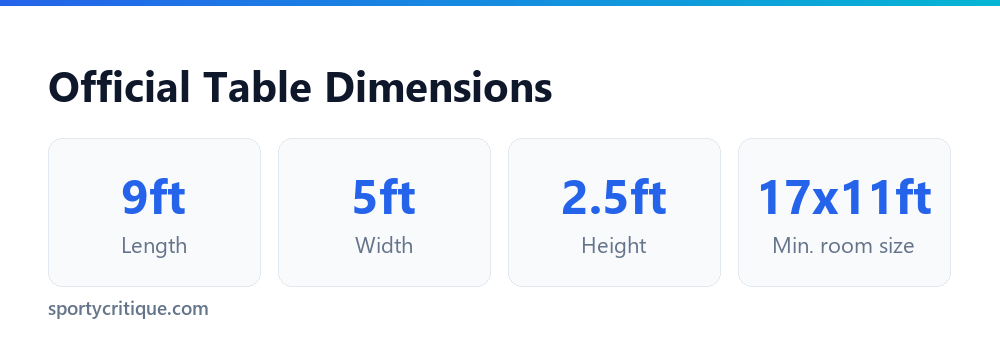
Table of Contents
Official ping pong table dimensions
| Measurement | Imperial | Metric |
|---|---|---|
| Length | 9 ft | 2.74 m |
| Width | 5 ft | 1.525 m |
| Height (floor to surface) | 2 ft 6 in | 76 cm |
| Net length | 6 ft | 1.83 m |
| Net height | 6 in | 15.25 cm |
| Net overhang (each side) | 6 in | 15.25 cm |
| Edge line width | ¾ in | 2 cm |
| Centre line (doubles) | ⅛ in | 3 mm |
| Playing area (competition) | 46 × 23 ft | 14 × 7 m |
A few of those deserve unpacking. The net is wider than the table — it overhangs by 6 inches on each side, which is why a ball can travel around the net assembly and still land legally (a genuinely legal and infuriating shot, covered in our rules guide). The centre line is only 3 mm wide and exists solely for doubles serving; in singles it’s decoration, and a ball landing on it means nothing at all.
The height is the specification that quietly matters most on cheap tables. Everything about your stroke mechanics — where your contact point sits, how you bend, how the ball behaves relative to your body — is calibrated to 76 cm. A ‘kids table’ that shrinks the height as well as the surface teaches strokes that have to be unlearned later, which is why quality junior and midsize tables always keep the official height and only reduce the playing surface.
The specification that isn’t on the box: bounce
Here’s what separates a real table from a toy, and it’s not in the dimensions at all. The ITTF standard is a uniform bounce of roughly 23 cm from a 30 cm drop — consistently, across the entire surface.
That word ‘uniform’ is doing enormous work. A cheap table might bounce correctly in the middle and die near the edges, or have dead spots where the frame supports the top. You discover this the first time a perfectly-judged shot bounces wrong and you blame yourself. On a bad table, you can’t develop a feel for timing, because the table isn’t telling you the truth.
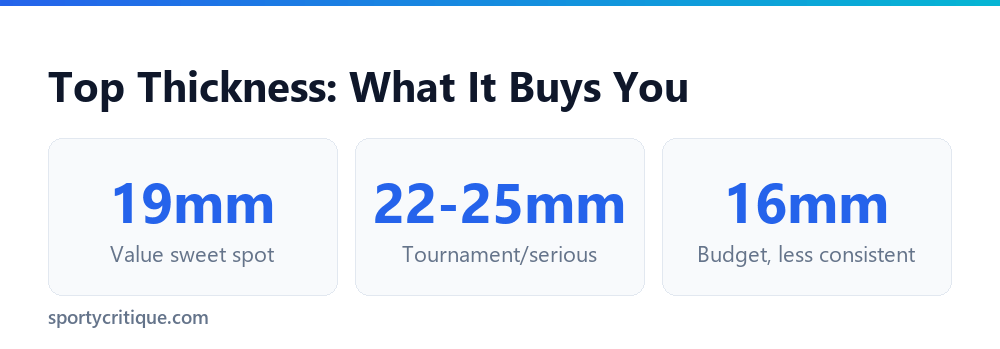
What produces uniform bounce is top thickness, and this is the number you should actually shop on:
| Thickness | Class | What it feels like |
|---|---|---|
| 25 mm | Tournament / club | Deep, true, consistent bounce everywhere |
| 22 mm | Very good home table | Nearly indistinguishable for most players |
| 19 mm | Solid home table — the sweet spot | Good bounce; the honest value pick |
| 16 mm | Budget | Noticeably livelier and less consistent |
| 12–15 mm | Toy territory | Dead, hollow, inconsistent — you’ll feel it in a week |
The jump from 16 mm to 19 mm is the biggest single upgrade in the range, and it usually costs less than the difference between two paint finishes. If you’re deciding between a 16 mm table with a fancy frame and a 19 mm one without, take the 19 mm every time — our table reviews list thickness for every model precisely because manufacturers bury it.
The number that actually decides your purchase: room size
The table is 9 × 5 ft. Nobody plays inside 9 × 5 ft. You play in the space around it, and that’s what determines whether the table is a joy or a regret.
| How you’ll play | Room needed (ft) | Room needed (m) | Verdict |
|---|---|---|---|
| Kids, casual knockabout | 16 × 10 | 4.9 × 3.0 | Tight but workable |
| Family games, beginners | 17 × 11 | 5.2 × 3.4 | The practical minimum |
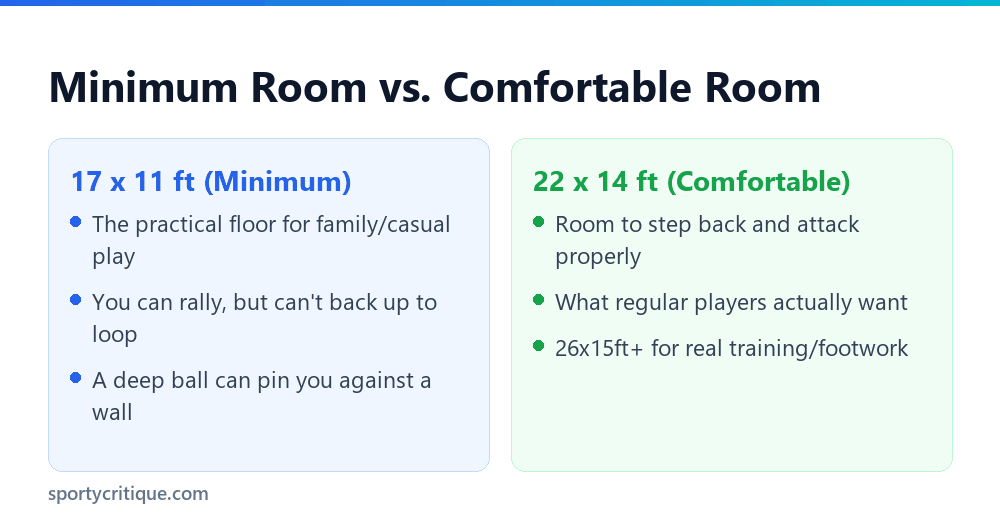
| Regular players, real rallies | 22 × 14 | 6.7 × 4.3 | Comfortable |
| Training, loops and footwork | 26 × 15 | 8 × 4.6 | What improvement needs |
| Club standard | 30 × 16.5 | 9 × 5 | Per-table club spec |
| ITTF competition | 46 × 23 | 14 × 7 | The full show court |
The arithmetic behind the minimum: 9 feet of table, plus about 4 feet behind each end for a player to stand and swing, plus roughly 3 feet total of side clearance. That’s 17 × 11 — and it is genuinely a minimum, not a target. At that size you can rally and enjoy yourself; you cannot back up to loop, and a deep ball will pin you against a wall.
If you can only add space in one direction, add it behind the ends. Depth is where table tennis lives — every attacking stroke involves stepping back to create room, and a player with a foot of extra space behind them has options that a player against a wall doesn’t. Width is nice; depth is the game.
Ceiling height
Less critical than people fear. 8 ft works for casual play; 9–10 ft is comfortable; clubs prefer higher for lobbing. If your basement is 7’6″, you can still play perfectly good table tennis — you simply agree in advance that defensive lobbing is off the menu, and honestly most recreational players never lob anyway. Check for ductwork and light fixtures before you measure, though; a pipe at head height in the middle of a rally is its own kind of problem.
The usual rooms, honestly assessed
Single-car garage (~20 × 12 ft): yes — this is the most common home for a full-size table and it comfortably beats the minimum once the car’s out. The caveats are temperature and damp: an indoor table in an unheated, humid garage will warp over a few seasons. If your garage swings between freezing and baking, buy an outdoor table even though it lives indoors — the weatherproof top doesn’t care.
Double garage: comfortably yes, with room to actually train. This is the dream setup for most home players.
Typical basement: usually fine on floor area — check ceiling height and support columns first. A column two feet from the corner of the table will find your hip repeatedly.
Spare bedroom (12 × 12): no, not for full-size. That’s midsize territory, and pretending otherwise means buying a table you’ll resent.
Backyard or patio: space is easy outdoors; weather isn’t. A 2.7g ball is at the mercy of any breeze, and an indoor table left outside for one rainy night is finished. Outdoor tables exist for exactly this reason.
When the room says no: the compact classes
There’s no shame in this and it’s a better outcome than a full-size table you can’t use:
| Class | Size | Height | Room needed | Best for |
|---|---|---|---|---|
| Full-size | 9 × 5 ft | 30 in | 17 × 11 ft min | The real thing |
| Junior (¾) | ~7 × 4 ft | 30 in | ~15 × 10 ft | Kids 5–10, small rooms |
| Midsize (⅔) | ~6 × 3 ft | 30 in | ~13 × 9 ft | Apartments, offices |
| Conversion top | 9 × 5 ft | Depends on the table beneath | 17 × 11 ft | Pool table owners, dining tables |
| Mini / tabletop | 3–5 ft | Varies | Any | Toddlers, gifts, travel |
The playback trick is worth knowing: most folding full-size tables let you raise one half vertically and rally against it solo. In playback position, a full-size table needs only about 11 × 11 ft — so a garage that can’t host two players can still host you practising alone, and you unfold it when guests arrive. It’s the best of both and it’s why folding tables outsell fixed ones by a wide margin.
Conversion tops deserve a specific warning: they sit on your pool or dining table, which means their playing height is whatever that table’s height is plus the top’s thickness. Pool tables are typically about 31–32 inches, so the result usually lands a couple of inches above regulation. It’s fine for fun, mildly wrong for developing strokes, and worth knowing before you’re surprised.
Full breakdowns of the compact options are in our guides to smaller ping pong tables and midsize dimensions.
How to measure your room properly (before you buy)
People measure the floor, order the table, and discover the problem on assembly day. Here’s the ten-minute version that prevents that:
- Mark the table’s footprint on the floor with masking tape — a 9 × 5 ft rectangle. Do this first; it’s startling how much bigger it looks than the number sounds.
- Stand at each end and take a full forehand swing. If you hit a wall, a boiler, or a shelf, you have your answer.
- Walk the sides. You need to move around the table to reach wide balls; if you’re shuffling sideways past a bike, that’s your reality every game.
- Look up. Light fixtures, beams, and pipes are invisible until a ball finds them.
- Check the door. This is the one everyone forgets — a full-size table folded is still roughly 5 ft wide and 5-6 ft tall. Measure the doorway, the stairwell, and any corner it must turn. A table that doesn’t fit through the basement door is a table you’re assembling in the basement, permanently.
⚠️ Fixed vs folding is a decision you make once. A fixed table is a permanent installation — better rigidity, no wheels to fail, and it will never leave that room without disassembly. A folding table costs a little in stability and buys you playback practice, storage, and the ability to move house. For nearly every home player, folding is the right answer, and the wheels are the feature you’ll appreciate most.
Weight, assembly and the things nobody mentions
A full-size table weighs between about 150 and 300+ pounds, and heavier is generally better — mass means rigidity, and rigidity means the table doesn’t shift or vibrate when someone leans on it mid-rally. That weight is also why assembly is genuinely a two-person job and why the delivery is worth paying for.
Most quality tables arrive 90–95% pre-assembled: the halves come with the frames and undercarriage attached, and you’re mostly bolting on legs and wheels. Budget 45 minutes with a helper. The cheap ones arrive flat-packed and require actual construction, which is another hidden cost of the bargain price — an hour of your evening and the eternal question of whether you tightened everything evenly.
One practical note that catches people: the two halves of a folding table are separate units that latch together. They roll independently, which is how you get playback mode, and it also means one person can move half a table at a time. That’s genuinely useful when the alternative is finding a friend.
The rest of the equipment specs
- Ball: 40 mm+ diameter, 2.7 g, plastic (celluloid was retired in 2014). Star ratings indicate quality; 3-star is competition grade — our ball guide explains what the stars actually mean.
- Net: 6 ft long, 6 in high, with adjustable tension. The net that ships with a table is almost always its weakest component; a $15 replacement is the cheapest meaningful upgrade you can make (net reviews).
- Paddle: genuinely no maximum size in the rules — the blade must simply be flat, rigid, and at least 85% natural wood by thickness.
- Surface colour: dark and matte — usually green or blue — so the white or orange ball stays visible.
- Weight: a real full-size table runs 150–300+ lbs. This is not a one-person job, and the wheels on folding models are the reason they’re worth paying for.
Every Table Size, Not Just Regulation
Searches for table dimensions are frequently not about the regulation table at all, but about whether a smaller one will do. Here is the full range with the figures for each.
- Full size / regulation: 274cm x 152.5cm (9ft x 5ft), 76cm high. The only size used in sanctioned competition.
- Three-quarter size: roughly 206cm x 114cm (about 6.75ft x 3.75ft), usually at full height. A genuine compromise for rooms that cannot take a full table.
- Midsize / compact: around 183cm x 91cm (6ft x 3ft), commonly at full 76cm height so the playing feel stays closer to standard.
- Mini / tabletop: anything smaller, typically laid over an existing table. A different game rather than a smaller version of the same one.
The height figure is the one worth noticing across that list. Better small tables keep the regulation 76cm height even as the surface shrinks, which preserves much more of the real playing feel than a table that is scaled down in every dimension. A short table at full height plays like a cramped real table; one at reduced height plays like a toy.
On the common question of whether a 7ft table is good: it is genuinely playable and a reasonable compromise where a 9ft table will not fit, but rallies are shorter and there is less room for the deep, spin-heavy exchanges the full size allows. It is a space decision rather than a quality one.
Thickness: The Dimension That Changes How It Plays
Length, width and height are fixed by the rules, which means the dimension that actually differs between tables you can buy is the thickness of the playing surface. It is also the one that determines bounce quality more than any other.
- 12-15mm: entry-level recreational. Lower and less consistent bounce, and more prone to warping.
- 16-19mm: the mid range, and where most home buyers should be looking. Genuinely good bounce and a much more stable surface.
- 22-25mm: club and tournament thickness. Excellent consistency, considerable weight, and a price to match.
The consequence of a thin top is not simply a lower bounce but a less consistent one, since thinner surfaces flex more and warp more readily with humidity. A ball behaving differently in the middle of the table than near the edge is the symptom, and it cannot be corrected once it appears.
Outdoor tables sit outside this scale entirely, because they use aluminium composite or weatherproof laminate rather than MDF. Their thickness figures are not comparable to indoor ones, and a thinner outdoor top is not automatically worse.
How Much Room the Table Actually Needs
The table’s own footprint is the smaller half of the answer, and the reason so many tables end up unused is that the surrounding space was never measured.
A regulation table occupies 274cm x 152.5cm. Comfortable recreational play wants meaningful clearance behind each end and along each side on top of that, and the more seriously the table is used the more that matters, since attacking play involves stepping back rather than standing at the line. Our dedicated minimum room size guide sets out figures by intended use.
Ceiling height is the forgotten dimension. Serves and lobs travel higher than people expect, and a low basement or loft ceiling restricts what shots are playable. It also determines whether the table can be folded upright for storage, which needs considerably more height than playing does.
If the room genuinely will not take a full table with clearance, the sensible move is a smaller table rather than a full-size one squeezed in. A three-quarter table with room to move around it gives better play than a regulation table pressed against two walls.
What Size Suits Children
A frequent version of this question is about age rather than room, and the honest answer is that age matters less than height and reach.
The regulation table stands at 76cm, which is roughly waist height for an adult and chest height for a young child. A child who cannot see comfortably over the surface will develop a compensating posture, which is the practical argument for a junior table rather than any rule about ages.
By around eleven to thirteen, most children are tall enough to use a full-height table comfortably, which makes a full-size or three-quarter table the sensible purchase at that stage rather than a junior one they will outgrow within a year or two. Below that, a reduced-height junior table is genuinely easier to learn on.
The trade to weigh is that a junior table gets outgrown while a full-size one may be unusable for a period. Where budget allows only one purchase and the child is close to the threshold, a full-height compact table is often the better compromise than either extreme. Our junior table guide covers the sizing in more detail.
Do Outdoor Tables Use the Same Dimensions?
Yes. An outdoor table built to regulation is the same 274cm x 152.5cm at 76cm high, and the net specification is identical. The differences are entirely in materials rather than measurements.
Where outdoor tables do differ dimensionally is thickness, because aluminium composite and weatherproof laminate tops achieve their rigidity differently from MDF. An outdoor top may be considerably thinner than an indoor one of equivalent quality, and comparing the two thickness figures directly is misleading.
Frame dimensions also tend to be heavier on outdoor tables, since galvanised or coated steel undercarriages are built to resist corrosion and to stay stable outdoors. That shows up as extra weight rather than a different playing footprint.
So if you are measuring for space, an outdoor table needs exactly the same room as an indoor one. If you are comparing specifications between the two, thickness is the figure that does not translate.
Conversion Tops and Whether They Match the Dimensions
A conversion top laid over a dining or pool table is a common space-saving route, and the dimension question it raises is whether the result is actually regulation.
The top itself is usually made to the full 274cm x 152.5cm playing surface, so length and width are correct. Height is not, because it is determined by whatever the top is resting on, and few dining tables sit at exactly 76cm. The result is generally close rather than exact.
The other consideration is support. A conversion top needs backing across most of its area rather than only at the ends, and one overhanging a smaller host table will flex near the edges and produce inconsistent bounce there. A large, sturdy host table gives genuinely good results; a small wobbly one does not.
Measuring a Table You Already Own
If you are trying to work out whether an existing table is standard, the checks are quick and need nothing more than a tape measure.
- Length and width across the playing surface: 274cm x 152.5cm for a full-size table. Measure the surface itself, not the frame.
- Height from the floor to the top surface: 76cm. Measure at more than one corner, since an uneven floor will show up as a difference between them.
- Net height from the surface to the top of the net: 15.25cm, checked at the centre and at both posts.
- Bounce from a 30cm drop: roughly 23cm of rebound.
If the height differs between corners, the table is not level, and that is a levelling problem rather than a manufacturing one. Leg levellers exist precisely for this, and a table without them sitting on an uneven floor will play slightly differently at each end no matter what the specification says.
A surface measurement that comes in noticeably under 274cm x 152.5cm means you have a three-quarter or midsize table rather than a faulty full-size one. That is worth establishing before concluding anything is wrong, since smaller tables are sold legitimately and in quantity.
Line Markings, Net Height and the Rest of the Specification
Dimensions extend beyond the tabletop, and the surrounding figures come up often enough to be worth stating.
- Net height: 15.25cm above the playing surface, consistent across the full width.
- Net assembly width: 183cm total, which is the 152.5cm table width plus 15.25cm of overhang on each side.
- Side and end lines: 2cm wide, white, running along each edge of the playing surface.
- Centre line: 3mm wide, running the length of the table. It is used only for doubles service and has no function whatsoever in singles.
- Bounce: a ball dropped from 30cm should rebound roughly 23cm on a compliant surface.
That last figure is the most useful one on the list, because it is the only specification here you can test without equipment. A table returning noticeably less than that has a surface that is too thin, warped, or both, and it is a quick check worth doing on any used table before buying.
The centre line confuses newcomers more than anything else on the table, since it looks as though it divides the surface into halves that matter. In singles a ball landing on it is simply in, and the line can be ignored entirely.
Why the Dimensions Are Fixed at All
It is worth knowing that these numbers are not conventions that drifted into place but a specification maintained by the ITTF, and that every figure interacts with the others.
The table’s length relative to the net height determines the trajectory a ball must take to land legally, which in turn determines how much margin a spin shot has. Change the length and the entire balance between attacking and defensive play shifts. The same is true of net height: raising it a centimetre would penalise low, flat shots disproportionately.
This is also why a table that is not level matters more than it sounds. The specification assumes a flat playing surface at a uniform height, and a table sitting even slightly out of true changes the effective clearance at one end. Players adapt without noticing, then find their margins wrong elsewhere.
For a home buyer the practical takeaway is simply that the regulation figures are worth matching where you can. A table that hits them lets you practise against the same geometry you will face anywhere else, which a scaled-down one does not.
Dimension Questions People Actually Ask
Is a 9ft table the same as regulation? Yes. 9ft x 5ft is 274cm x 152.5cm, the same table described in imperial units.
How high is a ping pong table? 76cm, or about 30 inches, from the floor to the playing surface. This is fixed and does not vary between full-size tables.
How thick should the top be? 16mm or more for a table used regularly. Below that, both bounce quality and warp resistance drop noticeably.
What area does a table need in total? Considerably more than its own footprint, since you need clearance behind each end and along the sides. Our minimum room size guide gives figures by how seriously the table will be used.
Are all tables the same size? No. Full-size, three-quarter, midsize and mini tables all exist and are sold legitimately, which is why a table measuring under 274cm is usually a smaller model rather than a faulty one.
The Numbers, in One Place
A full-size table is 274cm by 152.5cm, standing 76cm high, with a net 15.25cm tall extending 15.25cm past each side for a total net width of 183cm. A ball dropped from 30cm should rebound about 23cm.
Everything else on this page is context around those figures: what the smaller sizes measure, how much room the table needs beyond its own footprint, which dimension actually varies between tables you can buy, and how to check an existing table against the standard.
Frequently asked questions
What size is a regulation ping pong table?
9 ft × 5 ft, with the surface 2 ft 6 in off the floor (2.74 m × 1.525 m × 76 cm). This is the only size used in sanctioned competition anywhere in the world.
Can a ping pong table fit in a garage?
Usually yes — a standard single-car garage (~20 × 12 ft) exceeds the 17 × 11 ft minimum once the car is out. Watch for temperature swings and damp, which warp indoor tables over time.
How much space do you need around a ping pong table?
At least 4 ft behind each end and about 1.5 ft each side — that’s the 17 × 11 ft minimum. 5–6 ft behind each end is comfortable; 8+ ft is what training needs.
How high is a ping pong net?
6 inches (15.25 cm) above the surface, at even tension across its full 6-foot width — which overhangs the 5-foot table by 6 inches each side.
Are outdoor tables the same dimensions?
Yes — quality outdoor tables use identical 9 × 5 ft dimensions at 30 in. Only the surface material differs, trading a little bounce quality for weatherproofing.
What thickness should I buy?
19 mm is the value sweet spot for home use, 22–25 mm if you’re serious. Below 16 mm the bounce is genuinely poor and you’ll notice within a week.
Does a ping pong table have to be green?
No — it must be dark and matte for ball visibility. Green and blue are the standards; you’ll see both at professional events.

Ping Pong Reviewed is an equipment review site covering table tennis and baseball gear. Specifications are checked against manufacturer listings, and prices against live retail pages, before publication.