Can You Volley in Ping Pong? The Obstruction Rule
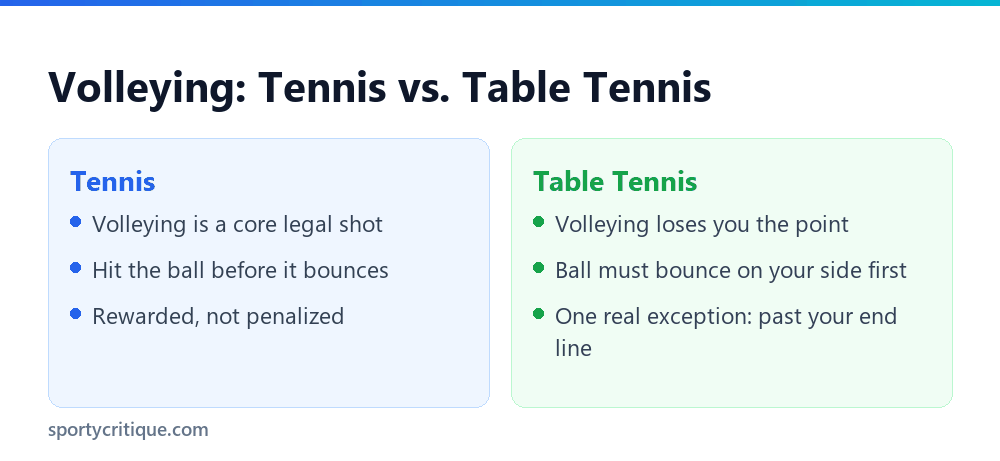
No — volleying loses you the point in table tennis. Unlike tennis, the ball must bounce on your side before you hit it. But the actual rule is about obstruction, and it contains an exception worth knowing: if the ball has already passed your end line and can no longer land, touching it is legal — and if their shot was flying long, the point is yours.
This is the rule that catches everyone arriving from tennis, badminton or squash. The ball floats invitingly at chest height, your whole body says hit it, and the moment you do, you’ve given away a point you were probably about to win anyway.
- →Volleying isn’t a separate rule — it’s covered by obstruction
- →The ball must bounce on your side before you strike it
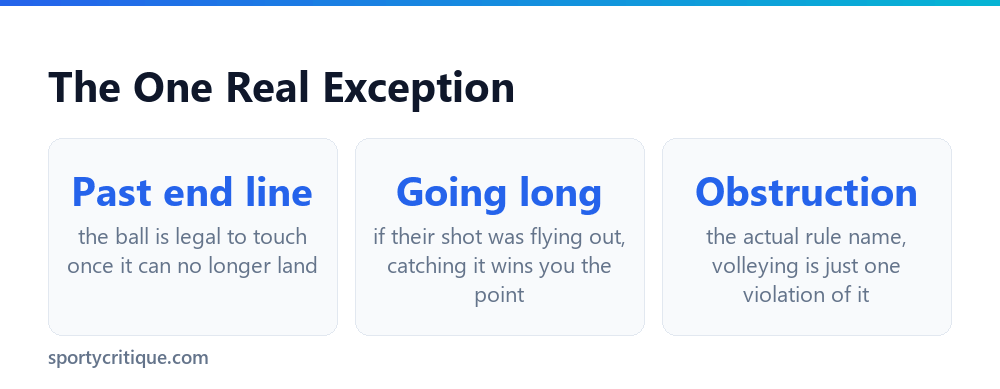
- →The exception: a ball that has passed your end line can be touched freely
- →If their shot was going long and you catch it behind the table, you win the point
- →The rule exists to protect what makes table tennis interesting: spin surviving the bounce
Table of Contents
What the rule actually says
The word ‘volley’ doesn’t appear in the official laws. What exists is obstruction, and it works like this: you obstruct the ball if you — or your racket, or anything you’re wearing — touch it when it is above or travelling toward the playing surface, before it has bounced on your side.
Obstruction isn’t about where you’re standing. It’s about whether the ball still had a chance to land.
That single sentence resolves almost every argument about this rule. A ball hovering over the table still has a chance to land — touch it and you’ve obstructed. A ball that has sailed past your end line has no chance to land — touching it changes nothing, so it isn’t obstruction.
Three situations, three different answers
- Obstruction
- Point to your opponent
- It still had a chance to land
- Felt amazing. Cost you a point.
- Legal — your point
- It had passed your end line
- It could never have landed
- This is the exception in action
- Obstruction
- Point to your opponent
- Still above the playing surface
- Wait for the bounce, however tempting
⚠️ Watch out: The judgment call is trajectory, not position. Umpires assess whether the ball could still legally land — and ‘clearly past the end line and travelling away’ is the standard. Which is why you’ll see players confidently catch obvious overshoots, and never touch anything borderline. When in doubt, let it land or let it pass.
Why the rule exists at all
Rules like this usually have a reason, and this one is genuinely important to the sport’s identity.
Without it, a tall player could simply stand at the table and swat everything out of the air before it landed. Rallies would become a reach contest. Worse, the entire spin element of table tennis would vanish — because spin only reveals itself at the bounce.
A heavy topspin loop kicks forward off the table. A backspin chop skids and stops. A sidespin serve curves away. All of that happens in the moment the ball meets the surface, and none of it exists if the ball is intercepted mid-flight. Ban the bounce and you’ve deleted the reason the sport is interesting.
The related rules people also get wrong
Obstruction sits in a cluster of rules that surprise players from other racket sports. Worth knowing all of them together:
The around-the-net shot is the one people refuse to believe. The rules say the ball must pass over or around the net assembly — so a wide ball that curves around the outside of the net and lands on the table is completely legal, and one of the most spectacular shots in the sport. Full details of all of these live in our complete rules guide.
Coming from tennis? Here’s what changes
Tennis players adapt to table tennis faster than most — the timing instincts transfer, and the strokes rhyme. But three habits actively work against you:
- ✓Let every ball bounce, always
- ✓Wait for the ball to reach the top of its bounce
- ✓Read spin from your opponent’s racket motion, not the ball’s flight
- ✓Stay close to the table — the geometry is tiny compared to a court
- ✕Volley anything, ever — it’s a point against you
- ✕Serve overhand — table tennis serves are struck below the table’s height rule
- ✕Take a full tennis backswing — there’s no room and no time
- ✕Assume ‘in’ means the same thing — the edge counts, the side doesn’t
💡 Pro tip: The habit that takes longest to break: stepping into the ball to take it early, tennis-style. In table tennis that puts you too close to your own contact point, cramps the stroke, and — if you’re early enough — becomes obstruction. Stay back a step and let the ball come to you.
What to do instead when the ball comes at you high
The volley instinct usually fires in one specific situation: a ball floating toward you at chest height, apparently unmissable. Here’s the legal way to punish it.
📊 Note: The frustration of watching a perfect ball bounce before you can hit it fades quickly, because the bounce almost always improves your position. You get more time, more height, and a bigger target. The rule isn’t taking a shot away from you — it’s giving you a better one a half-second later.
Calling it in casual play (where there’s no umpire)
Almost nobody reading this has an umpire. So the practical question isn’t what the rule says — it’s how to handle it at a club table or in someone’s garage when it happens and both players saw something different.
The convention is self-calling, and it leans generous. Table tennis has an unusually strong culture of players calling faults against themselves — you’ll routinely see club players award a point to their opponent for something nobody else noticed. If you touched the ball and you know it, say so. It costs one point and buys a reputation that’s worth considerably more.
For genuinely ambiguous cases — the ball was near the end line, both of you were watching different things — the standard resolution is simply to replay the point. No arguing, no reconstructing trajectories from memory. It’s a let, take it again, move on. Anyone who fights hard for an ambiguous point in a friendly game has misunderstood what a friendly game is for.
The one thing worth agreeing before you start, especially with mixed-experience groups: whether you’re playing that a ball hitting a player is automatically their loss (it is, under the rules) and whether edge balls count (they do). Those two produce more garage-table arguments than every other rule combined, and thirty seconds of agreement beforehand prevents all of them.
A quick note on where this comes from
Table tennis began as an indoor imitation of lawn tennis in 1880s England — books for a net, cigar-box lids for bats. Almost every early rule was borrowed directly from tennis, and the sport spent decades gradually diverging as it discovered what made it distinct.
The obstruction rule is one of those divergences: the moment the sport decided it was a spin game rather than a miniature tennis game, banning the volley became inevitable. Everything interesting in modern table tennis — the loop, the chop, the sidespin serve — depends on the ball touching the table. That history is covered properly in our history of table tennis and our table tennis vs ping pong explainer.
- →Complete ping pong rules — scoring, serving, faults, doubles
- →Serving rules — the most-broken rules in casual play
- →How to smash — what to do with that high ball instead
- →Doubles rules — where the rules change again
Frequently asked questions
Can you hit the ball before it bounces in ping pong?
No — that’s obstruction and it costs you the point. The ball must bounce on your side of the table first. The only exception is a ball that has already passed your end line and can no longer land.
What happens if I catch a ball that was going out?
If it had clearly passed your end line, the point is yours — their shot was going long and touching it doesn’t change that. If it was still over the table, you’ve obstructed and lost the point.
Is it obstruction if the ball hits my clothing?
Yes. Anything you wear counts, and the ruling is the same as if you’d hit it with your hand. Which is also why a ball that hits you anywhere, even when it was going out, is a point against you.
Can I hit a ball that bounces back over the net?
Yes — if backspin brings the ball back over to your opponent’s side, you may reach over and play it, as long as you don’t touch the net or the table.
Is a ball around the side of the net legal?
Completely. The rules say over or around the net assembly. It’s spectacular and it’s legal.
Why can’t you volley in table tennis when you can in tennis?
Because table tennis is a spin sport and spin reveals itself at the bounce. Allowing volleys would erase the difference between a loop, a chop and a flat drive.
Does the obstruction rule apply in doubles too?
Yes, identically — plus the doubles-specific rules about alternating shots and diagonal serves.

Ping Pong Reviewed is an equipment review site covering table tennis and baseball gear. Specifications are checked against manufacturer listings, and prices against live retail pages, before publication.