The Most Expensive Ping Pong Paddles (And Why Butterfly Isn’t the Ceiling)
A fully assembled professional setup runs $250–450: a premium blade at $150–350 plus two flagship rubbers at $95–120 each. Butterfly’s Dignics line (from $93.99, with Dignics 05 at $104.99) is the famous ceiling — but it isn’t the actual one. DHS’s national-team rubbers cost more, and almost nobody outside China knows they exist.
You can buy a paddle for the price of a sandwich, so a $350 blade with no rubber on it sounds like a joke at your expense. It mostly isn’t — there’s real engineering in there. But the gap between ‘expensive’ and ‘better for you’ is enormous, and it’s where most equipment money gets wasted.
- →A pro setup is $250–450 assembled, and rubbers are a consumable — pros replace them monthly or faster
- →Butterfly isn’t the ceiling — DHS’s provincial and national-grade Hurricane rubbers cost more
- →You’re paying for exotic composites, hand assembly and tolerance matching
- →Below advanced level, premium gear usually makes you worse, not better
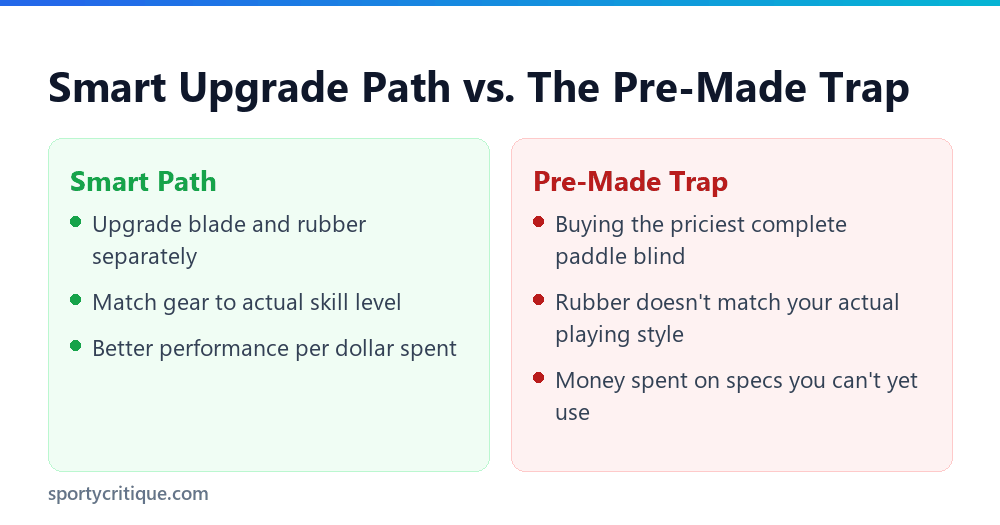
- →The smart upgrade path costs about $120 and beats a $400 impulse buy
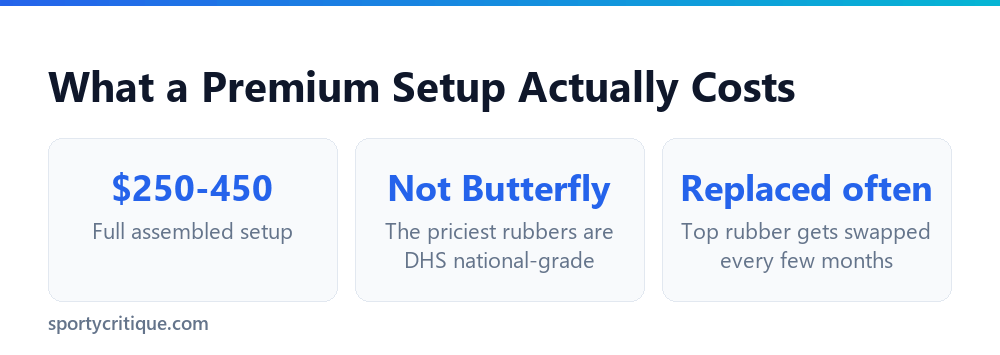
Table of Contents
What the top of the market actually costs
The plot twist: Butterfly isn’t the most expensive
Ask anyone what the priciest table tennis rubber is and they’ll say Butterfly. Dignics is the famous name, the marketing is everywhere, and $105 for a single sheet of rubber is a number that sticks in the memory.
The genuinely most expensive rubbers you can buy are made by DHS — and most Western players have never seen one for sale.
Here’s why almost nobody knows this. DHS’s Hurricane rubbers exist in grades — commercial, provincial and national — and they are not the same product despite sharing a name. The commercial version sells for $25–40 in any Western shop. The provincial and national versions are hand-selected sheets, made to tighter tolerances, sometimes with different sponge hardness specs, and produced primarily for the Chinese team system rather than retail.
When they reach the open market they command $100–150 and beyond, sometimes considerably more for a specific batch with a reputation. They’re bought by serious players who care intensely about sponge hardness consistency, and they’re effectively invisible to the recreational market — which is why the ‘most expensive paddle’ question almost always gets answered wrong.
⚠️ Watch out: Grade confusion is the most expensive mistake in Chinese rubber. A buyer sees ‘Hurricane 3’ at $30 and ‘Hurricane 3’ at $130 and assumes one is a rip-off. They’re different products with the same name. The cheap one is genuinely excellent for learning spin; the expensive one is a specialist tool selected for a specific playing profile.
Why premium gear costs what it does
- ZL-carbon, arylate-carbon weaves
- Speed without killing feel
- Materials cost real money
- Plies assembled by hand
- Weight matched within grams
- Balance points checked
- The rejects become cheaper models
- This is much of the premium
- Tensioned sponge, engineered
- Genuine R&D, not marketing
- Dignics/Tenergy really are different
- Short shelf life by design
- Champion endorsements
- Sponsorship budgets
- Distribution margins
- Some of it is simply brand
Tolerance matching deserves the emphasis. When a manufacturer builds a batch of blades, they vary — in weight, in balance, in stiffness. The ones that land closest to spec become the flagship model at flagship prices. The ones that drift become mid-range models. You are, in a real sense, paying for consistency rather than raw performance, and for a professional playing thousands of hours a year, consistency is worth more than almost anything.
Does expensive gear actually make you better?
Honest answer, and it’s the part the retailers won’t lead with: below advanced club level, premium equipment usually makes you worse.
Fast carbon blades punish imperfect technique by amplifying every timing error — a mishit that a flexible wooden blade would absorb becomes a ball flying off the end. Flagship rubbers are faster and less forgiving in exactly the same way. Give a developing player a $400 setup and their error rate goes up while their feel goes down.
The upgrade path that actually works
💡 Pro tip: Where $200 genuinely goes furthest: a $100 setup, quality 3-star balls, and a few months of club fees or a handful of coaching sessions. That combination will improve you more than a $200 blade — every time, without exception.
The expensive pre-made paddle trap
There’s a whole category of gear that looks premium, costs premium money, and is a genuinely poor buy — and it catches gift-buyers and enthusiastic beginners constantly.
Expensive pre-made paddles — the sealed-blister-pack rackets at $80–150 with impressive branding, carbon graphics and a case included — occupy an awkward dead zone. At that price you could assemble a custom setup with a real blade and rubbers chosen for your game. What you get instead is a factory-glued unit where the rubber is usually the manufacturer’s cheapest, the blade is unremarkable, and nothing can be replaced when the rubber dies in a year.
The economics are brutal when you look closely. A $120 pre-made might contain perhaps $40 of components. The same $120 spent on a Stiga or Yasaka blade with a mid-range tensor rubber buys genuinely better equipment that you can maintain, re-rubber, and keep for a decade. The pre-made is convenience packaging sold at a performance price.
Where pre-mades are the right answer: under about $50, for beginners and casual play, where the alternative is nothing. That end of the market is honestly served and the paddles are fine. It’s the $80–150 tier that’s selling the appearance of seriousness rather than the substance of it.
Beyond equipment: the collector’s end
There’s a category above all of this that isn’t really about playing at all. Limited editions, signed blades, anniversary models and novelty paddles with precious-metal inlays have sold for four and five figures — and occasionally a lot more.
These are memorabilia. A gold-plated paddle isn’t a fast paddle; a blade signed by a world champion doesn’t loop better than the identical unsigned one. The market for them is collectors, gift-buyers and display cases, and there’s nothing wrong with any of that — it’s simply a different hobby that happens to share a shape with yours.
📊 Note: Worth knowing if you’re buying a gift: a $60–90 mid-range setup from a recognisable brand looks and feels genuinely premium to a recreational player, plays beautifully, and won’t make them worse. A $300 pro blade will impress them for an evening and frustrate them for a year.
The cost nobody budgets for
The sticker price is the smaller half of the story. Rubber is a consumable, and the better it is, the faster it dies.
Flagship rubbers lose their edge in months — sometimes weeks under heavy training — because the tensioned sponge that makes them explosive also relaxes with use. A serious club player replacing two flagship sheets twice a year is spending $400 annually on rubber alone, on top of the blade. Professionals change rubbers monthly or more often, which puts their real equipment cost into the thousands per year.
This is the practical argument for mid-range gear that has nothing to do with performance: a $35 rubber that lasts a year costs a tenth of a $105 rubber replaced quarterly, and for most players the difference in results is roughly zero. Keeping what you have alive helps too — our paddle cleaning guide covers how much life a routine wipe actually adds.
- →Paddle reviews — the mid-range picks that punch above their price
- →Rubber guide — what actually changes between tiers
- →Brands explained — including the tacky vs tensor divide
- →Paddle care — make what you own last longer
Frequently asked questions
What is the most expensive ping pong paddle?
For playable equipment, a premium blade at $150–350 plus two flagship rubbers at $95–120 takes a full setup to roughly $450. DHS national-grade Hurricane rubbers push the rubber ceiling higher than Butterfly’s Dignics, despite being far less famous. Above that sits collector memorabilia, which isn’t really equipment.
Why are table tennis rubbers so expensive?
Engineered tensioned sponge, genuine R&D, hand assembly, tight tolerance selection — and a short usable life by design. You’re buying a consumable performance part, closer to tyres than to a racket.
Is Dignics worth the money?
For advanced players who can access what it offers, genuinely yes — it’s not just an expensive Tenergy. For anyone below that level it’s fast, unforgiving and expensive, and a $35 tensor will produce better results.
What’s the difference between commercial and national-grade Hurricane?
Selection and specification. National and provincial grades are hand-picked sheets made to tighter tolerances for the Chinese team system. Same name, different product, roughly four times the price.
How long does an expensive rubber last?
Two to six months for a club player, weeks under heavy training. Premium tensioned rubbers arguably die faster than cheap ones — the property that makes them explosive is the property that fades.
Should I buy an expensive paddle as a gift?
No. A $60–90 mid-range setup feels premium, plays well and won’t frustrate the recipient. Pro-level gear makes recreational players worse.
Do professionals pay for their equipment?
Overwhelmingly no — they’re sponsored, and often use hand-selected or specially prepared versions not sold in shops. Which is worth remembering whenever a price is justified by ‘it’s what the pros use’.
Is a used premium blade a good way to save money?
Often yes, and it’s an underrated route. Blades last years and don’t degrade the way rubbers do — a second-hand flagship blade at half price is usually a genuine bargain, provided the handle is sound and there’s no delamination at the edges. Check for chips, listen for a dull sound when you tap it, and never buy one with rubber already glued on unless you can see the blade face underneath.
How much should I spend on my first serious paddle?
Around $80–150 for a custom blade-and-rubber setup, which is the biggest quality jump available at any price point. Spending more before you’ve developed consistent technique buys you speed you can’t yet control, and spending less keeps you on equipment that mutes the feedback you’re trying to learn from.

Ping Pong Reviewed is an equipment review site covering table tennis and baseball gear. Specifications are checked against manufacturer listings, and prices against live retail pages, before publication.