Illegal Serves in Ping Pong: 7 Ways Players Break the Rules
Most casual players have never hit a legal serve. The seven common violations: no toss (serving from the hand), spinning the toss, hiding the ball, striking it over the table, serving below table height, quick-serving an unready receiver, and in doubles, serving to the wrong court. Each one hands your opponent a point in any refereed match.
Here’s an uncomfortable thing to discover at your first tournament: the serve you’ve used for fifteen years doesn’t exist under the rules. Not a variation of it — it isn’t a serve at all, and an umpire will call it every single time.
- →The serve is the only shot your opponent can’t influence — which is why it’s the most regulated
- →Every rule exists to stop the server gaining an unfair informational advantage
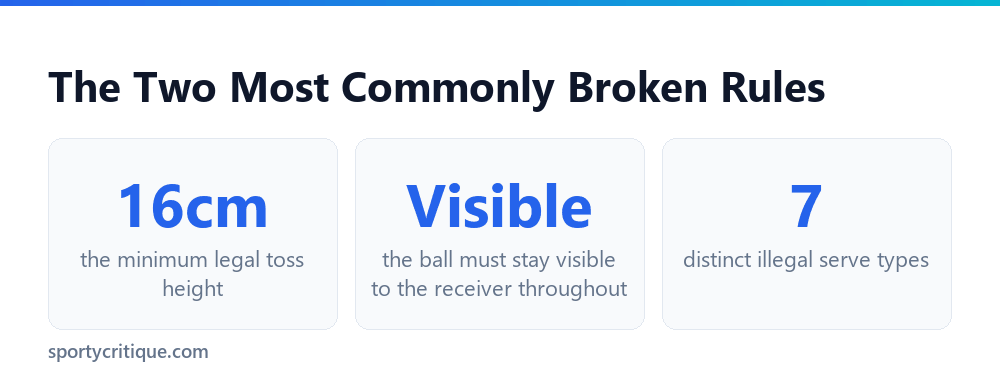
- →The 16 cm toss and visibility rules are the two most commonly broken
- →Casual play breaks all seven constantly — and that’s fine until it isn’t
- →Legal serves can still be devastating: spin comes from contact, not from cheating
Table of Contents
The seven illegal serves, in order of how often they happen
Why these rules exist
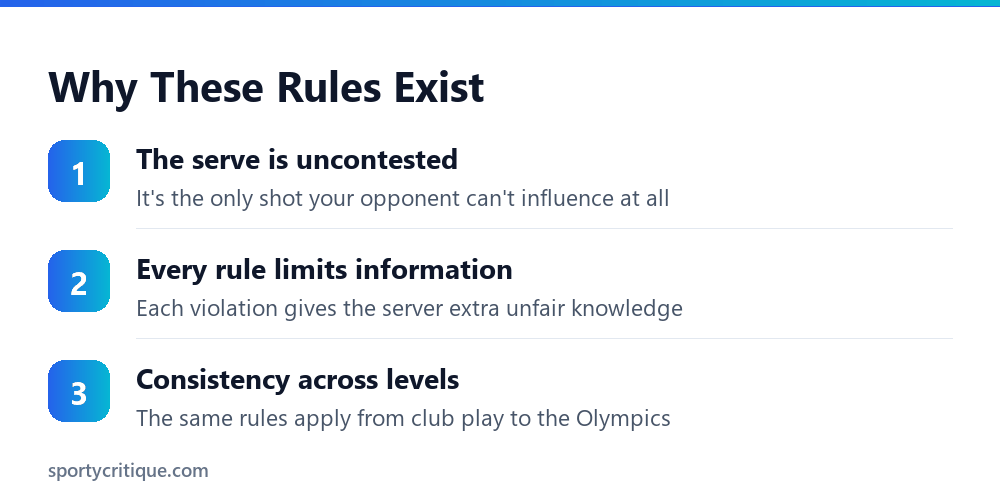
Every one of them traces back to a single principle: the serve is the only shot in the sport your opponent cannot influence. You choose the spin, the placement, the speed, and the timing, and they must simply deal with whatever arrives.
The rules don’t limit how good your serve can be. They limit how much you can hide about it.
Read them again with that in mind and they stop being arbitrary. The toss requirement means the ball has a predictable, observable flight before you strike it. The visibility rule means the receiver can see your racket meet the ball. The behind-the-line rule means you can’t shorten the distance. Every rule is about information — making sure the receiver can see what’s happening and has a fair chance to read it.
The hidden serve ban: the rule that changed professional table tennis
Before 2002, hiding the serve was legal — and elite players built entire careers on serves the receiver genuinely could not read. The ball would disappear behind a shoulder or a sweeping arm, emerge with unknown spin, and the return was close to guesswork.
Then the ITTF required the ball to remain visible throughout. The effect was immediate and enormous: an entire generation of professionals had to rebuild their serves around spin that could be seen but not solved, rather than spin that couldn’t be seen at all.
It’s arguably the most skill-altering rule change in the sport’s history — more consequential than the 40mm ball or 11-point games, because it removed a weapon rather than adjusting a parameter. The full sequence of modern rule changes is covered in our history of table tennis.
📊 Note: This is why professional serves look so exaggerated and open today — the wide arm, the obvious ball, the deliberate display. Players aren’t showing off; they’re demonstrating legality to an umpire who is specifically watching for concealment.
What actually happens if you serve illegally
⚠️ Watch out: There is no second serve in table tennis. Unlike tennis, a fault doesn’t give you another attempt — it’s simply your opponent’s point. That makes the stakes on serve legality higher than newcomers assume: an illegal serve isn’t a do-over, it’s a donation.
Fixing your serve (before it costs you)
The good news: a legal serve is not a weaker serve. The bad news: if you’ve spent years on an illegal motion, rebuilding it takes a few weeks of feeling incompetent.
- ✓Rest the ball on a flat, open, still palm
- ✓Toss at least 16 cm, near-vertically
- ✓Keep your free arm out of the way after the toss
- ✓Contact the ball behind the end line, above table height
- ✓Practise the legal motion from day one if you’re new
- ✕Serve out of your fingers or cupped hand
- ✕Spin the ball as you toss it
- ✕Screen the ball with your shoulder or arm
- ✕Lean over the table to place a short serve
- ✕Assume ‘nobody calls it’ means it’ll never be called
💡 Pro tip: Film yourself. Thirty seconds of phone video from the receiver’s angle tells you more about your serve’s legality than any amount of reading. Almost everyone who does this discovers at least one violation they were completely unaware of — usually the toss height or a drifting free arm.
What to do when your opponent serves illegally
This is the awkward half of the topic, and it comes up constantly at club level. Someone is serving out of their hand with a screened ball, they’ve done it for a decade, and you have to decide what kind of evening you want to have.
In a friendly game: usually let it go. Correcting someone’s serve mid-game rarely lands well, and ‘actually, that’s illegal’ is a sentence that has never once improved a casual match. If it genuinely bothers you, raise it afterwards and frame it as useful information rather than an accusation — most people are genuinely surprised, and quite a few are grateful to learn it before a tournament embarrasses them.
In league or tournament play, it’s different. There’s a proper channel: you ask the umpire to watch the serve, or in an unumpired league match you raise it politely with your opponent before the next serve — not after you’ve lost the point, which reads as sour grapes. Say what you’re seeing specifically (‘I can’t see the ball at contact’) rather than delivering a verdict.
And be honest about the mirror. Most players complaining about illegal serves have at least one violation of their own — usually the toss. Film yourself before you appoint yourself as an enforcer; there’s a decent chance the exercise ends the complaint.
The three-question self-test
Run through these next time you serve. Three yeses and you’d survive an umpire:
- Does the ball rise at least six inches off a flat, open palm? Not two, not ‘roughly’ — six.
- Is your free arm clear of the space between the ball and the receiver at contact?
- Is contact behind the end line and above the table’s surface?
Anything less than three and you’re gifting points in league play. Fix them in that order — the toss is both the most commonly broken and the easiest to correct, and once it’s habitual the others tend to follow.
- →Full serving rules — the complete legal requirements
- →Spin guide — where deception legally comes from
- →Complete rules — scoring, faults, lets and doubles
- →Drills — the target-serving routine that builds three reliable serves
Frequently asked questions
How high do I have to toss the ball?
At least 16 cm — about 6 inches — and near-vertically, from a flat open palm. Umpires genuinely watch for this and it’s the most commonly broken serve rule in the sport.
Is it illegal to hide the serve?
Yes, since 2002. The ball must remain visible to the receiver throughout. It’s the rule that forced professionals to rebuild their serves around visible spin.
Can I serve anywhere in singles?
Yes — the diagonal requirement applies only to doubles. Many casual players believe the opposite, which is one of the most widespread false rules in the sport.
What happens if my serve hits the net and lands in?
That’s a let — replay it, as many times as it happens. There’s no limit and no penalty.
Do I get a second serve like tennis?
No. A fault is simply your opponent’s point. Table tennis has no second-serve safety net, which is why professional serves are more conservative than they look.
Will anyone actually call these in a friendly game?
Usually not — casual play breaks all seven rules constantly and nobody minds. The problem is that habits built over years don’t survive a tournament, and by then it’s too late to rebuild quickly.
Does a legal serve have to be weaker?
Not at all. Spin comes from racket contact, and nothing in the rules limits it. Every devastating professional serve you’ve ever seen is fully legal.
How long does it take to rebuild an illegal serve?
Two to four weeks to feel normal, longer to feel dangerous. Expect your serve to be genuinely worse for the first fortnight — you’re replacing an automatic motion with a deliberate one, and deliberate is always slower. Almost everyone who pushes through says they ended up with a better serve than they started with, because legal contact forces you to generate spin properly rather than relying on concealment.
Are serve rules the same for children and juniors?
The laws are identical at every level, though umpires in junior events are usually more inclined to warn and explain than to penalise immediately. Which is a strong argument for teaching kids the legal motion from their very first session — it costs nothing when they have no habits to unlearn, and it saves them the rebuild later.

Ping Pong Reviewed is an equipment review site covering table tennis and baseball gear. Specifications are checked against manufacturer listings, and prices against live retail pages, before publication.