Best Air Hockey Ping Pong Table Combo (2026 Verified Picks)

An air hockey and ping pong combo table involves a tradeoff worth accepting upfront: it is rarely as good at either game as a dedicated table built for one. That is not a reason to avoid them — for a family room where space allows one table and not two, the compromise is usually worth it — but it should shape what you expect. Below are three combo tables verified against live listings, from compact budget to full-size premium.
The Real Tradeoff of a Combo Table
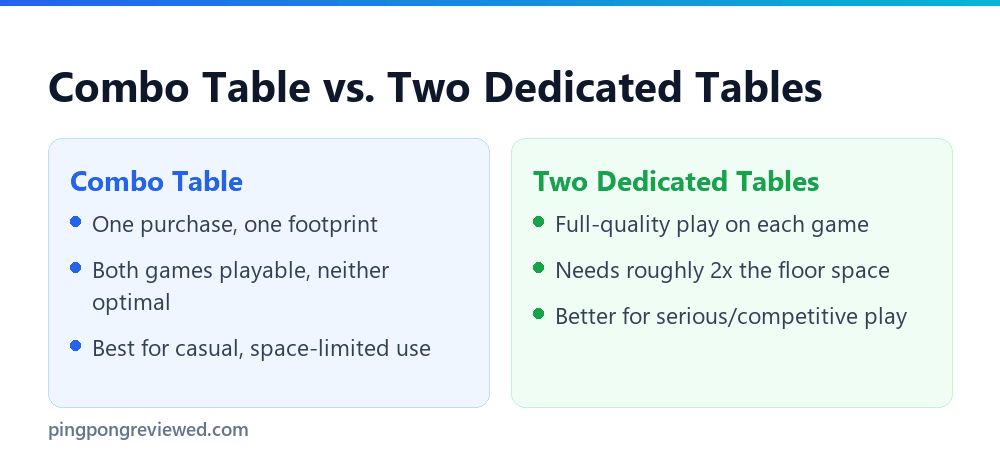
A combo table’s table tennis surface is almost always thinner and less consistent than a dedicated table tennis table, and the air hockey surface is usually smaller than a standalone air hockey table. That’s the honest cost of fitting two games into one footprint. If either game is a serious, regular priority rather than casual family fun, a dedicated table for that specific game — see our ping pong table guide — will outperform any combo option.
The 3 Verified Picks
1. Best Choice Products Combo Game Table Set — Best Budget
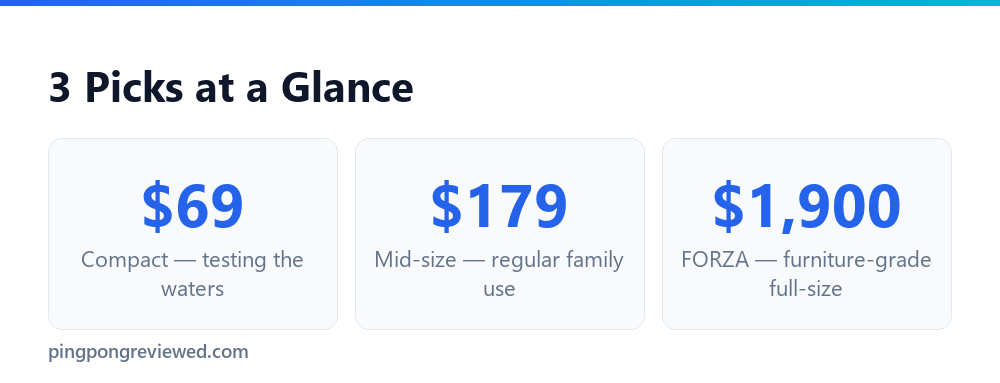
Best Choice Products Combo Game Table Set, $69, is a compact multi-game set covering ping pong, foosball, air hockey, and several other games in one small footprint. The most affordable genuine multi-game option we verified — expect toy-grade rather than serious build quality at this price.
2. Best Choice Products Combo Game Table Set (Larger) — Best Mid-Size
Best Choice Products Combo Game Table Set, Larger Size, $179, is the same product line at a larger size, giving more realistic playing dimensions for both air hockey and table tennis without reaching full-size, full-price territory. A reasonable middle ground for a family game room getting genuine regular use.
3. FORZA 4-in-1 Multi-Game Table — Best Premium Full-Size
FORZA 4-in-1 Multi-Game Table, $1,899.99, is a genuine full-size 7ft table covering pool, air hockey, table tennis, and a flat tabletop mode, with a furniture-grade driftwood finish built to actually live in a game room rather than get put away between uses. The pick for buyers who want combo convenience without a toy-grade compromise on build quality.
Quick Price Reference
What We Checked and Skipped
A caution about this category: several combo models that appear on most guides — specific Lancaster, Fat Cat, Hathaway and Atomic units among them — have no live, matching Amazon listing we could verify, so expect dead ends while shopping. One that is genuinely live, the Sports Illustrated 35″ 4-in-1, carries a 1.0-star rating from verified buyers. It is mentioned here rather than quietly omitted, because seeing it in stock and cheap without knowing its review history is exactly how people end up disappointed.
This kind of gap is common in the combo-table category specifically, more so than in single-purpose table tennis or air hockey tables individually. A product that combines two games into one SKU is more likely to get discontinued, reissued under a slightly different name, or replaced by a newer model than a simpler single-game product, which is exactly why checking live availability individually matters more here than it might for a more stable product category.
What Actually Matters When Buying a Combo Table
Size and Scale
Combo tables scale down both games to fit one shared surface, so check the actual playing dimensions for each game separately rather than assuming “combo” means full regulation size for both. A 6-7ft combo table plays noticeably different table tennis than a true 9x5ft regulation table.
Surface Switching
Most combo tables use a flip-top or slide-away mechanism to switch between games. Check how many people it takes to switch — some genuinely need two people to flip a heavier tabletop safely, which matters if you’re switching games mid-session with kids around.
Included Accessories
Confirm what’s actually included — pucks, pushers, paddles, and balls are usually bundled, but net/post sets for the table tennis side are sometimes a separate purchase on budget combo tables specifically.
Build Quality vs. Price
This category splits sharply between toy-grade budget sets (under $200) and furniture-grade premium tables ($1,500+), with not much genuine mid-range in between on Amazon specifically. Set expectations accordingly rather than assuming a $300-500 combo table exists in meaningful supply.
Who Actually Fits Each Tier
Compact Budget Tier
Best for a household testing whether a combo table gets genuine regular use before investing more, or a smaller space where even a mid-size combo table wouldn’t comfortably fit. Expect basic materials and a shorter realistic lifespan than the tiers above it.
Mid-Size Tier
Best for a family game room that will see combo-table use several times a week rather than occasionally — the larger playing surface genuinely changes how both games feel compared to the compact tier, without the cost or space commitment of a full-size premium table.
Full-Size Premium Tier
Best for a dedicated game room where the table stays set up permanently and gets heavy, repeated use across multiple games. The furniture-grade build quality at this tier is built to last years of regular play rather than months of occasional use.
Assembly and Setup
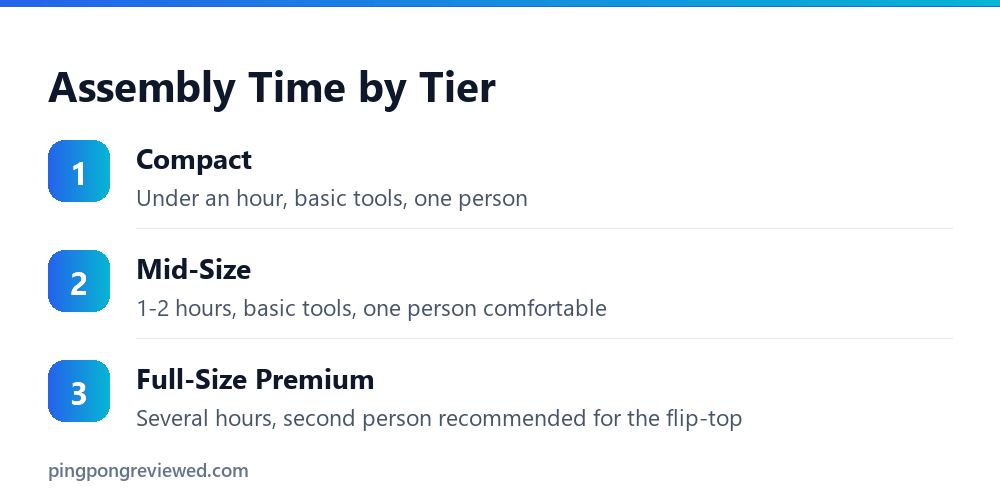
Combo tables generally take longer to assemble than a single-game table, since there’s more hardware and often a flip-mechanism to install correctly. Budget compact sets typically assemble in under an hour with basic tools; the full-size premium tier can take several hours and often benefits from a second person, particularly when maneuvering a heavier flip-top tabletop into place.
Before starting, confirm you have enough clearance not just for the table’s footprint but for whichever game mode isn’t currently in use — a flip-top table needs headroom above it to actually flip, which is easy to overlook when measuring just the floor footprint.
Keeping a Combo Table in Good Condition
- Clean the air hockey surface regularly — dust buildup on the playing surface directly reduces puck glide and speed.
- Check the flip mechanism periodically for loose hardware, since it takes more mechanical stress than a fixed single-game table.
- Store accessories in one place — pucks, pushers, and paddles are easy to misplace across a household when the table serves multiple games.
- Cover the table when not in active use, especially the table tennis surface, which is generally the more delicate of the two game surfaces on a combo table.
How Combo Tables Actually Work
Multi-game tables achieve their versatility in one of a few ways, and which one a table uses determines nearly everything about how good it is at each game.
- Swivel or flip designs rotate a two-sided top to present a different playing surface. Generally the most solid approach, since each surface is purpose-built, but heavier and usually more expensive.
- Conversion tops lay one playing surface over another. Cheapest and most common, but the upper surface is only as level as what it rests on, and storage of the removed top becomes your problem.
- Modular multi-game units swap several inserts. Maximum game count, and typically the weakest at any individual game.
The trade-off is consistent across all of them: a combo table is meaningfully worse at each individual game than a dedicated table at the same price. What you are buying is breadth and floor space efficiency, which is a legitimate thing to want, particularly for a family room where nobody is playing any of the games seriously.
The Air Hockey Half: What to Check
Air hockey quality on a combo table comes down almost entirely to the blower and the surface, and these are where budget tables economise hardest.
The blower creates the air cushion the puck floats on. A weak blower produces a puck that drags and stalls, which is the single most common complaint about cheap air hockey surfaces. Motor power is usually quoted, but the more telling detail is whether the air holes are evenly distributed and unblocked, since even a strong blower produces dead zones if the surface is poorly drilled.
Surface flatness matters as much. A slightly warped or insufficiently rigid playing surface produces a puck that drifts consistently toward one area, which becomes obvious within minutes of play and cannot be fixed afterwards.
Scoring systems on combo tables are usually electronic and are frequently the first component to fail. It is worth knowing that a failed scorer does not stop the table being usable, which makes it a less serious concern than blower or surface quality.
Space, Weight and Practical Ownership
Combo tables are frequently bought for space efficiency and then turn out to have practical requirements buyers had not anticipated.
The playing footprint is only part of it. You need clearance around the table for table tennis specifically, which is more than air hockey requires, and if the table converts by swivelling you need room for that motion as well as for play.
Weight is the other surprise. A combo table containing two playing surfaces plus an air hockey blower and its electronics is substantially heavier than a comparable dedicated table, which matters if you intend to move or fold it regularly. Check whether the model has castors and whether one person can realistically operate the conversion, since many require two.
- Measure clearance for the largest game, not the smallest.
- Check conversion mechanism clearance if the top swivels or flips.
- Confirm where a removable conversion top will be stored, since that is a real object needing real space.
- Check the table’s weight and whether it has castors if it will ever be moved.
- Confirm a mains outlet is reachable, since the air hockey blower needs power.
None of these are reasons not to buy one. They are the details that determine whether the table gets used in both modes or quietly settles into whichever configuration is least trouble to leave it in, which is the common fate of a combo table in an awkward space.
Maintenance and What Fails First
Combo tables have more components than dedicated tables and correspondingly more that can go wrong, though most failures are minor and predictable.
- Air holes clogging is the most common air hockey complaint over time, and is usually dust rather than a failing blower. Periodic vacuuming of the surface prevents most of it.
- Electronic scorers are frequently the first thing to stop working, and are the least consequential, since the table remains fully playable.
- Conversion mechanisms loosen with repeated use. Checking and tightening fixings periodically keeps the playing surface level.
- Table tennis surface damage from the other game’s hardware, pucks and mallets are heavier than balls, and a knock that would not mark a dedicated table can dent a thinner combo surface.
That last point is worth taking seriously if the table tennis surface matters to you. Storing pucks and mallets off the table rather than on it prevents most of the damage, and is a habit worth establishing before the first dent rather than after.
Who a Combo Table Actually Suits
Being direct about this saves disappointment, because combo tables are bought by two quite different groups and only one of them is reliably satisfied.
They suit families and shared spaces where several people want several games occasionally, where floor space is genuinely limited, and where nobody is playing any of the games with serious intent. For that use they are excellent value, since buying separate tables would cost more and fit nowhere.
They do not suit anyone who plays table tennis seriously. A combo surface is typically thinner than a dedicated table tennis top, which produces a lower and less consistent bounce, and the conversion mechanisms rarely produce a perfectly level playing surface. If table tennis is the main event and the other games are an afterthought, a dedicated table from our main table guide will be better in every respect that matters.
The intermediate case, wanting a decent table tennis table that occasionally becomes something else, is usually best served by a dedicated table plus a conversion top rather than by an integrated combo unit. That way the table tennis surface is uncompromised and the second game is the one making the concession.
Alternatives Worth Considering First
Before committing to a combo unit, two other routes solve similar problems and are frequently better value.
A dedicated table plus a conversion top gives you an uncompromised table tennis surface with a second game laid over it. The compromise lands on the game you play less, which is usually the right way round, and the conversion top can be replaced or changed later without replacing the table.
A dedicated table plus a separate small air hockey table is worth considering if space genuinely allows, since small standalone air hockey tables are inexpensive and both games are then uncompromised. This only works where floor space is the lesser constraint.
The genuine case for an integrated combo remains real: one footprint, one purchase, several games, and no separate top to store. If that combination is what you need, a combo table is the right answer and the alternatives above are not.
Questions Buyers Ask
Is the table tennis surface as good as a dedicated table? Generally no. Combo surfaces are typically thinner, which produces a lower and less consistent bounce, and conversion mechanisms rarely produce a perfectly level playing surface.
Can one person set it up? Depends on the mechanism. Swivel designs are usually manageable alone; heavy conversion tops frequently are not. Check before buying if you will usually be converting it by yourself.
Does the air hockey need mains power? Yes, the blower requires it. Confirm an outlet is reachable from where the table will actually stand.
How many games do I actually need? Fewer than multi-game tables offer. Units advertising many games generally do each of them poorly, and the additional inserts tend to be used once and stored thereafter.
The Short Version
A combo table is a space and budget decision rather than a performance one, and it is an entirely sensible purchase for a family room where several games get played casually.
Check the blower and surface flatness rather than the feature list, since those determine whether the air hockey half is genuinely playable. Measure clearance for table tennis rather than for the table’s footprint. And keep pucks and mallets off the playing surface between games.
If table tennis is what you actually care about, buy a dedicated table and add a conversion top for the second game. That path costs similar money, and the compromise lands on the game you care less about rather than the one you play most.
Frequently Asked Questions
Can you put a ping pong table top on an air hockey table?
Some manufacturers sell a compatible table tennis top separately for their own air hockey tables, but this isn’t universal or interchangeable across brands — check the specific manufacturer’s accessory compatibility rather than assuming any table tennis top fits any air hockey table.
Are air hockey ping pong combo tables worth it?
For casual, space-limited family use, yes — one purchase and one footprint covering two games is genuinely convenient. For anyone taking either game seriously, a dedicated table for that specific game will outperform a combo table every time.
What is a regulation-size air hockey table?
Regulation air hockey tables run 8 feet long, though most home and combo tables are considerably smaller — commonly 6-7 feet — which is a genuine compromise on ball speed and gameplay feel compared to a true regulation table.
Is a 6ft air hockey table big enough?
For casual family and kids’ play, yes. For faster, more competitive play, a 6ft table plays noticeably slower and more cramped than the 7-8ft tables serious players prefer.
Why did this guide only feature 3 products instead of 9?
Because the combo category has an unusually high proportion of listings that are discontinued, unfulfilled or badly reviewed. Three tables individually confirmed as real, live and purchasable is a more useful list than nine names that mostly cannot be bought.
How much does a decent combo table actually cost?
The real market splits into two tiers rather than a smooth range: toy-grade compact and mid-size sets from roughly $69-$180, and furniture-grade full-size tables starting around $1,500-$1,900. There isn’t much genuine mid-range supply between those two tiers on Amazon specifically.
Do combo tables include the paddles, pucks, and balls?
Usually yes for the tiers covered in this guide, though it’s worth confirming on the specific listing before buying — budget sets occasionally sell net/post hardware separately even when paddles and balls are included.
How long does a combo table typically last?
Budget compact and mid-size sets are generally built for a few years of regular use before hinges, surfaces, or scoring mechanisms start to wear. Furniture-grade premium tables like the FORZA pick are built to a meaningfully higher durability standard and can reasonably last a decade or more with normal care.
Can one person set up a full-size combo table alone?
Basic assembly can often be done solo, but maneuvering a heavy flip-top tabletop into its final position is genuinely easier and safer with two people, particularly on the full-size premium tier where the tabletop itself is substantially heavier than on compact sets.
As an Amazon Associate, we earn from qualifying purchases through links on this page.

Ping Pong Reviewed is an equipment review site covering table tennis and baseball gear. Specifications are checked against manufacturer listings, and prices against live retail pages, before publication.