Ping Pong Doubles Rules: Serving, Rotation & Positioning
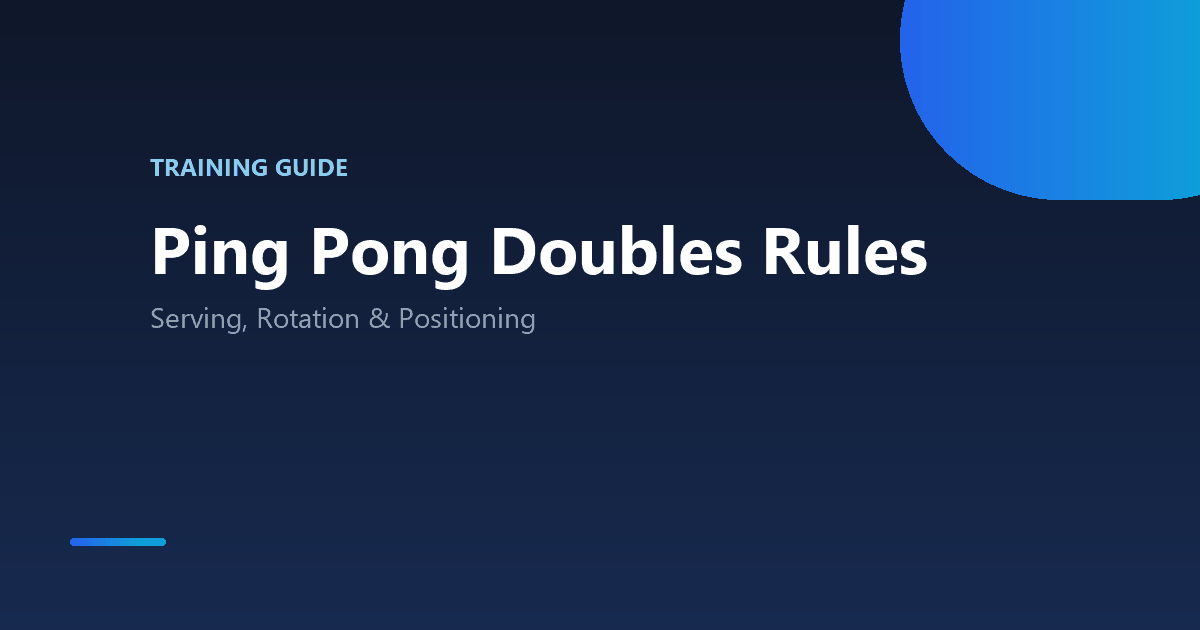
Quick Answer: Three rules change everything in doubles: serves must go diagonally (right half-court to right half-court), partners must alternate every shot, and the serving rotation cycles through all four players — the previous receiver becomes the next server. Get those three and doubles stops being confusing immediately.
Doubles turns table tennis into a different sport. The table is the same size but you’re sharing half of it, you’re not allowed to hit two balls in a row no matter how easy the second one is, and there’s a rotation system that reliably produces an argument in the third game.
Here’s all of it, including a full worked rotation cycle — the thing almost every explanation skips, and the reason people find this hard.
Table of Contents
The three rules that change the game
- Diagonal serves. From the right half of your side to the right half of theirs. Unlike singles, no exceptions ever. Serving to the wrong court is an outright point loss.
- Alternating hits. You, opponent, your partner, their partner — strict order, all rally long. If the same player strikes twice for their team, the point is lost. Even on a floating sitter your partner is somehow not moving toward.
- The rotation cycles through all four players, not just two — and this is the one everyone gets wrong.
A detail worth knowing on the first rule: the centre line belongs to the right half for serving purposes. A serve that clips the centre line is good. It’s a 3 mm painted line that exists only for this rule, and in singles it means nothing at all.
The rotation, worked all the way through
The rule in one sentence: the previous receiver becomes the next server, and the previous server’s partner becomes the next receiver. That sentence is correct and almost useless until you see it happen. So:
Anna & Ben play Xu & Yara. Anna serves first, to Xu. Serve changes every 2 points.
| Points | Server | Receiver | What just happened |
|---|---|---|---|
| 1–2 | Anna | Xu | Starting arrangement |
| 3–4 | Xu | Ben | Xu was receiving → now serves. Anna’s partner Ben receives |
| 5–6 | Ben | Yara | Ben was receiving → now serves. Xu’s partner Yara receives |
| 7–8 | Yara | Anna | Yara was receiving → now serves. Ben’s partner Anna receives |
| 9–10 | Anna | Xu | Full cycle complete — back to the start |
Look at what that produces: every player serves to exactly one opponent all game. Anna always serves to Xu. Ben always serves to Yara. Never the other pairing. That’s not a coincidence — it’s what the rotation is designed to do, and it’s why the next game flips the pairings when the receiving team chooses differently.
At 10–10, the rotation order stays exactly the same but the serve switches every single point rather than every two. Nothing else changes, which is a mercy.
💡 Assign one person to track it before the match starts. Genuinely — it’s the easiest job on the table and it eliminates every rotation argument. Most confusion in club doubles isn’t that people don’t know the rule; it’s that all four assumed someone else was keeping track.
Changing ends and the deciding game
Teams switch ends after each game, and the receiving pair chooses who receives first in the new game — which reshuffles the pairings, so the player who served to you last game won’t be serving to you this one.
⚠️ The deciding game is where doubles matches descend into chaos. When one pair reaches 5 points, teams switch ends — and the receiving pair also swaps who is receiving. Both things at once, mid-game, while everyone is tense. This is the single most commonly botched moment in doubles, and it’s worth rehearsing before it matters.
Positioning: the movement problem
The alternating-hit rule creates doubles’ real challenge, and it isn’t a rules problem — it’s a traffic problem. After you hit, your partner needs the space you’re standing in, immediately. Two adults trying to occupy the same square metre at speed is how doubles points are actually lost.
| System | How it works | Suits |
|---|---|---|
| The circle | Both players rotate in a loop — typically anticlockwise for two right-handers | Most right-handed pairs; the default |
| Side-to-side | Partners slide left and right past each other | Pairs with similar styles; simpler to learn |
| The T | One player covers wide, the other the middle | Mismatched pairs — a strong attacker with a steady blocker |
The circle is what you’ll see good pairs doing, and it looks like choreography because it is: hit, rotate out and back, arrive ready for your next ball. The key insight is that you move immediately after contact, not after watching your shot. Admiring a good shot in doubles doesn’t just cost you the follow-up — it blocks your partner’s.
Why left-handers are prized partners
A right-hander and a left-hander are the classic doubles pairing, and the reason is geometric: both players can take forehands from the middle of the table. Their forehand sides face outward, so the pair covers the whole table with strong wings and rotates without the two players’ hitting zones colliding.
Two right-handers both want the same forehand position, which means one of them is constantly playing backhands from an awkward spot or crossing through their partner’s space. It’s manageable and most pairs are two right-handers — but if there’s a lefty in your club looking for a partner, that’s a genuine competitive advantage sitting there for free.
Why the alternating rule exists (and what it does to the game)
It’s worth understanding the reasoning, because it explains why doubles feels the way it does rather than being an arbitrary irritation.
Without alternation, doubles would be singles with a spectator. The stronger player would simply take every ball, the weaker one would stand in the corner, and the format would test nothing that singles doesn’t. The rule forces every player to play every third ball, which means a pair is only as good as its weaker half — and that transforms both the tactics and the fairness of the format.
The knock-on effects are what make doubles its own sport. Because you know exactly who’s hitting next, you can target the player, not the space — put a ball at the feet of the weaker partner and there’s nothing their teammate can do about it. Because everyone must move after every shot, the game is as much about traffic management as stroke play. And because you only get every third ball, patience becomes structural: you cannot force the game single-handedly, so you set your partner up instead.
It also produces doubles’ signature agony: the ball floats up, sitting perfectly for a smash, and it isn’t your turn. You watch your partner mishit a shot you’d have buried. Every doubles player knows the feeling, and there is nothing whatsoever you can do about it except get better at putting them in position.
What actually changes from singles
| Singles | Doubles | |
|---|---|---|
| Serve target | Anywhere on their side | Diagonal only, right to right |
| Who hits | You, every ball | Strict alternation — every third ball is yours |
| Serve rotation | Every 2 points between two players | Every 2 points, cycling through all four |
| Court coverage | The whole table | Half — plus getting out of the way |
| Main skill | Movement and shot-making | Movement, positioning and setting up your partner |
| Biggest error | Bad shot selection | Blocking your partner |
Singles players moving into doubles almost always make the same mistake: they keep playing the ball as though the next one is theirs too. It isn’t. Every shot you hit is a gift or a problem for someone else, and the players who adjust to that fastest are the ones who suddenly find doubles easy while their more talented friends struggle.
Doubles tactics that actually work
- Serve short backspin. A long serve in doubles hands the receiver’s partner a free attack — you’ve fed a ball to a player who has time to set up. Short serves force a push, and a push is what you want. Toss requirements are in our serving rules guide.
- Target the incoming player’s recovery path, not the person who just hit. You know who’s next — put the ball where they haven’t finished moving to yet.
- Plan two shots ahead. Your placement decides what ball your partner faces. Selfish winners that leave your partner stranded lose more points than they win, and this is the hardest habit for singles players to break.
- Talk. ‘Short.’ ‘Long.’ ‘Yours.’ Doubles pairs who communicate beat better pairs who don’t, at every level below professional.
- Attack the middle. Between two players is where nobody’s forehand lives — and in doubles there’s an actual decision to make about whose ball it is, which takes time they don’t have.
How to practise doubles (nobody does this)
Almost every doubles pair’s entire preparation is playing doubles matches. That’s like preparing for a driving test exclusively by driving to work — you’ll get comfortable, but you won’t get better at the specific things being tested.
What actually helps, and none of it takes long:
- Rotation shadowing, no ball. Stand at the table with your partner and physically walk the circle rotation ten times. It feels silly for about ninety seconds and then it’s automatic. This alone fixes most collisions.
- Two-ball alternation drill. All four players, ball in play, but you must call your partner’s name before every one of their shots. Ridiculous, noisy, and it builds the anticipation that stops you both going for the same ball.
- Short-serve target practice. The diagonal short serve is doubles’ single most important shot and the one nobody drills. Box on the far right half-court, 20 serves, aim for short backspin that bounces twice. Our drills guide has the full routine.
- Third-ball with a partner rotation. Serve short, opponent pushes, your partner attacks. Notice how different that feels from doing it yourself — that’s the doubles skill in one drill.
- Deciding-game rehearsal. Genuinely: practise the 5-point switch with your partner once. It costs a minute and saves the match you’d otherwise lose to confusion at 5–4 in the fifth.
Fifteen minutes of this before you play beats another hour of matches, because doubles’ failures are specific and drillable. Most pairs never diagnose them because in a match everything blurs into ‘we lost’.
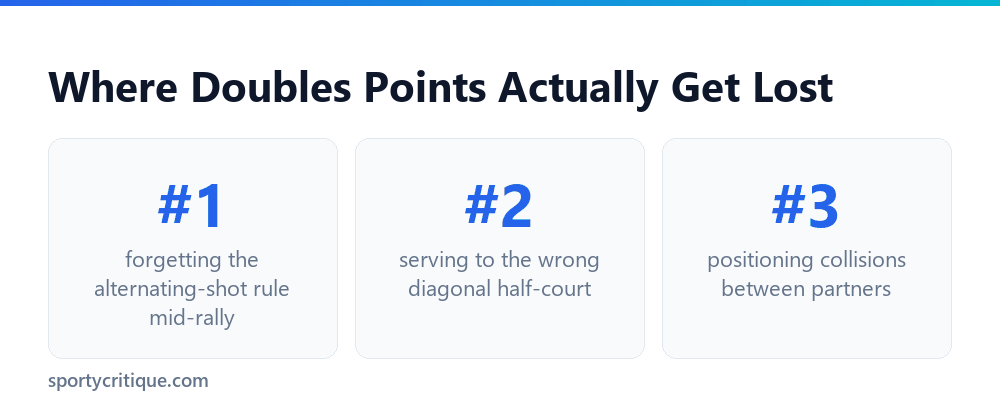
The mistakes that cost doubles points
| Mistake | What happens | Fix |
|---|---|---|
| Hitting out of turn | Instant point loss | Alternation is absolute. Even the easy ball is your partner’s |
| Freezing after your shot | You block your partner | Move immediately on contact — rotate, don’t watch |
| Serving long | Free attack for the opposition | Short backspin, every time, until you have a reason not to |
| Both going for the middle ball | Nobody hits it | Call it. Decide the convention before the match |
| Playing your singles game | You strand your partner | Half the table is theirs. Set them up |
| Nobody tracking the rotation | Arguments, lost points, bad feeling | Assign it before the first serve |
Frequently asked questions
Can either partner return the serve in doubles?
No — only the designated receiver may take the serve. After that return, strict alternation applies for the rest of the rally.
What if the ball hits my partner?
If the ball touches your partner when it wasn’t their turn — or at all before a legal return — the point goes to your opponents. The same as any other obstruction.
Is the centre line in or out on a doubles serve?
In. The centre line belongs to the right half-court for serving purposes, so a serve that clips it is legal.
Do you have to serve diagonally in singles too?
No — that’s doubles only, and it’s the most common false belief in casual table tennis. In singles you may serve anywhere on your opponent’s side. Full details in our complete rules guide.
What happens at 10-10 in doubles?
Serve alternates every single point instead of every two. The rotation order itself is unchanged — the same four players in the same sequence, just faster.
Can we change who serves first in the next game?
The receiving pair chooses who receives first each game, which effectively reshuffles the pairings. The serving pair’s order follows from that.
Why must partners alternate shots?
So a pair can’t simply hide their weaker player. Without it, the stronger partner would take every ball and doubles would be singles with a spectator — the rule is what makes it a genuine team game.
What the Rotation Does at Deuce
The serving rotation is where doubles trips people up, and it causes the most confusion at deuce, when the two-serve pattern changes to alternating single serves. The rotation order itself doesn’t reset or reverse, it simply continues, but each server now serves once instead of twice before handing over.
The practical way to keep it straight is to stop tracking the sequence as a memorised list and instead remember two rules that generate it. First, the server is always the player who received the previous service from the pair now serving. Second, the receiver is always the partner of the player who served last time your pair received. Those two rules regenerate the correct order at any point in the game, including deep into a long deuce.
If a pair genuinely loses track mid-game and cannot reconstruct it, the fair resolution is to work back from the last point everyone agrees on rather than guessing. In a friendly game, agreeing the order aloud before resuming costs nothing; in an umpired match, the umpire holds the sequence and will correct it.
Positioning and Movement Patterns
The rules force alternating shots, which means doubles is as much a movement problem as a shot-making one. Two players have to occupy the same half of a table in sequence without obstructing each other, and the pairs who look effortless are the ones who have settled on a movement pattern rather than improvising each rally.
- Side-to-side: partners move laterally past each other. Simple to learn and works well when both players are similar in style, though it can leave both stranded wide.
- Front-to-back (in-and-out): one player takes the shot and drops back while the other steps in. Suits pairs where one plays closer to the table than the other.
- Rotational (T-pattern): players circle around each other after each shot. The most space-efficient at pace and the most demanding to coordinate.
Whichever you use, the principle is the same: clear the space immediately after your shot rather than watching it. A partner who admires their own winner is a partner blocking the next stroke, and at speed that is the single most common source of unforced errors in recreational doubles.
Pairing Players Sensibly
Because shots alternate strictly, doubles rewards complementary pairs rather than two similar players, and it punishes a large skill gap less than people expect, since the weaker player is guaranteed to be involved in exactly half the shots either way.
A left-hander and a right-hander is the classic pairing, because their natural movement paths conflict less and their forehands cover opposite corners. Beyond handedness, pairing a close-to-table attacker with a player comfortable a step back generally works better than two players who both want the same position.
The thing that genuinely doesn’t work is two players who both refuse to communicate. Doubles requires calling the obvious, who is taking a ball down the middle, whether you’re switching serve order next game, and pairs who talk beat technically better pairs who don’t with some regularity.
Recreational Doubles vs. the Official Rules
Plenty of casual doubles is played without the strict alternation rule, with each pair simply hitting whichever ball is nearest. That’s a perfectly enjoyable game, but it is a different game, and it’s worth knowing which one you’re playing before a disagreement arrives mid-point.
The two rules most often dropped casually are strict alternation and the diagonal serve requirement, where doubles service must go from the server’s right half-court to the receiver’s right half-court. Both exist to keep the game fair and structured, and both are worth adopting as soon as you play anyone outside your usual group.
If you’re introducing doubles to newcomers, alternation is the rule worth insisting on from the start, because it shapes movement habits. Nearest-ball doubles teaches players to crowd the table, which then has to be unlearned. The diagonal serve is easier to add later once the rotation feels natural.
🏓 Need High Maneuverability for Quick Doubles Exchanges?
Doubles requires rapid court switching and split-second close-to-table recovery. A racket with high control and predictable throw angles prevents costly unforced errors during chaotic rallies:

Ping Pong Reviewed is an equipment review site covering table tennis and baseball gear. Specifications are checked against manufacturer listings, and prices against live retail pages, before publication.