Why Ping Pong Paddles Are Red and Black (The Real Rule)
Why ping pong paddles are red and black comes down to one rule: ITTF Law 2.4, not speed or spin. The rule requires one side to be black and the other clearly different from it. Red was the only option until 1 October 2021, when the ITTF also authorised pink, purple, green and blue. That way, an opponent can always see which rubber just hit the ball. Color itself has no effect on speed or spin — that comes entirely from the rubber’s type, sponge, and surface, not its color.
- →The rule is ITTF Law 2.4: one side of the racket covering must be bright red, the other black. Nothing more.
- →The rule exists so opponents can see which rubber surface just struck the ball — not to signal speed or spin.
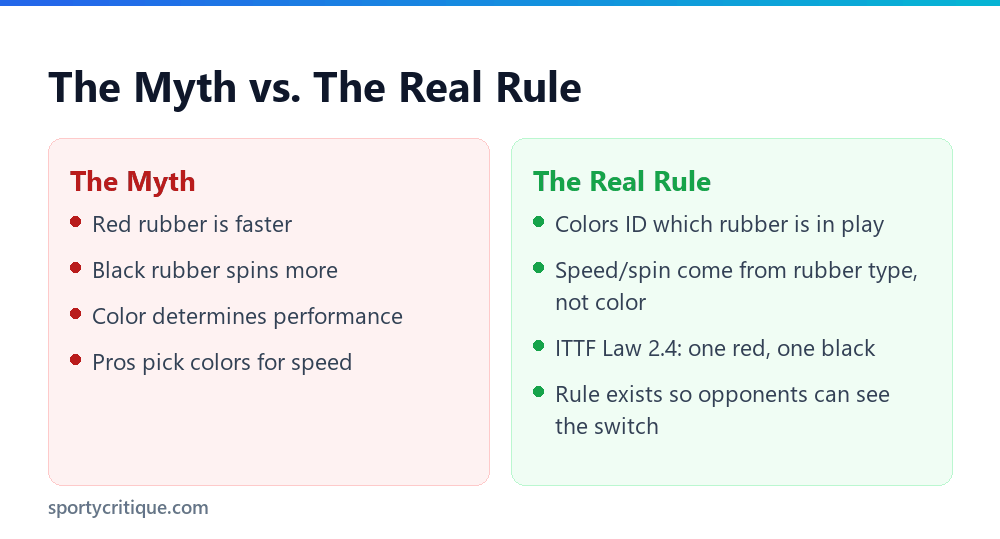
- →A common myth says red rubber is faster and black rubber spins more. That’s false. Color and performance are unrelated.
- →Speed and spin actually come from the rubber’s sponge thickness, surface type, and tackiness — the same rubber sold in red or black performs identically either way.
Ask most casual players why ping pong paddles are red and black, and you’ll usually hear some version of the same answer: red is faster, black spins more. It’s a tidy story. It’s also wrong. The real reason is simpler, and it has nothing to do with performance at all. It’s a visibility rule, written into the official ITTF rulebook, and it exists to solve a very specific problem that used to plague competitive play.
The Real Rule: ITTF Law 2.4
The International Table Tennis Federation’s Law 2.4 requires that one side of a racket’s covering be bright red and the other black. That’s the entire rule. It says nothing about which color goes on which side, and nothing about speed or spin. Players are free to put red on their forehand or their backhand, whichever they prefer. The only requirement is that the two sides look different, so anyone watching can tell them apart at a glance.
Why the Rule Exists
Before 1983, there was no color requirement at all. Both sides of a racket could match, or even both be the same shade. That created a loophole. Players began pairing two very different rubbers on one racket — say, a fast, low-spin rubber on one side and a slow, high-spin rubber on the other. Mid-rally, they’d flip the racket between shots. Since both sides looked the same, an opponent had no way to tell which rubber had just made contact. That made returns nearly impossible to read.

The ITTF closed that loophole with Law 2.4. Once one side had to be red and the other black, the trick stopped working. An opponent could simply watch which color made contact and immediately know which rubber’s characteristics to expect. The rule isn’t about performance at all — it’s about keeping the game readable.
The Myth: Does Red Rubber Play Differently Than Black?
This myth persists because manufacturers do sometimes offer a rubber in both colors, and players build up a preference over years of using one color on their forehand. That preference is real. It’s just not caused by the color itself — it’s caused by whichever rubber type that player happens to associate with each side of their own racket.
What Actually Controls Speed and Spin
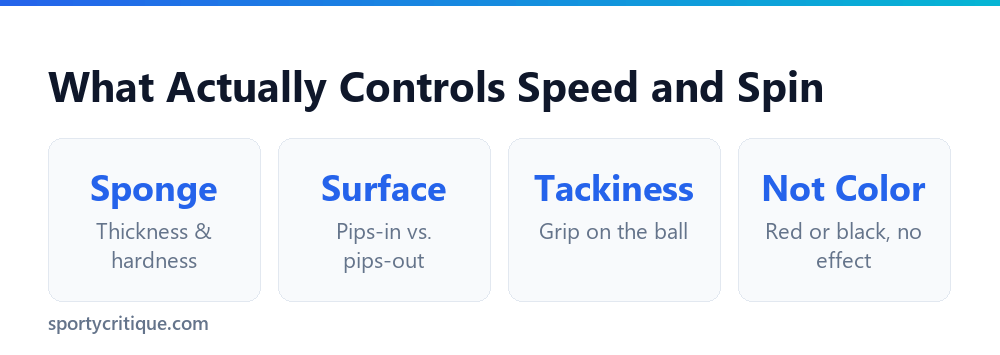
If color isn’t the answer, what is? Three things, and none of them are pigment.
- Thicker sponge = more speed and power
- Softer sponge = more control, less speed
- Pips-in (smooth): higher spin potential
- Pips-out: faster, more unpredictable bounce
- Tackier surface grabs the ball longer
- More grab generally means more spin
💡 Pro tip: If you want a faster or spinnier paddle, shop by sponge thickness and surface type, not by color. A red rubber and a black rubber with identical specs will feel identical in play.
Why the Myth Won’t Die
This myth is unusually persistent, even among players who’ve been in the sport for years. Part of the reason is that many manufacturers genuinely do sell their fastest, most aggressive rubbers with red as a common option, and their control-oriented rubbers somewhat more often in black. That’s a marketing pattern, though, not a rule. Nothing about red pigment makes a rubber faster. A company could just as easily sell the exact same fast rubber in black and the exact same control rubber in red, and it would play identically either way.
Another reason the myth sticks around is that most players never actually test it. They buy a red rubber once, like how it plays, and then credit the color instead of the underlying sponge and surface. Swap that same player onto an identical rubber in a different color, with a blindfold, and they wouldn’t be able to tell the difference by feel.
How to Actually Shop for a Faster or Spinnier Rubber
Skip the color filter entirely. Instead, look at three numbers most manufacturers publish on the packaging or product page: sponge thickness in millimeters, speed rating, and spin rating. A thicker sponge, usually in the 1.8-2.2mm range, adds power. A tackier surface adds spin. Neither of those numbers has anything to do with which color you pick. If a listing doesn’t publish speed and spin ratings at all, that’s a better reason to skip it than the color ever would be.
Can a Paddle Be Any Other Colors Besides Red and Black?
No, not in sanctioned play. The ITTF rule is specific to red and black — no other color combination satisfies Law 2.4. You’ll sometimes see novelty or recreational paddles sold in other color pairs, but those aren’t tournament-legal. If you’re buying a paddle for league or competitive play, confirm it’s ITTF-approved and follows the red/black requirement, not just any two contrasting colors.
What Other Sports Learned From This Rule
Table tennis isn’t the only sport that had to solve a version of this problem. Any sport where equipment can be disguised or swapped mid-play eventually adds a rule to keep things visible. Fencing added conductive equipment checks. Boxing standardized glove colors. Table tennis picked the simplest fix available: force a visible difference between the two surfaces that actually touch the ball. It’s a low-tech solution, and that’s exactly why it’s worked without changes since 1983.
A Quick Way to Spot a Non-Regulation Paddle
If you’re shopping and want to confirm a paddle is tournament-legal, check for two things beyond the red-and-black requirement. First, look for an ITTF-approved stamp near the handle — legitimate competition rubbers carry this marking. Second, check that the rubber thickness, including sponge, doesn’t exceed 4mm total per side, which is the other major spec regulated alongside color. A paddle can be perfectly red and black and still fail inspection if it skips either of those two checks.
Does the Rule Apply to Both Sides of Every Paddle?
Yes, with one narrow exception. If a player chooses to leave one side of the racket uncovered — no rubber at all, just bare wood or a specific approved surface — that side doesn’t need to follow the color rule, since there’s no rubber to identify. In practice, this is rare. The overwhelming majority of rackets in competitive play have rubber on both sides, which means both the red and black requirement apply in full.
⚠️ Watch out: Buying a cheap paddle with mismatched or same-color sides for casual play is fine — the color rule only matters for ITTF-sanctioned competition. Just don’t expect it to be tournament-legal if you ever want to play rated matches.
What About Recreational and Kids’ Paddles?
Paddles sold for backyard play, kids’ sets, or novelty games don’t need to follow the red-black rule at all, since they’re never used in sanctioned competition. That’s why you’ll see plenty of blue, green, or patterned paddles at toy stores and in family multi-packs. If a child ends up joining a club or league later, they’ll eventually need gear that follows the actual ITTF spec, but there’s no reason a first paddle has to.
Should You Pick Red or Black for Your Forehand?
Since color doesn’t affect performance, the choice is really about your own rubber selection on each side, not the colors themselves. Most players end up choosing based on habit or whatever combination they first learned on. If you’re just starting out, pick whichever color combination feels natural and focus your actual decision-making on the rubber specs — sponge thickness and surface type — for each side instead.
- ✓Pick rubber by sponge thickness and surface type
- ✓Confirm ITTF approval if you play sanctioned matches
- ✓Stick with a consistent forehand/backhand setup once you find one that works
- ✕Assume red hits harder than black
- ✕Buy a rubber based on color alone
- ✕Expect a color swap to change how your shots feel
A Real Rule Violation From Competitive Play
The reason this rule gets enforced so strictly traces back to real incidents before 1983. Players were documented using a fast, unspun rubber on one side and a high-friction, high-spin rubber on the other, both in matching colors. Mid-match, a quick flip of the wrist between shots made it nearly impossible for an opponent to read what kind of return was coming. It wasn’t cheating in a technical sense — nothing in the old rules banned it — but it was widely seen as unsporting, since it turned equipment into a disguise rather than a tool. The ITTF’s fix was permanent and simple: force visible contrast, every time, on every racket.
Bottom Line
Ping pong paddles are red and black because of a fairness rule, not a performance difference. The color tells you which rubber just hit the ball. It says nothing about how fast or spinny that rubber actually is. When you’re shopping for a new rubber, ignore the color entirely and look at the sponge thickness, surface type, and tackiness instead — those are the specs that actually change how the ball comes off your paddle. Once you understand that distinction, choosing equipment gets a lot simpler, and a lot more accurate.
FAQ
Is red rubber really faster than black rubber?
No. Speed comes from sponge thickness and surface type, not color. A red and black rubber with identical specs perform the same.
Why did the ITTF require red and black specifically?
The rule was introduced in 1983 to stop players from disguising two very different rubbers on a same-colored racket and flipping between them mid-rally undetected.
Can I use any two colors on my paddle for casual play?
Yes, for casual or recreational play any colors are fine. Red and black is only required for ITTF-sanctioned competitive matches.
Does the color rule affect which rubber I should buy?
No — pick a rubber based on sponge thickness, surface type, and tackiness for the speed and spin you want, not based on whether it’s sold in red or black.

Ping Pong Reviewed is an equipment review site covering table tennis and baseball gear. Specifications are checked against manufacturer listings, and prices against live retail pages, before publication.