
Jan-Ove Waldner: The Best European Ever, and His 1992 Gold

Jan-Ove Waldner is the only non-Asian man ever to complete a career Grand Slam. He was also the first player of any nationality to do it.
He managed it while playing an all-wood blade, in a sport that was already moving to carbon. That detail matters more than it sounds, and we will come back to it.
Short answer: Jan-Ove Waldner is 60, born on 3 October 1965 in Stockholm, and right-handed. He won the World Championships in 1989 and 1997, the World Cup in 1990 and Olympic singles gold in 1992. That made him the first man to complete the career Grand Slam, and he is still the only non-Asian player to have done it. He retired in February 2016.
Table of Contents
The First Grand Slam
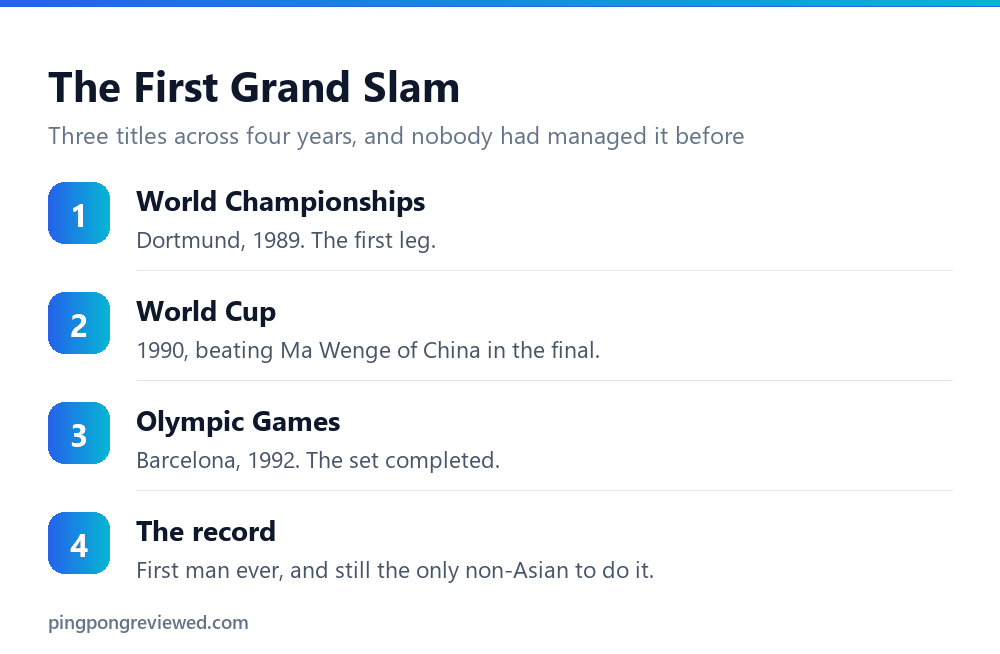
The set took him four years. He won the World Championship in Dortmund in 1989, then the World Cup in 1990, then Olympic gold in Barcelona in 1992.
The World Cup final is the one worth pausing on. He beat Ma Wenge of China, which is the recurring theme of his whole career.
Five men have completed the Grand Slam since. Every one of them is Chinese. So more than thirty years later, he is still the only player from outside Asia on that list.
What Jan-Ove Waldner Won
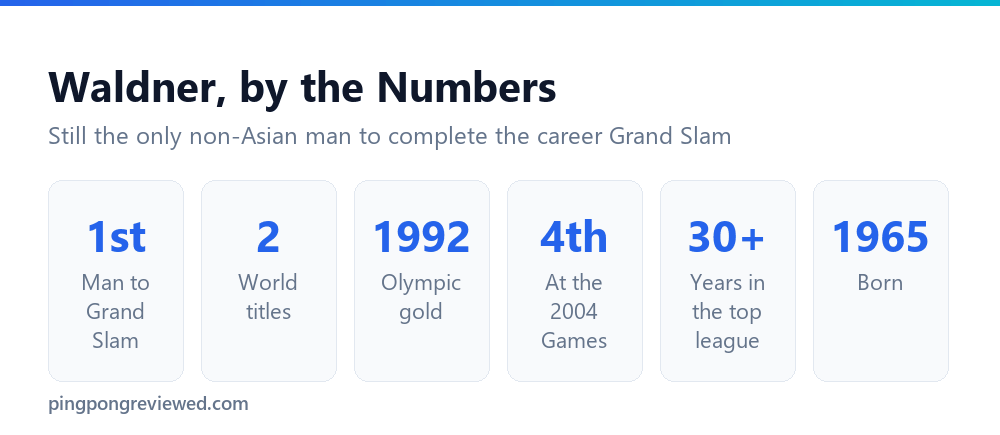
Two World Championships eight years apart is the detail that gets overlooked. Waldner won in Dortmund in 1989 and again in Manchester in 1997, which means he was the best player in the world at two separate points in his career.
The 2000 silver adds to that. He reached an Olympic final eight years after winning one, at 34, losing to China’s Kong Linghui.
He Won It All on Wood
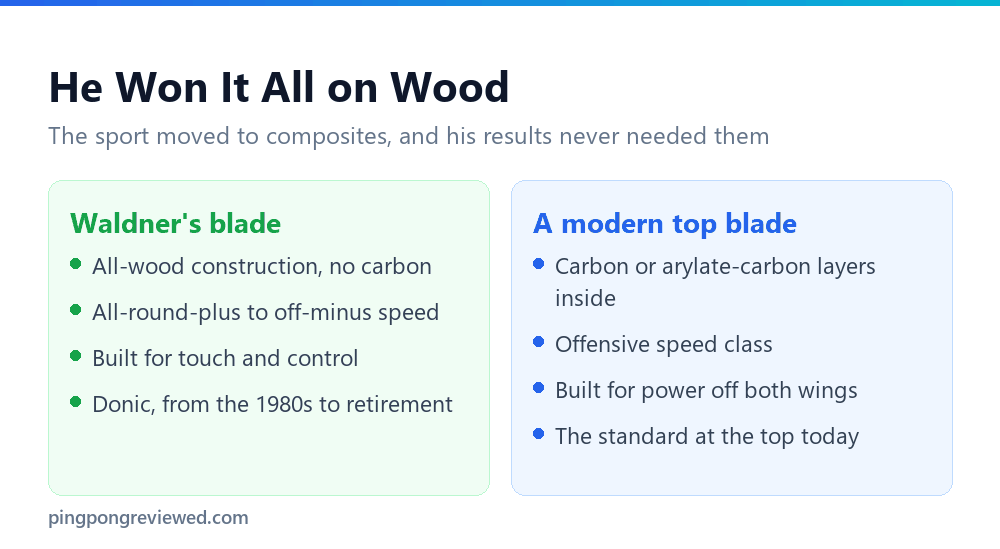
Every player at the top of the sport today uses a composite blade. Carbon or arylate-carbon sits between the wood plies, adding speed and a bigger sweet spot.
Waldner did not. He played a custom all-wood Donic blade for essentially his whole career, in the all-round-plus to off-minus speed range.
In modern terms that is slow. It is the sort of blade a coach recommends to an improving club player, not the sort a world champion is expected to use.
So why did it work? Because his game was built on touch, placement and reading opponents rather than on overpowering them. A slower blade gave him more information about the ball, and he converted that into control.
📊 Note: There is a real lesson here, and it is not that wood is better. It is that equipment should match the game you actually play. He chose a blade that amplified his strengths instead of chasing the fastest option available.
Should You Be Playing an All-Wood Blade?
For a lot of club players, honestly, yes. And Waldner is the strongest argument anyone can make for it.
Carbon blades are fast, and speed punishes a stroke that is not yet consistent. Because the ball leaves quicker, a slightly wrong angle goes long instead of landing.
All-wood blades give more feedback. You feel where on the blade you hit the ball, which is exactly the information a developing player needs.
- Choose wood if you are still building technique, or if your game is based on control, placement and blocking rather than power.
- Choose composite if you already loop hard off both wings and want the extra speed and the wider sweet spot that comes with it.
- Do not choose by price. All-wood blades are not the budget option and composite is not the upgrade. They are different tools.
- Remember the rubber matters more. Most players notice a rubber change far more than a blade change, and rubber is the cheaper experiment.
⚠️ Watch out: One practical difference. Wood dents against table edges and bag zips more easily than a composite blade does, so a proper case matters if you intend to keep it for years.
Why China Loves Him
This is the part of his career that surprises people. He is not merely respected in China. He is famous there.
In the 1990s he was reportedly more recognisable in China than the president of the United States. Fans call him Lao Wa, which means Old Wa, and also the Evergreen Tree.
The reason is straightforward. He beat their best players, repeatedly, over two decades, at a time when Chinese dominance was close to total.
But he did it without ever seeming to force anything. His game was built on timing and placement, which is precisely the style Chinese coaching admires most.
So he became the acceptable outsider. Beating China with raw power would have read as an anomaly. Beating them with touch read as mastery.
Fourth Place at 38
The statistic that best captures him is not the gold medal. It is where he finished twelve years afterwards.
At the 2004 Olympics in Athens he reached the semi-finals and finished fourth. He was 38, and he was beating players who had been children when he won in Barcelona.
Then he kept going. He played Swedish first-league table tennis for more than thirty years, and did not formally retire until 11 February 2016, at 50.
So his career spans the entire modern history of the sport. He started before speed glue was banned, before the ball changed from 38mm to 40mm, and before carbon blades became standard.
That is why the nickname Evergreen Tree stuck. Very few athletes remain competitive across that many rule changes, let alone that many opponents.
The Mozart Comparison
He is usually called the Mozart of table tennis, and the nickname is about how he played rather than how much he won.
His game looked unhurried. Where other players generated pace, he changed it, using placement and timing to make opponents do the work.
The serve and receive were the foundation. He read opponents unusually well, which meant he was frequently in position before the ball arrived.
So watching him is a different experience from watching a modern match. The rallies are slower, and the tactics are visible in a way they often are not now.
💡 Pro tip: If you want to learn from old footage rather than just enjoy it, his matches are the best place to start. The ball moves slowly enough that you can actually see why each shot was played where it was.
The Swedish Team That Beat China 5-0
His individual record is only half the story. Because for a stretch around 1990, Sweden were simply the best team in the world.
They won the world team title in 1989, then again in 1991, then again in 1993. And the 1989 final is the one people still talk about.
Sweden beat China 5-0 in that final. Not narrowly, and not on a bad day for China. A clean sweep, at a time when China had held the event almost continuously.
The squad was Waldner, Jorgen Persson, Mikael Appelgren, Erik Lindh and Peter Karlsson. So he was not carrying a weak team. He was the best player in a great one.
Then they did it again in 1993, beating China 3-1 in the final. Three world team titles in five years, from a country of eight million people.
📊 Note: Nothing comparable has happened since. Chinese depth has grown enormously, and no European team has come close to a run like that in the thirty years after it.
The Rule Changes He Outlasted
Because his career ran from the early 1980s to 2016, he played through changes that reshaped the sport completely. Most players experience one. He went through several.
Each of these ended somebody’s career. A player built entirely around a hidden serve had to rebuild. A player relying on freshly glued rubber lost their margin overnight.
But Waldner adapted every time. That is partly because his game was never built on one trick, and partly because touch and placement survive rule changes better than speed does.
So the fourth place in Athens in 2004 is more impressive in that light. He achieved it with a bigger ball, a shorter scoring format and stricter serve rules than the ones he won Olympic gold under.
Waldner and Timo Boll
The two are usually named together as the greatest European players, and comparing them is close.
Boll has the better ranking longevity and far more European titles. But Waldner has the titles that settle arguments, and Boll never won either of them.
So the honest verdict is not close on the biggest events. Waldner won the World Championship twice and the Olympics once. Boll reached world number one three times without either.
But context matters too. Waldner played through a period when Europe could still beat China as a team. Boll spent his career facing a Chinese system that had pulled further ahead than it ever was in 1989.
The Shots Nobody Plays Any More
Watch his old matches and you notice something odd. He plays shots that have almost disappeared from the professional game.
The clearest one is the change of pace. Instead of hitting every ball hard, he would take speed off deliberately, forcing an opponent to generate their own.
Then there is the short game. He would drop a ball short over the net in the middle of a rally, which is now rare because modern players stand ready to attack anything short.
So why did it work then and not now? Partly the equipment. Slower blades and unglued rubber left more time to play a touch shot without being punished.
But partly it is the ball. A 38mm ball carried more spin and less air resistance, which made deception easier and made a well-disguised slow ball dangerous.
Still, the underlying idea transfers. Most club players lose points by hitting hard into a good block. Changing pace costs nothing and beats opponents who only have one gear.
💡 Pro tip: Try this in your next practice. Play three balls at normal pace, then take 30 percent off the fourth and place it deep. Most club opponents will pop it up, because they have already committed to the rhythm.
Waldner Questions, Answered
How old is Jan-Ove Waldner?
He was born on 3 October 1965 in Stockholm, Sweden, which makes him 60. He played right-handed with a shakehand grip.
What did Jan-Ove Waldner win?
Olympic singles gold in 1992, World Championship singles titles in 1989 and 1997, and the World Cup in 1990. He also took Olympic singles silver in 2000.
Was Waldner the first to win a career Grand Slam?
Yes. He completed it in 1992 with his Olympic gold, becoming the first man to hold the World Championship, World Cup and Olympic singles titles. He is still the only non-Asian player to have done it.
Why is Jan-Ove Waldner famous in China?
Because he beat Chinese players at their own game for two decades, during a period when China dominated the sport. He is known there as Lao Wa, meaning Old Wa, and in the 1990s he was more widely recognised in China than the US president.
What blade did Waldner use?
A custom all-wood Donic blade with a flared handle, in the all-round-plus to off-minus speed range. He was a Donic player from the 1980s until he retired, and Donic later released Waldner Senso blades based on the same family.
When did Jan-Ove Waldner retire?
On 11 February 2016, after more than 30 years playing in the Swedish first league. He was 50.
Was Jan-Ove Waldner better than Timo Boll?
On the biggest titles, yes. Waldner won two World Championships and Olympic gold, and Boll won neither. But Boll has eight European titles to Waldner’s fewer, and he reached world number one three times across fifteen years. They are the two strongest European candidates and the answer depends on what you count.
What is Waldner’s nickname?
He is most often called the Mozart of table tennis. In Sweden he is J-O, and in China he is Lao Wa, or Old Wa, and sometimes the Evergreen Tree.
Did Sweden ever beat China at table tennis?
Yes, decisively. Sweden won the world team title in 1989, 1991 and 1993, beating China 5-0 in the 1989 final and 3-1 in the 1993 final. Waldner played in that team alongside Jorgen Persson, Mikael Appelgren, Erik Lindh and Peter Karlsson.
How did Waldner do at the 2004 Olympics?
He finished fourth in the singles at 38 years old, twelve years after winning the title. It is one of the most remarkable late-career runs the sport has seen.
The Short Version
- →Born 3 October 1965, so 60, and a right-handed shakehand all-round attacker.
- →First man ever to complete the career Grand Slam, in 1992.
- →Still the only non-Asian player on that list, more than thirty years later.
- →Won it all on an all-wood Donic blade, never switching to carbon.
- →Finished fourth at the 2004 Olympics aged 38, and retired in 2016 at 50.
Records get broken. Timo Boll took his age record in 2018, and five Chinese players have matched the Grand Slam since. But the part nobody has taken is the one that needed a European to beat China repeatedly, and that has stood since 1992.

Ping Pong Reviewed is an equipment review site covering table tennis and baseball gear. Specifications are checked against manufacturer listings, and prices against live retail pages, before publication.