Stiga Offensive CR WRB vs Classic WRB: Full Comparison
These two older Stiga blades get confused constantly, partly because the name “CR” sounds like it should mean carbon. It doesn’t, and that single mix-up is worth clearing up before getting into how the two actually differ.
Short answer: The Offensive CR WRB is faster (Speed 80 vs 77) and harder (Hardness 7.3 vs 6.2), suited to mid-distance attacking play, while the Offensive Classic WRB is softer and better suited to close-to-table looping with more control feel. Neither blade actually contains carbon fiber, “CR” refers to a UV-finished surface coating, not a carbon ply.
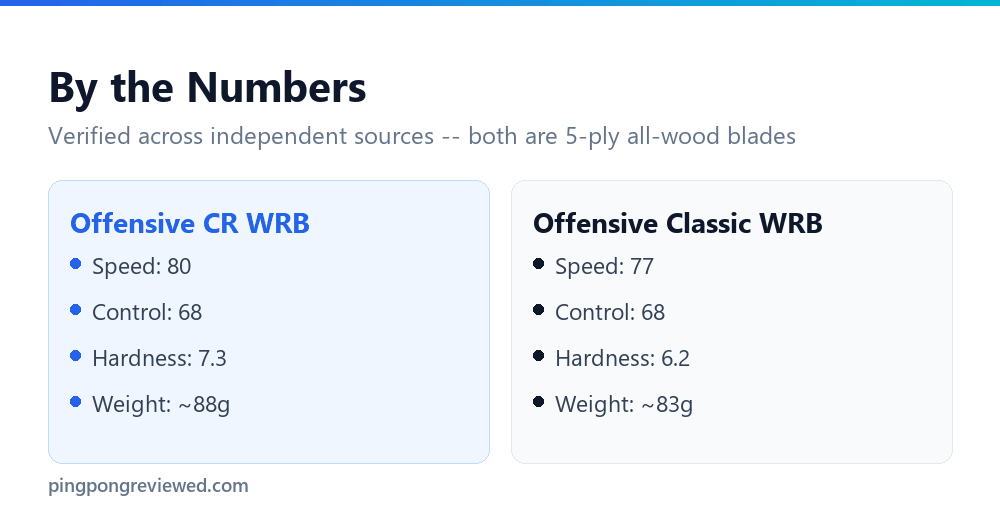
Table of Contents
Clearing Up the Biggest Point of Confusion: “CR” Isn’t Carbon
This is worth stating plainly because it’s a common mix-up: despite the name, the Offensive CR WRB does not contain carbon fiber. Both blades checked for this comparison are 5-ply, all-wood construction with a limba top ply. “CR” specifically refers to a UV-finished coating applied to the front surface of the blade, which increases speed through a harder, more responsive surface rather than through an actual carbon composite layer. If you’re specifically shopping for a carbon-plied blade, neither of these two is actually that, a different Stiga model would be required.
⚠️ Watch out: Don’t assume “CR” means carbon just because the letters suggest it. This mix-up shows up regularly in secondhand listings and forum discussions, and confirming construction directly with the seller or manufacturer spec sheet is worth doing before buying either blade expecting carbon-blade playing characteristics.
What “WRB” Means on Both Blades
Both variants share the WRB handle system, a hollowed-out handle design that reduces overall weight and is described across sources as shifting the blade’s center of inflection forward while adding a slight, enhanced vibration that improves ball feel. This is a shared feature between both blades, not a point of difference, which is part of why the two get compared against each other so often, they share the same handle technology and general lineage, differing mainly in surface finish and resulting speed/control balance.
The Actual Performance Difference
The verified specs put the CR WRB at Speed 80 and Hardness 7.3, versus the Classic WRB’s Speed 77 and Hardness 6.2, with both sharing an identical Control rating of 68. That harder, faster surface on the CR WRB translates into a noticeably lower throw angle and less spin generation on opening loops compared to the Classic WRB, according to independent comparison sourcing, meaning the CR WRB rewards a flatter, more direct contact style rather than the higher-arc, spin-heavy loop the softer Classic WRB surface more naturally produces.
Which Playing Style Each One Actually Fits
Sourcing consistently describes the CR WRB as suited to mid-distance looping and faster, more direct attacking play, while the Classic WRB is described as better suited to close-to-table looping, where its softer, more control-oriented surface pairs more naturally with heavier or slower, spin-focused rubbers. One comparison source also specifically noted the Classic WRB responds well when paired with medium-to-heavy rubber or long pips, suggesting it has a wider practical range of compatible rubber choices for players building a defensive or mixed-style setup around it.
An Honest Note on Availability
It’s worth being direct about something that matters more for these two blades than for most current-production equipment reviewed on this site: as of the check date, both blades show as out of stock, with restock-notification options, at major listed retailers including Megaspin and the official Stiga website. This review does not claim either blade has been permanently discontinued, since that wasn’t something this review could independently confirm, only that current availability appears limited at the specific sources checked. A separate attempt to verify Amazon-specific availability failed due to a technical access issue, so that channel’s current stock status is an honest gap in this review rather than something guessed at.
📊 Note: No current, reliable price is given for either blade in this comparison, since none was found that this review could confirm as current and accurate. If you find either blade listed for sale, treat the listed price as current information from that specific seller rather than something this review can validate.
Rubber Pairing Considerations for Each Blade
Because the CR WRB’s harder, faster surface already supplies more inherent speed and a lower, flatter throw, pairing it with an already-fast, hard rubber risks producing a combination that’s difficult to control except for players with a very developed, compact stroke. Sourcing suggests it’s more forgiving when paired with a softer or more control-oriented rubber that tempers the blade’s own speed rather than compounding it. The Classic WRB, by contrast, was specifically noted as pairing well with medium-to-heavy rubbers and even long pips, meaning it has more headroom to add speed through the rubber choice itself without the combined setup becoming unmanageable.
💡 Pro tip: If you’re building a setup around either blade and unsure where to start, err toward a more control-oriented rubber on the CR WRB and consider a slightly faster rubber on the Classic WRB to compensate for its softer base speed, treating the blade and rubber choice as a combined system rather than picking each in isolation.
A Grip Difference Worth Double-Checking
One source specifically listed the CR WRB with penhold grip options mentioned and the Classic WRB in a shakehand configuration in the particular listings checked, but this doesn’t necessarily mean one blade is exclusively available in only one grip style as a rule. Both blade families typically offer shakehand, penhold (Chinese and Japanese-style), and sometimes cut/penhold variants across different retailers and listings. If grip style matters for your decision, confirm the specific handle configuration on the exact listing you’re considering rather than assuming based on general comparison information like what’s summarized here.
Why These Two Specific Blades Get Compared So Often
Beyond sharing the WRB handle system, part of why these two blades are so frequently searched and compared together is simply the confusing naming, “Offensive Classic” and “Offensive CR” differ by exactly one distinguishing word in an already crowded lineup of similarly-named Stiga blades, which includes plain “Offensive Classic” (without WRB), “Offensive CR” (without WRB), and multiple carbon-branded relatives that occupy an entirely different performance tier. A buyer scanning listings quickly can reasonably end up unsure which specific model they’re actually looking at, which is exactly the kind of confusion a direct side-by-side comparison like this one is meant to resolve.
Related Models Worth Knowing About, By Name Only
This comparison is specifically scoped to the CR WRB and Classic WRB variants and does not attempt to independently verify specs for the non-WRB “Offensive Classic” or “Offensive CR” models, or for Stiga’s separately-branded carbon blades, since mixing in unverified claims about adjacent models would undercut the specific, sourced comparison this piece is built around. If you’re considering one of those related models specifically, treat it as its own separate research question rather than assuming its specs mirror either blade covered here.
Should You Look for a Secondhand One?
Given the availability picture above, a realistic path to owning either blade today may well involve a secondhand marketplace rather than a first-party retailer. If you go that route, confirming the exact model, CR WRB versus Classic WRB, given how similar the naming is, and asking about the surface condition (since the UV-finished CR surface can degrade differently with wear than the Classic’s plain wood surface) are both reasonable questions to ask a seller before buying, independent of anything this review can verify about a specific used listing.
A Broader Point About Stiga’s WRB Lineup
These two blades are part of a broader family of Stiga models using the WRB handle system alongside different surface treatments and ply constructions, and the naming across that lineup can be confusing to a buyer comparing options casually. When shopping this family of blades, it’s worth checking the specific ply count, surface treatment, and whether carbon is actually present directly against a manufacturer spec sheet rather than assuming from the name alone, exactly as the “CR doesn’t mean carbon” point above illustrates.
- ✓Confirm construction (all-wood vs actual carbon) directly against a spec sheet before buying either blade
- ✓Match the CR WRB to a flatter, more direct attacking style and the Classic WRB to close-to-table looping
- ✓Check current stock and condition carefully if buying secondhand
- ✓Treat any price you find as current information from that specific listing, not a general market price
- ✕Assume “CR” means carbon fiber construction
- ✕Assume the higher speed rating makes the CR WRB objectively better for every player
- ✕Assume either blade is permanently discontinued without checking current listings yourself
- ✕Pair either blade with a rubber setup meant for a completely different speed/control profile without testing
Who Each Blade Actually Makes Sense For
Pulling the sourcing together into a practical recommendation: an attacking player who plays a step or more off the table and wants a flatter, faster response to finish points is the better fit for the CR WRB. A player who stays close to the table and relies on generating their own spin through a slower, more controlled stroke, or who’s building a setup around heavier, slower rubber, is better served by the Classic WRB’s softer surface. Neither is a beginner blade in the sense of being particularly forgiving; both are classified as offensive-tier equipment intended for a player who already has reasonably developed stroke mechanics to work with.
The Short Version, Restated
The Offensive CR WRB is faster and harder (Speed 80, Hardness 7.3), suited to mid-distance attacking play. The Offensive Classic WRB is softer (Speed 77, Hardness 6.2), suited to close-to-table looping and pairing with heavier or slower rubbers. Neither contains actual carbon fiber despite the “CR” name. Current retail availability for both appears limited, so check stock directly before assuming either is easily purchasable new.
Common Questions
Does the Stiga Offensive CR WRB contain carbon fiber?
No, despite the name, it’s a 5-ply all-wood blade. “CR” refers to a UV-finished surface coating, not a carbon composite layer.
What’s the speed and control difference between the two blades?
The CR WRB rates Speed 80 / Control 68 / Hardness 7.3; the Classic WRB rates Speed 77 / Control 68 / Hardness 6.2.
Which blade is better for close-to-table looping?
The Offensive Classic WRB, thanks to its softer surface and lower hardness rating, which better suits close-to-table, spin-focused play.
What does WRB mean on these blades?
A hollowed-out handle system shared by both blades that reduces weight and is described as improving ball feel.
Are these blades still available to buy new?
As of the check date, both show as out of stock at major listed retailers, though this review can’t confirm permanent discontinuation, check current listings directly.
The Short Version
- →Neither blade contains actual carbon fiber, both are 5-ply all-wood.
- →“CR” means a UV-finished surface coating, not carbon.
- →CR WRB: Speed 80, Hardness 7.3, suited to mid-distance attacking play.
- →Classic WRB: Speed 77, Hardness 6.2, suited to close-to-table looping.
- →Both share the same WRB hollowed-handle system.
- →Current retail stock appears limited for both, check availability before assuming purchasability.

Benjamin Fink is the Lead Equipment Analyst and Senior Contributor at Ping Pong Reviewed. A competitive USATT tournament player and table tennis technician with over 12 years of testing experience, Benjamin specializes in blade carbon composite physics, rubber sponge durometer hardness testing, ITTF equipment compliance, and table tennis robotics mechanics.