Chen Meng: 2 Olympic Golds and the Title She Never Won

Chen Meng has won the Olympic singles title twice. Only two women in the history of the sport had ever done that before her.
She has also never won a World Championship singles title. That is the one thing standing between her and a career Grand Slam. Both facts belong in the same paragraph, because together they describe an unusual career.
Short answer: Chen Meng is 32, born on 15 January 1994 in Qingdao, and right-handed. She won Olympic singles gold at Tokyo in 2021 and again at Paris in 2024, beating Sun Yingsha 4-2 in both finals. She has four Olympic golds in total and a World Cup title, but her best World Championships singles result is silver.
Table of Contents
Back-to-Back Olympic Gold
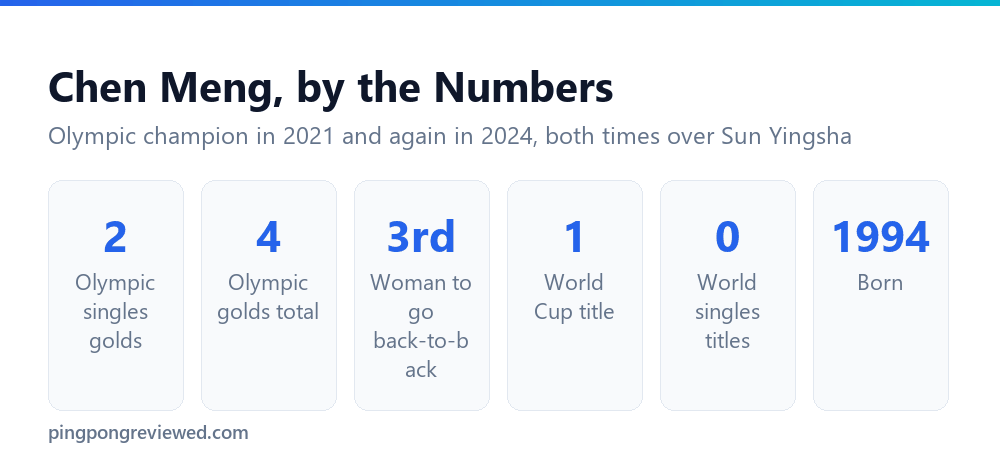
Defending an Olympic singles title in table tennis is extremely rare. Before Paris, only two women had managed it.
The difficulty is not only the standard. It is that China limits how many players it enters. So a defending champion has to earn selection again four years later, against a squad that has refreshed underneath her.
She was 30 in Paris and not the world number one. Sun Yingsha was, and had been for more than two years. So Chen Meng went into that final as the underdog on paper and won it 4-2, exactly as she had in Tokyo.
The Mirror Image of Sun Yingsha
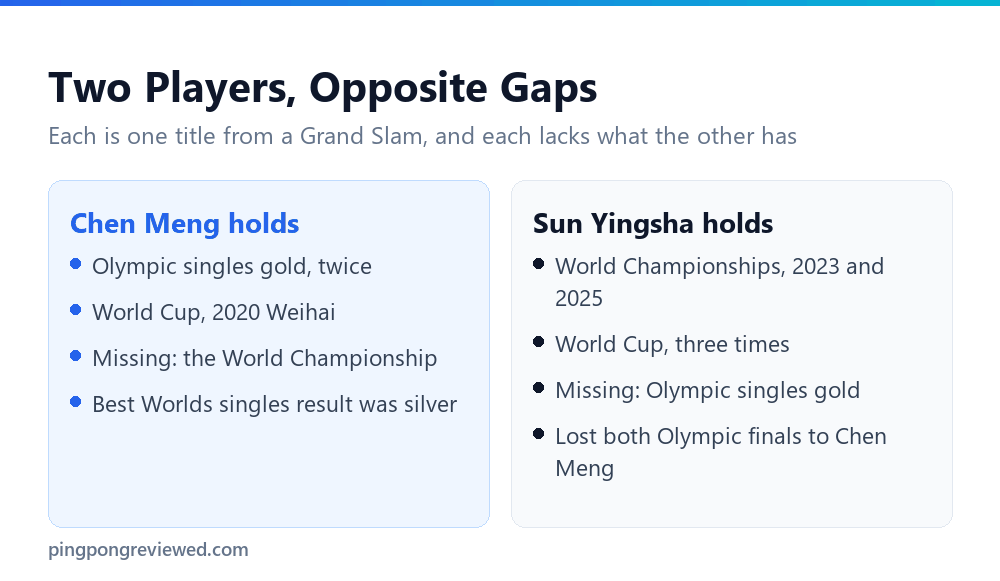
A career Grand Slam means winning the World Championships, the World Cup and the Olympic singles title. Both of these players hold two of the three.
Chen Meng has the Olympics and the World Cup. Sun Yingsha has the World Championships and the World Cup. So the piece each of them is missing is the piece the other already owns.
That is a genuinely unusual symmetry. It is sharpened by the fact that they have met in two Olympic finals. Chen Meng won both, which is why one of those gaps looks likely to close sooner than the other.
The Full Record
Six World Championship golds in team and doubles is easy to skim past. But it shows the singles gap is not about level. She has been winning at that event for years, just not in the singles draw.
The 2019 silver in Budapest is the closest she came. And the World Championships singles is held every two years. So the number of chances a player gets is smaller than people assume.
Why She Wins the Matches That Matter
Beating the world number one twice in Olympic finals, three years apart, is not luck. So it is worth asking what she does differently when the stakes are highest.
Her game is built on control rather than raw speed. She absorbs pace well, stays close to the table, and does not need to force winners to stay in a rally.
That style ages well and it holds up under pressure. She is not relying on hitting through opponents. So a small drop in sharpness costs her less than it would cost a power player.
There is also the matchup itself. Sun Yingsha wins by taking the ball early and rushing opponents. But that only works if the opponent is disturbed by it. Chen Meng is unusually hard to rush.
📊 Note: This is the most useful thing in her whole record for a club player. Consistency under pressure beats a bigger shot more often than highlight reels suggest, and it is a skill you can actually practise.
The Viscaria, and Why Her Setup Is Different
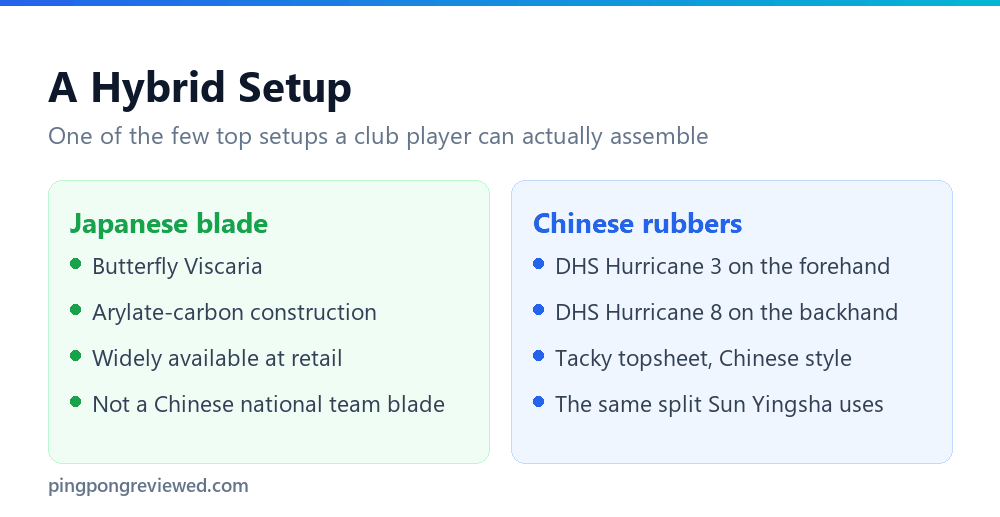
Most Chinese national players use a full DHS setup. Chen Meng does not, and that makes her equipment more interesting than usual.
She plays a Butterfly Viscaria, which is a Japanese blade with arylate-carbon construction. Then she puts Chinese rubbers on it. Hurricane 3 goes on the forehand, and Hurricane 8 on the backhand.
The Viscaria matters here for a practical reason. Unlike the DHS blades built for national team players, it is a normal retail product.
So her setup is one of the few at this level that a club player could genuinely assemble. That does not mean they should, but the option exists in a way it does not with a custom DHS blade.
⚠️ Watch out: The rubbers are still the problem. Hurricane sheets used by national players are made to tighter specifications than the retail versions, and the tacky topsheet needs a fast swing to work at all. Buying the blade is realistic. Buying her exact rubbers is not.
Three Players, One Rubber Split
Something worth noticing across the top of the sport. Chen Meng, Sun Yingsha and Wang Chuqin all run Hurricane 3 on the forehand and Hurricane 8 on the backhand.
Three different blades, three different games, and the same rubber logic on both wings. That is not a coincidence.
The forehand needs grip for heavy spin. That often means a brushing contact, where a springy sheet would throw the ball off. So a tacky Hurricane 3 suits it.
But the backhand swings over a shorter distance, with less room to generate speed. So a different sheet does that job better, and Hurricane 8 is the one they have all landed on.
💡 Pro tip: The transferable idea is not the brand. It is that the two wings do different jobs and deserve different rubbers. Most club players buy two identical sheets without ever asking whether that suits how they play.
A Late Peak
Her career has an unusual shape. She reached world number one in January 2018, aged 24, which is not early by the standards of Chinese table tennis.
Then the Olympic titles came at 27 and 30. Most players in this sport have their best years earlier, and plenty have stepped away entirely by 30.
So she has been at her most effective in the second half of her career, at exactly the moments that count most. That is the opposite of the pattern Zhang Jike showed, where an extraordinary peak burned out quickly.
Chinese selection is brutally competitive. So staying picked into your thirties is itself an achievement. She did it while a younger world number one was ahead of her in the rankings.
Why the World Title Never Came
It is tempting to read a missing title as a weakness. But the structure of the calendar explains a lot of it.
The World Championships singles is held every two years, not every year. So across a career, a player gets far fewer attempts at it than the entry list suggests.
Then there is selection. Because China can only enter a limited number of players, a place in the singles draw is not guaranteed even to an Olympic champion.
And the draw itself is brutal. Chinese players are seeded apart, which means the toughest matches often arrive in the semi-final and final rather than being spread through the week.
So her 2019 silver in Budapest was not a near miss in a weak field. It was reaching the final of the hardest singles event outside the Olympics, and losing it.
📊 Note: The same structural point applies to Timo Boll, who reached world number one three times and never won the World Championship singles either. Rankings and one-week tournaments reward different things.
Chen Meng Among the Chinese Greats
Being one of three women to defend an Olympic singles title puts her in specific company. But the three careers do not look alike.
Deng Yaping dominated the 1990s completely, winning her golds in 1992 and 1996. Zhang Yining did the same through the 2000s, in 2004 and 2008.
Both of them were also the clear world number one for long stretches while they were winning. Chen Meng was not, at least not in Paris.
So her version of the achievement is arguably harder in one specific way. She defended the title while a younger player sat above her in the rankings and had done for over two years.
But the comparison cuts the other way on the World Championship. Both Deng Yaping and Zhang Yining won that title, and it is the gap that keeps Chen Meng out of the Grand Slam conversation.
Should You Buy a Viscaria?
Because her blade is a normal retail product, this is one of the few pro setups where the question is worth asking seriously.
The Viscaria is an attacking blade with arylate-carbon inside it. So it is fast, and it is not a beginner’s blade whatever the endorsement suggests.
- Worth considering if you already attack off both wings and generate your own racket speed. The arylate-carbon keeps more feel in the short game than pure carbon would.
- Not for you if you are still building a stroke. A fast blade sends marginal shots long, and you will learn less from it than from a slower all-round blade.
- Do not copy the rubbers. Tacky Hurricane sheets need a fast swing to activate the sponge, and on a slower arm they produce less speed than a mid-range tensor rubber would.
- Budget for the whole bat. A blade price is a blade price. Two decent rubber sheets add a substantial amount on top.
So the honest version is this. Her blade is buyable and genuinely good. Her full setup is not a sensible target for most club players, and the reason is the rubber rather than the wood.
What Comes Next
She turned 32 in January, which in table tennis terms is late but not finished. Timo Boll was ranked world number one at 36.
The Grand Slam remains theoretically available, because the World Championship is the only piece missing. But it would mean being selected for a singles draw. Then winning it outright, against a squad that keeps getting younger.
So the realistic reading is that her record is close to final. And it is remarkable either way. Only two other women in the sport have ever won two Olympic singles golds.
Whatever happens, the Paris final is the match she will be remembered for. Beating the world number one to defend an Olympic title, at 30, outlasts any ranking list. And she did it in a sport where almost nobody gets a second chance at that stage. Four years is a long time to stay selected, stay fit and stay ahead of a squad that refreshes constantly. So the second gold is the harder one, even though the first is the one that made her a champion.
The Qingdao Connection
She was born in Qingdao, on the Shandong coast. So was Zhang Jike.
That is a small coincidence with a real cause behind it. Chinese table tennis runs on provincial systems, and some provinces produce far more national players than others.
Shandong is one of them. Children are identified young, then moved into provincial training setups. Only after that does the national team become a possibility.
So a player’s home province matters more than it would in most sports. It shapes who coaches them, who they train against, and whether they are seen at all.
Then the funnel narrows sharply. Thousands of provincial players compete for a handful of national places. And the national team is where the world ranking starts.
Both Chen Meng and Zhang Jike came through that route. Both reached world number one. But their careers took opposite shapes after that, which says something about how little the starting point guarantees.
Chen Meng Questions, Answered
How old is Chen Meng?
She was born on 15 January 1994 in Qingdao, Shandong province, which makes her 32. She is 1.66 metres tall and plays right-handed with a shakehand grip.
How many Olympic gold medals has Chen Meng won?
Four. She won the women’s singles at Tokyo 2020 and Paris 2024, and team gold at both Games as well.
Has Chen Meng won the World Championships?
Not in singles. Her best singles result there is silver, from Budapest in 2019. She has six World Championship golds in team and doubles events.
Who did Chen Meng beat in the Olympic finals?
Sun Yingsha, both times. She won 4-2 in the Tokyo final and 4-2 again in the Paris final, which made her the third woman to win back-to-back Olympic singles golds.
Has Chen Meng completed a career Grand Slam?
No. She holds the Olympic singles title and the World Cup, but not the World Championship. That single missing title is the only gap in her record.
What equipment does Chen Meng use?
A Butterfly Viscaria blade with DHS Hurricane 3 on the forehand and DHS Hurricane 8 on the backhand. It is a hybrid setup, pairing a Japanese blade with Chinese rubbers.
Is the Butterfly Viscaria good for beginners?
No. It is an attacking blade with arylate-carbon inside it, built for a player who already generates their own racket speed. A slower all-round blade will teach a beginner more, and it costs less. The Viscaria is worth considering once you attack off both wings consistently.
Was Chen Meng ever world number one?
Yes. She first reached the top of the women’s singles ranking in January 2018. She was not the number one going into either of her Olympic finals, though.
Who is better, Chen Meng or Sun Yingsha?
It depends what you count. Sun Yingsha has held the world number one ranking since 2022 and has two World Championship titles. Chen Meng has two Olympic singles golds and beat Sun Yingsha in both finals.
The Short Version
- →Born 15 January 1994, so 32, and right-handed with a shakehand grip.
- →Two Olympic singles golds, in 2021 and 2024, both won 4-2 over Sun Yingsha.
- →Third woman ever to go back-to-back, after Deng Yaping and Zhang Yining.
- →Never won the World Championship singles title, her only major gap.
- →Plays a Butterfly Viscaria blade with DHS Hurricane 3 and Hurricane 8 rubbers.
Rankings measure the season. Olympic finals measure one afternoon every four years. Chen Meng has spent her career being better at the second of those, and it has left her with the medal most players would trade the rest for.

Ping Pong Reviewed is an equipment review site covering table tennis and baseball gear. Specifications are checked against manufacturer listings, and prices against live retail pages, before publication.