
Mattias Falck: World Number 7, Then a 107-Place Fall
In 2019, Mattias Falck was ranked world number 7 and reached a World Championships singles final. By February 2026, he was ranked 114th.
Most player profiles lead with a rise or a near-miss. This one is honestly a decline, and it’s worth telling straight rather than stopping at the highlight reel from 2019.
Short answer: Mattias Falck was born Mattias Karlsson on 7 September 1991 in Karlskrona, Sweden, and competed under the surname Falck from 2018, after marrying Julia Falck, through the biggest results of his career. He reached the 2019 World Championships singles final, losing to Ma Long, and won the 2021 World Championships men’s doubles title with Kristian Karlsson, the first Swedish men’s doubles world title since 1991. His ranking peaked at world number 7 in August 2019 and had fallen to 114th by February 2026, around the same time he reverted to his birth surname following a divorce. Verified across his own tournament and ranking record on 4 September 2026.
Table of Contents
The 2019 Final
So the peak of Falck’s career is specific and dated: the 2019 World Championships in Budapest, where he reached the men’s singles final before losing to Ma Long, also profiled on this site.
Losing a World Championships final to Ma Long, one of the deepest records in the sport’s history, isn’t a mark against Falck’s level. It placed him, for that tournament, as the second-best men’s singles player on earth.
📊 Note: Reaching a World Championships singles final at all is a result most national federations never produce even once. Falck did it representing Sweden, a country whose table tennis peak is otherwise most associated with Jan-Ove Waldner’s era, also covered on this site.
The Doubles Title That Ended a 30-Year Wait
So the 2021 World Championships doubles gold, with Kristian Karlsson, deserves its own weight. It was the first Swedish men’s doubles world title since 1991, a thirty-year gap.
So two players sharing a surname, one by birth and one throughout his whole career, won a World Championship together. That’s a detail worth stating plainly since it reads like an error at first glance.
The Fall
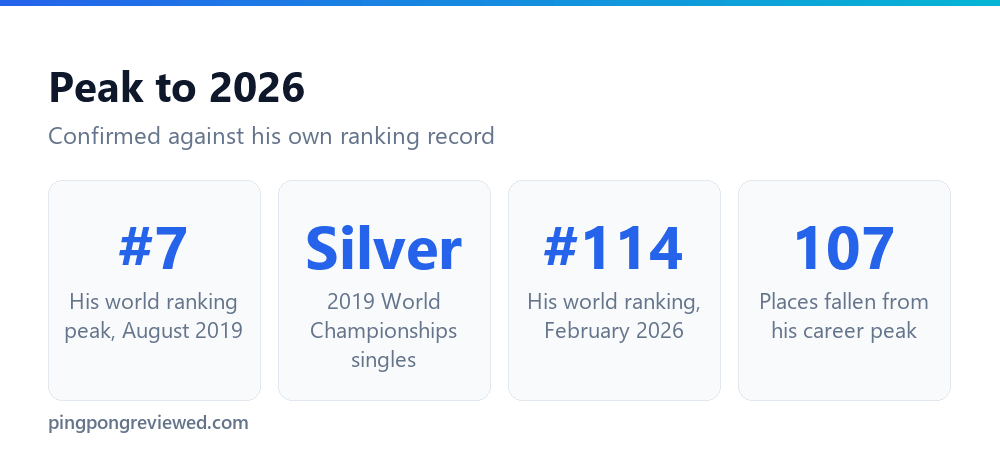
So by February 2026, seven years after his ranking peak, Falck sat at world number 114. That’s a fall of over 100 places from a player who had been, briefly, one of the ten best in the world.
Table tennis careers, like most fast, reaction-dependent sports, tend to decline gradually as players move into their thirties, and Falck turned 35 in September 2026. But the specific scale of this decline, from top-10 to outside the top 100, is steeper than a typical age-related fade.
⚠️ Watch out: This article isn’t speculating about why the decline happened beyond what’s documented. Injuries, personal circumstances, and simple competitive aging are all plausible contributors for any player at this stage of a career, and nothing in the available record singles out one specific cause.
A Name That Tracked His Marriage
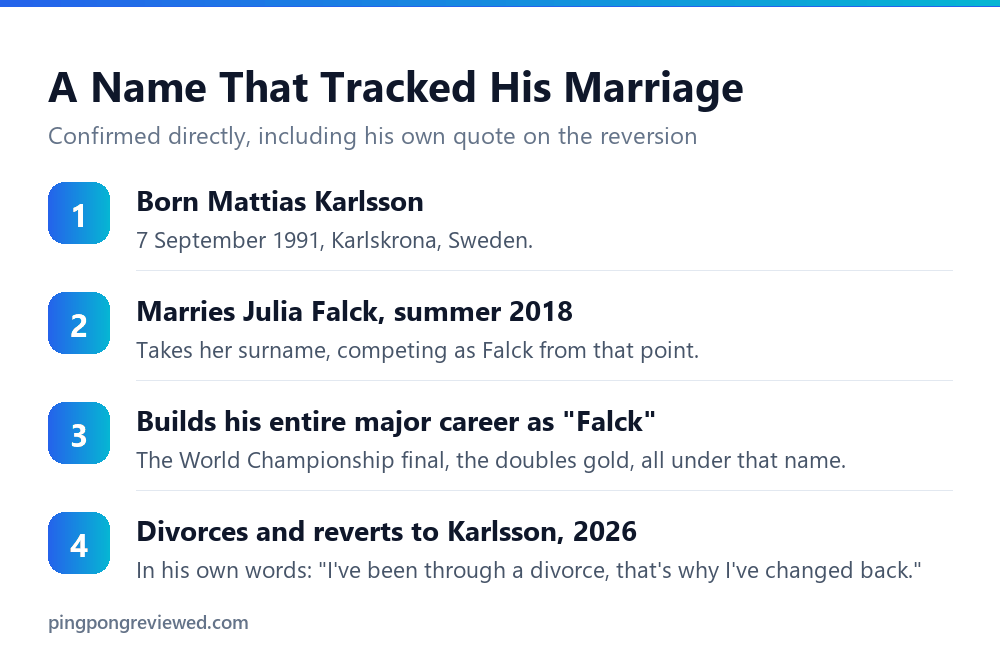
So the name itself has its own timeline, worth stating plainly since it explains why searches for “Mattias Karlsson” and “Mattias Falck” both turn up the same player.
He was born Mattias Karlsson. In the summer of 2018, he married Julia Falck and took her surname, competing as Mattias Falck from that point forward. Every major result covered in this article, the 2019 final, the 2021 doubles gold, happened under that name.
In 2026, following a divorce, he reverted to his birth surname. His own explanation was direct: “I’ve been through a divorce, that’s why I’ve changed back.”
💡 Pro tip: If searching for his more recent results and finding nothing under “Falck,” try “Mattias Karlsson” instead, since that’s the name his post-2026 results are likely recorded under going forward.
What the Fall Actually Looks Like Year to Year
So it’s worth resisting the urge to picture a straight, steady slide from number 7 to 114. Ranking declines at this level rarely move in a clean line, and Falck’s own record includes a European Championships team gold as recently as 2023, well after his ranking peak.
That means the decline wasn’t a single collapse. It was a longer, uneven stretch that still included real team success even as his individual ranking kept sliding, a pattern common to players transitioning from an individual-results peak toward a team-focused role later in a career.
💡 Pro tip: When tracking any player’s career arc, checking team results alongside individual ranking often tells a fuller story than the ranking number alone. A player can remain useful to a national team well past their individual peak.
Why This Profile Matters Alongside the Others
So most of the other player profiles on this site, so far, tell rise stories or near-miss stories. Falck’s is neither. It’s the honest reminder that even a genuine World Championships finalist and former top-10 player can see a career decline sharply within a handful of years.
That’s not a criticism. It’s simply the complete picture, and telling it accurately, peak and fall both, is more useful than a profile that stops at the highlight reel and never checks what happened next.
⚠️ Watch out: A player’s Wikipedia-style highlight list, gold medals and finals reached, can create a misleading impression of a career’s current state if nobody checks the most recent ranking data against it. Falck’s page is a direct example of why that check matters.
The Doubles Partnership, in More Detail
So the 2021 doubles title with Kristian Karlsson deserves a closer look, since men’s doubles at World Championship level requires a specific kind of chemistry that doesn’t always develop between two otherwise strong singles players.
Doubles success at this level typically comes from partnerships built over years of specific practice together, not simply pairing two high-ranked singles players and expecting results. Sweden’s ability to produce a doubles world championship team, ending a thirty-year national drought, reflects a specific, deliberate pairing rather than an accident of two good players happening to team up.
📊 Note: Thirty years is a long wait for any specific title in a sport with regular World Championships. It places the 2021 win alongside the kind of drought-ending results covered elsewhere on this site, like Felix Lebrun ending France’s own decades-long individual Olympic medal wait.
His Equipment
Falck plays a Yasaka Ma Lin Soft Carbon blade, with Yasaka Rakza PO on the forehand and Rakza X on the backhand, a split setup running two different rubbers rather than matching sheets on both wings.
The blade itself is named for Ma Lin, a Chinese player from an earlier generation, a reminder that signature-named equipment doesn’t always belong to the player currently using it. Falck built his career on a blade named after someone else’s legacy.
A Career Told in Two Halves
So it’s worth separating Falck’s career cleanly into two distinct halves rather than treating it as one continuous story. The first half, roughly 2016 through 2021, produced his ranking peak, his World Championships singles final, and his doubles world title.
The second half, from 2022 onward, still included real success, the 2022 European doubles gold and the 2023 European team gold, but against a backdrop of steadily declining individual ranking.
That split matters because it avoids two equally misleading narratives: treating him purely as a fading former star, which ignores the 2022 and 2023 team results, or treating him purely by his 2019-2021 peak, which ignores what’s happened to his individual ranking since.
What a 1.91-Meter Frame Means at the Table
So Falck’s height, 1.91 metres, is unusually tall for elite table tennis, a sport where many top players sit closer to average height or shorter. Height carries real tradeoffs at the table rather than being simply an advantage.
A taller player generally has to work harder to get low for short balls near the net, since the distance from a standing position down to table height is simply greater. The tradeoff is typically more reach and leverage on full-extension shots away from the table.
💡 Pro tip: Watching how a taller player like Falck handles short serves and receives near the net, compared to how they handle balls at arm’s-length distance, is a useful way to see this height tradeoff play out point by point.
Sweden’s Broader Table Tennis Picture
So Falck’s career sits inside a broader Swedish table tennis story that this site covers from multiple angles. Jan-Ove Waldner’s era defined the sport’s peak decades ago. Truls Moregard, also profiled here, represents the current generation’s own Olympic-silver-level peak.
Falck’s 2019 World Championships final sits in between those two eras chronologically, a genuine individual peak for Swedish men’s table tennis in a period when the sport’s very top level was otherwise dominated even more heavily by Chinese players than it is today.
⚠️ Watch out: It’s easy to read three strong Swedish player profiles on this site, Waldner, Falck, and Moregard, as evidence of one continuous program. The reality is more like three separate peaks decades apart, connected by national identity rather than a single unbroken run of dominance.
So reading all three profiles together gives a more accurate picture of Swedish table tennis than any single one alone: a golden era, a genuine but shorter individual peak, and a current-generation Olympic silver, spread across more than three decades rather than clustered together, with Falck’s own story sitting honestly in the middle of that longer timeline.
Mattias Falck Questions, Answered
Is Mattias Falck’s real name Karlsson?
Yes. He was born Mattias Karlsson and competed under that name until 2018, when he married Julia Falck and took her surname. He reverted to Karlsson in 2026 following a divorce.
Did Mattias Falck reach a World Championships final?
Yes, the 2019 World Championships in Budapest, losing the men’s singles final to Ma Long and winning silver.
Has Mattias Falck won a World Championships title?
Yes, men’s doubles gold at the 2021 World Championships in Houston, with Kristian Karlsson, a different player who shares Falck’s birth surname by coincidence. It was Sweden’s first men’s doubles world title since 1991.
What is Mattias Falck’s current world ranking?
He was ranked 114th as of February 2026, down from a career-high of world number 7 in August 2019.
What equipment does Mattias Falck use?
A Yasaka Ma Lin Soft Carbon blade, with Yasaka Rakza PO on the forehand and Rakza X on the backhand.
Who did Mattias Falck lose the 2019 World Championship final to?
Ma Long, also profiled on this site, in what remains the best World Championships singles result of Falck’s career.
The Short Version
- →Born Mattias Karlsson in 1991; competed as Falck from 2018 to 2026 after marriage.
- →Reached the 2019 World Championships singles final, losing to Ma Long for silver.
- →Won 2021 World Championships doubles gold with Kristian Karlsson, Sweden’s first since 1991.
- →Peaked at world number 7 in August 2019.
- →Fell to world number 114 by February 2026.
- →Reverted to his birth surname, Karlsson, in 2026 following a divorce.
That’s the full record, peak and fall and name both, told straight rather than stopping at whichever part makes the better headline.

Ping Pong Reviewed is an equipment review site covering table tennis and baseball gear. Specifications are checked against manufacturer listings, and prices against live retail pages, before publication.