Ping Pong at Home: Real Setup, Practice, and Buying Advice (2026)

Getting ping pong right at home comes down to a handful of practical decisions: table size and placement, indoor versus outdoor construction, and how you will practise when nobody else is around. Those are the parts that determine whether the table gets used or becomes an expensive shelf, and they are the parts most home-setup advice skips in favour of telling you to invite friends over.
If you’re looking for the complete official rules specifically, our dedicated ping pong rules guide covers scoring, serving, and faults in full detail. This page focuses on the practical side of actually setting up and playing at home.
Table of Contents
Space and Setup
A regulation table needs roughly 9 by 5 feet for the table itself, plus clearance on all sides for players to move and swing freely, generally at least 5 feet behind each end and 3 feet along the sides at a minimum for comfortable recreational play. If your space is tighter than that, our dedicated minimum room size guide breaks down exactly what fits by how seriously you plan to play, and our compact table guides cover smaller footprint options if a full regulation table genuinely won’t fit.
Flooring matters more than most people expect before setting up: a hard, level, non-carpeted surface gives a truer, more consistent bounce than carpet does, which noticeably affects how the ball plays even on an otherwise good table. If you’re setting up over carpet because that’s what your space has, expect the ball’s bounce to feel slightly different than on a hard floor, not a defect in the table itself.
Lighting is a genuinely underrated setup factor too, overhead lighting that creates glare off the table surface or leaves part of the play area dim makes tracking a fast-moving ball meaningfully harder, worth checking and adjusting before you assume a missed shot is a skill issue rather than a lighting one.
Indoor or Outdoor Table: What Actually Differs
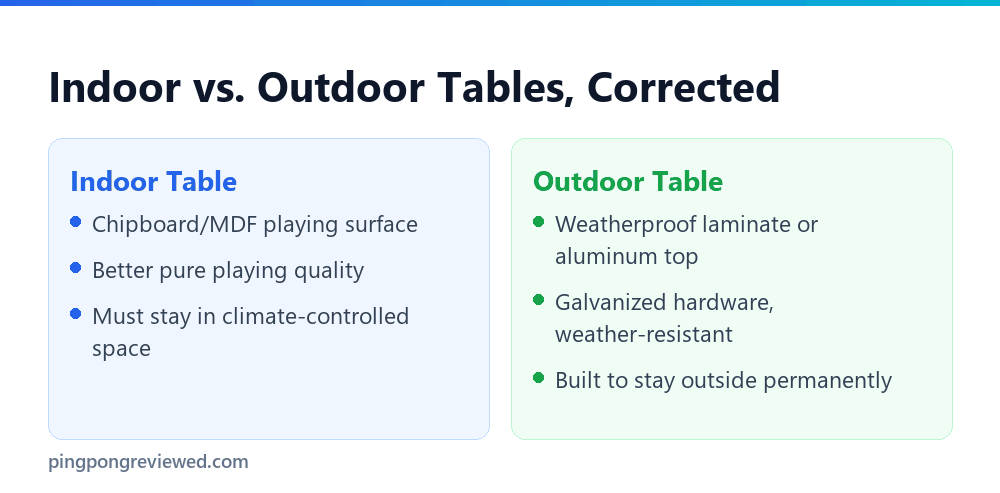
This distinction is frequently stated backwards, with outdoor tables described as the “portable” option and indoor tables as the “permanent” one. That is not the difference. Indoor tables use a chipboard or MDF playing surface that gives genuinely better playing quality but cannot handle weather exposure at all. Outdoor tables use weatherproof materials — laminate or aluminium composite tops, galvanised steel hardware, weather-resistant nets — specifically so they can be left outside through rain, sun and temperature swings. Portability is a separate feature that either type may or may not have.
The actual decision comes down to where the table will genuinely live day to day. If it’s going in a garage, basement, or dedicated indoor room, an indoor table gives you better playing quality for the same budget. If it’s staying on a patio, deck, or anywhere exposed to weather long-term, an outdoor table is the only real option, an indoor table left outside will warp or degrade quickly regardless of how carefully you otherwise treat it.
Practicing Without a Partner
You genuinely can practice alone, and it’s a common situation worth planning for rather than treating as a dead end. A table tennis robot, covered in more depth in our robot buying guides, feeds balls at a consistent, adjustable pace so you can drill specific shots repeatedly without needing a second person. A rebound board or return net, positioned at the opposite end of the table, sends your own shots back at you for solo rally practice, a genuinely useful lower-cost alternative if a full robot isn’t in your budget yet.
Shadow practice, going through stroke mechanics and footwork without a ball at all, is worth more than it might sound like for building consistent form, especially for correcting a specific technique issue you’ve identified, since removing ball contact lets you focus entirely on the motion itself without also tracking where the ball goes.
Realistic Cost Expectations
Home table prices span a wide range depending on quality tier and features, and pricing shifts over time, so treat any specific number as a general reference rather than a current quote. Entry-level indoor tables aimed at casual family use are typically the most affordable tier, mid-range tables add better surface consistency and sturdier folding mechanisms, and tournament-quality tables built for serious or club-level play sit at the top of the range. Outdoor tables generally cost more than a comparable indoor table at the same quality tier, specifically because of the weatherproof materials and hardware involved.
Beyond the table itself, budget for paddles and balls separately if they’re not included, our dedicated paddle and ball guides cover verified picks by skill level and use case, rather than assuming a bundled starter set will genuinely cover a serious player’s needs long-term.
A Quick, Correct Scoring Note
Standard modern table tennis is played to 11 points, win by two, not 21. You will still see 21 offered as an interchangeable “longer game” option, which is misleading without context: 21-point scoring was the official rule until the ITTF changed it to 11 in 2001, to make matches shorter and more spectator-friendly. Nothing stops you playing to any target score at home, but 21 is the old rule rather than a current alternative. For the complete current serving, scoring and fault rules, see our full ping pong rules guide.
Making It Work for Family and Casual Play
Home ping pong rarely stays strictly competitive, and that’s genuinely fine, several casual variants are worth knowing for mixed-skill or mixed-age groups rather than forcing everyone into standard singles rules. Round-robin “king of the table” formats, where the winner stays on and rotates through challengers, keep larger groups engaged without everyone waiting through full games. Cooperative rally counting, seeing how many consecutive hits a pair can manage together, works well for younger kids or complete beginners who aren’t ready for competitive scoring yet.
Handicap scoring, giving a weaker player a starting point lead, is another genuinely practical way to keep casual games competitive across a real skill gap, common between parents and kids or between an experienced player and a total beginner. None of this needs to be formalized, adjusting the lead as the weaker player improves over repeated sessions works fine without any fixed system.
If noise is a concern, shared walls, downstairs neighbors, late-evening play, a sound-dampening mat under the table legs and playing on a lower-bounce ball can meaningfully cut down on the paddle-and-table impact noise that tends to carry further than people expect through floors and walls.
The Short Version
Getting ping pong working at home comes down to confirming your space fits with real clearance, matching indoor or outdoor construction to where the table will actually live, having a plan for solo practice, and knowing current 11-point scoring rather than the old 21-point rule. Get those right and the rest — inviting people over, casual family games — genuinely does take care of itself.
Frequently Asked Questions
What do I need to play ping pong at home?
A table, two paddles, and balls at minimum, plus enough real clearance space around the table for players to move and swing freely, not just the table’s own footprint.
Is an indoor or outdoor ping pong table better for home use?
Depends where it’ll actually live — indoor tables give better pure playing quality for climate-controlled spaces, while outdoor tables use weatherproof materials built to stay outside permanently.
Can I practice ping pong alone at home?
Yes — a table tennis robot or a rebound board/return net both let you practice solo, feeding or returning balls without needing a second player.
How much does a home ping pong table cost?
Ranges widely by quality tier, from affordable entry-level indoor tables for casual family use up to tournament-quality tables for serious play, with outdoor tables generally costing more than a comparable indoor table.
Do you play to 11 or 21 points in ping pong?
11 points, win by 2, under current official rules since 2001. 21-point scoring is the old pre-2001 rule, not a current official alternative, though nothing stops casual home games from using any target score.
Does floor type affect how a ping pong table plays?
Yes — a hard, level, non-carpeted floor gives a truer, more consistent bounce than carpet, which noticeably affects play even on an otherwise good table.
Can an indoor table be used outside occasionally?
Not safely for regular use — indoor tables use materials that warp or degrade with weather exposure, so an outdoor table is the genuinely correct choice for anywhere exposed to weather long-term.
What’s a good way to improve at home besides full games?
Shadow practice, going through stroke mechanics and footwork without a ball, is worth doing for correcting specific technique issues, since it removes ball tracking and lets you focus entirely on the motion.
How can I make home games fair between very different skill levels?
Handicap scoring, giving the weaker player a starting point lead, keeps casual games competitive across a real skill gap without needing any formal or fixed system to manage it.
As an Amazon Associate, we earn from qualifying purchases through links on this page.

Ping Pong Reviewed is an equipment review site covering table tennis and baseball gear. Specifications are checked against manufacturer listings, and prices against live retail pages, before publication.