Timo Boll: The Real Record of the Oldest World No. 1

Timo Boll never won a World Championship singles title. He never won an Olympic medal of any colour in singles either. And he is still the most important European player of the last thirty years.
He is also, for anyone who buys equipment, the most familiar name in the sport. His name is on a blade that has been in Butterfly’s range for years, which means plenty of people own his gear without knowing much about him.
Short answer: Timo Boll is 45, born on 8 March 1981 in Erbach im Odenwald, Germany, and left-handed. He reached world number one three times, in 2003, 2011 and 2018, and won eight European singles titles. He retired from international play after the Paris Olympics in 2024 and played his last professional match in June 2025.
Table of Contents
The Record That Defines Him
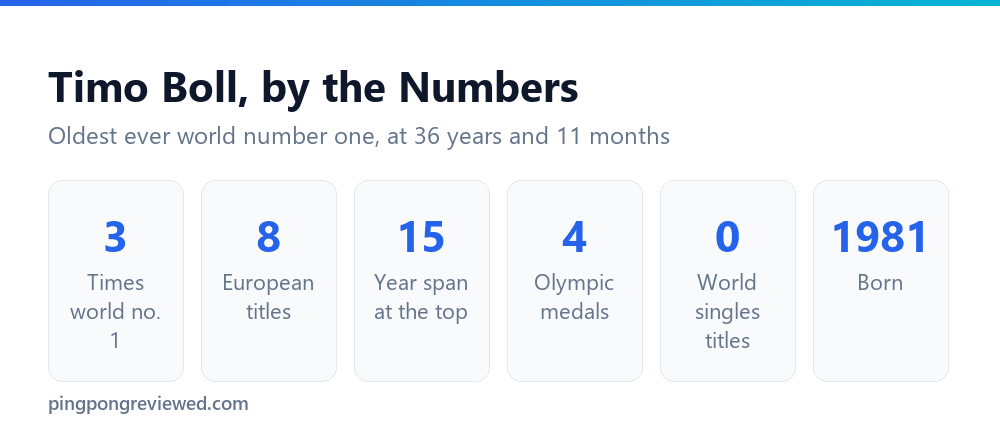
On 1 March 2018 he became the oldest player ever to be ranked world number one. He was 36 years, 11 months and 21 days old.
The previous record belonged to Jan-Ove Waldner, who was 32 years and 28 days old when he last held the top spot in October 1997. So Boll did not edge the record. He broke it by nearly five years.
The span matters more than the peak. He first reached number one in January 2003, aged 21, and held it for 20 weeks. Then he did it again in 2011. Then once more in 2018.
Fifteen years separate the first from the last. Very few athletes in any sport are ranked first in the world in two different decades.
📊 Note: He was also the first German man to top the ranking. That is easy to overlook now, but in 2003 it broke a long stretch of Chinese and Swedish dominance at the top.
What Timo Boll Actually Won
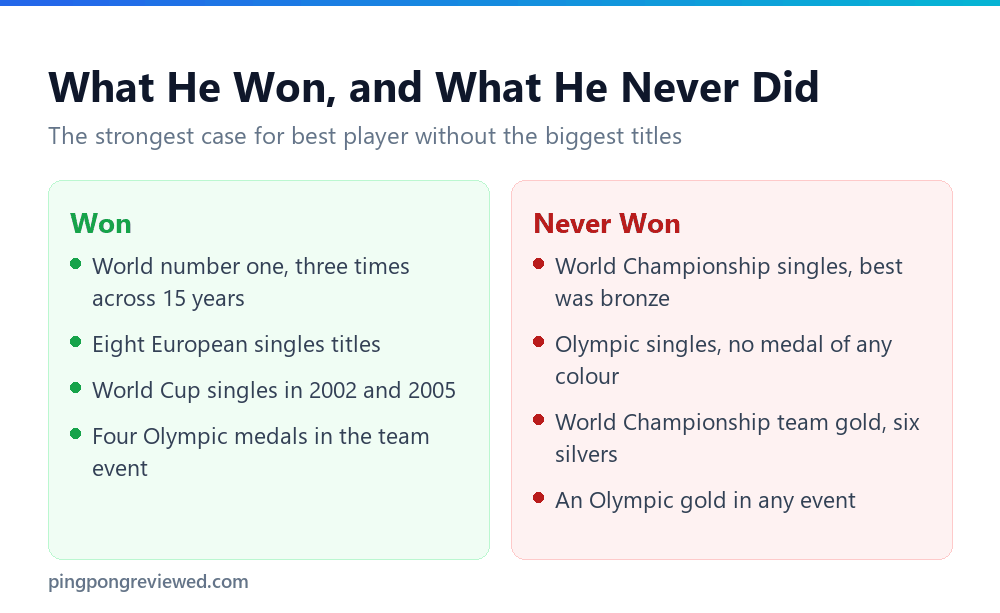
Eight European titles is the headline. But the two World Cup wins are arguably the better measure, because that event brings the Chinese players and the European Championships does not.
So the honest framing is the one he has lived with for two decades. He is the strongest candidate for best player never to win a World or Olympic singles title.
How His Career Actually Ended
The retirement happened in two stages, which is why the date is often reported differently in different places.
First came the international ending. He had said in May 2024 that Paris would be his last championship. So his final international match was on 6 August 2024, a 3-1 defeat to Sweden’s Anton Kallberg.
But he kept playing club table tennis. He had been at Borussia Duesseldorf since 2007, and he stayed for one more Bundesliga season.
The real ending came on 15 June 2025, in the Bundesliga final. Duesseldorf lost 3-2 to TTF Ochsenhausen. Boll lost his singles to Hugo Calderano in five sets, then lost the deciding doubles alongside Kallberg.
So he finished on a defeat, in a final, at 44. Then the sport moved on, and the equipment carrying his name did not.
The Timo Boll ALC, and What ALC Means
The blade is the reason most people searching his name end up on an equipment site. So here is what Butterfly actually publishes about it.
ALC stands for arylate-carbon. It is a composite layer sitting inside the blade, between the wood plies, rather than on the surface.
Pure carbon is stiff and fast, but it can feel harsh and vague on soft touch shots. Arylate is softer. So blending the two gives you most of the speed while keeping more feedback in the short game.
That is the whole design argument. Butterfly describes it as a classic in their range, and the reason it has stayed there is that the compromise suits a lot of attacking players.
Check the Thickness Before You Buy
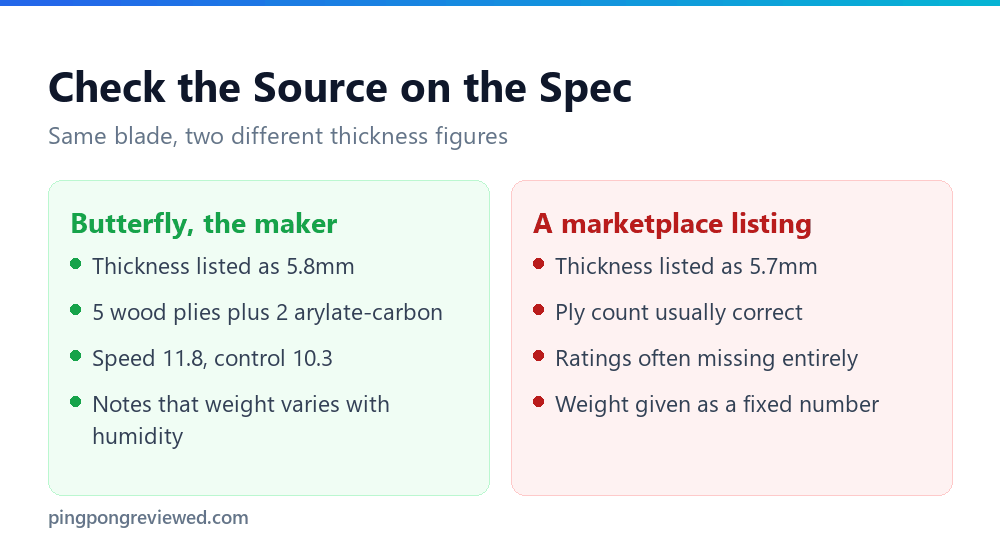
Here is a small thing worth knowing. Butterfly lists the blade at 5.8mm. A major marketplace listing for the same blade says 5.7mm.
The difference is trivial in play. But it is a useful reminder, because we keep finding the same pattern across table tennis equipment. Retail listings copy specifications loosely, and the manufacturer is the only reliable source.
⚠️ Watch out: This matters far more on rubber than on blades. We have found listings quoting sponge hardness and thickness that contradict the manufacturer outright. Always check the brand’s own product page before buying on a spec.
Butterfly also adds a detail most listings drop entirely. They note that blade weight varies with humidity and temperature, which is why they do not publish a single fixed weight.
That is honest, and it explains something players find confusing. Two blades of the same model can weigh several grams apart. So a replacement is never quite the same bat as the one it replaces.
Who the Timo Boll ALC Is Actually For
A speed rating of 11.8 on Butterfly’s scale is quick. So this is not a blade to learn on, whatever the name recognition suggests.
- Suits you if you already loop off both wings and generate your own power, and you want a blade that will not dull your touch in the short game.
- Does not suit you if you are still grooving a stroke. A fast blade sends marginal shots long, so it punishes errors rather than hiding them.
- Skip it entirely if you play a blocking or defensive game. The speed works against you, and a slower all-round blade gives more control for less money.
- Remember it is a blade only. The price does not include rubber, and two decent sheets add a substantial amount to the total.
💡 Pro tip: If you want his feel without his speed, Butterfly sells slower blades in the same family. The name on the handle is the same, but the class rating is what actually determines whether the blade suits your game.
The Rubbers He Played
He finished his career on Butterfly Dignics 09C, and the C matters. It marks a tacky topsheet, which is unusual for a European player.
Most European rubbers grip through a springy sponge rather than surface stickiness. Chinese rubbers do the opposite. So 09C is Butterfly’s answer to the Chinese tacky sheets, built on their own sponge technology.
That tells you something about how the game changed around him. He started against speed glue and finished on a rubber designed to imitate a Chinese one, and he adapted through both eras.
📊 Note: He signed with Butterfly in 1993, aged 12, and stayed for his entire career. Very few sponsorships in any sport last that long, and it is why his name sits on so much of their range.
The Two-Winged Looper
His playing style is worth understanding, because it became the standard. He was among the first genuine two-winged loopers at the top of the game.
That means he attacked with topspin off both forehand and backhand. Before that, most attacking players built everything around the forehand and used the backhand to survive until they could get around it.
He was also left-handed, which is uncommon at the top and a real tactical asset. His sidespin serves curved into a right-hander’s crossover point, which is the awkward zone between their two wings.
And he was known for the block. Instead of always looping, he would absorb pace and return the ball early with spin, which took time away from bigger hitters.
So the record makes more sense in that light. He was never the most powerful player in any era he played through. But he was extremely difficult to rush, which is how a European stayed at the top while Chinese depth kept increasing.
Seven Olympic Games
He competed at seven Olympic Games, from Sydney in 2000 to Paris in 2024. Only five table tennis players had done that before him.
That is 24 years of qualifying. And qualifying for Germany is not a formality, because the country has produced several world top ten players across that period.
But the singles medal never came. He played seven Olympic tournaments and finished without one, while collecting four medals in the team event alongside teammates who changed almost completely between his first Games and his last.
So the Olympic record is the clearest version of his whole career. Present at the highest level for longer than anyone, and never quite first.
Why a European Staying at the Top Was So Unusual
The context explains the achievement better than the trophy list does. China has dominated men’s table tennis for the whole of his career.
Their system is built on depth. Because the internal standard is so high, a Chinese player ranked outside their own top five may still beat most of the world.
So for a European, the problem is not one opponent. It is that the draw keeps producing them, and surviving a tournament often means beating two or three.
That is why his two World Cup wins carry weight. The World Cup brings the Chinese players, unlike the European Championships, and he won it twice.
What a Club Player Can Take From His Game
Buying his blade is the least useful thing to copy, and it is the thing most people do. Three other parts of his game transfer far better.
- Learn to block properly. He took pace off big hitters and returned the ball early. Most club players either swing or panic, and a controlled block wins points against anyone who relies on power.
- Attack off both wings. He helped make the two-winged game standard. If you are hiding a backhand, that is costing you more points than a faster blade will ever win.
- Take the ball early. Time pressure beats raw speed. Standing closer to the table and meeting the ball sooner is free, and it is what made him hard to rush.
- Stay adaptable. He played through the speed glue era and finished on a tacky rubber designed to imitate Chinese sheets. He changed with the sport rather than defending a style.
None of those cost anything. And all of them matter more to a club player’s results than the blade does, which is worth saying plainly on a site that reviews equipment.
He Started in the Speed Glue Era
One change during his career reshaped the equipment side of the sport entirely, and he played on both sides of it.
Players used to reglue their rubbers shortly before matches. The solvent swelled the sponge and left it under tension, which added noticeable speed and spin. So a freshly glued sheet played faster than the same sheet an hour later.
But the glues released volatile organic compounds, and the health concerns were serious. The ITTF banned them from September 2008, right after the Beijing Olympics.
That forced manufacturers to build the effect into the rubber itself. Tensor and similar sheets arrive pre-tensioned from the factory, which is why modern rubber is so much faster out of the packet than it was in the 1990s.
So Boll learned the game on equipment that had to be prepared before every match. Then he finished it on Dignics, a rubber engineered to deliver that tension permanently. Very few players competed at the top across that whole transition.
📊 Note: This is worth knowing when you read old equipment reviews. A rubber praised in 2005 was being judged glued, and the same sheet unglued is a different product. Reviews written before September 2008 do not transfer.
Timo Boll Questions, Answered
How old is Timo Boll?
He was born on 8 March 1981 in Erbach im Odenwald, Germany, which makes him 45. He is 1.81 metres tall and plays left-handed with a shakehand grip.
Did Timo Boll ever win the World Championship?
Not in singles. His best World Championships singles result was bronze, in 2011 and 2021. He won eight European singles titles and two World Cups, but the World Championship and an Olympic singles medal both eluded him.
Was Timo Boll ever world number one?
Yes, three times. He first topped the ranking in January 2003 at 21, then again in 2011, and once more in March 2018. Those first and last dates are 15 years apart.
Is Timo Boll the oldest world number one ever?
Yes. On 1 March 2018 he was 36 years, 11 months and 21 days old, which broke Jan-Ove Waldner’s record of 32 years and 28 days set in October 1997.
When did Timo Boll retire?
His last international match was on 6 August 2024 at the Paris Olympics, a 3-1 defeat to Anton Kallberg. He kept playing club table tennis and retired for good after the Bundesliga final on 15 June 2025.
What blade does Timo Boll use?
The Butterfly Timo Boll ALC, which is built from five wood plies and two arylate-carbon layers. He has been sponsored by Butterfly since 1993 and used Dignics 09C rubber.
Is the Timo Boll ALC good for beginners?
No. Butterfly classes it as an offensive blade with a speed rating of 11.8, and it is built for a player who already generates their own power. A beginner is better served by a slower all-round blade.
How many Olympics did Timo Boll play?
Seven, from Sydney in 2000 to Paris in 2024. He was only the sixth table tennis player to reach seven Games. He won four medals across them, two silver and two bronze, all in the team event.
Is Timo Boll left-handed?
Yes. He is a left-handed shakehand player and one of the game’s early two-winged loopers, meaning he attacked with topspin off both wings rather than favouring the forehand.
The Short Version
- →Born 8 March 1981, so 45, and left-handed with a shakehand grip.
- →World number one three times, in 2003, 2011 and 2018, a span of 15 years.
- →The oldest player ever to top the ranking, at 36 years and 11 months.
- →Eight European singles titles and two World Cups, but no World or Olympic singles title.
- →Seven Olympic Games from 2000 to 2024, with four team medals and no singles medal.
- →The Timo Boll ALC is an offensive blade rated 11.8 for speed, not a beginner’s bat.
The missing titles are the first thing people mention, and they are real. But being ranked first in the world in 2003 and again in 2018 is a kind of achievement the trophy cabinet does not record.

Ping Pong Reviewed is an equipment review site covering table tennis and baseball gear. Specifications are checked against manufacturer listings, and prices against live retail pages, before publication.