Zhang Jike: The Real Record Behind a 445-Day Grand Slam
Zhang Jike won the three biggest titles in table tennis in 445 days. Nobody has done it faster, and the record has stood since 2012.
He is also the reason a lot of people get confused in a shop. Search his name and you will find blades from two different manufacturers, because he changed brands late in his career.
Short answer: Zhang Jike is 38, born on 16 February 1988 in Qingdao, and right-handed. He won the World Championships in 2011 and 2013, Olympic singles gold in 2012, and the World Cup in 2011 and 2014. Completing that set took him 445 days, which is the fastest career Grand Slam in the sport’s history. He is now retired and coaching.
Table of Contents
The 445-Day Grand Slam
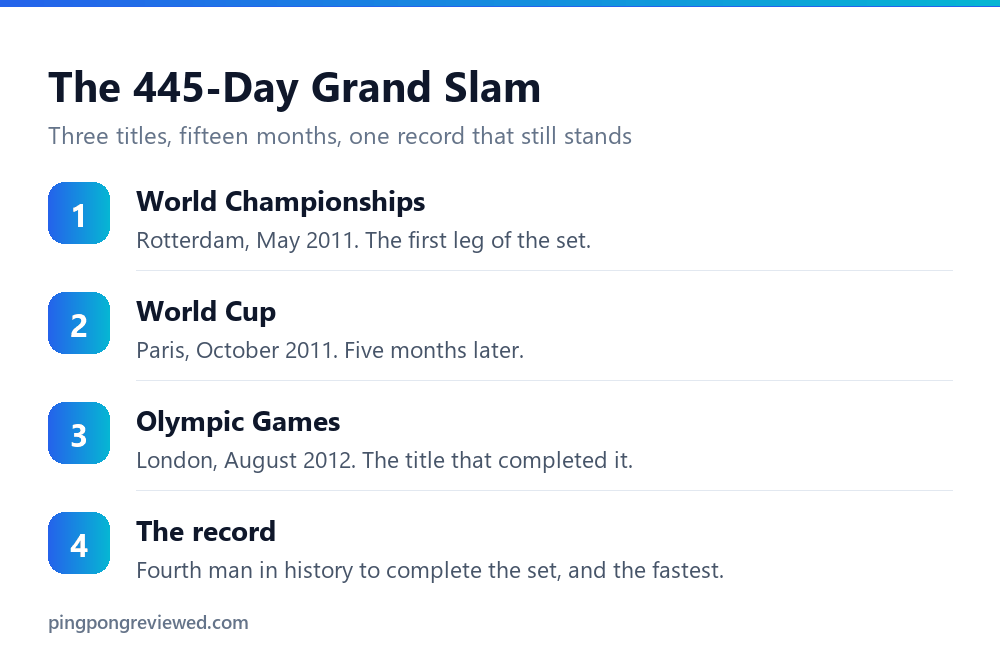
A career Grand Slam in table tennis means winning the World Championships, the World Cup and the Olympic singles title. Most players who manage it take years.
He started in Rotterdam in May 2011 with the World Championship. Then he took the World Cup in Paris that October. Then he won Olympic gold in London in August 2012.
That is 445 days from the first to the last. He was the fourth man in history to complete the set, and he did it faster than any of the three before him.
The timing helps explain it. Because the Olympics fall every four years, a player usually has to hold form across a long stretch to line all three up. He simply won them back to back.
What He Actually Won
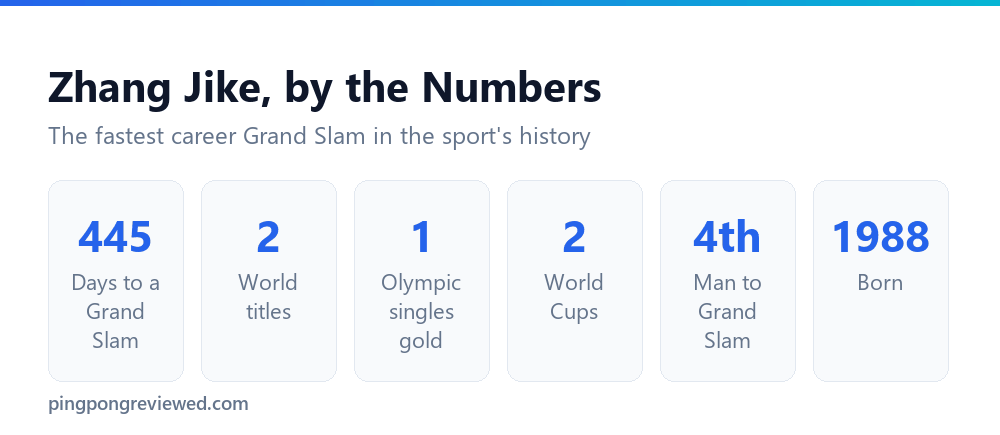
Two World Championship singles titles is the correct figure, and it gets inflated online more often than almost any other number in the sport.
The 2016 silver is worth noting too. He reached the Olympic final again in Rio and lost it to Ma Long, which is the match that closed his run at the top.
The $45,000 Celebration
One story follows him more than any title. After winning the 2014 World Cup in Duesseldorf, he celebrated by destroying the barriers around the court.
His prize money was US$45,000. All of it was taken as a fine, and he proposed the penalty himself.
So he won the World Cup and went home with nothing. It is the kind of detail that says more about a player’s temperament than a results table can.
📊 Note: He was known for enormous, physical celebrations throughout his career. That intensity was part of how he played, and it is why the 445-day run happened when it did.
Why There Are Two Zhang Jike Blades
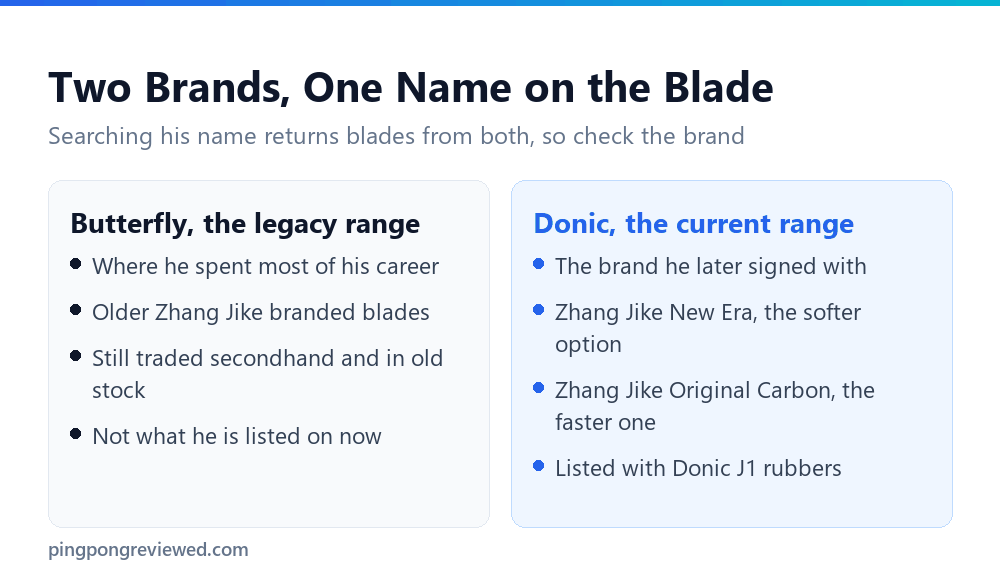
This is the part that matters if you are shopping rather than reading. His name appears on blades from two different manufacturers.
He spent the bulk of his career with Butterfly, and Butterfly sold blades carrying his name during that period. Those are still in circulation, both as old stock and secondhand.
He later signed with Donic, who released their own Zhang Jike range. He is currently listed on a Donic Zhang Jike New Era blade with Donic J1 rubbers.
Donic’s range splits into two. The Original Carbon is the faster build, closer to what he actually played. The New Era is softer and more controllable, which is the version aimed at the rest of us.
⚠️ Watch out: Reports of exactly when he changed brands do not agree, so we are not putting a date on it. What matters for a buyer is simpler. Check which manufacturer made the blade in front of you, because two very different bats carry the same player’s name.
Named After a Footballer
His father named him after Zico, the Brazilian footballer. Jike is the Chinese rendering of the name.
It is a small detail, but it says something about expectation. He was given the name of a world-class athlete before he had played anything, and he grew up carrying it.
His route through the Chinese system was not smooth either. Competition for a national team place is brutal, and plenty of players with his talent never get one. So the 445-day run reads differently once you know how long the wait was.
The Backhand and the Flick
If you only watch one thing in his old matches, make it the receive. That is where he changed how the modern game is played.
He was a two-winged attacker, which means he looped off both sides rather than building everything around the forehand. But the backhand was the stronger wing, and that was unusual for a Chinese player of his era.
The signature shot was the over-the-table flick. Instead of pushing a short serve back passively, he would attack it with topspin off the backhand while the ball was still over the table.
That shot flipped the logic of serve and receive. Before it became standard, a good short serve gave the server the first attack almost automatically. After it, the receiver could take the initiative instead.
💡 Pro tip: This is the one part of his game worth copying at club level. Learning to flick a short backspin serve takes months, but it removes the single biggest advantage your opponent has. Start with slow serves and a small brushing contact.
Zhang Jike and Ma Long
The two came up together, and their careers are usually told as one story with two halves.
Zhang Jike got there first. He won the World Championship in 2011 and the Olympic title in 2012, while Ma Long was still carrying the label of best player without a major singles title.
Then it reversed completely. Ma Long won the World Championship in 2015 and the Olympic singles in 2016, beating Zhang Jike in that Rio final.
So the comparison depends entirely on what you value. Ma Long has the deeper record by a wide margin. But nobody has matched the intensity of Zhang Jike’s peak, and the 445 days remain untouched.
If You Are Buying a Zhang Jike Blade
The two Donic models are aimed at different players, and the names do not make that obvious. So it is worth being clear about which is which.
- Zhang Jike Original Carbon is the faster build, closer to the configuration he actually played. It suits a player who already generates their own power and wants speed.
- Zhang Jike New Era is the softer, more controllable option. It has more feel in the short game, which makes it the sensible choice for most club players.
- Older Butterfly blades carrying his name still turn up secondhand and as old stock. They are a different product from the Donic range entirely.
- Neither is a beginner’s blade. Both are built for attacking play, and a slower all-round blade will teach you more in your first year.
The general point applies well beyond him. A signature blade is a marketing arrangement as much as an engineering one, and the version sold to the public is rarely the version the player uses.
How His Career Ended
The retirement is harder to date than most, and it is worth explaining why rather than picking a year and hoping.
He said as early as August 2016, straight after Rio, that he was ready to retire. But he did not stop then.
Instead he faded out across the following Olympic cycle, slowed by injury and by the sheer depth of the Chinese team. There was no farewell match and no single announcement that everyone reported at once.
So the honest answer is that he stepped away gradually. He has since moved into coaching and works with young players, which is the most common path for retired Chinese internationals.
📊 Note: This is why retirement dates for him vary between sources. Where reporting genuinely disagrees, we would rather say so than pick the version that reads more cleanly.
What He Left Behind
Two things outlast the trophies. The first is the record, and 445 days is the kind of number that only falls if someone wins three specific tournaments in a very short window.
The second is the flick. Watch any professional match now and receivers attack short serves as a matter of routine. That was not true before his generation.
So his influence on how the game is played may be larger than his influence on the record books. And for a player with an Olympic gold and two world titles, that is saying something.
The Six Men Who Have Done It
Calling him the fourth man to complete the Grand Slam only means something if you know who the others are. So here is the full list.
Six players in the history of the sport. And only one of them, Waldner, was not Chinese, which tells you how tightly China has held the biggest titles.
But the speed is where Zhang Jike separates himself. The others assembled the set over years, and in some cases over more than one Olympic cycle.
So he is not the most decorated name on that list. He is simply the one who got there fastest, by a distance nobody has threatened since.
What It Would Take to Beat 445 Days
The record looks arbitrary until you work out what breaking it actually requires. Then it starts to look very hard.
First, the Olympics only happen every four years. So the clock is effectively set by when a player wins their Olympic title, because that is the fixed point.
Second, a player has to win their first of the three and then not miss. Because the World Championships and World Cup both run on their own cycles, the window between them is not something anyone can choose.
Third, and hardest, they have to be Chinese or beat the Chinese team three times in a row at the biggest events. Selection alone removes most candidates.
So the record is protected by the calendar as much as by the difficulty. Someone will break it eventually. But it has stood since 2012, and no current player is close.
📊 Note: Wang Chuqin is the obvious candidate. He already holds the World Championship and a World Cup, so an Olympic singles title would complete the set. But the 445-day clock would have needed all three inside fifteen months.
Why His Peak Was So Short
Five years separate his first World Championship from his last Olympic final. That is a brief window for a player of his standing, and the reasons are worth setting out.
The style is the first one. He played at very high intensity, attacking off both wings and taking the ball early. So the physical cost per match was higher than it is for a player who controls rallies and waits.
Then there is the injury record. He struggled with fitness through the years after Rio, and at that level even a small drop is enough to lose a place.
But the biggest factor is structural. Because the Chinese team is so deep, a player who slips slightly does not fall to world number five. They fall out of selection entirely, and stop entering the events that generate results.
So his career did not end with a decline anyone could watch. It ended with him no longer being picked, which is a quieter and much faster exit.
Compare that with Ma Long, who stayed selectable into his mid-thirties. Same team, same era, and a completely different shape of career.
Zhang Jike Questions, Answered
How old is Zhang Jike?
He was born on 16 February 1988 in Qingdao, Shandong province, which makes him 38. He is right-handed and plays with a shakehand grip.
Is Zhang Jike left-handed?
No, he is right-handed. He plays a two-winged attacking game with a shakehand grip, and he was best known for his backhand and his over-the-table flick.
How many World Championships did Zhang Jike win?
Two. He won the men’s singles title in Rotterdam in 2011 and again in Paris in 2013. Higher figures circulate online, but two is the correct number.
What is Zhang Jike’s Grand Slam record?
He completed the career Grand Slam in 445 days, which is the fastest in the sport’s history. He won the 2011 World Championships, the 2011 World Cup and the 2012 Olympic singles title, becoming the fourth man to complete the set.
Did Zhang Jike win an Olympic gold medal?
Yes. He won the men’s singles gold at London 2012 and team gold at both London 2012 and Rio 2016. He also took singles silver in Rio, losing the final to Ma Long.
Why was Zhang Jike fined $45,000?
He destroyed the barriers around the court celebrating his 2014 World Cup win in Duesseldorf. His entire US$45,000 prize was taken as a fine, a penalty he proposed himself.
What equipment does Zhang Jike use?
He is currently listed on a Donic Zhang Jike New Era blade with Donic J1 rubbers. He spent most of his career with Butterfly, which is why blades carrying his name exist from both brands.
Does Zhang Jike still hold the fastest Grand Slam record?
Yes. His 445 days has stood since August 2012. Ma Long and Fan Zhendong have both completed the career Grand Slam since, but neither assembled the three titles in anything close to that window.
Is Zhang Jike still playing?
No, he is retired and has moved into coaching, working with young players. Reports of the exact retirement date vary, because he stepped back gradually rather than announcing a single farewell match.
The Short Version
- →Born 16 February 1988, so 38, and right-handed with a shakehand grip.
- →Completed the career Grand Slam in 445 days, the fastest in the sport’s history.
- →Two World Championship singles titles, in 2011 and 2013, not four.
- →Olympic singles gold in 2012 and silver in 2016, losing that final to Ma Long.
- →His name is on blades from both Butterfly and Donic, so check the brand before buying.
The 445 days are what will last. Titles get matched eventually, but winning all three of them inside fifteen months is a different kind of achievement, and nobody has come close since.

Ping Pong Reviewed is an equipment review site covering table tennis and baseball gear. Specifications are checked against manufacturer listings, and prices against live retail pages, before publication.