Best Ping Pong Rubber: 5 Genuine Sheets Across Every Budget
Table of Contents
Finding the Best Ping Pong Rubber, Honestly Audited
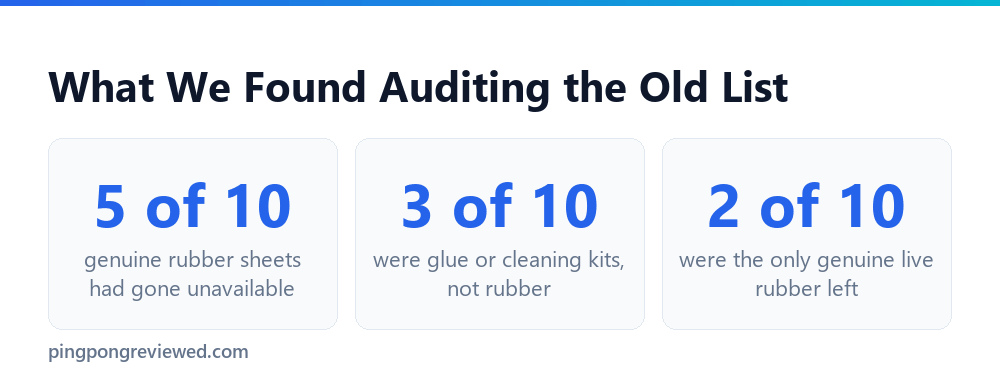
We checked all 10 original ASINs on this best ping pong rubber post individually on Amazon. Five genuine rubber sheets had gone unavailable since the post was written, three of the ten were actually glue or cleaning kits mislabeled with rubber-adjacent titles, and only two genuine, live rubber sheets survived the audit.
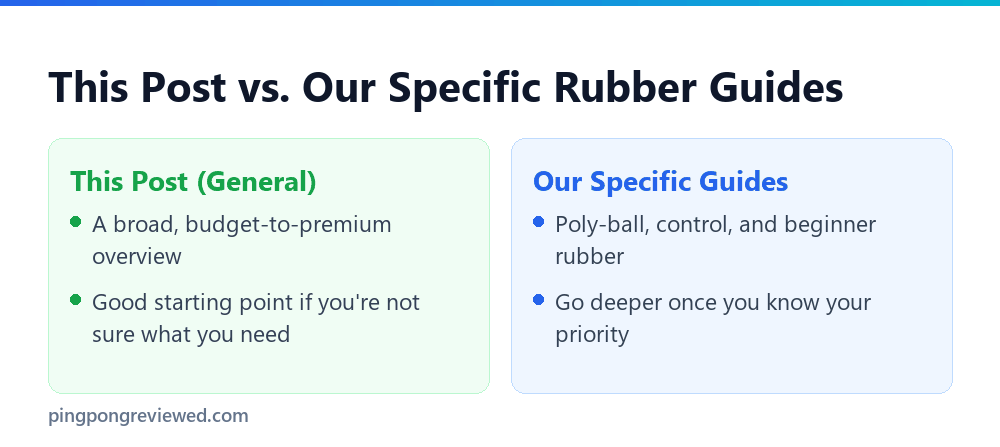
We kept those two and sourced three more to build a proper five-pick list spanning budget to premium. This is deliberately a general overview, if you already know you want rubber tuned for the modern poly ball, for control, or specifically for beginners, our dedicated guides for each go deeper than a general list like this one can.
1. Coherny 2.2mm Rubber Sponge
The most consistently reliable budget pick across every rubber guide on this site. Real tacky rubber over a real sponge, delivered dependably at a low price, which is why it keeps earning a recommendation rather than being included as filler.
There’s real value in an option that keeps showing up across separate buying guides written for different priorities, control, beginners, and now this general list. A product that performs consistently across different use cases rarely does so by accident, and it’s a safer default than chasing a specialized sheet before you know what you actually need.
- ✓Lowest realistic starting price
- ✓Consistent quality across multiple purchases
- ✓Safe first custom rubber for any player
- ✕Not tuned for any specific playstyle
- ✕Won’t satisfy an advanced player long-term
2. Loki RXTON 1 Table Tennis Rubber Sheet
An ITTF-approved, allround spin-control sheet explicitly built for quick attack play. Loki has built a strong reputation in the DIY custom-racket community specifically, where buyers tend to be more demanding about consistency than a casual shopper.
“Allround” is doing real work in how this rubber is built, it’s not tuned to maximize one specific trait like top-end spin or blistering speed, it behaves predictably across a wide range of shots. That versatility matters most for a player who hasn’t yet settled into a clear playing style, since a specialized sheet can actively work against you before you know what you’re specializing toward.
3. DHS Hurricane 3-NEO
DHS is the dominant rubber brand in Chinese national-team-level play, and the NEO revision exists because DHS themselves redesigned their classic Hurricane formula specifically around the modern poly ball’s lower inherent spin. If you want a rubber genuinely engineered for the ball everyone plays with today, this is it.
Every rubber sold today is technically compatible with poly balls, since celluloid balls aren’t manufactured anymore. What sets the NEO line apart is that DHS specifically re-engineered the formula around that lower-spin baseline rather than just continuing to sell an older formula unchanged, which is a meaningful difference once you’re advanced enough to feel it.
4. YASAKA Rakza 7
One of the most respected control-oriented rubbers available, widely used by intermediate and advanced players for its blend of grip and predictability. YASAKA is a Japanese manufacturer with a long track record in control-and-grip-focused rubber specifically.
The Rakza line has stayed popular for years rather than being replaced by a newer model every season, which in a market full of constant new releases usually signals a formula that genuinely works rather than one propped up by marketing. If placement and consistency matter more to your game than maximum spin or speed, this is the established choice.
5. Nittaku Fastark G-1 Tension Rubber
The premium pick and the only tension rubber on this list, tension construction stores and releases more energy through the stroke than a traditional sponge, adding speed and spin most standard sheets can’t match. Built for players who already have the technique to control the extra output.
Nittaku originally built the Fastark line to add extra pop during the celluloid-ball era, and it turned out to be exactly the kind of compensation poly-ball players need now that the ball itself provides less inherent liveliness. The extra-thick sponge option pushes that stored-energy effect even further for players who can control it.
- ✓Highest performance ceiling on this list
- ✓Trusted Japanese tension-rubber specialist
- ✓Extra thick sponge option available
- ✕Priciest pick here by a wide margin
- ✕Overkill for a beginner or casual player
How to Actually Choose Between These Five
Price is the honest first filter for most buyers. The Coherny and Loki RXTON 1 sit under $16 and are both genuinely capable rubber, not compromise picks, they’re simply not tuned toward any one specific priority. Start here if you’re not sure yet what you want from your rubber.
Once you know what you’re optimizing for, the remaining three diverge. The DHS Hurricane 3-NEO is the pick if modern poly-ball performance specifically matters to you, our poly-ball rubber guide goes deeper on that angle. The YASAKA Rakza 7 is the pick for predictability and placement over raw power, covered further in our control rubber guide. And the Nittaku Fastark G-1 is for players who’ve already outgrown standard sponge rubber and want the extra performance ceiling tension construction provides.
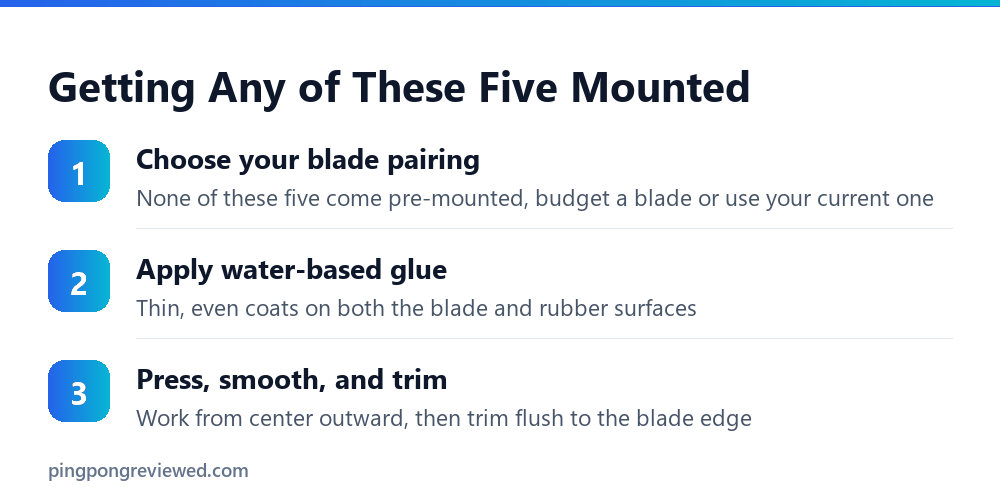
None of these five ship pre-mounted, so budget for glue and either a blade to pair it with or your current racket’s existing blade. Our rubber glue guide covers genuine water-based glue options if you don’t already have some on hand.
The One Spec That Matters More Than Brand
Across every rubber guide on this site, one variable comes up more than any other as the real determinant of how a sheet feels and performs, sponge hardness. Brand name and price matter for consistency and manufacturing quality, but hardness determines the actual playing characteristics more directly than either.
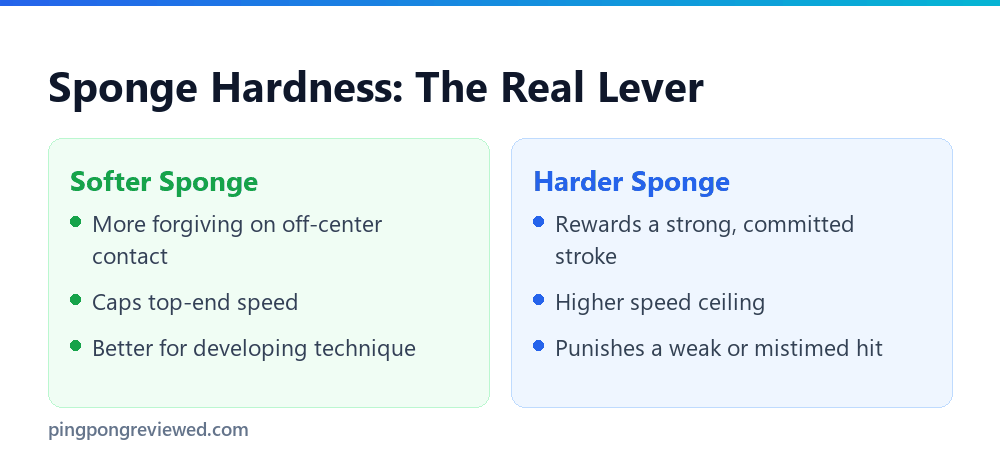
A softer sponge is more forgiving when you don’t make perfect contact, which is exactly why it suits developing players, but it also caps how much speed you can generate even with a strong stroke. A harder sponge rewards a confident, well-timed swing with more speed and spin, but it punishes a weak or mistimed one more severely than a softer sheet would.
Most of the five picks above sit in a medium-to-medium-hard range for exactly this reason, that’s where usability and performance overlap best for the widest range of players. The Nittaku Fastark G-1 pushes further toward performance, which is why it’s positioned as the pick for players who already have the technique to handle it.
Keeping Whichever Rubber You Choose Performing Well
Regardless of which of these five you pick, rubber performance degrades gradually with use and exposure rather than failing suddenly. Dust and skin oils build up on the surface every session, dulling the tackiness that makes any of these sheets worth buying over a starter paddle’s built-in rubber in the first place.
Wipe the surface down with a dedicated rubber cleaner and sponge after each session rather than letting residue accumulate, and store your paddle with a protective sheet over the rubber between uses. Keep it away from direct sunlight and extreme heat too, both degrade rubber faster than normal wear from play does, a paddle left in a hot car is a common and avoidable way to shorten a good sheet’s usable life.
Reading a Rubber Spec Sheet
Manufacturers publish numbers for speed, spin and control, and those numbers are close to useless for cross-brand comparison because every manufacturer scales them differently. A 9.0 for spin from one brand and a 9.0 from another are not measurements of the same thing on the same scale.
What the ratings are useful for is comparing within a single brand’s range. If a manufacturer rates one of its own sheets faster than another, that ordering is meaningful, because the same internal method produced both figures. Treat published numbers as an in-house ranking, never as an absolute specification.
The specifications that do transfer across brands are the physical ones: sponge thickness in millimetres, sponge hardness where it is given on a stated scale, whether the surface is inverted or pips-out, and whether the sheet carries ITTF approval. Those are measurable facts rather than marketing scales, and they are what genuinely support a like-for-like comparison.
Sponge Hardness and Why It Confuses People
Sponge hardness is one of the most-quoted rubber specifications and one of the most misread, because there is more than one measurement scale in circulation and the same physical sponge produces very different numbers depending on which is used.
The practical consequence is that a hardness figure is only comparable to another figure measured the same way. A sheet listed at one number under a Chinese scale and another listed at a different number under a European or Japanese scale may be far closer in actual firmness than the raw figures suggest, or further apart. If a listing does not state which scale it is quoting, the number tells you very little on its own.
What hardness actually controls is straightforward once the measurement noise is set aside. A harder sponge needs more racket speed to compress and activate, and rewards that speed with more spin and control at the top end. A softer sponge activates at lower stroke speeds, feels livelier immediately, and gives up some precision at high pace.
- Softer sponge suits developing players, anyone with a shorter or slower stroke, and backhand use where stroke length is naturally more restricted.
- Harder sponge suits players generating high racket speed, typically on the forehand, and anyone whose complaint about their current rubber is that it feels uncontrollably fast on soft contacts.
The common error is treating harder as more advanced and therefore better. A hard sponge that you cannot activate simply plays dead, producing less spin and less speed than a softer sheet would have in the same hands.
Throw Angle: The Property Nobody Explains
Throw angle describes how high off the racket a rubber sends the ball for a given stroke. It is rarely printed on packaging and it affects how a rubber feels more than almost any other property, which is why two sheets with similar published speed and spin numbers can feel completely different to play with.
A high-throw rubber sends the ball on a more arcing trajectory. That gives margin over the net and suits looping play away from the table, and it makes opening against backspin considerably easier because the rubber does some of the lifting for you.
A low-throw rubber keeps the ball flatter. That suits blocking and close-to-table hitting, where you want the ball to travel more directly, and it makes short touch play easier to keep low over the net.
Throw angle also interacts with blade stiffness, which is why swapping rubber onto a different blade can change its character noticeably. A high-throw rubber on a stiff, fast blade behaves differently from the same rubber on a flexible one, and it is a common reason players report that a well-reviewed rubber “doesn’t work” for them when the mismatch is actually with the blade underneath it.
Tensioned Rubber and What ‘Tensor’ Means
Most modern non-tacky rubber is described as tensioned or tensor rubber, and the term is used so universally that it has stopped conveying much. It refers to rubber manufactured with the topsheet and sponge held under tension, which pre-loads the sheet so it returns energy more readily on contact.
The practical effect is what players describe as catapult: the sheet contributes speed of its own rather than only transmitting what your stroke supplies. That makes tensioned rubber feel lively and powerful, particularly on strokes that are not fully committed.
It also makes control harder in one specific area, short touch play over the table. A sheet that adds energy adds it to soft touches too, which is why players moving from a controlled rubber to a highly tensioned one often find their short game deteriorating while their attacking shots improve.
This is worth weighing honestly against what you actually need. If your losses come from being outgunned in rallies, more catapult helps. If they come from serves and short pushes sitting up for the opponent, more catapult makes it worse, and a more controlled sheet is the upgrade even though it is the less exciting purchase.
Inverted Is Not the Only Option
Every sheet compared on this page is inverted rubber, the smooth surface the large majority of players use, and for most readers that is correct. It is still worth knowing what else exists, because a small number of players are using the wrong category rather than the wrong sheet within a category.
- Inverted (pimples-in): smooth playing surface, maximum spin generation, the default for attacking and all-round play.
- Short pips: stubby pimples facing outward. Generates less spin of its own but is less affected by incoming spin, which suits close-to-table hitters and blockers who want predictable returns without reading spin precisely.
- Long pips: long thin pimples that buckle on contact and reverse incoming spin rather than gripping. A specialist defensive surface requiring its own technique.
- Anti-spin: smooth but deliberately low-friction, neutralising spin without reversing it. Genuinely niche and rarely the right first choice.
The reason this matters on a general rubber page is that a player struggling to read spin sometimes solves more by moving to short pips on the backhand than by upgrading their inverted rubber twice. That is not a common answer, but it is a real one, and it is invisible if you only ever compare inverted sheets against each other.
If you are curious about a different surface type, try it on a budget sheet first. The question you are answering is whether the category suits you, and that answer transfers to better sheets later without the cost of finding out at premium prices.
Choosing by Playing Style
Style is a more useful starting filter than skill level, because two players of identical standard playing different games want genuinely different rubber. The categories below are broad, but recognising yourself in one narrows the field considerably.
- Close-to-table attacker. You take the ball early and play fast, flat exchanges. A lower-throw, quicker-activating sheet suits this; extremely high-throw rubber sends early-contact balls long.
- Looper away from the table. You step back and play heavy topspin. High throw and a harder sponge reward the full stroke you are making and give net margin on the arc.
- All-round control player. You place the ball and wait for errors. A controlled, moderately tensioned mid-tier sheet does more for you than anything faster.
- Blocker. You absorb pace and redirect it. Lower throw and moderate speed keep blocks low and on the table; a high-catapult sheet makes blocking genuinely harder.
- Defender or chopper. A separate category with its own equipment logic, covered fully in our defensive rubber guide.
If you cannot place yourself, that is itself informative, it usually means your game is still forming, and the right answer is a controlled all-round sheet that lets you develop in any direction rather than one that commits you early.
Different Rubber on Each Side
Running the same rubber on both sides is the simplest approach and a perfectly reasonable default, but most players past the developing stage end up with different sheets on forehand and backhand, and the reasoning is worth understanding rather than copying blindly.
The forehand stroke is longer and generates more racket speed, which means it can activate a harder, higher-throw sheet and extract the spin such a rubber offers. The backhand stroke is shorter and more compact, particularly over the table, so it typically benefits from something softer and quicker to activate.
That produces the common pairing of a harder forehand rubber with a softer, more responsive backhand rubber. The Chinese-forehand, European-backhand setup discussed in our Chinese rubber guide is one widespread version of exactly this logic.
A caution worth stating: two different sheets means two different feels to learn, and changing both at once makes it impossible to tell which change caused what. Change one side at a time and play several sessions before judging, otherwise you are guessing.
Matching Rubber to the Blade You Own
Rubber and blade function as a single system, and evaluating rubber without reference to what it is glued to is the most common reason a well-reviewed sheet disappoints. The general principle is that the combination determines speed and control, not either part alone.
- Fast, stiff blade (carbon or similar): pairs sensibly with a controlled rubber. Adding a fast, high-throw rubber to an already-fast blade produces a setup most players cannot keep on the table.
- Slower, flexible allwood blade: can carry a faster, livelier rubber comfortably, since the blade absorbs energy the rubber returns.
- Defensive blade: covered in our defensive rubber guide, and generally paired with thin sponge or specialist surfaces.
If you are changing equipment and cannot change both at once, change the rubber first. It is the cheaper component, it wears out on its own schedule anyway, and a rubber change is reversible in a way that selling on a blade is not.
What Each Price Tier Actually Buys
Rubber pricing spans a wide range, and the returns are distinctly non-linear, which is worth understanding before assuming that spending more is straightforwardly better.
- Entry tier: functional inverted rubber with adequate grip. Perfectly sufficient for developing technique, and genuinely better than entry rubber from a decade ago.
- Mid tier: where most of the meaningful gain sits. Noticeably better grip and consistency, tensioned construction, and usually ITTF approval. The best value in the category for most players.
- Premium tier: the newest topsheet formulations, tighter sheet-to-sheet consistency, and sponges tuned for very high racket speed. Real differences that require a developed stroke to access.
The jump from entry to mid tier delivers far more than the jump from mid to premium, for most players by a wide margin. If budget is a constraint, buying mid-tier rubber and replacing it promptly when it wears beats buying premium rubber and playing it long past its useful life.
It is also worth remembering that rubber is recurring rather than one-off spending. A premium sheet replaced three times a year is a significant annual cost, and that ongoing figure, rather than the single purchase price, is the number worth deciding against.
How to Judge a New Rubber Fairly
Most rubber opinions are formed in the first session, and first sessions are systematically misleading. New rubber feels different from what you are used to, and “different” gets interpreted as better or worse depending mostly on expectation.
A more reliable approach is to give any new sheet several sessions before judging it, and to test specific shots rather than general feel. Serve and see whether the spin you intended arrives. Push and see whether the ball stays low. Open against backspin and see whether the ball clears comfortably. Block a fast ball and see whether it stays on the table. Those are answerable questions; “does it feel good” is not.
It also helps enormously to change one variable at a time. New rubber on both sides, on a new blade, is four changes at once, and no useful conclusion can be drawn from the result. Players who cycle equipment constantly often learn less about what suits them than players who keep one setup long enough to identify what it actually does well and badly.
The Adaptation Period Nobody Budgets For
Every rubber change costs you a period of playing worse before you play better, and underestimating that is why so many players conclude a perfectly good sheet is wrong for them.
The mechanism is simple. Your strokes are calibrated to the equipment you have been using, particularly your serve and short game, where small differences in grip and throw show up immediately. New rubber invalidates that calibration, and rebuilding it takes repetition rather than time.
A reasonable expectation is several sessions before the new sheet stops feeling foreign, and longer before you are serving as well as you did. Judging within one session measures unfamiliarity, not suitability.
Two practical consequences. Do not change rubber immediately before a competition, which is a surprisingly common mistake, and do not change while you are also working on a technique change, since you will not be able to attribute the results to either. Change equipment during a quiet stretch of your schedule.
A Sensible Upgrade Path
Players often ask what to buy next without a clear sense of what the sequence should be. A path that works for most people, and avoids the expensive detours, looks roughly like this.
- Start on controlled inverted rubber, medium sponge, both sides. Learn what a clean contact feels like on equipment that does not disguise a poor one.
- Change only when you can name the limitation. Not “I want to improve” but “my openings against backspin land in the net” or “my blocks fly long”. A named problem points at a specific property.
- Change one side first. Usually the forehand, since that stroke generates the racket speed that harder or faster rubber requires.
- Give it several sessions before judging. Covered above, and consistently ignored.
- Only then consider the blade. Blades are the more expensive and less reversible change, and rubber differences are frequently mistaken for blade differences.
The reason to follow something like this rather than buying the best-reviewed sheet available is that equipment choices interact. Changing several things at once leaves you unable to attribute any result, which means you learn nothing about what actually suits you and are no better placed for the next decision.
It is also worth saying plainly that most players below advanced level are not held back by their rubber. If you are choosing between spending on a premium sheet and spending on coaching or more table time, the second wins comfortably, and it is not close.
Five Ways Players Pick the Wrong Rubber
- Copying a professional’s setup. Professional equipment is chosen for strokes most players cannot reproduce. A sheet that rewards enormous racket speed simply plays dead without it.
- Buying for the shots you want rather than the shots you play. Rubber optimised for looping helps a player who loops. It does not create the loop.
- Changing rubber to fix a technique problem. Inconsistent contact is not a rubber problem, and new rubber will not fix it. It will, briefly, feel like it did.
- Ignoring the blade. Covered above, and the single most common reason a well-reviewed sheet disappoints.
- Switching too often. Every change restarts the adaptation period. Players who change constantly spend most of their playing time adapting rather than improving.
The through-line is that rubber choice is a matching problem, not a quality ranking. The best rubber for you is the one that suits your stroke speed, your blade, and the shots you actually play, and that is frequently not the most expensive or most reviewed sheet available.
Care That Genuinely Extends Rubber Life
Rubber degrades from three things: dust, oxidation, and physical wear. Only the third is unavoidable, which means a meaningful share of rubber life is under your control.
Dust is the easiest to address and the most neglected. A wipe after each session with a clean damp sponge removes the dust that otherwise embeds in the surface and abrades it during play. This takes seconds and is the single highest-return habit available.
Oxidation happens through air and light exposure, and it is why rubber ages even when unused. Protective film applied between sessions substantially slows it, as does keeping the bat in a case rather than open in a bag. A player who plays infrequently benefits from film more than a frequent player does, because for them oxidation rather than wear is the limiting factor.
Heat accelerates everything. A bat left in a car, near a radiator, or in direct sun ages dramatically faster than one stored at room temperature, and that damage is not recoverable through cleaning. Our rubber cleaner guide covers products and technique in more detail, including the surfaces that need specific handling.
Storing a Bat Between Sessions
Where a bat lives between sessions affects rubber life more than most players realise, and the fixes cost almost nothing.
A case is the single most useful item. It keeps dust off the surface, blocks light that drives oxidation, and buffers the temperature swings that age rubber fastest. Loose in a sports bag, a bat picks up dust and gets knocked against whatever else is in there, which is how edges chip and surfaces scuff.
Protective film is worth adding if you play infrequently. For a player at the table several times a week, rubber wears out before oxidation matters much; for someone playing fortnightly, oxidation is the limiting factor and film genuinely extends usable life.
Avoid the two worst locations specifically: a car, which combines heat with sunlight through glass, and anywhere near a radiator. Both age rubber measurably faster than normal room storage, and neither is recoverable through cleaning once the damage has been done, since what has changed is the rubber compound itself rather than anything sitting on the surface of it.
When Rubber Is Finished
Rubber is a consumable, and playing on dead rubber is one of the most common invisible handicaps in recreational play, precisely because the decline is gradual enough not to notice.
- Grip test: drag a thumb across the surface. Fresh rubber resists; worn rubber slides.
- Visual shine: the matte finish polishing to a gloss, particularly in the sweet spot, is the surface wearing smooth.
- Spin on serve: if the same serve motion produces noticeably less spin than it used to, the surface has lost grip.
- Edges and separation: lifting edges or a sponge parting from the topsheet are gluing or manufacturing faults rather than wear, and need attention immediately either way.
For a player training regularly, a few months is a common lifespan; for a casual player, rubber often ages out through oxidation and storage before it wears out through use. Either way, the replacement decision should come from the tests above rather than from a date, and a fresh mid-range sheet reliably outperforms a worn premium one.
A Short Checklist Before You Order
- Two colours. The two sides of the bat must be clearly different colours under the rules. Ordering two of the same is the most common single mistake.
- ITTF approval if you might ever play sanctioned competition. Approved sheets carry the logo.
- Sponge thickness chosen deliberately, not left as whatever the default option is. Medium is the sensible unsure answer.
- Sheet size versus blade size. Rubber is sold oversized and trimmed, but confirm it is larger than your blade head.
- Glue, if you do not already have a usable bottle.
- Both sides at once if both are the same age, since replacing one leaves a bat with two very different responses.
None of these are expensive to get wrong individually, which is exactly why they get skipped. Two minutes spent on the list is reliably cheaper than a second order.
Questions Worth Answering Directly
Does the blade or the rubber matter more? For most players below advanced level, rubber, because it is what contacts the ball and it wears out on a schedule that forces regular decisions. The blade sets the ceiling; the rubber determines whether you reach it. That said, the two interact, and a badly matched pair underperforms either component’s individual quality.
Does the colour change how a rubber plays? No. Colour is a rules requirement so opponents can identify which surface struck the ball, not a performance variable. Any perceived difference between colours of the same model is not something you should expect to find.
Can I use two sheets of the same rubber? Yes, provided they are different colours. Matching sheets on both sides is a perfectly reasonable setup and the simplest one to learn on, since there is only one response to calibrate to.
How do I know whether the problem is me or the equipment? A useful test is whether the problem is consistent. Equipment problems are consistent, the ball goes long on the same shot every time. Technique problems vary, sometimes long, sometimes into the net, depending on contact quality. Variable errors are almost always technique.
The Short Version
If you take nothing else from this page: choose rubber to match your stroke speed and your blade, not to match a review score or a professional’s setup. Medium sponge thickness and a controlled mid-tier sheet is the right answer far more often than the equipment discussion online would suggest.
Beyond that, the properties worth understanding are hardness, which determines how much racket speed the sheet needs to activate, and throw angle, which determines the trajectory it produces. Those two explain most of why a given sheet feels right or wrong to a given player, and neither is reliably captured by a published speed number.
Replace rubber when the grip tests above say it is finished rather than on a schedule, and remember that a fresh mid-tier sheet consistently outplays a worn premium one. That single habit does more for most players’ results than any upgrade decision on this page.
What happened to the original products on this post?
Five genuine rubber sheets had gone unavailable since the post was written, and three of the ten were actually glue or cleaning kits, not rubber. Only two genuine live products survived, so we sourced three more.
What’s the difference between this post and your other rubber guides?
This is a general overview spanning budget to premium without optimizing for one specific trait. Our poly-ball, control, and beginner rubber guides go deeper once you know which specific priority matters most to you.
Is more expensive rubber always better?
Not for every player. Tension rubber like the Nittaku Fastark G-1 has the highest performance ceiling, but it also requires more technique to control well, a budget or mid-tier sheet often suits a developing player better.
How do I mount new rubber onto my blade?
With water-based table tennis glue, applied thinly and evenly to both surfaces, pressed together, then trimmed flush to the blade. Our rubber glue guide covers real glue options and the full mounting process.
What sponge hardness should I start with?
Medium hardness is the safest starting point for most players, forgiving enough for developing technique while still giving you a real sense of what a dedicated sheet can do compared to a starter paddle’s built-in rubber, before you specialize toward softer or harder later.
How long does rubber typically last before replacement?
Most players get several months of regular play before surface tack degrades noticeably. Cleaning after sessions extends that meaningfully, and at these price points, replacing a worn sheet isn’t a significant expense.
Should I use the same rubber on both sides of my paddle?
Not necessarily. Many players run a faster, spinnier sheet on the forehand for attacking and a more controlled sheet on the backhand for blocking, though a matched pair works fine while you’re still developing your game and figuring out your preferences.
Can I mix rubber brands on the same blade?
Yes, there’s no requirement to match rubber brands to each other or to your blade’s brand. Mixing a DHS forehand with a YASAKA backhand, for example, is common practice among players who’ve found a specific combination that suits their game.
As an Amazon Associate, we earn from qualifying purchases through links on this page.

Ping Pong Reviewed is an equipment review site covering table tennis and baseball gear. Specifications are checked against manufacturer listings, and prices against live retail pages, before publication.