Best Ping Pong Blades: 7 Bare Blades With Maker Specs (2026)

Butterfly and JOOLA both describe plain five-ply all-wood blades as suited to beginners, in the Falcima and the BASEline Allround. We list seven bare ping pong blades, from $27.95 (Counterstrike Karma) to $73.99 (Butterfly Falcima), with each maker’s published plies, weight and handle options, checked on October 8, 2026. We haven’t tested any blade, so we report what makers and listings state.
A bare blade is only part of a paddle, so buying one means choosing a handle, a weight and a rubber setup. Many of the pages we found on this topic list blades by opinion. This guide uses only numbers makers publish, the Laws of Table Tennis and the ITTF’s technical leaflet, and it says where sources disagree.
It leads with all-wood blades because makers pitch their five-ply all-wood blades to beginners. For carbon or fast blades, see our carbon blade guide, looping blade guide and Butterfly blade guide.
- →Six of the seven picks are all-wood blades from Butterfly or JOOLA. The seventh, the Counterstrike Karma, is listed by its seller as a defensive blade.
- →Law 2.4 says a blade must be flat and rigid and at least 85 percent natural wood. It sets no limit on plies, weight or size.
- →Butterfly’s Reaction and Vibration numbers are its own. Don’t compare them with other brands’ figures.
- →Where we found them, Butterfly handles are separate Amazon listings, so open the one that matches the handle you want.
- →A listing that says a blade is ITTF approved is the seller’s wording. We could not establish that the ITTF approves blades.
⚡ Quick Picks: Best Ping Pong Blades At-A-Glance
Short on time? Here are our top 4 tested bare blade recommendations across looping, control, lightweight touch, and value:

Top Overall Looping Blade
Butterfly Petr Korbel
The worldwide standard for classic looping and offensive drive. Limba outer plies deliver supreme dwell time and tactile feedback.
Best Starter / Growth Blade
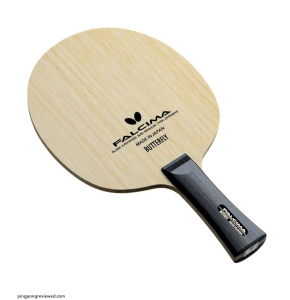
Butterfly Falcima
Butterfly’s direct recommendation for serious beginners. Crisp feel, 6.0mm stability, and high forgiveness for developing strokes.

Best Allround / High Control
Butterfly Andrzej Grubba
Legendary all-round control blade. Low reaction rating gives unmatched dwell time for precision blocking and placement.

Best Lightweight Feel
Butterfly Boll Mezzoforte
Thin 5.0mm profile and 77g weight minimize wrist fatigue while enabling lightning-quick recovery on close-table counters.
Table of Contents
Do you need a bare blade, or a ready-made paddle?
A bare blade has no rubber. You buy the blade, then rubber for each side, then glue or a double-sided sheet to attach it. That gives you control over every part, at the cost of more steps. If you want to start playing now, a ready-made paddle is simpler, and our paddle guide covers them. Our guide to what a blade is and our guide on whether a blade makes a difference go further.
What the rules say about a ping pong blade
The Laws of Table Tennis 2026-27, as published by Table Tennis England, give two main rules for the blade. Law 2.4.1 says the racket may be of any size, shape or weight, but the blade must be flat and rigid. Law 2.4.2 says at least 85 percent of the blade by thickness must be natural wood, and that an adhesive layer inside the blade may be reinforced with fibrous material such as carbon fiber, as long as it is no thicker than 7.5 percent of the total thickness or 0.35 mm, whichever is smaller. See the Laws.
The ITTF’s Technical Leaflet T4, in its 2017 edition, adds detail. It says natural wood permits plywood but not particle board or other composites. It says a very thin layer of lacquer, no more than 0.1 mm, is allowed to anchor wood fibers so the covering can be replaced, and that a thick layer of adhesive is not permitted within the blade or between the blade and the covering. See T4, which a German federation hosts.
Notice what the Laws don’t say. They set no limit on the number of plies or on weight. Carbon and other fiber is limited only through the 85 percent natural-wood rule and the 7.5 percent or 0.35 mm cap on fibrous adhesive layers. So a 5-ply or 7-ply blade is legal on those points if it meets the wood and rigidity rules.
Ping pong blades compared: maker specs for seven picks
📊 2026 Ping Pong Blades Comparison Matrix: Maker Specs & Direct Links
Design: Oversized Defensive HeadSpeed: 40Control: 96Touch: 92
Plies: 5-Ply All-Wood (Limba)Weight: 90gThickness: 5.9mmClass: OFF / Reaction 10.6
Plies: 5-Ply All-WoodWeight: 87gThickness: 6.0mmClass: OFF / Reaction 10.9 (Japan)
Plies: 5-Ply All-WoodWeight: 77g (Ultra-Light)Thickness: 5.0mmClass: ALL / Reaction 9.0
Plies: 5-Ply All-WoodWeight: 85gThickness: 5.7mmClass: ALL+ / Reaction 8.7
Plies: 5-Ply All-Wood (Limba)Weight: 83gThickness: 6.5mmClass: ALL Classic
Plies: 5-Ply All-WoodWeight: 85gThickness: 5.9mmClass: OFF- / Reaction 9.7
| Blade & Category | Class & Plies | Weight & Thickness | Reaction / Vibration | Price & Buy |
|---|---|---|---|---|
|
Butterfly Petr Korbel
★ Top Looping Standard |
OFF 5-ply all-wood (Limba) |
90 g 5.9 mm |
10.6 / 8.2 High Dwell Time |
$68.99
|
|
Butterfly Falcima
★ Best Growth Blade |
OFF 5-ply all-wood (Japan) |
87 g 6.0 mm |
10.9 / 9.7 High Reaction |
$73.99
|
|
Butterfly Andrzej Grubba
★ Best Allround Control |
ALL+ 5-ply all-wood |
85 g 5.7 mm |
8.7 / 7.8 Softest Touch |
$54.99
|
Butterfly Maze Magic
Best Value Butterfly |
OFF- 5-ply all-wood |
85 g 5.9 mm |
9.7 / 8.2 Spin-Oriented |
$49.99
|
|
Butterfly Boll Mezzoforte
★ Lightest Pick (77g) |
ALL 5-ply all-wood |
77 g 5.0 mm (Thin) |
9.0 / 7.9 Fast Recovery |
$69.99
|
|
🏓
JOOLA BASEline Allround
Lowest Priced Maker Blade |
ALL 5-ply all-wood (Limba) |
83 g 6.5 mm |
High Touch Soft Limba Top |
$34.95
|

Counterstrike Karma
Defensive Controller |
DEF Specialty Oversized |
Seller Spec High Flex |
Speed 40 / Ctrl 96 Chopping & Backspin |
$27.95
|
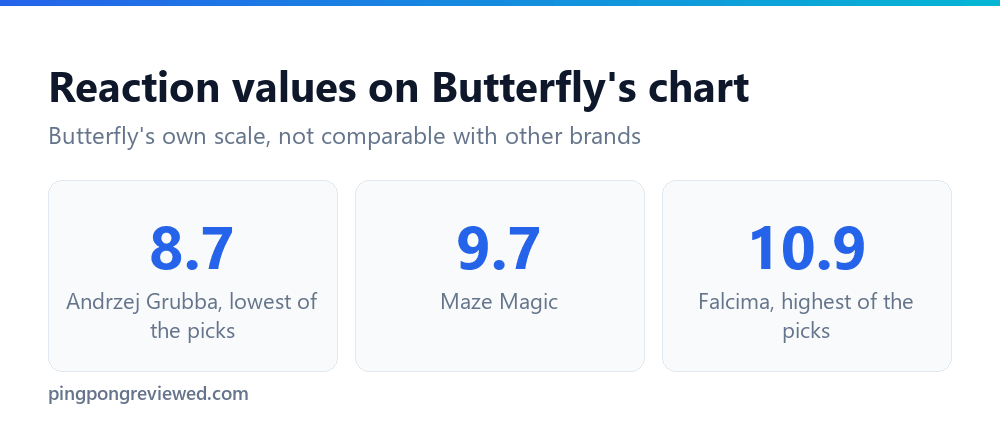
A note on Reaction and Vibration. Butterfly defines Reaction as the quantified base speed of a blade, where a higher value means a faster ball after impact, and says a low Vibration value denotes a softer touch and a high one a harder touch. Both are Butterfly’s own numbers, so they can’t be compared with another brand’s. JOOLA publishes no equivalent for the BASEline.
🛒 Check Price for Timo Boll Mezzoforte on Amazon →
🛒 Check Price for Butterfly Andrzej Grubba on Amazon →
The seven blades
1. Butterfly Maze Magic: the lowest-priced Butterfly all-wood blade here
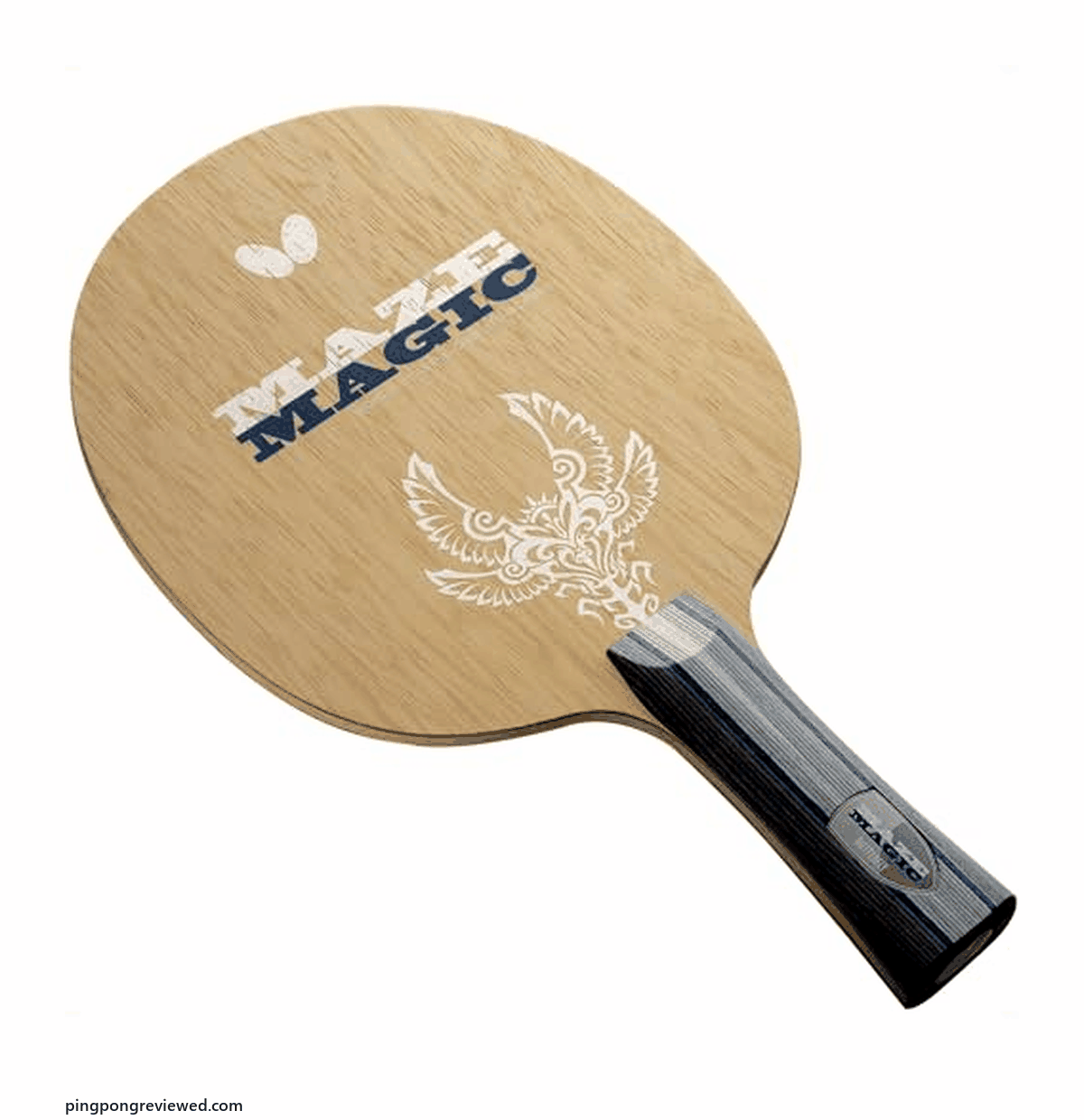
Butterfly’s chart lists the Maze Magic as an all-round shakehand blade, 5-ply, all wood, 85 g, with a 159 by 151 mm head and 5.9 mm thickness. Handle sizes are 100 by 24 by 34 mm for the anatomic and flared handles and 100 by 24 by 28 mm for the straight. Butterfly’s item page says it has an all-wood 5-ply composition that keeps the touch and control for spin-oriented play, and classes it as OFF. The item page gives about 82 g and slightly different Reaction and Vibration numbers than the chart, so treat the weight as approximate.
It costs $49.99 at Butterfly’s shop. On Amazon each handle has its own link: flared, straight and anatomic, all $49.99 on October 8. The Amazon title calls it a great beginner blade, which is the seller’s wording, not Butterfly’s.
2. JOOLA BASEline Allround: the lowest-priced of the six blades with maker specs
JOOLA describes the BASEline Allround as a classic 5-ply all-wood blade with a soft limba top layer, at 83 grams and 6.5 mm thick for stability and power, and says it is particularly suitable for beginners and young developing players. It comes in flared and straight handles at $34.95 on JOOLA’s own site. We found no BASEline blade on Amazon US, so there is no Amazon link, and JOOLA publishes no head size or speed rating.
3. Butterfly Andrzej Grubba: the lowest Reaction value of the Butterfly picks
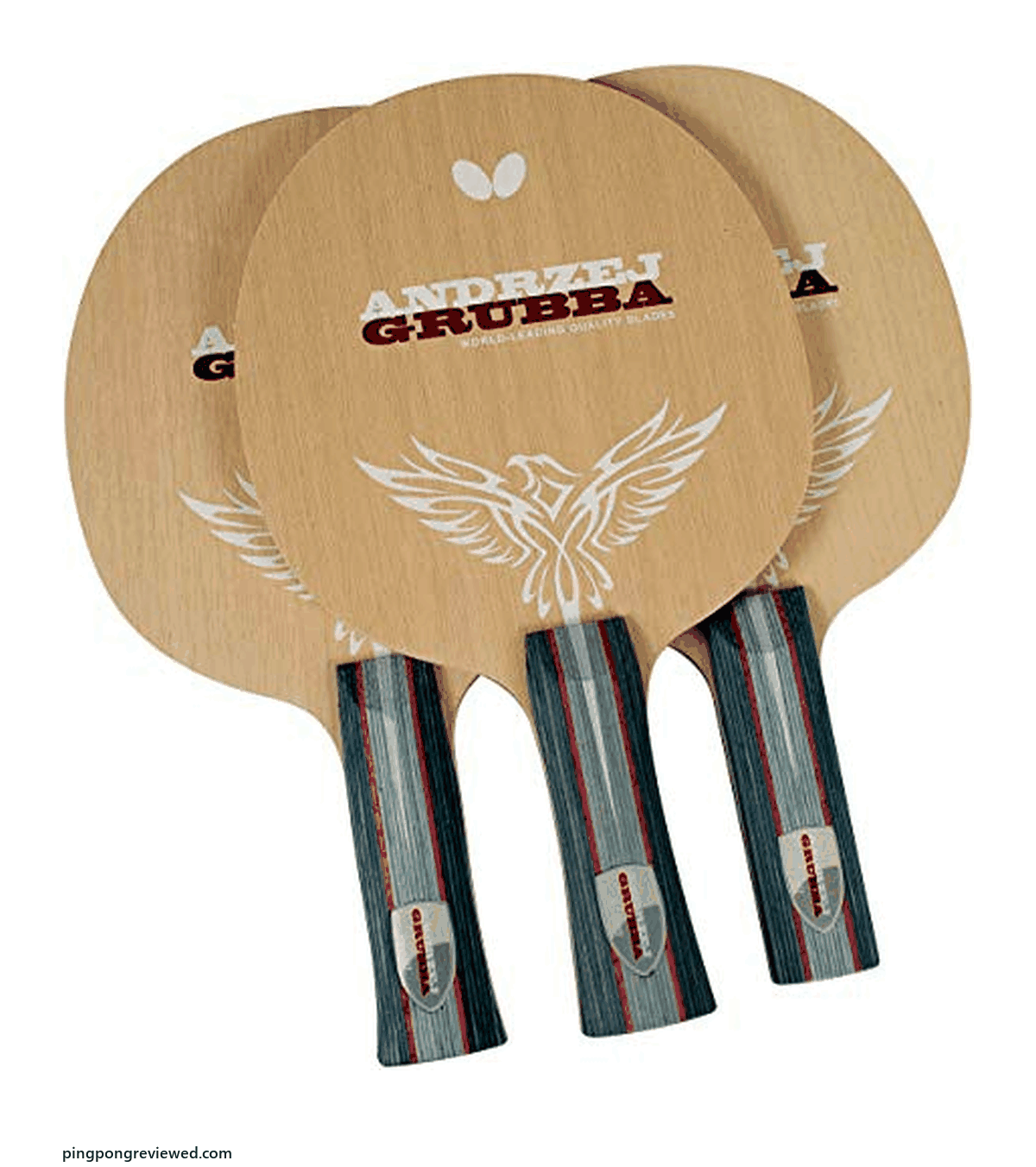
The Grubba has the lowest Reaction value of the picks on Butterfly’s chart, 8.7, with Vibration 7.8, 85 g, a 159 by 151 mm head and 5-ply all-wood construction. Butterfly calls it a classic allround blade, classes it ALL+, and says it is ideal for topspin, short chops, blocks and smashes. The chart lists 5.7 mm thickness while the item page says 5.1, so we give the chart’s figure and flag the difference. It costs $54.99 at Butterfly, and only the anatomic handle was in stock there. The anatomic version was $54.99 on Amazon on October 8, and the straight version was $63.99 from a third-party seller.
4. Butterfly Boll Mezzoforte: the lightest of the picks

Butterfly’s chart and item page agree on the Mezzoforte: all-round shakehand, 5-ply all wood, 77 g, 5.0 mm, a 158 by 152 mm head, Reaction 9 and Vibration 7.9. Butterfly says it is playable in all game situations. The handle sizes differ between the chart and item page, so we give none. It costs $69.99, and the flared version and the anatomic version were $69.99 on Amazon on October 8. Butterfly’s page also suggests adding grip tape for more grip and comfort, and side tape to protect the wood if it hits the table.
5. Butterfly Falcima: the one Butterfly itself pitches at beginners
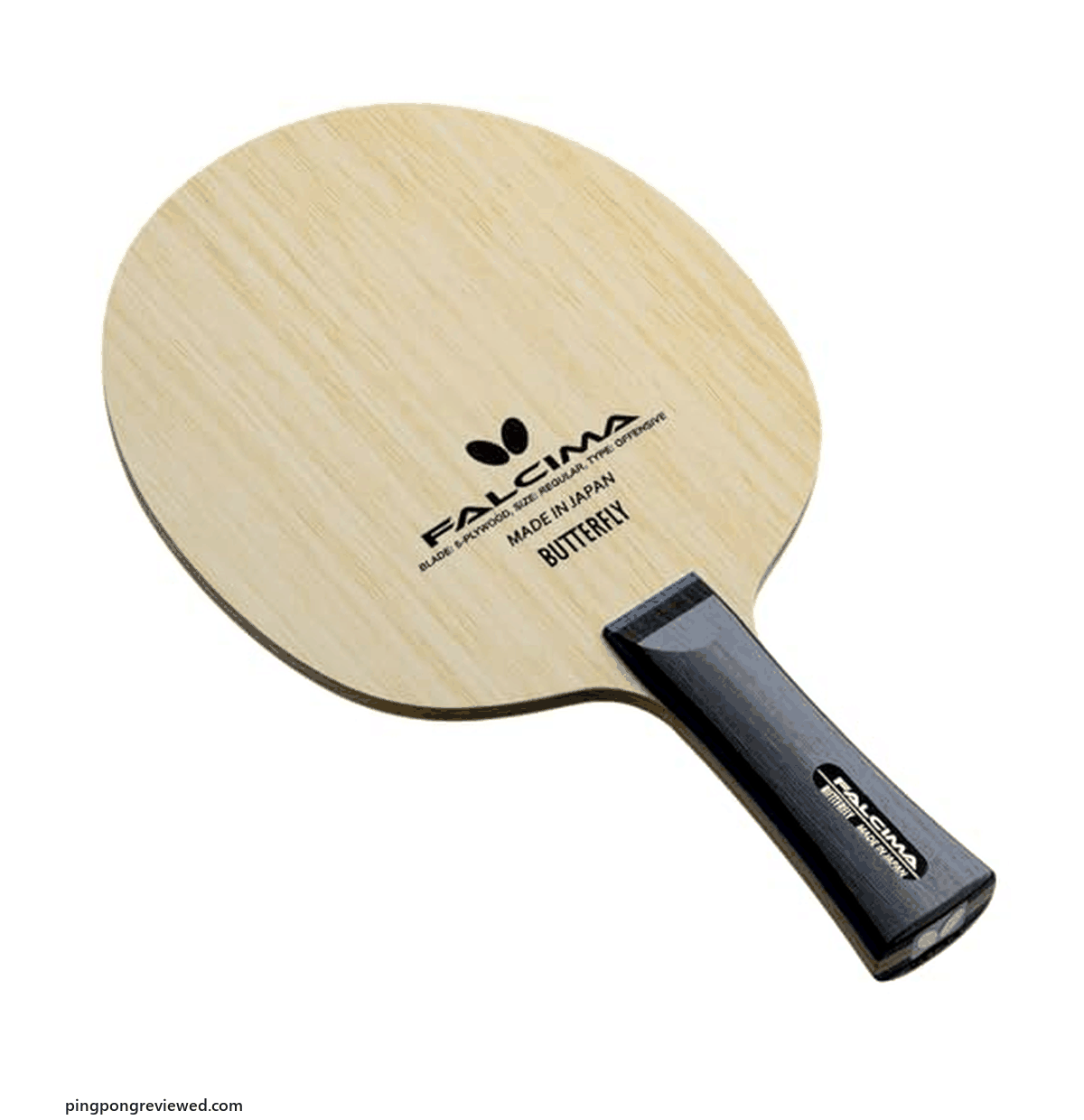
Butterfly’s page says the Falcima is an excellent choice for people just starting their table tennis journey, as well as those who want good speed from a maneuverable wood blade. The chart classes it as an offensive shakehand, 5-ply all wood, Reaction 10.9, Vibration 9.7, 87 g, a 157 by 150 mm head, 6.0 mm thick, in a flared handle. It’s made in Japan, and it costs $73.99. The flared version was $73.99 on Amazon on October 8. For rubbers, Butterfly says players just getting started could benefit from the feel and control of Sapphira, and that Rozena and Roundell give controllable power and spin to players moving to their first high-tension rubber.
6. Butterfly Petr Korbel: the step toward offense

Butterfly says that if you want to develop a consistent offensive game but are unsure which blade to use, you can’t go wrong with the Petr Korbel, a limba outer-ply blade that can do it all. The chart lists it as an offensive shakehand, 5-ply all wood, Reaction 10.6, Vibration 8.2, 90 g, a 158 by 152 mm head and 5.9 mm thickness, and the shop prices it at $68.99. The Amazon listing was $68.99 on October 8, but its size field doesn’t say which handle it is, so confirm the handle on the listing before you order.
7. Counterstrike Karma: the one listed as defensive
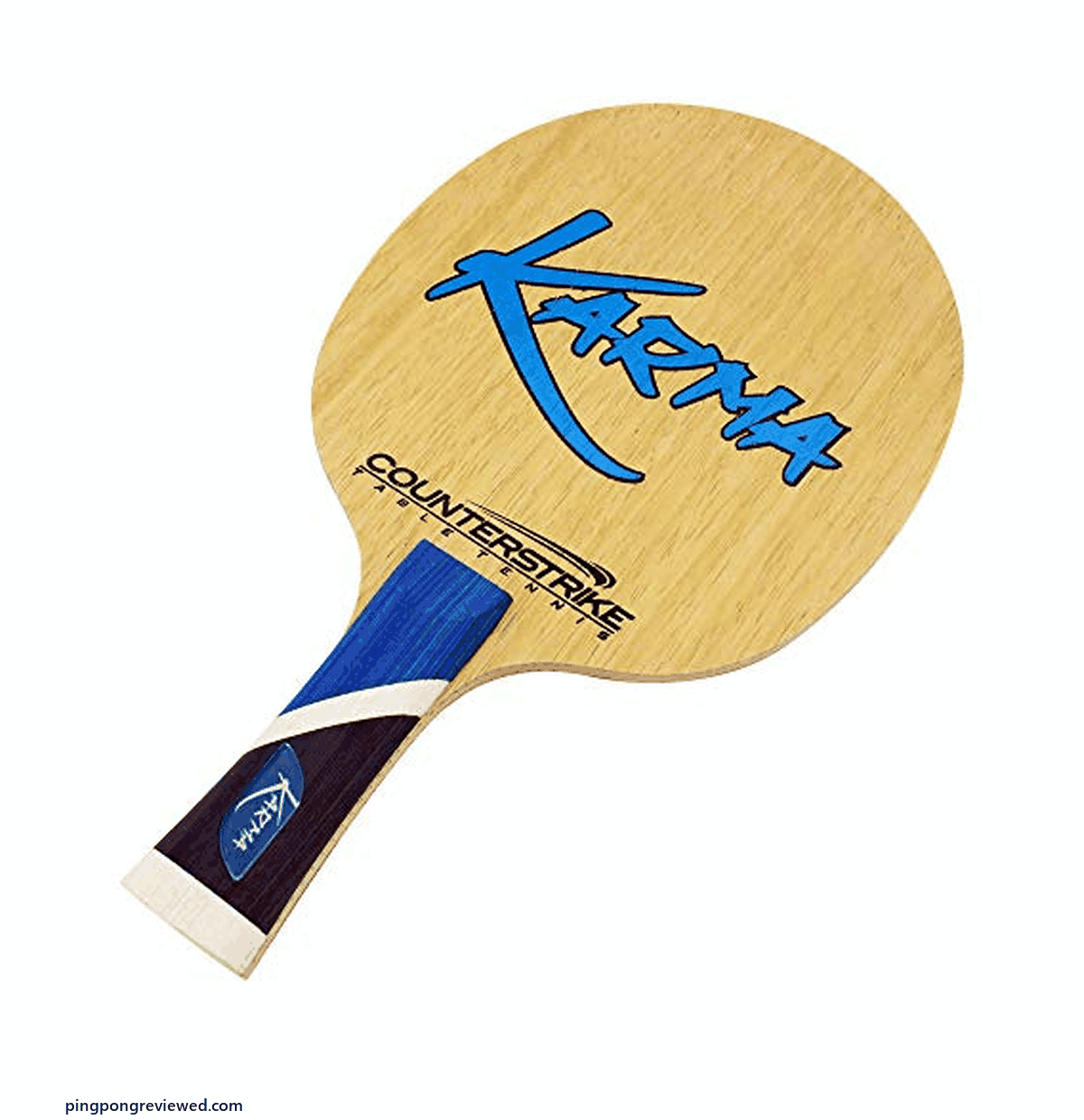
The Counterstrike Karma was $27.95 on Amazon on October 8. Its listing is titled as a defensive table tennis blade, and says it is built for defensive players who want control, touch and consistency, with figures of speed 40, control 96, touch 92 and consistency 90. Those are the seller’s numbers, not an independent scale, and the listing data we pulled doesn’t state plies or weight. We couldn’t reach a maker page for it. We also leave out the listing’s approval wording, because we couldn’t establish that the ITTF approves blades.
Butterfly’s Primorac, which Butterfly calls its best-selling shakehand blade, was out of stock at Butterfly’s shop on October 8, so we don’t list it as a pick.
Reading the numbers: plies, weight and speed
It’s tempting to read ply count as speed. Butterfly’s chart doesn’t support that on its own. Of the 15 all-wood shakehand blades on it, 13 are five-ply, and their Reaction values run from 8.7 to 11.0. The two seven-ply all-wood blades are 11.1. The five-ply Falcima, at 10.9, is nearly as fast on Butterfly’s scale as the seven-ply blades. That comparison is our arithmetic from Butterfly’s chart.
Weights overlap too. On Butterfly’s shakehand table, all-wood blades run from 73 to 96 g, and the other blades from 71 to 92 g. So we can’t say carbon is lighter. JOOLA’s BASEline blades are 80 to 83 g by the maker’s figures. Our guide to choosing a blade and rubber goes deeper.
Handles: what FL, AN and ST mean on a ping pong blade
Amazon’s feature bullets and size fields for Butterfly’s Maze Magic and Mezzoforte name three shakehand handle styles: flared, anatomic and straight. Butterfly’s chart lists handle sizes for each in millimeters but doesn’t spell out the letters. For the Maze Magic, the flared and anatomic handles are both 100 by 24 by 34 mm and the straight is 100 by 24 by 28 mm. For the Grubba, the anatomic and flared are 100 by 25 by 34 mm and the straight 100 by 25 by 28 mm.
We found no source saying which handle suits which player, so we don’t. Try to hold one, if you can, before you order. JOOLA’s BASEline comes in flared and straight handles, and its Tezzo Guardian blade also comes in a penhold version. On Butterfly’s chart, penhold blades are in a separate table.
Putting rubber on a ping pong blade: what the makers and the rules say
Butterfly’s Chack Sheet II is a double-sided adhesive sheet, sold as an alternative to rubber glue. Butterfly’s steps are to remove the protective layer, put the adhesive side flat on the blade, cut around the edges, remove the second layer, apply the rubber and cut around the edges. You need two sheets to cover both sides of a blade. Butterfly’s Free Chack II is a water-based adhesive that it says allows easy removal of excess glue from the sponge and the blade.
The rules limit how much adhesive you can use. T4 says a thick layer of adhesive is not permitted between the blade and the covering, and that a thick glue layer can push a covering past the 4.0 mm limit for sandwich rubber, or 2.0 mm for rubber without sponge, including adhesive. It also warns that re-gluing a covering immediately before a match can make the sponge expand, so a measurement could find it illegal, and says players should air their rackets for up to 72 hours to let solvents escape. For replacing rubber on a blade you already own, see our rubber replacement guide and blade sealing guide.
Which rubber goes on it?
We only repeat pairings that makers state. Butterfly’s Falcima page names Sapphira for feel and control and Rozena and Roundell for a first high-tension rubber. Butterfly’s Mezzoforte page also lists rubbers it suits, which we don’t repeat here, and we found no maker pairing for the other blades, so we make no general rule. For help choosing rubbers, see our rubber guide.
How we checked this guide
We read Butterfly’s Blade Specifications Chart and its shop pages for each Butterfly blade and for Chack Sheet II and Free Chack II, JOOLA’s product page and catalogue, the Laws of Table Tennis 2026-27, the ITTF’s Technical Leaflet T4, and Amazon’s product data, all on October 8, 2026. We did not test any blade, so we don’t say how any of them plays. We could not read the ITTF’s website, reach a Counterstrike maker page, or open specs for Nittaku, Yasaka, STIGA, Donic, Andro, Tibhar or Palio blades, so those are left out. Prices and stock change daily.
Frequently asked questions
What is the best ping pong blade for a beginner?
We can’t name one winner, because we haven’t tested any blade. Makers’ own wording points to a few: Butterfly says the Falcima is an excellent choice for people just starting out, JOOLA says its BASEline Allround is particularly suitable for beginners and young developing players, and an Amazon listing for the Maze Magic calls it a great beginner blade.
What is the difference between a ping pong blade and a paddle?
A blade is the wooden base without rubber. A paddle, or racket, is a blade with rubber on both sides. A bare blade needs rubber and adhesive before you can play. Our guide to what a blade is covers it in more detail.
Does a table tennis blade have to be ITTF approved?
The ITTF’s authorization system applies to racket coverings, according to its Technical Leaflet T4. The Laws set rules for the blade itself: it must be flat and rigid, and at least 85 percent natural wood. We could not read the ITTF’s own website, so we make no claim about a list of approved blades. A listing that says a blade is ITTF approved is the seller’s wording.
How much does a ping pong blade weigh?
On Butterfly’s shakehand chart, the all-wood blades run from 73 to 96 g, and the other blades from 71 to 92 g. JOOLA lists its BASEline blades at 80 to 83 g. Butterfly says weights vary with humidity and temperature.
Is a 7-ply blade faster than a 5-ply blade?
Not by ply count alone, on Butterfly’s numbers. On its chart, 13 five-ply all-wood blades have a Reaction value from 8.7 to 11.0, and the two 7-ply all-wood blades are 11.1. The Falcima, a 5-ply blade, is 10.9. That arithmetic is ours, from Butterfly’s chart.
What do FL, AN and ST mean on a blade?
Amazon’s listings for Butterfly blades name three shakehand handle styles in their feature bullets and size fields: Flared, Anatomic and Straight. Butterfly’s chart gives handle dimensions in millimeters for each, but doesn’t spell out the letters. Make sure the Amazon link you open is the handle you want, because where we found them, each handle is a separate listing.
Can I glue rubber on myself, and how thick can the glue layer be?
Yes. Butterfly sells a double-sided Chack Sheet II as an alternative to rubber glue, and Free Chack II, a water-based adhesive. The ITTF’s Technical Leaflet T4 says a thick glue layer is not permitted, and the total covering thickness limit, 4.0 mm for sandwich rubber, includes the adhesive.
How thick can the rubber be?
Law 2.4.3 says under 2.05 mm in total, including adhesive, for pimples-out rubber without sponge, and under 4.05 mm for sandwich rubber. T4 describes 4.0 mm and 2.0 mm as the maximum thickness including adhesive.
Where can I buy the JOOLA BASEline blade?
We found it at joola.com. We searched Amazon US on October 8, 2026 and found no BASEline blade, so there is no Amazon link for it here.
Sources
Blade specs come from Butterfly’s Blade Specifications Chart and Butterfly’s pages for the Maze Magic, Grubba, Mezzoforte, Falcima and Petr Korbel, and from JOOLA’s BASEline Allround page. Rules come from the Laws of Table Tennis 2026-27 and ITTF Technical Leaflet T4. Prices and stock come from Amazon’s product data and the makers’ shops.
As an Amazon Associate, we earn from qualifying purchases through links on this page.

Ping Pong Reviewed is an equipment review site covering table tennis and baseball gear. Specifications are checked against manufacturer listings, and prices against live retail pages, before publication.