XIOM Vega Pro Review: Is ‘Extreme Spin’ Actually More Spin?
Vega Pro sits at the firmer, faster end of XIOM’s four-variant Vega family, and this page checks exactly what that positioning costs and delivers against Vega Europe, the softer sibling already verified on this site.
What follows is Megaspin’s own published specifications, current retail pricing, and a direct comparison against Vega Europe. Not a claimed hands-on verdict.
📊 Note: What this review is. We have not logged hours on this sheet, and we’re not going to describe a feel we haven’t felt. What follows is verified pricing, a retailer’s published specification numbers, and the buying decisions that follow from them.
Table of Contents
What Vega Pro Costs Right Now
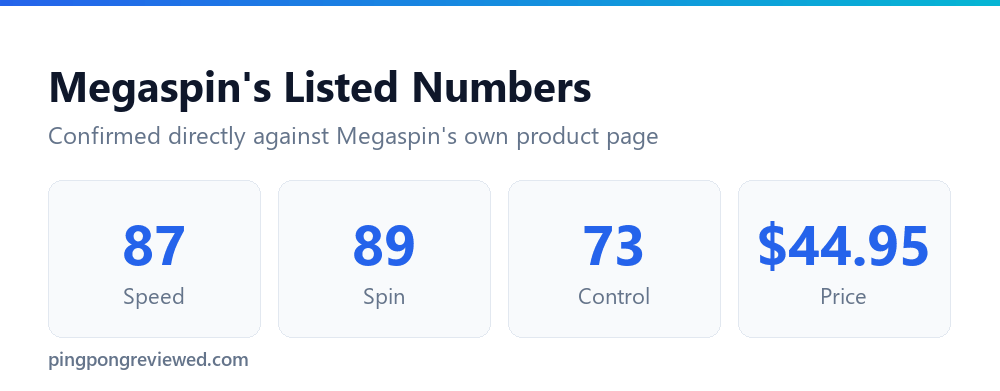
Megaspin lists Vega Pro at $44.95, identical to Vega Europe’s price, in Red and Black, across 1.8mm, 2.0mm, and MAX thicknesses (1.8mm frequently shows as out of stock).
Vega Pro is listed on Amazon alongside Megaspin and other established retailers.
Where “Pro” Sits in the Vega Family
XIOM’s own positioning places Vega Pro at the “extreme spin” end of the four-variant Vega lineup, built on the same Hyper Elasto topsheet and Carbo Sponge tensor technology as Vega Europe, tuned firmer specifically for players chasing more rotation without committing to a fully hard-sponge hybrid rubber. That’s a meaningfully different use case than “the premium version”, Pro isn’t positioned above Europe in quality, just tuned differently within the same family and price point.
This mirrors the same regional/stylistic organizing principle this site’s Vega Europe review covers in more depth: XIOM sells four flavors of essentially the same underlying technology, priced identically, rather than a tiered good/better/best lineup.
The Official Specifications
The hardness gap is the real story behind these numbers. At roughly 47.5° versus Vega Europe’s 42.5°, Vega Pro is a firmer sponge, which is exactly what produces its modest speed edge and slightly lower spin figure, more of the output comes from sponge rebound, less from the extended dwell time a softer sponge allows.
How It Actually Compares to Vega Europe
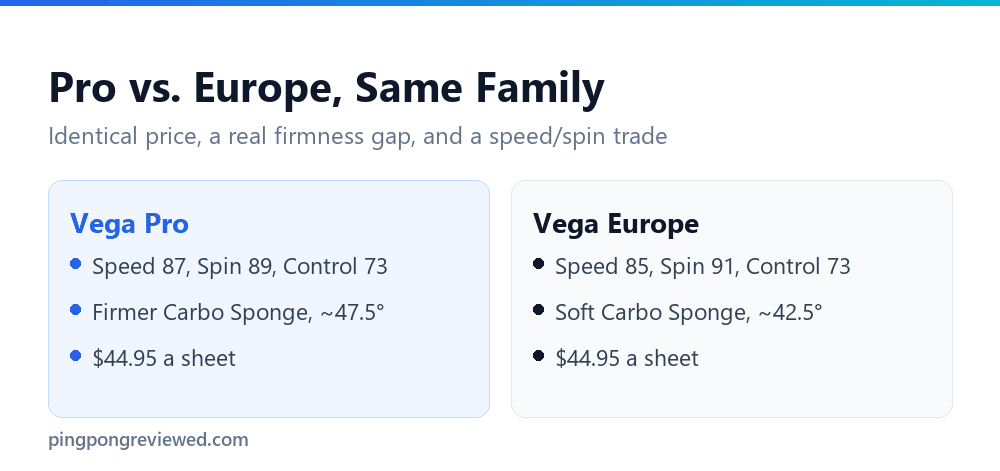
For a player with a fast, committed stroke already in place, Vega Pro’s firmer sponge translates that swing speed into a real, if modest, speed advantage over Europe. For a player without that swing speed yet, the same firm sponge simply won’t be pushed to its ceiling, and Europe’s softer, more responsive sponge likely delivers a more usable result at the same price.
A Quick Reality Check on Swing Speed
Since so much of the Vega Pro versus Vega Europe decision comes down to swing speed, it’s worth naming a concrete way to judge your own honestly rather than guessing. If your current rubber feels like it’s working against you on anything but a full, committed stroke, shots feeling dead or short unless you swing hard, that’s a signal you’re already generating the racket speed a firmer sponge like Vega Pro would reward. If your best results come from moderate, controlled strokes rather than full power, Vega Europe’s softer sponge is more likely to match how you actually play right now.
Who Vega Pro Is Actually For
- ✓You already generate real racket speed and want to convert it to pace
- ✓You want maximum rotation without moving to a fully hard hybrid rubber
- ✓You’re comparing XIOM’s own Vega family rather than switching brands
- ✓You’ve tried Vega Europe and want to test whether the firmer sponge suits you
- ✕You’re still developing a consistent, committed stroke
- ✕You want the softest, most forgiving option in the Vega line
- ✕You mainly value spin over speed specifically
- ✕You’re a complete beginner who hasn’t tried tensor rubber before
💡 Pro tip: If you’re deciding between Vega Pro and Vega Europe without having tried either, Europe is the lower-risk starting point given its more forgiving sponge, you can always move to Pro later once you’ve confirmed your stroke can actually push a firmer sponge to its ceiling.
Thickness Options
Vega Pro is offered in 1.8mm, 2.0mm, and MAX thickness, matching Vega Europe’s range. The thickest option maximizes the speed and spin this firmer sponge is built to deliver; thinner options trade some of that output for more control.
Buying It Alongside a Blade
Vega Pro’s firmer sponge follows the same general blade-pairing principle as any medium-hard attacking rubber covered on this site: a stiff, offensive blade generally handles it more predictably than a soft or flexible one does. Players already running a hard-sponge setup successfully have a reasonably direct path to trying Vega Pro without necessarily needing to change blades.
Why “Extreme Spin” and “Slightly Lower Spin Score” Both Describe This Rubber
It’s worth resolving the apparent contradiction directly: XIOM markets Vega Pro as the extreme-spin variant, yet Megaspin’s own numbers show it scoring slightly behind Vega Europe on spin. Both things are true, and they’re describing different aspects of the rubber’s character. “Extreme spin” in XIOM’s marketing positioning refers to Vega Pro’s ability to generate very high spin specifically off a fast, committed stroke, the ceiling it reaches when driven hard. The retailer’s numeric score reflects a more general, averaged performance rating rather than that specific peak-effort scenario.
This distinction matters because it explains why two seemingly contradictory descriptions, “extreme spin” and “scores lower on spin than its softer sibling”, can both be accurate descriptions of the same product from different angles. A player with the swing speed to access Vega Pro’s ceiling may well generate more spin with it in practice than the numbers alone suggest; a player without that swing speed will likely find Europe’s more accessible spin generation the more practical choice regardless of Pro’s marketed positioning.
Gluing and Care
Vega Pro uses the same modern, water-based gluing process as any current inverted rubber, spread thin on both blade and rubber, let both go touch-dry, then lay the sheet down from one edge to avoid trapping air underneath it. No special process applies specifically to the firmer Carbo Sponge tuning.
Storage and care follow standard practice for any medium-hard tensor rubber: keep it covered with its protective film between sessions, avoid heat and direct sunlight, and expect gradual performance decline over months of regular use as the sponge and topsheet naturally age.
Counterfeits and Where to Buy It
The same precautions from this site’s Vega Europe review apply here: buy from Megaspin, an established table tennis retailer, or a reputable Amazon listing with genuine seller history, rather than an unfamiliar marketplace seller offering a price well below the confirmed $44.95.
⚠️ Watch out: Given that Vega Pro and Vega Europe share an identical price point, double-check the exact variant name on any listing before buying, confusing the two, whether by accident or through a mislabeled listing, means getting a different sponge hardness than intended.
A Worked Comparison
Picture two players with similar mid-distance attacking styles, one on Vega Pro and one on Vega Europe, both on comparable offensive blades. If both players share the same fast, committed swing, the Vega Pro player likely gets more out of their firmer sponge, more pace on the shot, and spin that may well exceed what the raw numbers suggest once real swing speed is applied against it.
If instead one of those players has a more moderate, developing swing, the comparison flips: that player is more likely to get more usable output from Vega Europe’s softer, more responsive sponge than from Vega Pro’s firmer one, since Pro’s ceiling simply isn’t being reached without the swing speed to drive it there. Same two rubbers, same price, different correct choice depending entirely on the player holding the racket.
If You Can Only Try One First
For a player unsure which Vega variant actually fits their game, the honest starting recommendation leans toward Europe rather than Pro, given Europe’s more forgiving sponge and its counterintuitively higher spin score on the same retailer scale. Moving to Pro later, once a player’s stroke has clearly outgrown what Europe’s softer sponge can deliver, is a lower-risk sequence than starting with the firmer rubber and potentially fighting a sponge that doesn’t yet match the swing driving it.
How This Fits the Broader Pattern on This Site
This review, paired with Vega Europe’s, adds a second confirmed example of a same-price, different-character rubber family, alongside Donic’s Bluefire M2 and Baracuda pairing covered elsewhere on this site. Across both manufacturers, the pattern holds: rubbers sharing a price point within the same brand aren’t automatically ranked better-to-worse, and checking the actual specification numbers directly against each other reveals a specific character trade-off rather than a hidden quality hierarchy.
That’s an useful shopping habit to carry forward beyond just these two brands: when a manufacturer sells multiple rubbers at the same price, the differences almost always describe a playing-style trade-off, not a value judgment, and the specific numbers, not the naming or marketing language, are what actually reveal which one fits a given player’s game.
Naming aside, the numbers already told the whole story. Trust them over the label every time a brand sells more than one rubber at the exact same price.
Common Questions
How much does XIOM Vega Pro cost?
Megaspin lists it at $44.95 per sheet, the same price as XIOM Vega Europe.
Is Vega Pro better than Vega Europe?
Not objectively, control is tied exactly, spin actually favors Europe, and Pro’s only clear edge is a 2-point speed advantage from its firmer sponge.
Is Vega Pro harder than Vega Europe?
Yes, at roughly 47.5° compared to Europe’s ~42.5°, tuned for players seeking more rotation without a fully hard hybrid rubber.
Does Vega Pro’s firmer sponge mean more spin?
No. Vega Europe actually scores slightly higher on spin (91 versus 89) despite being the softer variant.
Is XIOM Vega Pro good for beginners?
Generally not. Its medium-hard sponge rewards an already committed, developed stroke rather than helping build one.
That’s the whole review, distilled to one practical filter: match the sponge to the swing you actually have today, not the swing you’re hoping to grow into.
The Verdict
The short version: Vega Pro is XIOM’s firmer, extreme-spin-positioned Vega variant, priced identically to Vega Europe at $44.95, with control tied exactly and only a modest 2-point speed edge to show for its firmer sponge, spin actually favors the softer Europe variant. It rewards a stroke that’s already fast and committed, not a developing one. Verified directly against Megaspin’s own listing on 6 September 2026.
- →Megaspin’s listing: Speed 87, Spin 89, Control 73 at $44.95.
- →Positioned as the ‘extreme spin’ variant, but scores slightly lower on spin than Europe.
- →Firmer sponge (~47.5°) than Vega Europe’s ~42.5°.
- →Control is tied exactly with Vega Europe at 73.
- →The only clear numerical edge over Europe is a 2-point speed advantage.
- →Same-price rubber pairs from one brand usually trade character, not quality.
So the closing question is precise: is a 2-point speed gain worth trading for a firmer sponge that demands more from your stroke, when spin and control don’t clearly favor Pro at all?
Same price, same core technology, different character, and now a real answer for which one actually fits the swing you bring to the table.
As an Amazon Associate, we earn from qualifying purchases through links on this page.

Ping Pong Reviewed is an equipment review site covering table tennis and baseball gear. Specifications are checked against manufacturer listings, and prices against live retail pages, before publication.