What Is Backhand Serve in Table Tennis? (2026)
What is a backhand serve in table tennis? It is a serve struck from your backhand side, the side opposite your dominant hand, rather than the forehand side. That is the whole definition. Two things commonly said about it are wrong and worth clearing up first: it is not “the most powerful shot in table tennis” — serves are not the power shots at all, loops and smashes are — and it is not a beginner technique. Backhand serving is used at every level, including by many professionals as their primary serve.
This kind of confusion, mixing up which side of the body a technique is named for with how powerful or advanced it supposedly is, shows up in a few different equipment and technique pages across the internet, not just this one. It’s worth being precise about terminology specifically because it affects how you think about and practice a skill: approaching backhand serving as “the power move” sets up the wrong training priority compared to approaching it as one of two equally valid positioning choices.
Table of Contents
What a Backhand Serve Actually Is
The distinction between forehand and backhand serving is purely about which side of your body the paddle moves across during the toss and strike, not about power, difficulty, or skill level. A forehand serve strikes the ball with the paddle moving across your dominant side; a backhand serve strikes it with the paddle moving across your non-dominant side, typically from a more central or slightly crossed-body stance. Both are equally legitimate, equally legal serving styles under standard rules, covered in more depth in our full serve rules guide.
Handedness affects which physical side counts as “backhand” for a given player, worth clarifying since it’s easy to assume everyone’s backhand is on the same physical side. For a right-handed player, backhand serving happens on the left side of the body; for a left-handed player, it’s the reverse. This mirrors the same handedness logic that applies to backhand shots generally throughout a rally, not something unique to serving specifically.
Why Players Actually Use It
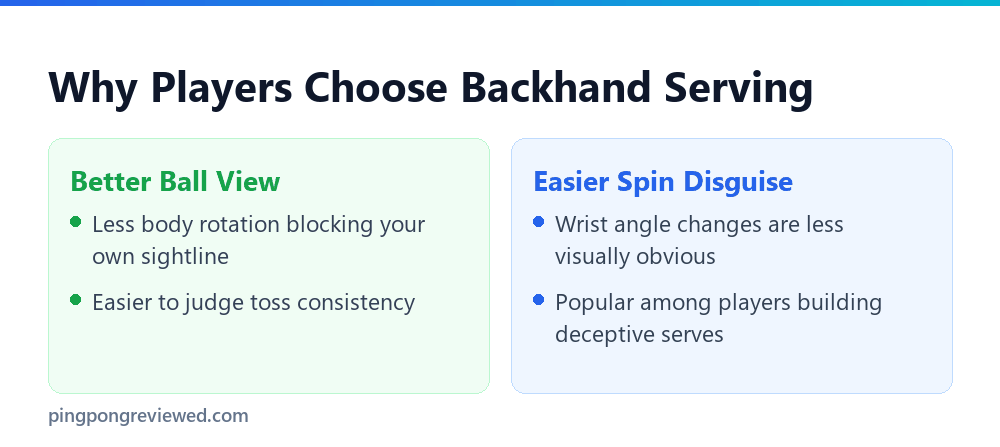
Backhand serving offers two genuine practical advantages that explain its popularity across skill levels, not just among beginners. First, many players find they have a clearer view of the ball toss and contact point, since less body rotation blocks their own sightline compared to some forehand serving stances. Second, the wrist motion involved in backhand serving can make spin variation harder for an opponent to read visually, since the movement is generally more compact and less telegraphed than a full forehand swing.
It’s worth noting these two advantages don’t apply equally to every player, which is part of why serving preference genuinely varies. A player with strong wrist flexibility and good touch might find backhand serving’s compact motion naturally suits their disguise strategy, while a player who generates spin more effectively through a fuller arm extension might get more consistent results forehand. Neither preference is more advanced or more correct than the other; both are simply different paths to the same goal, a legal, hard-to-read serve.
The Real Technique
- Stance: stand with your body relatively square to the table rather than heavily angled, paddle held on your backhand side.
- Toss: follow the standard legal serve requirements, ball resting on an open palm, tossed at least 16cm straight up without spin, covered fully in our serve rules guide.
- Contact: strike the ball with a brushing motion across your body’s backhand side, adjusting paddle angle and wrist snap to apply topspin, backspin, or sidespin as needed.
- Follow-through: keep the motion compact and consistent, since a smaller, repeatable motion is generally easier to disguise and control than a large, exaggerated one.
Building this technique reliably takes real, repeated practice, the same as any serve, and it’s worth practicing the toss and legal positioning requirements in isolation before worrying about spin variation on top of them. A technically legal but spin-inconsistent serve still gets you a fair, working point; an illegal serve costs you the point outright regardless of how much spin you managed to generate, which is why getting the fundamentals genuinely solid first matters more than rushing to add spin variation before the basic motion is consistent.
Once the fundamentals are solid, layering in the same spin principles covered in our full spin technique guide, brushing contact rather than raw force, applies directly to backhand serving. The mechanics of generating topspin, backspin, or sidespin don’t change based on which body side you’re serving from; only the specific arm and wrist positioning needed to execute the brushing motion changes.
Forehand vs. Backhand Serve: The Real Difference
The core difference is body-side positioning, not power or difficulty. Neither serve is objectively more powerful, since serve power in table tennis comes primarily from spin and placement rather than raw force in the first place, given how tightly regulated the toss and contact rules are. Which one you should use comes down to which motion you can execute more consistently and disguise more effectively, a personal preference that develops with practice rather than a fixed rule about which is “better.”
A useful way to actually test this for yourself rather than picking based on what a page like this one recommends: try both serve styles in casual practice over a few sessions and pay attention to which one your training partner consistently struggles more to read, not just which one feels more comfortable to execute. Comfort and effectiveness don’t always line up perfectly when you’re first developing either style, and effectiveness against a real opponent is ultimately what matters more than which motion feels more natural in isolation.
How We Corrected This Page
The power and skill-level claims above are checked against standard table tennis coaching sources, which is worth stating because both misconceptions are repeated widely enough that they are easy to absorb without noticing.
Multiple independent coaching resources were consulted on this specifically, and none describes backhand serving as either more powerful or more beginner-oriented than forehand serving. The difference is one of angle, deception and recovery position, not of power or difficulty.
If you have picked up “backhand equals power” somewhere, it is worth actively unlearning rather than just setting aside: it leads players to swing harder on serves, which costs them the placement and spin control that make a serve effective in the first place.
Frequently Asked Questions
How do you actually do a backhand serve in table tennis?
Stand with your body relatively square to the table, paddle on your backhand side, follow the standard legal toss requirements, then strike with a compact brushing motion across your body to apply spin as needed, keeping the whole motion consistent and repeatable rather than varying it.
Are backhand serves genuinely allowed in table tennis?
Yes, fully legal under standard rules, as long as the toss and contact follow the exact same legal serve requirements that apply to any serve, whether forehand or backhand in style.
When would you use a backhand serve instead of forehand?
Whenever it’s the motion you can execute more consistently and disguise more effectively, a personal preference rather than a fixed rule tied to skill level or situation.
What’s the actual difference between backhand and forehand serves?
Which side of your body the paddle moves across during the toss and strike, not power or difficulty, both are equally legitimate serving styles used across every skill level.
Is the backhand serve harder to master than forehand?
Not inherently — difficulty comes down to individual comfort and practice, not a fixed property of the serve style itself. Some players find backhand more natural, others find forehand easier.
Do professional players use backhand serves?
Yes, regularly — many professional and advanced players use backhand serving as a primary or significant part of their serve repertoire, not just as a beginner fallback technique.
Can you get as much spin from a backhand serve as a forehand serve?
Yes, genuinely — spin generation depends on brushing contact quality and wrist action, both of which are fully available in a backhand motion, not just a forehand one. Neither style has an inherent spin ceiling over the other.
Should beginners learn forehand or backhand serve first?
There’s no fixed correct order — try both early on and see which motion you can execute more consistently and control more comfortably, then build from there rather than assuming one is the required starting point.
Does the receiver need to react differently to a backhand serve?
Not fundamentally — a receiver reads spin and placement from the server’s paddle angle and contact regardless of which body side the serve came from, so the core reading skill transfers across both serve styles equally.
As an Amazon Associate, we earn from qualifying purchases through links on this page.

Ping Pong Reviewed is an equipment review site covering table tennis and baseball gear. Specifications are checked against manufacturer listings, and prices against live retail pages, before publication.