Ping Pong vs Pickleball: 7 Real Differences and Who Should Pick Which
Ping pong vs pickleball comes down to space and speed. Pickleball is slower and easier to rally in your first week, but it needs a 20 by 44 foot court. Ping pong is faster and spinnier, and it fits on a 9 by 5 foot table that can live in a spare room. Choose pickleball if you want easy social games outdoors. Choose ping pong if you want a private, year-round game and don’t mind a steeper first week.
People compare these two sports because they share the basics: a paddle, a net, and a ball that has to bounce in the right place. After that, they split fast.
One is played on a tabletop with a 40 mm ball and a net six inches high. The other is played on a court roughly twenty times bigger, with a perforated ball and a net around waist height. So the real question isn’t which sport is better. It’s which one fits your body, your space and your week.
We pulled the official numbers instead of repeating the usual talking points. The pickleball figures come from the 2026 USA Pickleball Official Rulebook. The ping pong figures match our own rules and room-size guides. Where we couldn’t find a fair comparison, we say so.
- →A pickleball court is about 20 times bigger than a ping pong table, and a ping pong room is about a fifth of a court.
- →Both games play to 11 and win by 2, but the serving and scoring rules make each rally feel completely different.
- →Pickleball is easier for the first week. Ping pong asks more of you early because of spin and reaction time.
- →Starting costs are similar for a paddle. The bigger cost difference is where you can play.
- →Neither sport is clearly safer on the data we could find, and we explain why.
Table of Contents
Ping pong vs pickleball at a glance
Seven of those eight rows are differences. The scoring target is the one thing the two sports share, and even that plays out differently. The next sections take the differences one at a time, starting with the one that decides where you can play.
The size gap is bigger than it sounds
Do the arithmetic. A ping pong table covers 45 square feet. A pickleball court covers 880. That’s a ratio of about 19.6 to 1.
It gets more interesting when you think about where each sport lives. Our room-size guide gives 17 by 11 feet as the practical minimum for casual play, which is 187 square feet. That entire room is about 21 percent of one pickleball court. So a spare bedroom or a garage bay can hold a real ping pong game, while pickleball nearly always sends you out to a shared facility.
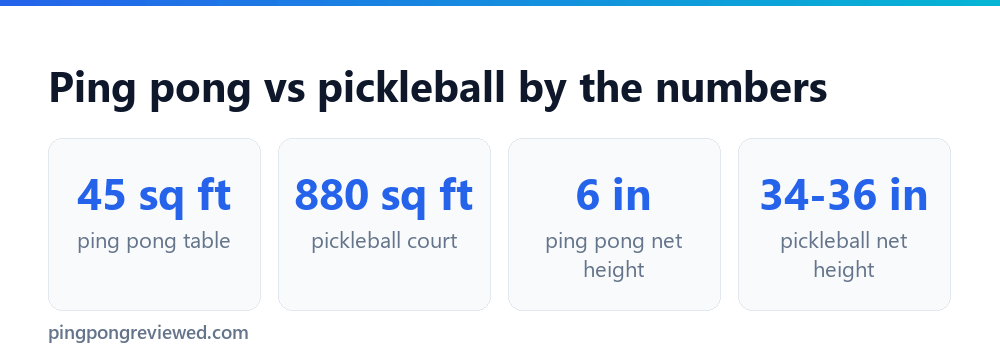
The ball tells a similar story. A ping pong ball is 40 mm. A pickleball measures 2.87 to 2.97 inches, which is 7.29 to 7.54 cm. That makes it nearly twice as wide, and the holes make it slow and predictable in the air.
The net matters too. Six inches of net in ping pong means the ball can skim across low and fast. Around three feet of net in pickleball means the ball has to arc up and over, which is one reason pickleball rallies look so different.
How the rules change the feel of the game
On paper the two sports look alike. Both go to 11, and both need a two-point margin. In practice they feel nothing alike.
Scoring and serving
In ping pong, either player can score on any rally, and the serve changes every two points. That keeps the pressure on both sides constantly. A serve is a real weapon, because you can hit it with heavy spin.
Pickleball works differently by default. Only the serving side can score a point. If the server loses the rally, the serve moves over without a point for the other side. According to the 2026 rulebook, rally scoring, where every rally scores, has been provisionally approved as an option. You may meet either version depending on the venue.
The two-bounce rule and the kitchen
Pickleball has two rules with no ping pong equivalent. The two-bounce rule says the receiving side must let the serve bounce, and then the serving side must let the return bounce, before anyone can volley. And the non-volley zone, called the kitchen, extends 7 feet from the net. You can’t hit a ball out of the air while standing in it.
Those two rules explain a lot. They stop the serving side from rushing the net, so rallies build slowly, and they create the soft “dink” exchanges pickleball is known for. Ping pong has no such brakes. A ball can be attacked at once, and points are often short and explosive.
⚠️ Watch out: Rulebooks change. The 2026 USA Pickleball rulebook was our source, and rally scoring is only a provisional option there. Check the rules your local venue uses before you play a league or tournament.
Ping pong vs pickleball: which is easier to learn?
Nearly every comparison says pickleball, and we agree with them for the first few sessions. The ball is slow, the paddle is big, and the court is forgiving. Two beginners can keep a rally going within an hour.
Ping pong asks more early on. The ball moves fast at close range, and spin changes where it goes after the bounce. So a beginner’s first week often involves a lot of chasing balls. The reward comes later. Once you learn to read spin, rallies get much more fun.
Easy to start isn’t the same as easy to get good at. Pickleball wins week one. Neither sport is simple once you’re serious.
Here’s our opinion, not a measured fact. Ping pong’s first hurdle is control. Pickleball’s first hurdle is strategy, because placement and patience decide most points once players are past the basics. So the sport you find easier may depend on which kind of difficulty you dislike less.
Ping pong vs pickleball cost: what it takes to start
Both sports start cheap. Where the costs differ is in what you need around the paddle.
The fair comparison isn’t paddle against paddle. It’s what you pay to play in your own way. A table costs money once, and then it’s yours. A court, if you have access to a free one, costs nothing but travel. If you don’t, court fees or memberships become the real expense.
💡 Pro tip: Not sure what to buy first? Our best ping pong paddle guide sorts eight paddles by skill level, and our table guide groups eight tables by budget and space.
Fitness and injury: what the data does and doesn’t say
Both sports are moderate exercise. Table tennis is listed at 4.0 METs in the 2024 Adult Compendium of Physical Activities. We checked for a matching pickleball entry and couldn’t verify one, so we won’t claim a calorie winner. In both cases, how hard you play changes the numbers more than which sport you choose.
Injuries are trickier. Pickleball has published emergency-room data. Researchers at the University of Arkansas, using the National Electronic Injury Surveillance System, estimated 17,416 pickleball-related emergency room visits in 2022. They found that 87 percent of those visits involved people over 50, with fractures (30 percent) and sprains (17 percent) the most common injuries.
📊 Note: Those are visit counts, not injury rates. Without knowing how many people play, you can’t say pickleball is more dangerous per hour. We also did not find a matching estimate for table tennis, so we can’t rank the two on safety. Anyone with joint, heart or balance concerns should ask a doctor before starting either sport.
What we can say is where the risk tends to sit. Pickleball adds lateral court movement and the chance of a fall, especially for older players. Ping pong keeps you in a small area, but repeated arm and wrist motion can build up over time. Our ping pong injuries guide covers stroke-by-stroke strain in more detail.
The equipment is a different world
A ping pong paddle is a wooden blade covered with rubber on both sides. The rubber does most of the work. It grips the ball, and it lets a player add heavy spin with a short brushing motion. That’s why two paddles that look identical can play very differently.
A pickleball paddle is larger and solid, and the ball is perforated. The sources we read say the holes create air resistance and slow the ball down. So spin sits at the center of ping pong, while placement and patience carry more of the load in pickleball. That’s our reading of the equipment, and players will disagree at the edges.
This matters when you shop. In ping pong, the paddle you buy shapes your game. In pickleball, most beginners can borrow a paddle and feel little difference.
Popularity and finding people to play
The number of players matters for one practical reason: it’s easier to find a game when a sport is busy. PPA Tour calls pickleball the fastest-growing sport in the United States. Table tennis has a large, steadier base. Our statistics page reports that US participation has stayed between 15 and 16 million for years, based on SFIA survey data for people who played at least once in a year.
So neither sport is short of players. The difference is the format. In many places, pickleball organizes around public courts and open-play sessions, while ping pong organizes around clubs, leagues and home tables. Check what exists near you before you buy anything.
Doubles works differently in each sport
Both sports have doubles, but they don’t feel alike. In table tennis doubles, partners must take turns hitting the ball. You can’t stand still and let your partner cover the table. The serve also goes diagonally, from your right half to the opponent’s right half. Our doubles rules guide explains serving order and rotation.
Pickleball doubles is the default way most people play. Partners split the court, either partner can hit any ball that comes to them, and the two-bounce rule shapes the opening exchanges. As a result, pickleball rewards positioning and communication. Ping pong doubles rewards footwork and timing, because you have to get out of your partner’s way after every shot.
Your first hour, compared
This is what we’d expect from the equipment and rules, not a report from a lesson we took. In ping pong, your first hour is mostly about contact. You will work on keeping the ball on the table and seeing why it bounces where it does. Expect to spend a chunk of that time picking balls off the floor.
In pickleball, you will probably rally within minutes because the ball is slow. However, you will spend the hour learning where to stand, why you can’t volley from the kitchen, and how the two-bounce rule works. So ping pong front-loads the physical difficulty, while pickleball front-loads rules and positioning. Neither is a reason to quit early.
What carries over if you play both
Some things transfer. Tracking a moving ball, judging bounces and staying relaxed under pressure all help in either sport.
Other things don’t. The strokes differ, since ping pong relies on brushing contact and small wrist and forearm movements, while pickleball uses a larger paddle and bigger swings. Footwork differs too. Ping pong is about quick shuffles in a tiny box. Pickleball is about covering ground and moving as a pair.
So think of each as a fresh start with a small head start. Don’t expect a strong ping pong player to dominate pickleball in week one, or the other way around.

Who should pick which
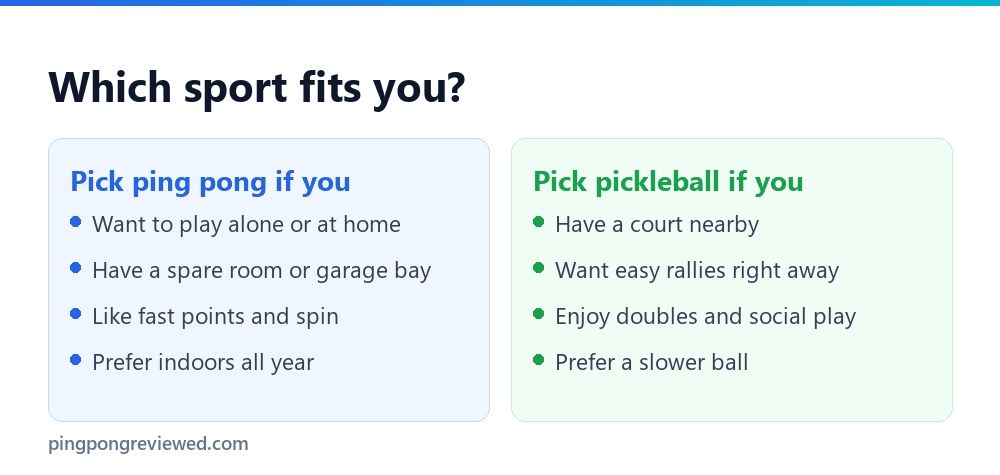
- You need a game you can play at home.
- You want to practice alone, even with a ball-launching robot.
- You like fast reactions and don’t mind a hard first week.
- Weather and daylight shouldn’t decide your schedule.
- You have easy access to courts.
- You want playable rallies in your first hour.
- You’d rather play doubles with friends.
- You like an outdoor, social setting.
- You like racket sports in general.
- You want a rainy-day game and a sunny-day game.
- You’re curious and don’t want to pick yet.
- You can borrow gear before you buy.
If you’re leaning toward ping pong, start with the basics. Our grip guide is the best first read, and our table tennis vs ping pong explainer clears up the name question. Not sure which paddle fits? Try the paddle selector quiz.
Frequently asked questions
Is ping pong or pickleball harder to learn?
Most sources say pickleball is easier to pick up, and we agree for the first few sessions: the ball is slow and the court is forgiving. Ping pong has a steeper first week because of spin and speed at close range. Getting good at either takes years.
Can you play pickleball with a ping pong paddle?
No. A pickleball is a perforated ball roughly 2.87 to 2.97 inches across, and it needs a much larger, rigid paddle. A rubber-covered ping pong paddle is built for a 40 mm ball and would not work well with it.
Which sport burns more calories?
Table tennis is listed at 4.0 METs in the 2024 Adult Compendium of Physical Activities, which is moderate intensity. We could not verify a pickleball entry in the sources we checked, so we do not name a winner. How hard you play matters more than which sport you pick.
Is ping pong safer than pickleball?
We cannot say. Pickleball has published emergency-room data (an estimated 17,416 visits in 2022), but we did not find a matching estimate for table tennis, and raw visit counts are not injury rates. Both sports carry strain and fall risks.
Which one costs less to start?
A single ping pong paddle can run around $40 and a budget table starts around $129. Pickleball paddles for beginners are typically $50 to $100. The bigger difference is access: a home table is yours, while a pickleball court usually means a shared or public facility.
Can I play ping pong in a small apartment?
Sometimes. Our room-size guide lists 17 by 11 feet as the practical minimum for casual play with a full-size table, and compact tables exist for smaller rooms.
Do the two sports help each other?
Hand-eye tracking and comfort with a racket carry over. The strokes and footwork do not, so expect a learning curve going either way.
Sources
Pickleball figures come from the 2026 USA Pickleball Official Rulebook, and the ball size (2.87 to 2.97 inches, rule 2.D.3) comes from the USA Pickleball Equipment Standards Manual. Basic table and ball dimensions are covered by the PPA Tour comparison. Paddle prices come from Pickleheads, and the injury estimates come from a University of Arkansas summary of a study in the journal Health. The MET value is from the 2024 Adult Compendium of Physical Activities. The area and room ratios are our own arithmetic.

Benjamin Fink is the Lead Equipment Analyst and Senior Contributor at Ping Pong Reviewed. A competitive USATT tournament player and table tennis technician with over 12 years of testing experience, Benjamin specializes in blade carbon composite physics, rubber sponge durometer hardness testing, ITTF equipment compliance, and table tennis robotics mechanics.