
USATT Ratings Explained: The Points Chart and 2025 Changes
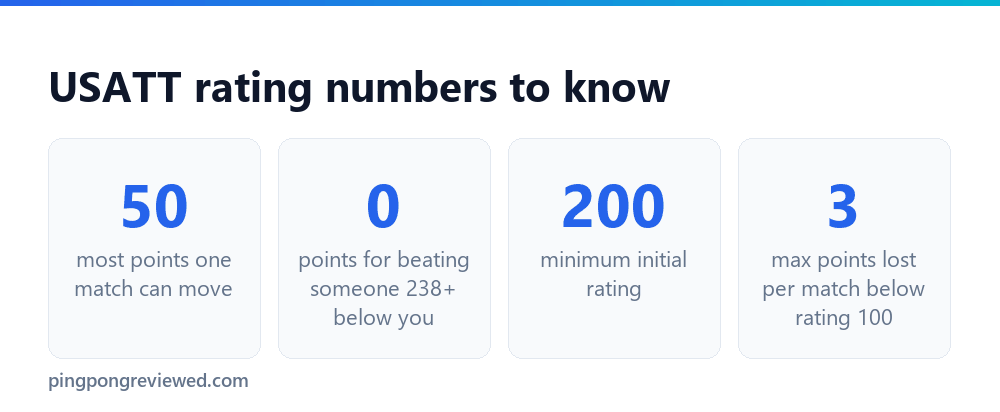
USATT ratings explained in one paragraph: a rating is an Elo-style number. After every sanctioned match, the winner takes points from the loser, and a fixed chart decides how many. Beat someone rated 238 or more points above you and you take 50 points. Beat someone 238 or more below you and you take zero. First-time players get an initial rating worked out from their results, and it can’t start below 200. USATT changed parts of this process for tournaments starting on or after December 22, 2025.
Most explanations of the USATT rating system stop at one line: your rating goes up when you win and down when you lose. That’s true. But it’s about as useful as saying a car moves when you press the pedal.
The real questions come next. How many points is a win worth? Why did a friend’s rating jump 90 points after one weekend? And why does beating a much weaker player do nothing at all? Then there’s the odd one: what happens to someone who walks into a first tournament with no rating?
USATT publishes the answers in a short document called USATT Ratings System Explained. It contains the exact points chart and the step-by-step process the federation runs after each event. So we read that document, along with USATT’s announcement of the December 2025 changes, and rebuilt it here in plain language. Every worked example below can be checked against the chart by hand.
- →The chart is fixed: 11 rating-gap bands decide how many points move on every match.
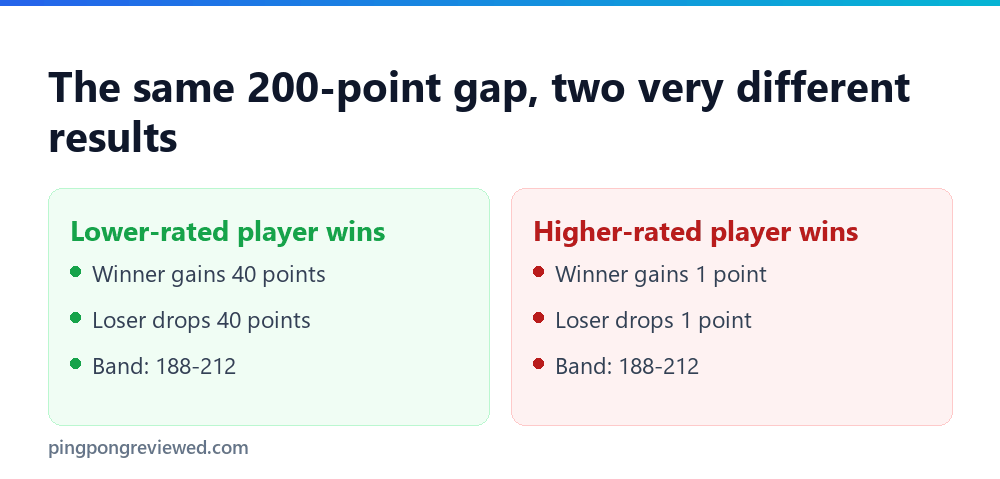
- →Playing up pays. Beating a player 200 points higher is worth 40 points, while beating one 200 lower is worth 1.
- →New players get a first rating from their tournament results, with a hard floor of 200.
- →Very strong results can trigger a bonus adjustment before the normal points are counted.
- →USATT changed the process for tournaments starting on or after December 22, 2025.
Table of Contents
What a USATT rating actually is
USATT says its ratings are based on the Elo system. Elo was designed for chess, and the idea is simple. Every player has a number. When two players meet, the gap between their numbers says who is expected to win. If the favorite wins, the numbers barely move. If the underdog wins, they move a lot.
USATT’s document adds one detail that surprises people. The same rules calculate USATT League ratings, so a league match and a tournament match are treated the same way by the math.
Here’s one more point before the numbers. A rating isn’t a grade. Instead, it’s a comparison. A 1600 means you have been beating and losing to players around that number, in the events USATT has processed. It says nothing about your forehand. Rather, it tells you where you sit among the players you have actually faced.
USATT ratings explained: the points exchange chart, in full
This is the heart of the system. For every match, USATT looks at the gap between the two ratings and reads off a row. The winner gains a set number of points, and the loser drops the same number. The chart has two columns: one for when the higher-rated player wins, and one for when the lower-rated player wins.
Look at the right-hand column first. It climbs from 8 to 50. Then look at the middle column, which falls from 8 to 0. That asymmetry is the whole design. The system pays you for surprising it, and it pays you almost nothing for doing what everyone expected.
Four matches, checked against the chart
Here are four quick cases, so you can see the chart at work.
⚠️ Watch out: The 238-point cutoff cuts both ways. A 1800 player who beats a 1500 player gains nothing, yet if the 1500 player wins, that single match moves 50 points. Higher-rated players carry all the risk in a mismatch.
A full tournament, one match at a time
Suppose you walk in rated 1500 and play four rated opponents. First, here’s how your day adds up under the chart.
Two wins and two losses, and you still come out ahead. The reason is who you beat and who you lost to. Because you were expected to lose to the 1650 player, that loss barely cost you anything. But the 1480 loss hurt, since you were expected to win it.
The upset math nobody shows you
The chart hides a useful piece of arithmetic. Since gains and losses depend on the gap, you can work out how often you need to win before a match is worth playing, purely in rating terms. This is our own calculation from the chart, not a USATT statement. Also, it ignores everything except the points.
Read the favorite column slowly. At a 200-point gap, the stronger player needs to win about 98 matches out of 100 just to hold their number. So grinding out wins over much weaker players is a poor way to protect a rating. In fact, a high-rated player who avoids lopsided events isn’t being snobbish. They’re doing arithmetic.
For the underdog, the story flips. Playing someone 100 points above you and winning one time in six already breaks even. Anything better than that is free rating.
What happens after the event: three passes
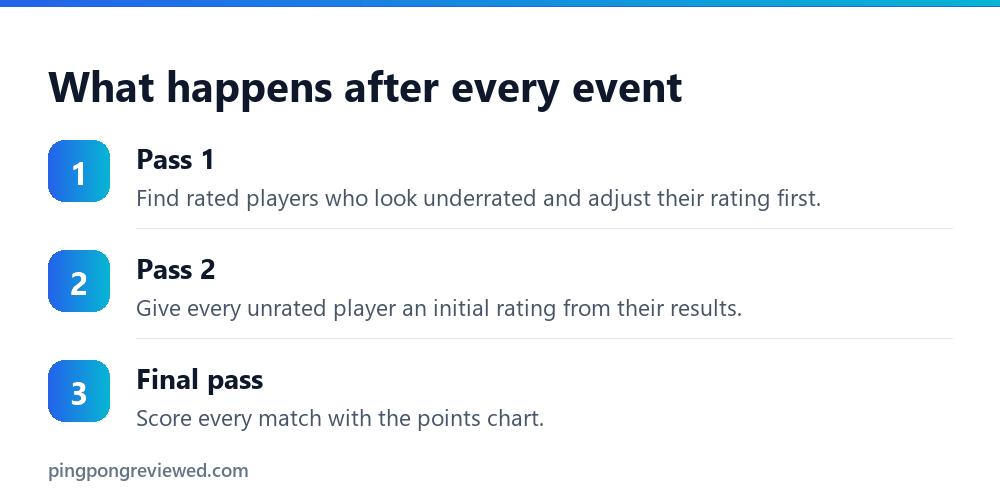
Here’s where the process gets less obvious. USATT doesn’t run the chart once from top to bottom. Instead, its document describes a sequence of passes, and two of them happen before the chart is applied.
Pass 1: catching underrated players
The first pass looks only at matches between players who already have ratings. USATT explains why it exists. Raising an underrated player’s rating before the chart runs limits the points lost by the players they beat.
There are two levels of adjustment. First, the standard adjustment applies if a player gains 60 or more points, or gains 40 or more points with at least two wins worth 20 points or more. Their rating becomes the old rating plus the net points gained in those matches.
Second, the special adjustment covers extreme cases. It kicks in if a player meets any one of three tests:
- Gains 150 or more points.
- Has three or more 50-point wins.
- Has two 50-point wins where the two opponents are 700 or more points above the player in total.
USATT gives its own example for the third test. A 1200 player beats a 1500 player and a 1600 player. The gaps are 300 and 400, which add up to 700, so the special adjustment applies. In that case USATT ignores the old rating and builds a new one from the qualifying results in this tournament.
How the special adjustment is averaged
Two terms help here. In USATT’s wording, your best win is the win over your highest-rated opponent, and your worst loss is the loss to your lowest-rated opponent. That reading matches USATT’s own examples, which list wins from highest to lowest and losses from lowest to highest.
If the player had at least one loss, USATT pairs the best wins with the worst losses and keeps a running average. It stops when a pair would drag the number the wrong way. That sounds messy, so here’s a worked example from USATT’s document.
The logic is fair. A loss to someone rated above your best remaining win shouldn’t boost you. Likewise, a win over someone rated below your worst remaining loss shouldn’t pull you down. And if a player earning this adjustment had no losses at all, USATT simply averages their two best wins.
Pass 2: first ratings for unrated players
The second pass looks only at matches between unrated players and rated players. This is the pass that gives a newcomer their first number. The rules depend on how their day went.
The estimated rating deserves a comment. When someone wins or loses everything, the results alone can’t pin down their level. Beating everyone shows they are at least as good as the best player they beat, but not how much better. So the tournament director has to submit an estimate. According to USATT, if that estimate is missing or doesn’t fit the rule above, processing halts with an error.
A first-rating example, following USATT’s steps
Here’s our own worked example, applying the steps above. A player with no rating beats a 1200 and a 1000. Then they lose to a 1100 and a 1400. Their worst loss is the 1100, and their best win is the 1200. Since the worst loss is below the best win, the paired averaging applies.
First, pair the best win (1200) with the worst loss (1100). The loss is lower, so the pair is included, and the running average is 1150. Next, pair the second-best win (1000) with the next loss up (1400). That loss is higher than the win, so USATT’s rule says to stop. The initial rating is 1150. Note that this is our application of the published steps, not a number taken from USATT.
The final pass: the chart, plus one safety net
Once everyone has a rating and the underrated adjustments are in, USATT runs every match through the points chart. There’s one guardrail. A player below a rating of 100 at this stage can lose at most 3 points in any single match. USATT describes it as a safeguard against ratings approaching zero.
What changed on December 22, 2025
USATT announced improvements to the rating system, effective for all tournaments starting on or after December 22, 2025. From the announcement, these are the changes:
- The minimum initial rating for any first-time tournament player is 200.
- Tournament directors now submit estimated ratings for unrated players whose results are all wins or all losses.
- Underrated players are handled by two separate methods, one for moderately underrated players and one for extreme cases.
- A one-time floor adjustment moved ratings from 100-199 up to 200, and lifted ratings below 100 by 100 points.
📊 Note: The calculation document we read is dated August 7, 2025, and USATT’s announcement sends readers to it for the full method. USATT can revise either page. So check its ratings page for the latest version before you rely on a fine detail.
This matters if you’ve read older guides. Racket Insight’s USATT ratings guide, written in 2022, describes a new player’s first rating as the average of their best win and their worst loss. That was a reasonable summary at the time. However, the current document uses a longer procedure, with the estimated-rating rules and the paired averaging shown above. As a result, the older shortcut won’t always match what USATT calculates.
What this means for how you play
Ratings aren’t only a scoreboard. Once you know the chart, they change how you think about entries and opponents. None of this is an official USATT recommendation, though. It’s what the math implies.
Common misunderstandings
Where to check your rating
USATT’s ratings page points players to ratings.usatt.org. According to that page, your membership needs to be current, and your profile needs its citizenship or permanent-residence details filled in to appear on the favorite-players search. If you spot an error, USATT asks you to contact its ratings staff with your membership ID, the URL, screenshots and a description of the issue.
Still new to sanctioned play? Our first tournament preparation guide covers the practical side. Meanwhile, our tactics guide covers how to beat players who are better on paper.
Frequently asked questions
What is the lowest USATT rating a new player can get?
USATT sets the minimum initial rating for any first-time tournament player at 200. Its December 2025 changes also moved existing ratings in the 100-199 range up to 200.
Do league matches count the same as tournament matches?
Yes. According to USATT’s document, the same rules are applied to the calculation of USATT League ratings.
Does beating a much lower-rated player raise my rating?
Not if the gap is 238 or more, because the chart gives 0 points to the higher-rated winner in that band. In smaller gaps it gives between 1 and 8 points.
Why did my rating move more than the chart says?
Before the chart runs, USATT checks whether rated players look underrated. Strong results, such as gaining 60 or more points among rated opponents, can trigger an adjustment first.
What happens if I win every match in my first tournament?
The tournament director has to submit an estimated rating for you. Your initial rating is set to it, provided it is at least as high as the best-rated player you beat.
Where can I see my rating?
USATT’s ratings page directs players to ratings.usatt.org. Your membership must be current for your profile to show up.
Is a USATT rating the same as an ITTF ranking?
No. USATT ratings come from USATT-sanctioned tournaments and leagues. This guide covers the USATT system only.
Sources
Everything above comes from USATT’s own material. See the USATT Ratings System Explained document, the announcement of the rating system improvements, and the USATT ratings page. This USATT ratings explained guide adds three pieces of our own arithmetic: the break-even percentages, the tournament example and the first-rating example. They are our own arithmetic based on the published chart and steps.

Benjamin Fink is the Lead Equipment Analyst and Senior Contributor at Ping Pong Reviewed. A competitive USATT tournament player and table tennis technician with over 12 years of testing experience, Benjamin specializes in blade carbon composite physics, rubber sponge durometer hardness testing, ITTF equipment compliance, and table tennis robotics mechanics.