
Best Ping Pong Ball Picker: 5 Tools That Clear the Floor Fast

Table of Contents
A Ping Pong Ball Picker Isn’t a Catch Net, and You Might Need Both
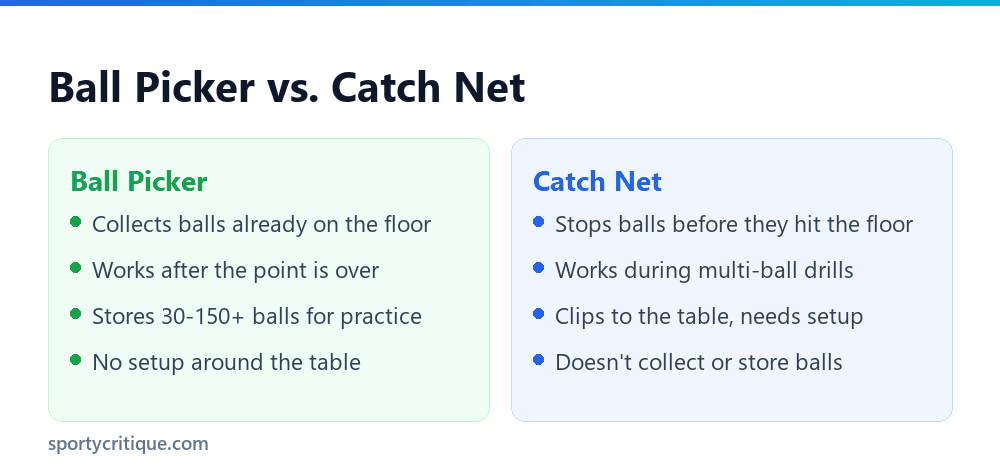
Every ping pong ball picker on this list solves one specific problem: the balls that are already rolling around the floor after a session. We’ve already covered catch nets in a separate guide, the mesh frames that clip to your table and stop balls before they scatter during multi-ball drills. A ball picker is a different tool for a different moment, cleanup after the drill, not prevention during it, whether or not you also use a catch net.
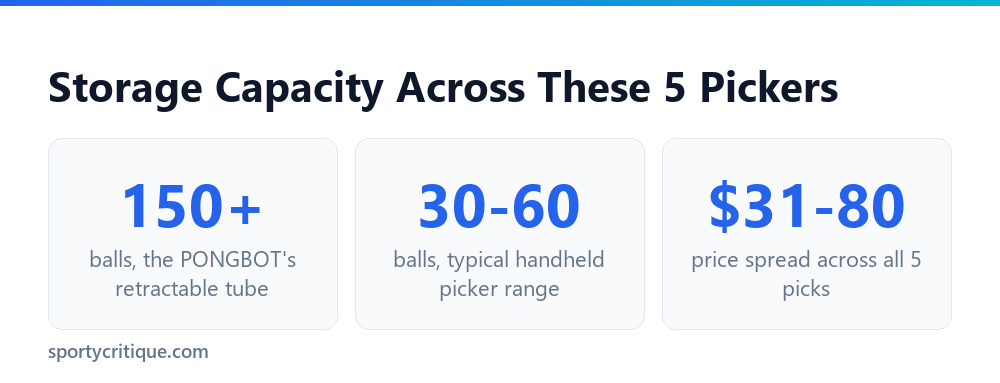
If you coach, run drills solo, or just hate crawling under furniture and tables chasing stray balls, a picker saves real time every single session, time that adds up fast across a week of daily practice. The five tools below range from a $31 budget option to a 150-ball retractable tube built for club volume, so the right pick depends mostly on how many balls you’re clearing and how often you’re clearing them.
How Much a Picker Actually Saves You
A typical solo practice session scatters 20-40 balls across the floor. Picking those up by hand takes several minutes of bending and reaching under tables and chairs, minutes that add up fast if you practice daily. Every picker on this list turns that into a single sweep with a long-handled tool, no bending required.
1. PONGBOT Retractable Table Tennis Ball Picker
The highest-capacity option here by a wide margin. Its retractable tube stores 150+ balls, which makes it the clear pick for coaches or clubs clearing a full practice session rather than a casual game. The retractable design means it collapses down for storage between sessions instead of taking up a corner of the room as a fixed-length tube.
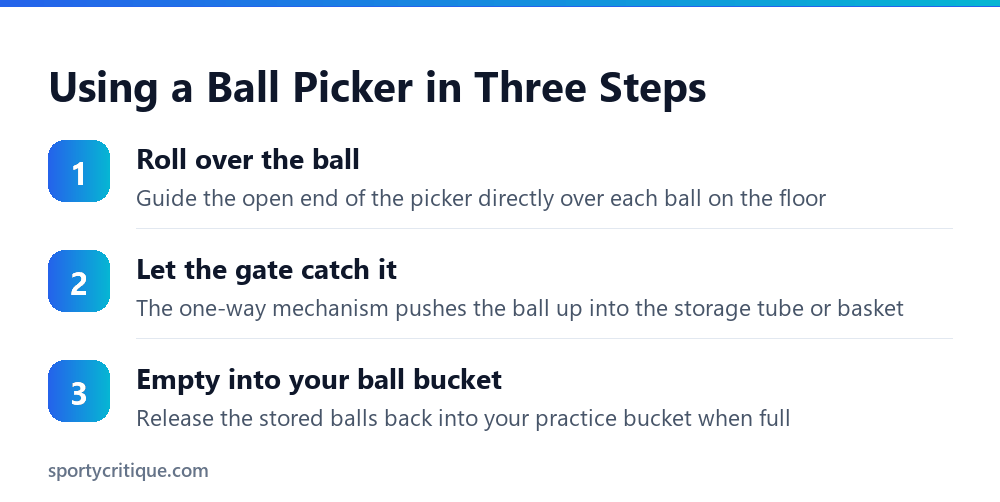
The mechanism works by rolling the open end over a ball, which pushes it up into the storage tube through a one-way gate, so balls collect without spilling back out as you keep moving. For a club running back-to-back sessions with multiple players and multi-ball feeding drills, that 150-ball capacity means one sweep clears the entire floor instead of stopping halfway to empty a smaller basket.
- ✓Stores 150+ balls, highest capacity here
- ✓Retractable for easy storage
- ✓Built for club or coaching volume
- ✕Overkill for casual home use
- ✕Priciest mid-tier option on this list
2. My Ping Pong Buddy Ball Picker Upper
The most established name in this category, made in the USA and built with a simple, durable wire-basket design that’s been around long enough to have a real track record instead of a generic overseas listing. It’s the most expensive pick here, but the build quality and U.S. manufacturing are what you’re paying for.
If you want the option with the longest history of reviews and the least uncertainty about durability, this is it. Everything else on this list is a newer brand without the same multi-year track record, and for buyers who’ve been burned by a flimsy import product before, that history is worth the extra cost on its own. The wire basket construction also means there’s less to break compared to tools with a spring-loaded gate mechanism.
3. TNZMART Adjustable Ping Pong Retriever
The budget pick, and a genuinely capable one. It’s adjustable, portable, and handles multiple-ball collection and storage in one tool, at roughly half the price of the picks above. If you’re testing whether a picker is worth owning at all before committing to a pricier option, start here.
The adjustable handle is the detail that separates it from a fixed-length budget tool. You can shorten it for storage in a bag between sessions or extend it for taller users who don’t want to bend at all, which is a level of flexibility the fixed-tube picks on this list don’t offer at any price.
4. TGA Sports Ping Pong Ball Catcher Upper Tube
A straightforward 31.5-inch tube picker with no moving parts to break, you roll it over a ball and it clicks up into the tube. That simplicity is the appeal: nothing to adjust, nothing to jam, just a consistent scoop-and-store motion for each ball.
The fixed 31.5-inch length is worth noting before you buy. It’s long enough to avoid bending for most balls, but unlike the PONGBOT’s retractable design, it doesn’t collapse down, so factor in storage space for a tube that length. For a player who just wants a reliable tool without extra features to worry about, that trade-off, fixed length for zero mechanical complexity, is a reasonable one.
5. PICK ’N GO Table Tennis Ball Picker
Marketed specifically at players and coaches who want speed over capacity, the PICK ‘N GO trades ball storage for a faster pickup motion per ball. It’s the priciest option on this list, so it makes the most sense if you value quick cleanup between drills over maximum ball count.
The safety angle is worth mentioning too, it’s built and marketed as safe and easy to use for coaches working with younger players, which matters if the picker will get handed to students during a session rather than staying in the coach’s hands the whole time.
Getting the Most Out of Your Ball Picker
Most of these tools use a spring-loaded or one-way gate to keep balls from falling back out once collected, and that gate is the part most likely to wear out first. Wipe it down occasionally rather than letting dust and grit build up inside the mechanism, especially if you play in a garage or a venue with a dusty floor.
Store the picker somewhere it won’t get stepped on between sessions. The tube and basket designs here are lightweight by design, which keeps them easy to swing around the floor, but that same lightness means they can crack under real weight if left on the ground near a doorway or storage closet.
Why We’re Reviewing This Separately From Our Catch Net Guide
It’s a fair question if you’ve read both guides: these tools and catch nets both deal with stray balls, so why treat them as separate buying decisions? The answer comes down to timing and use case. A catch net is a passive barrier you set up once and leave in place for the length of a multi-ball feeding drill, it does nothing after the drill ends. A ball picker is an active tool you pick up and use specifically because balls are already scattered on the floor, whether that scattering happened during a drill with no net, a casual rally, or a coaching session with multiple students hitting simultaneously.
Most serious clubs end up owning both. The net reduces how far balls travel during structured practice, which cuts down cleanup time, but it doesn’t eliminate the need for a picker entirely since balls still escape a net’s coverage area during rallies, serves, and any drill that isn’t strictly multi-ball feeding. Think of the net as reducing the size of the mess and the picker as the tool that actually cleans it up.
Which Picker Fits Your Situation
Coaching a club or running group drills with 40+ balls in play, get the PONGBOT for its 150-ball capacity. Want the most proven, longest-track-record option and don’t mind paying more, go with My Ping Pong Buddy. On a budget or just testing whether a picker earns a permanent spot in your bag, the TNZMART is the honest starting point. Want zero moving parts, the TGA tube is the simplest mechanism here. Prioritizing pickup speed over total capacity, the PICK ‘N GO is built for exactly that.
💡 Pro tip: If you already own a catch net, a picker isn’t a full replacement for it, it’s a second and genuinely different tool for a different moment: the net stops balls mid-drill, the picker clears what’s already scattered on the floor afterward.
The Collection Methods, Compared
Ball collection splits into a few distinct approaches, and which suits you depends far more on how many balls you are collecting than on the product’s quality.
- Telescoping pickers collect balls one or a few at a time from standing height. Good for occasional collection and anyone who would rather not bend repeatedly, less good for clearing a hundred balls after a robot session.
- Roller or basket collectors are pushed across the floor and pick up balls continuously. Much faster at volume, and the sensible choice if you drill with a machine.
- Nets and catchers prevent the problem instead of solving it, catching balls before they reach the floor. Covered in our catch net guide, and generally a better investment than any picker if you are drilling regularly.
- A bucket and bending over remains a legitimate answer for casual play, and the honest comparison point every product here has to beat.
The practical guidance is to be honest about your volume. If you lose a handful of balls per session, a picker is a convenience rather than a need. If you run a robot and clear the floor after every drill block, collection is eating a real share of your practice time and a proper collector pays for itself in recovered session minutes.
What to Check Before Buying
Ball pickers are simple products, which means the differences that matter are unglamorous and easy to overlook in listings.
- Ball size compatibility. Collectors are built around a ball diameter. A picker designed for tennis or golf balls will not hold 40mm table tennis balls reliably.
- Capacity. How many balls before you empty it. A small capacity turns one collection job into several.
- Floor surface. Roller collectors depend on the floor. Some work poorly on carpet or on very smooth polished surfaces where balls slide rather than being gathered.
- Reach and handle length, particularly if the reason you are buying is to avoid bending. Check the extended length rather than assuming.
- Build at the pickup end, which is the part that takes the wear and the part cheapest products economise on.
One thing worth stating plainly: a picker does not make you play better. It buys back practice time and reduces an annoyance, both of which are real, but if you are choosing between a picker and something that changes your practice quality, the picker is the lower priority.
Cheaper Ways to Solve the Same Problem
Before buying anything, it is worth knowing the approaches that cost nothing or almost nothing, since for many players they are genuinely sufficient.
A wide, low-sided box or tray placed at the far end of the table catches a surprising share of balls without any equipment at all. It will not match a proper catch net, but it converts a scattered floor into a partially contained one for the price of a cardboard box.
Simply owning more balls is the other underrated answer. Much of the frustration of collection is stopping mid-drill because you have run out. With a large enough set you collect once at the end of a session rather than four times during it, which is both faster overall and far less disruptive to concentration.
There are also plenty of home-made collector designs, typically a bottle or tube with a ball-sized opening that grips balls as it is pressed down. These work adequately for modest volumes and are a reasonable weekend project, though for serious volume a purpose-built collector is faster and less irritating.
The honest summary is that this is a convenience category rather than a performance one, and the right amount to spend is whatever makes collection stop interrupting your practice, which for many players is very little.
A Realistic Recommendation
Reduced to a single answer for most readers: buy more balls first, then reassess.
It is the cheapest intervention, it addresses the most disruptive part of the problem, which is stopping mid-drill, and it makes any later purchase work better, since collectors and nets are both more useful when there are actually enough balls in circulation to make filling them worthwhile in the first place.
Beyond that, the choice follows from volume. Occasional collection of a few balls suits a telescoping picker or simply bending over. Regular machine drilling that scatters dozens of balls per block justifies a roller collector, and ideally a catch net to stop the scattering happening at all.
Whichever route you take, size it for the practice you actually do rather than the practice you intend to start doing. Equipment bought for an aspirational training schedule tends to sit unused alongside the schedule itself.
Where This Sits in a Practice Setup
Ball collection is a small problem that quietly shapes how you practise, which is why it is worth solving deliberately rather than tolerating.
The mechanism is simple: if collecting balls is annoying enough, you unconsciously start avoiding the drills that scatter them, which are usually the multiball and serve drills with the highest training value. Solving collection removes a barrier to the practice you should be doing most of.
For most players the sensible order is more balls first, then a catch net if you drill with a machine, then a collector if gathering is still eating time. Buying a collector while owning three dozen balls solves the wrong half of the problem.
What’s the difference between a ball picker and a catch net?
A catch net clips to the table and stops balls before they hit the floor during multi-ball drills. A ball picker is a handheld tool you use afterward to collect balls that are already scattered on the floor. They solve different moments in a session, not the same problem.
How many balls can a picker hold?
It varies widely by model, from around 30-60 balls in a typical handheld picker up to 150+ in a retractable tube design like the PONGBOT. Match the capacity to how many balls you actually scatter in a session, not the largest number available.
Are ping pong ball pickers adjustable?
Some are. The TNZMART model on this list is explicitly adjustable for different hand sizes and storage needs, while fixed-tube designs like the TGA Sports picker are a set length with no adjustment.
Can kids use a ping pong ball picker?
Yes, most of these tools are lightweight and require no more coordination than rolling the opening over a ball on the floor, which makes them easy for kids to use during cleanup after family games.
Do I need both a ball picker and a catch net?
Not necessarily, but most clubs and serious home setups end up with both. A catch net reduces how far balls scatter during structured multi-ball drills, while a picker handles the balls that still end up on the floor from rallies, serves, and any drill that isn’t strictly net-covered. One reduces the mess, the other clears it.
What should I look for beyond ball capacity?
Handle length matters as much as capacity for most players, a longer or adjustable handle means less bending regardless of how many balls the tool holds. Also check whether the mechanism is a fixed tube or a spring-loaded gate, since fewer moving parts generally means less to eventually wear out or jam.
As an Amazon Associate, we earn from qualifying purchases through links on this page.

Ping Pong Reviewed is an equipment review site covering table tennis and baseball gear. Specifications are checked against manufacturer listings, and prices against live retail pages, before publication.