8 Basic Table Tennis Skills: The Order Beginners Should Learn Them
Most “basic table tennis skills” lists just enumerate eight things without any real logic to the order they’re presented in. That’s a problem, because some of these skills genuinely depend on the one before it — trying to learn footwork before your grip is settled, for instance, just means relearning your entire movement pattern later once your grip finally clicks into place. This list is ordered the way we’d actually teach a complete beginner, skill by skill, from day one onward.
Table of Contents
Why Order Matters Here
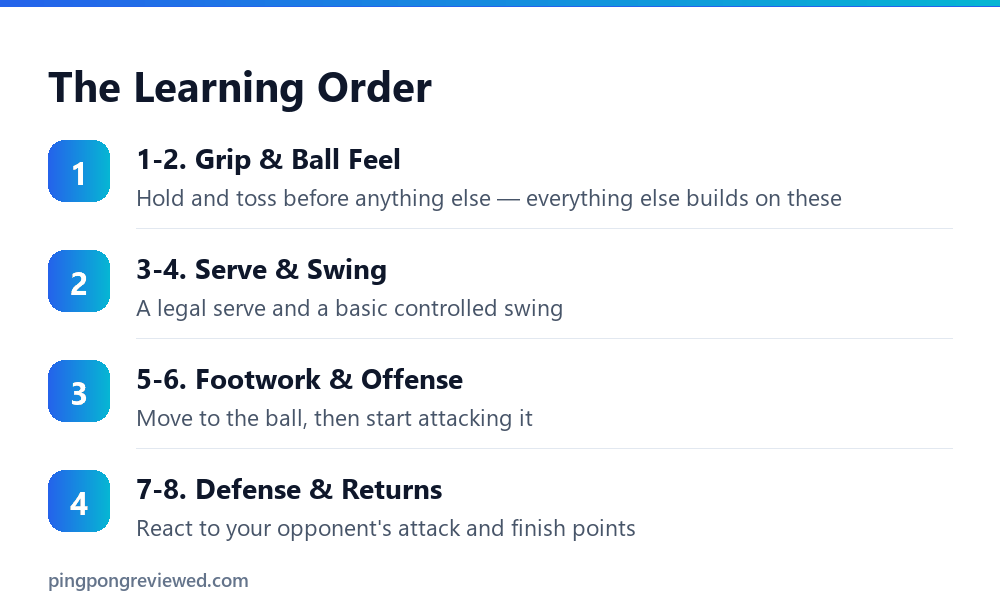
Table tennis is played by roughly 300 million people worldwide according to ITTF estimates, and nearly every one of them started with these same eight fundamentals. The skill that trips up self-taught beginners most often isn’t any single item on this list — it’s trying to work on offense and defense before the grip and footwork underneath them are solid.
The 8 Skills, In Order
1. Hold the Paddle Correctly
Grip comes first because every other skill on this list assumes a stable, correct hold. Use your thumb, index finger, and middle finger to control the handle with your palm facing down for a shakehand grip, the most common style for beginners. A firm but relaxed grip — not white-knuckled — lets your wrist move freely for spin later on, which a tense grip prevents.
2. Get a Feel for the Ball
Before serving or rallying, spend time simply bouncing the ball on your paddle and tossing it for a serve toss. This sounds trivial, but it’s the fastest way to learn how much force the ball needs and how your paddle angle changes where it goes — feedback you can’t get by jumping straight into a rally.
3. Learn a Legal Serve
A legal serve requires tossing the ball at least 16cm straight up from an open palm before striking it — see our full serving rules guide for the complete legal breakdown. Beginners often skip the proper toss height entirely, which becomes a hard habit to unlearn once you start playing competitively.
4. Develop a Basic Swing
Start with a simple, controlled forehand swing before adding spin or power. The goal at this stage is putting the ball consistently over the net and onto the table, not winning the point outright — accuracy has to come before aggression.
5. Learn Proper Footwork
Footwork is what lets you actually reach the ball in position to use the swing you just built. Small, quick side-steps work better than big lunging strides for the short distances table tennis actually requires — most points are decided within a couple of feet of your ready position, not far-reaching dives.
6. Play Offense
Once your swing and footwork are consistent, start adding intent — placing shots into open corners and increasing pace when your opponent gives you a high or short ball to attack. This is also where a basic topspin loop starts to matter; see our forehand loop guide when you’re ready to add real spin.
7. Play Defense
Defense means controlling a shot you didn’t initiate, not just reacting randomly. Blocking a hard-hit ball back with a slightly closed paddle angle, or chopping a spin-heavy attack to slow the point down, are the two defensive tools worth learning first — full technique in our chop-vs-push guide.
8. Return Well Under Pressure
The final skill ties everything together: producing a consistent, low return even when the incoming shot has heavy spin or pace. This is less a standalone technique and more the product of the first seven skills working together reliably under real match pressure, which is why it comes last.
Common Mistakes at Each Stage
- Skill 1-2 (grip/ball feel): switching grips constantly instead of committing to one long enough to build muscle memory around it.
- Skill 3 (serve): tossing the ball at an angle instead of straight up, which is both illegal under ITTF rules and harder to control consistently.
- Skill 4 (swing): swinging for power before accuracy is consistent, which just means missing the table harder and more often.
- Skill 5 (footwork): reaching with the arm instead of stepping with the feet, which looks fine in slow rallies but breaks down completely under real pace.
- Skill 6-7 (offense/defense): only ever practicing one or the other, leaving an obvious hole an opponent will find and exploit.
- Skill 8 (pressure returns): practicing exclusively in low-pressure cooperative rallies and never testing the same shots in a real competitive point.
Most of these mistakes aren’t really about the skill itself — they’re about skipping the deliberate, focused version of practice in favor of just playing casual points. Casual play has its place, but it tends to reinforce whatever habit is already there rather than correcting it.
Table Tennis Skills and Drills
Reading about a skill and actually drilling it are different things. A few simple drills map directly onto the order above:
- Wall rally: bounce the ball against a wall repeatedly to build ball feel and basic swing control without needing a partner.
- Toss-and-serve reps: practice 20 legal serves in a row focusing purely on toss height and placement, not power.
- Footwork ladder: shadow the side-to-side movement pattern without a ball first, then add it back in once the movement feels natural.
- Cooperative rally: rally with a partner at half pace, focused on consistency rather than winning the point, to blend offense and defense together.
Does Equipment Matter This Early?
A little, but less than most beginners assume. A basic, balanced beginner paddle is enough to learn all 8 skills on this list properly — an expensive, high-speed offensive blade actually works against you at this stage, since it punishes the small technique errors that are a normal part of learning. See our beginner paddle guide if you’re shopping for a first racket, but don’t treat equipment as a shortcut past the fundamentals above.
The one piece of equipment worth getting right early is the ball itself. Training-grade balls are perfectly fine for skills 1 through 5, but once you reach skills 6 through 8 and start working on spin-heavy offense and defense, a consistent, tournament-grade 3-star ball behaves more predictably and makes it easier to tell whether a missed shot was your technique or an inconsistent ball.
The Core Skills, Listed Plainly
Searches for this land on wildly different lists depending on the source, which is unhelpful when you are trying to work out what to learn. Here is the set that genuinely underpins the sport, in the order they become useful.
- Grip. How you hold the bat. It constrains every other skill, which is why it comes first.
- Ready position and recovery. Returning to a balanced stance after every shot. The least glamorous skill and the one that most separates players who improve from those who plateau.
- Footwork. Moving to the ball rather than reaching for it. Almost all shot errors at recreational level are actually position errors.
- Service. The only shot entirely under your control, and the most under-practised skill in the sport.
- Return of serve. Reading incoming spin and neutralising it. Half of every point begins here.
- Push and block. The controlled shots that keep you in rallies you would otherwise lose.
- Topspin drive and loop. The attacking strokes, and the ones most people want to learn first despite them depending on everything above.
- Spin recognition. Reading what the opponent has done to the ball. Cuts across every other skill.
The reason lists differ is mostly about how finely they subdivide. Some count forehand and backhand as separate skills, some count each stroke type individually, and a list of six and a list of ten frequently describe the same underlying set. The order matters far more than the count.
Why the Order Matters More Than the List
Skills in table tennis are not independent. Each one depends on the ones before it, which is why learning them out of sequence produces a collection of shots that never quite work.
Footwork is the clearest example. A player who has not built consistent movement will reach for balls, and reaching changes the body position every stroke depends on. That player can practise a forehand loop for months and see little improvement, because the loop is not the failing component, arriving in position is.
The same applies further up. Spin recognition is close to useless before you have a controlled push to return an unread ball with, and an attacking loop is unreliable before topspin drive mechanics are consistent. Each stage supplies something the next one assumes.
The practical consequence is that a plateau is often a signal to go back rather than forward. A player stuck on their loop frequently needs footwork work, not more looping practice, and that diagnosis is the single most valuable thing a coach provides early on.
Which Skills to Prioritise at Each Stage
The full list is long enough to be daunting, and nobody develops all of it simultaneously. Prioritising by stage makes it manageable.
In your first weeks, work on grip, ready position and simply keeping the ball on the table. Consistency is the whole objective, and rallies are the mechanism by which everything else gets learned. Do not worry about spin yet.
Once you can rally, add service and return of serve. These two decide the opening of every point, and a player with one reliable serve and a safe return has a functional game before they own a single attacking stroke.
Once serve and return are stable, build the topspin drive, then the loop. This is the point at which most players want to start, and starting here instead is why so many have an unreliable loop and no push.
Throughout, footwork and spin recognition develop alongside everything else rather than in a slot of their own. Neither is ever finished, and both keep returning value long after the stroke list stops growing.
How to Practise Each One
Knowing the list is not the same as knowing what to do with it, and several of these can be worked on with no partner at all.
- Grip: check it consciously at the start of every session until it stops drifting. Correcting grip costs nothing and takes days rather than months.
- Ready position: practise recovering after shadow strokes. The habit is what matters, not the stroke.
- Footwork: ball-free movement patterns around the table, focusing on returning to centre after each imagined shot.
- Service: a bucket of balls and a target. No partner, no machine, and the highest return of any solo practice available.
- Return of serve and spin recognition: these need a partner, since the whole skill is reading another player. Ask someone stronger to serve at you repeatedly rather than play games.
- Push, block, drive and loop: repetition against a consistent feed, whether from a partner, a robot or multiball.
Notice that the two skills requiring a partner are the two about reading an opponent. Everything else can be developed alone, which is worth knowing if your practice is limited by who is available rather than by time.
Specific Drills for the Skills That Need a Partner
Two of the skills on this list, return of serve and spin recognition, cannot be developed alone. These are the drills worth asking a partner for, and most players never ask.
- Serve and return only. Your partner serves repeatedly with varied spin, you return, and the point ends there. No rally. Concentrates an entire session on the phase that decides half of all points.
- Announced spin. Your partner tells you what spin they are about to serve. This sounds like it defeats the purpose and does the opposite: it lets you connect what you see at contact with what the ball then does, which is how recognition is learned.
- Unannounced, then confirm. The same drill without warning, but your partner confirms afterwards whether you read it correctly. Feedback is what turns guessing into reading.
- One-side feeding. Your partner feeds to a fixed spot while you work a single stroke. Not a rally, and far more useful than one.
The reason to ask a stronger player for these rather than a game is that they cost the partner very little and give you a great deal. Most club players are entirely willing to feed for twenty minutes, and almost nobody thinks to ask, which makes it one of the most underused resources available to an improving player.
Teaching These Skills to Beginners and Children
If you are introducing someone else to the sport rather than learning it yourself, the order shifts slightly and a few things matter more.
Start with contact rather than technique. Bouncing the ball on the bat, then simple cooperative rallying with no scoring, builds the hand-eye coordination that every stroke depends on. Formal grip and stroke correction lands far better once someone can already make contact reliably.
Correct grip early but gently. Grip is the one thing that becomes genuinely hard to change later, so it is worth establishing, but a beginner who is enjoying themselves and holding the bat imperfectly is in a better position than one being corrected out of the game.
Count rallies rather than points at first. Cooperative targets, seeing how many consecutive returns two people can manage, produce more practice and less frustration than competitive scoring does at the stage where neither player can sustain a rally.
Does Equipment Affect Skill Development?
Mostly no, with one genuine exception worth knowing about.
Beyond a basic threshold, equipment does not limit skill development. A player with a modest but functional bat can develop every skill on this page, and better equipment does not accelerate learning in any meaningful way. Time at the table and the quality of practice dominate everything else.
The exception is the very cheapest bundled bats, the kind that come free with a table or in a multi-bat set. These use rubber with almost no grip, which makes spin nearly impossible to produce or feel. A player learning on one cannot develop spin recognition or spin generation, because the equipment does not permit either.
So the practical rule is that a modest genuine bat is enough, and the gap worth closing is from a gripless bundled bat to an entry-level real one rather than from an entry-level one to something expensive.
Taking a Skill From Practice Into a Match
A skill that works in a drill and disappears in a match has not finished developing, and closing that gap is about how you practise rather than how much.
Practise under progressively less predictable conditions. A stroke learned against a consistent feed needs to survive a varied feed, then a rally, then a practice game, then a real one. Going straight from a controlled drill into competition is why skills collapse under pressure: they were never tested at any stage in between.
Accept that a new skill will cost you points at first. Players who only use a new shot when it feels safe never build the confidence to use it when it matters, and the skill quietly never enters their real game.
How to Tell a Skill Has Actually Developed
Skills improve too gradually to feel from session to session, which is why players routinely conclude they have plateaued when they have not.
- Consistency counts. How many consecutive returns can you and a partner manage? A number you can track beats an impression.
- Target accuracy. Serves landing in a marked area out of thirty. Insensitive to who you happen to be playing.
- What beats you. If the thing losing you points has changed from basic inconsistency to a specific tactical weakness, that is real progress even when the score has not moved.
- Recovery under pressure. A skill you can execute in a drill but not in a match has not finished developing yet.
That third one is the most useful and least intuitive. Moving from losing because you cannot control the ball, to losing because your opponent exploits a specific weakness, is genuine improvement, and recognising it is what keeps players working through the stretches where results lag behind ability.
What Holds Most Players Back
The same handful of gaps account for most stalled progress, and none of them are about talent.
- Never returning to ready position. Most recreational players remain where their last shot left them, which guarantees being out of position for the next one.
- Watching the ball instead of the opponent’s bat. By the time the ball tells you what spin it carries, it is nearly on you.
- Practising only the enjoyable shots. Attacking strokes are more fun than pushes, and pushes win more recreational points.
- Playing games instead of drilling. Games let you use existing strengths and avoid weaknesses, which is the opposite of what develops a skill.
- Neglecting the serve. The one shot fully under your control, and the one most players spend the least time on.
If you act on only one of these, make it the ready position. It requires no equipment, no partner and no new technique, and it improves every subsequent shot by ensuring you arrive at the ball balanced rather than stretching.
Questions People Ask About These Skills
How many basic skills are there? Different sources say six, eight or ten, and they are usually subdividing the same underlying set differently. The order matters more than the count.
Which skill should I learn first? Grip, then ready position and recovery. Both constrain everything that follows and both are quick to establish.
Can I learn these without a coach? Mostly yes. The hard part without a coach is diagnosing which skill is actually limiting you, which is why recording yourself is worth so much.
How long does it take? Basic consistency comes within weeks. The attacking strokes take considerably longer, and footwork and spin recognition never really stop developing.
The Short Version
The skills that matter, in order, are grip, ready position, footwork, service, return of serve, push and block, then the attacking strokes, with spin recognition developing throughout. Lists that give six or ten items are usually describing this same set at different levels of detail.
The order is the important part. Skills depend on the ones before them, and a stroke that will not improve is frequently a symptom of a gap further down rather than a problem with the stroke itself.
Most of these can be practised alone. Grip, ready position, footwork and service all need no partner at all, and service in particular returns more per minute than anything else you can do by yourself.
Frequently Asked Questions
What is the most important skill in table tennis?
Grip and ball feel, because every other skill on this list assumes both are already solid. A player with a shaky grip will struggle with serve, swing, and footwork alike, even if each is practiced individually.
How long does it take to learn these 8 basic skills?
Most beginners get a working version of all 8 within a few months of regular practice, though genuine consistency under match pressure — skill 8 — typically takes longer to develop than the others.
Do I need to master each skill before moving to the next?
Not fully, but you should have a reasonable baseline. Trying to layer footwork onto an unstable grip, for instance, usually means relearning the movement once the grip settles, so a rough order is still worth following even if mastery isn’t required at each step.
Can I learn these skills without a coach?
Yes, especially the earlier skills on this list like grip, ball feel, and basic serving. A coach or experienced partner becomes more valuable for the later skills — spin recognition, advanced footwork, and match-pressure consistency are harder to self-correct without outside feedback, since you often can’t feel your own timing errors the way an outside observer can spot them.
What if I already play casually but never learned these formally?
It’s worth going back through the list anyway. A lot of self-taught players develop working versions of skills 4 through 7 while skipping over skill 1 or 2 — an inconsistent grip or underdeveloped ball feel — and that gap tends to cap how much further their game can improve until it’s addressed directly.
How is this different from a general ping pong tips list?
A general tips list groups miscellaneous advice by situation — before serving, during a rally, and so on — without necessarily building toward anything. This page is specifically a beginner curriculum: eight skills in a deliberate teaching order, meant to be worked through roughly in sequence rather than dipped into at random.
Should kids learn these skills in the same order as adults?
Yes, the order itself doesn’t change for younger players, though the pace usually does — kids often need more repetition on grip and ball feel before their coordination is ready for the swing and footwork stages, so patience with the earlier skills pays off more than rushing straight ahead to the more exciting offensive and defensive skills further down this list.

Ping Pong Reviewed is an equipment review site covering table tennis and baseball gear. Specifications are checked against manufacturer listings, and prices against live retail pages, before publication.