Chinese vs European Table Tennis Rubber: 5 Real Differences
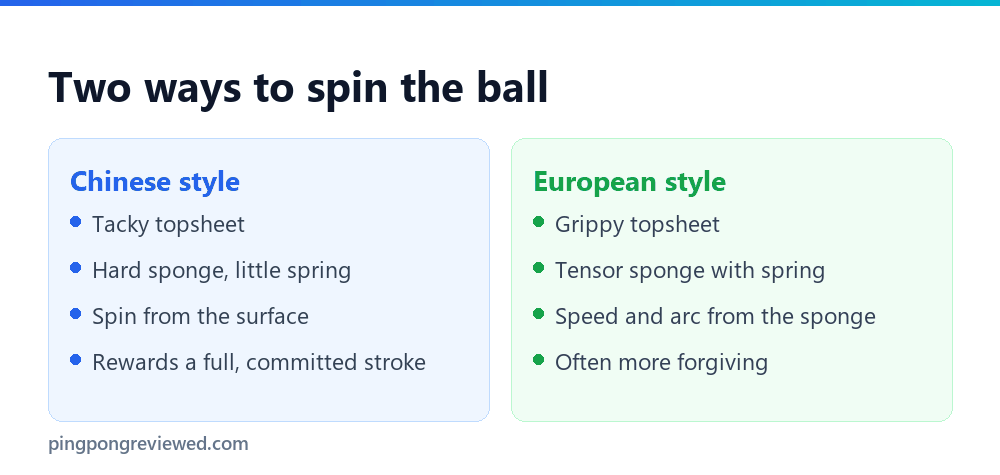
Chinese vs European table tennis rubber comes down to how the ball is held. Chinese rubbers have a tacky topsheet and usually a hard, low-tension sponge, so spin comes from the surface grabbing the ball. European rubbers have a grippy topsheet and a springy tensor sponge, so speed and arc come from the sponge. Japanese rubbers sit closer to the European side, and newer hybrids borrow tack from the Chinese side and tension from the European side.
Ask ten players which rubber to buy and you’ll get ten answers, most of them starting with a country. Chinese rubber, European rubber, Japanese rubber. It sounds like a map, but it’s really a description of two design ideas.
So this guide to Chinese vs European table tennis rubber skips the geography and explains the ideas. We’ll cover the five differences that actually change how a rubber plays, where Japanese rubbers fit, why hybrids exist, and why the speed and spin numbers on product pages can mislead you. To keep it grounded, we use the spec sheets and prices from our own rubber reviews instead of generic examples.
One note first. We haven’t logged playing hours on these sheets, and we won’t describe a feel we haven’t felt. What follows is manufacturer and retailer specifications, our published prices, and what the guides we compared say about the two styles.
- →Chinese rubbers grab the ball with a tacky topsheet. European rubbers rely on a grippy topsheet plus a tensor sponge.
- →Japanese rubbers mostly follow the European tensor approach, and hybrids blend both ideas.
- →‘Chinese’ does not mean cheap. Our Hurricane 3 review priced the top grade at $98.95.
- →Speed, spin and hardness numbers come from different scales, so don’t compare them across brands.
- →Any rubber you use in sanctioned play has to be on the ITTF’s authorized list, and boosting is banned.
Table of Contents
Chinese vs European table tennis rubber: the five real differences
1. The topsheet: tacky or grippy
This is the difference everyone mentions first, and it’s the right place to start. A tacky topsheet is sticky. When the ball lands, it holds on, so you can spin it with the surface even if the ball barely sinks in. A grippy topsheet holds the ball too, but it relies on the sponge underneath to sink and rebound.
The guides we compared put it the same way. Chinese rubbers create more spin from the topsheet, while European and Japanese rubbers create more spin through the way the sponge and topsheet work together. Racket Insight’s 2022 guide, for instance, calls Chinese rubbers tacky and European ones grippy.
2. The sponge: hard and low tension, or springy
Traditional Chinese rubbers use a hard sponge with very little spring. The ball doesn’t get catapulted off it. European tensor rubbers use a sponge that has been stretched during manufacturing, which gives a springy, trampoline-like response.
That single change explains a lot. A spring gives free speed and a higher arc, so you can hit with less effort. A hard, low-tension sponge gives you less help, so the speed has to come from your stroke.
3. Speed and arc
Because of that sponge, European rubbers are usually faster and send the ball on a higher, more forgiving arc. Chinese rubbers are usually slower and produce a flatter, lower trajectory, which the sources describe as a lower throw angle.
Neither is better in the abstract. A higher arc clears the net more easily. A lower, flatter path gives an attacker a faster ball that lands sooner. The right choice depends on how you like to play.
4. Price, and why ‘Chinese’ doesn’t mean cheap
A common claim is that Chinese rubbers are the budget option. Racket Insight’s 2022 guide, for example, says some Chinese rubbers cost as little as $5 to $10, while European rubbers typically start around $35 a sheet and reach $94 for a Dignics sheet. That’s a fair general picture, but it hides an important detail.
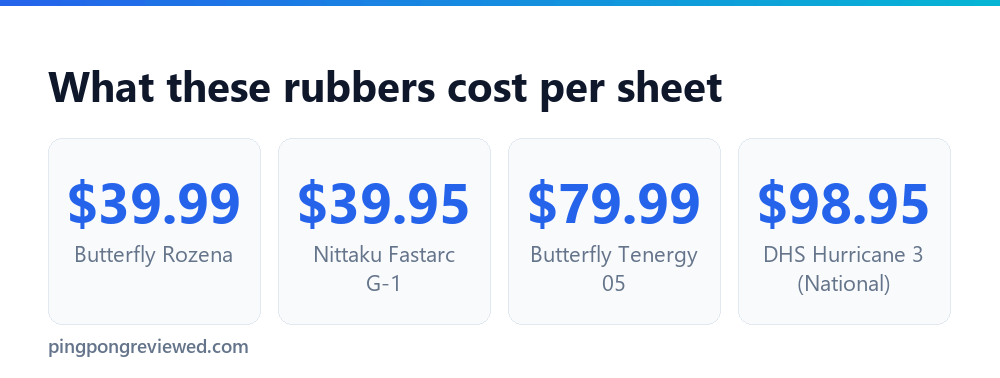
Chinese rubbers are sold in grades. In our Hurricane 3 review, the National grade with blue sponge was listed at $98.95 at Megaspin, marked down from a $125.95 list price. Lower grades of the same rubber cost far less. So the country tells you little. The grade and the sponge decide the price.
5. What the rubber asks of your stroke
A tacky, hard-sponge rubber tends to reward a slower, more deliberate, fully-committed swing. If your stroke is short and hurried, there’s not much spring to rescue it. A tensor rubber tends to forgive a shorter stroke, because the sponge adds power.
This is the difference that matters most for your choice. It isn’t about which style is stronger. It’s about which one matches the stroke you have today and the one you want to build.
What happens at contact: dwell, throw angle and arc
Three terms show up in every rubber discussion, and they’re easier than they sound. Dwell is how long the ball stays in contact with the rubber. Throw angle is the angle at which the ball leaves the surface. Arc is the shape of the path it takes over the net.
Now connect them to the two styles. A tacky topsheet holds the ball, so you can spin it even with a short contact. A tensor sponge sinks in and springs back, which tends to send the ball out higher. That’s why the sources link European and Japanese rubbers to a higher arc and Chinese rubbers to a lower throw angle.
Butterfly’s own numbers show the same idea inside one brand. Dignics 09C has an arc rating of 96 and Dignics 05 has 88, and Butterfly rates the 09C’s spin higher too. So a higher arc and more spin travel together in that lineup. Whether that suits you depends on how much clearance you want over the net.
Bigger stroke, smaller stroke
One claim keeps appearing in the discussions we read. Since tacky rubbers are usually slower than European and Japanese ones, the stroke has to be bigger to get the same power and spin. That fits the design. If the sponge gives less help, your body has to supply more.
We can’t test that on a table, so treat it as a reasonable reading of the design, not a measurement. Still, it’s a useful rule of thumb when you compare rubbers on paper.
Where Japanese rubbers fit
The phrase ‘Chinese vs Japanese vs European’ suggests three separate camps. In practice, Japanese rubbers sit much closer to European ones. Butterfly, Yasaka and Nittaku all build tensor rubbers, and several guides group European and Japanese rubbers together as grippy.
Take Butterfly’s Tenergy 05. In our review, Butterfly lists it at $79.99 per sheet with a hardness of 36. Rozena, Butterfly’s cheaper option, is $39.99 with matching speed. Nittaku’s Fastarc G-1 is a Japanese-brand rubber our review describes as grip-first, at $39.95 with a control figure of 68. Yasaka’s Rakza 7 uses an inverted tensor design with a topsheet high in natural rubber, which is where its grip comes from.
Hybrid rubbers: the third option
Hybrids exist because players wanted both. They combine a tacky or high-friction topsheet with a tensioned sponge. Butterfly’s own description of Dignics 09C is a good example: hard surface, high friction, high tension, pimples-in.
The numbers are telling. In our review, Butterfly lists Dignics 09C at speed 79, spin 96, arc 96 and hardness 44, at $93.99 per sheet. That’s lower speed than Dignics 05 (86) but higher spin and arc. So the hybrid idea isn’t about making everything bigger. It shifts the balance toward spin and arc.
Hybrids are demanding. They tend to be hard, expensive and best matched to players who already have a solid loop.
The numbers trap: why you can’t compare brands
Product pages love numbers. Speed 95, spin 96, control 68. The problem is that each brand measures on its own scale. Our own reviews keep hitting this wall, so here is every rubber we mentioned side by side with the source of each number.
⚠️ Watch out: Look at the Tibhar row: speed 125 and spin 120 on Tibhar’s scale. Those are not bigger than 95 and 96 on another brand’s scale. Compare rubbers within one brand’s lineup, or use a single retailer’s scale for everything, and never across sources.
Hardness has the same problem. Chinese sponges are often quoted in degrees, ESN degrees are a different measure, and Butterfly uses its own index. A 39 from one source and a 44 from another can’t be lined up directly.
What a full setup really costs
Product pages show the price of one sheet. But a racket has two sides, so a full setup needs two. That doubles every number in the table above, and it changes how the options feel once you add them up.
The spread is large. A pair of Rozena sheets costs less than half of a Hurricane 3 National setup. That gap matters because rubber wears out. A rubber that costs twice as much has to last twice as long to break even, and the other way around.
Many players run different rubbers on each side. If you do, the second sheet is where you can save money.
The rules that apply to every style
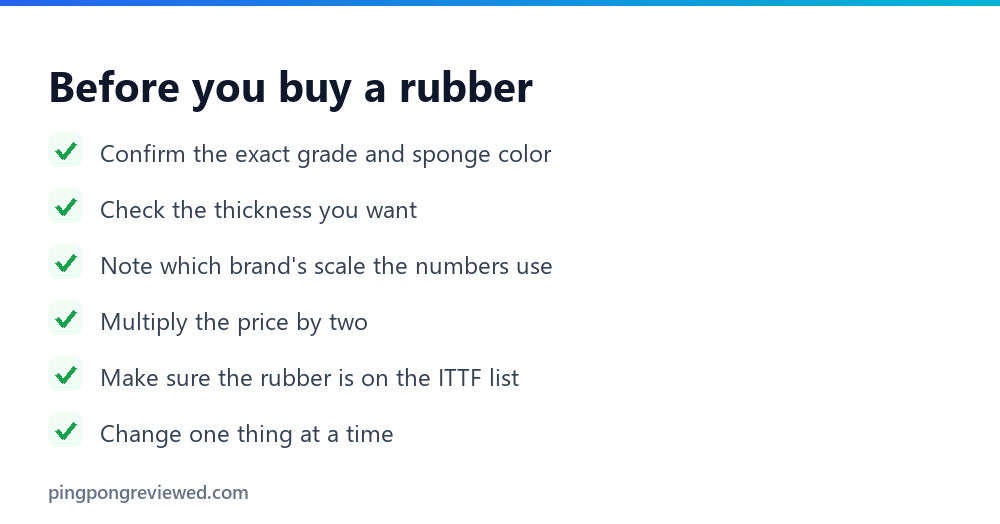
Style doesn’t change the legal side. To use a rubber in sanctioned play, it has to appear on the ITTF’s list of authorized racket coverings, and the two sides of your racket must be different colors. Our guide to rubber cleaners also covers the separate rule about treating a rubber.
That matters because some older guides recommend boosting, which means applying a liquid to the sponge to add speed. Speed gluing and boosting are banned outright, at any time, as an equipment modification. If a guide tells you to boost your rubber, check its date first.
How to choose between Chinese and European table tennis rubber
Buying mistakes worth avoiding
First, don’t buy on the strength of one number. A spin rating from one scale tells you almost nothing about a rubber from another brand.
Second, don’t assume a famous name is the right rubber for you. Tenergy 05 is the reference sheet in our reviews, and Butterfly lists it at $79.99, but Rozena matches its speed rating at half the price. Third, don’t ignore thickness. The same rubber comes in several thicknesses, and each one plays differently.
Finally, don’t switch everything at once. Change one rubber, play for a while, and then decide. It costs more patience than money.
If you’re ready to shop, our beginner rubber guide, Chinese rubber guide and budget rubber guide each narrow the field. And our replacement guide shows how to fit a new sheet without ruining your blade.
Common myths
Frequently asked questions
Are Chinese rubbers good for beginners?
They can be, but the guides we read agree they are less forgiving. Hard sponges without much spring ask for a full, committed stroke. Many beginners find a softer European or Japanese rubber easier to control first.
What does tacky mean on a table tennis rubber?
It means the topsheet is sticky to the touch, so it holds the ball on contact and creates spin from the surface. Grippy rubbers hold the ball too, but they rely more on the sponge sinking in.
What does tensor mean?
Tensor sponge is stretched during manufacturing, which gives it a springy, catapult-like feel. The result is usually more speed and a higher arc for the same effort.
Are hybrid rubbers legal?
A hybrid is an ordinary inverted rubber that mixes traits from both styles. Like any rubber, it is legal for sanctioned play only if it appears on the ITTF’s list of authorized racket coverings.
Can I use a Chinese rubber on one side and a European rubber on the other?
Yes, as long as both are on the ITTF list and the two sides are different colors. Nothing in the rules stops you from mixing styles across the two sides.
Are the speed and spin numbers on different brands comparable?
No. Butterfly, Tibhar, Yasaka and retailers such as Megaspin each use their own scales. Compare numbers within one brand’s line, not across brands.
What does sponge thickness change?
Thickness changes how much the sheet gives back. Thicker sponge generally adds speed and takes away some control. Our reviews list Tenergy 05 in 1.7, 1.9 and 2.1 mm and Rakza 7 in 1.8 mm, 2.0 mm and max.
How do I know I am buying the right grade of a Chinese rubber?
Read the listing for the grade name and the sponge color, not only the model name. With Hurricane 3, for example, the National grade and the Provincial grade are different products at very different prices.
Is a Chinese rubber always the cheaper choice?
No. In our Hurricane 3 review, the National grade with blue sponge was $98.95 at Megaspin when we checked. Chinese rubbers are sold in grades, and the price follows the grade.
Sources
Specifications and prices come from our own rubber reviews, which cite Butterfly, Tibhar, Yasaka and Megaspin product pages. The Chinese vs European table tennis rubber comparisons draw on Racket Insight’s rubber types guide (2022) and a discussion on the TableTennisDaily forum. Where we generalize, we say so.

Benjamin Fink is the Lead Equipment Analyst and Senior Contributor at Ping Pong Reviewed. A competitive USATT tournament player and table tennis technician with over 12 years of testing experience, Benjamin specializes in blade carbon composite physics, rubber sponge durometer hardness testing, ITTF equipment compliance, and table tennis robotics mechanics.