Table Tennis Team Match Format: Two Real Systems, Explained
Team competition format is one of those topics where a straightforward-sounding question, “what order do team matches get played in?”, turns out not to have one single, universal answer, and this review found a genuine discrepancy across sources worth disclosing directly rather than papering over.
This page walks through both real formats currently in use, what they share structurally despite their differences, and how captains actually make use of the tactical flexibility built into each one.
⚠️ Watch out: Team match format actually varies by competition and has changed over time. This review found two different sourced systems, a doubles-first format used at the Olympics since 2024, and the traditional Swaythling Cup / Corbillon Cup systems used in World Team Championships. Both are real, both are current in their respective competitions, and this piece reports both rather than picking one as “the” official format.
Short answer: A team tie is a series of individual matches (singles and sometimes doubles) between two three-player teams, ending as soon as one team wins 3 individual matches. The exact order of matches depends on which competition’s format is being used, the Olympics uses a doubles-first order since 2024, while traditional World Championship formats use different singles/doubles sequences.
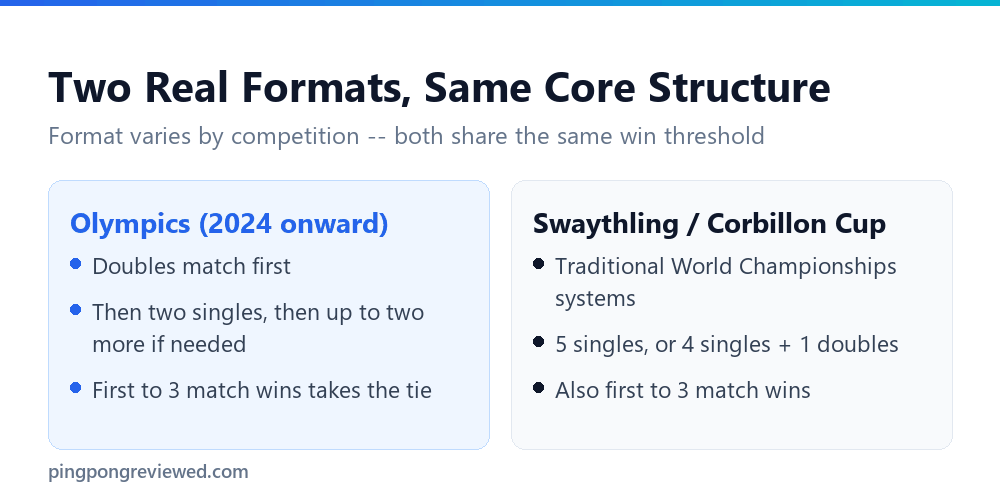
Table of Contents
What All Team Formats Share in Common
Regardless of which specific format a competition uses, several structural principles hold across all of them. Each team fields three players, conventionally labeled A, B, and C for one team and X, Y, and Z for the other. The tie consists of a fixed sequence of individual matches, singles, and in some formats a doubles match as well. The tie ends immediately once either team reaches 3 individual match wins, regardless of how many matches in the full sequence remain unplayed at that point.
That shared foundation is worth keeping in mind throughout the rest of this page, the differences between formats are real, but they’re differences in sequencing and match count, not in the underlying win-threshold logic that decides every team tie.
The Olympic Format Since 2024: Doubles First
Starting with the 2024 Olympics, the team format opens with a doubles match before moving into singles: first a doubles match (pairing two of the three players from each team), then two singles matches, and if neither team has reached 3 wins yet, up to two additional singles matches to decide it. A specific example order: doubles (B+C vs Y+Z), then A vs X, C vs Z, A vs Y, and finally B vs X if needed. This doubles-first structure is a genuine, deliberate change from the format the Olympics used in earlier cycles.
The Traditional Systems: Swaythling and Corbillon Cup
Separately, World Team Championships and various other competitions have historically used, and in many cases continue to use, two named systems. The Swaythling Cup system uses five singles matches only, no doubles at all, in the order A-X, B-Y, C-Z, A-Y, B-X. The Corbillon Cup system uses four singles plus one doubles match, in the order A-X, B-Y, doubles, A-Y, B-X. Both of these traditional systems, like the newer Olympic format, end the tie as soon as one team reaches 3 match wins.
📊 Note: This site could not confirm from the sources checked exactly which competitions currently use which specific system, or whether the Olympic doubles-first format has been or will be adopted more broadly across other competitions. Rather than guess, this is stated as a genuine open question, confirm the specific format with the rules of whatever competition you’re actually participating in or watching.
How Captains Select Player Order
Team captains carry real strategic responsibility in setting up the match order. Captains must initially nominate which two of their three players will compete in the first two singles matches, a decision made before seeing how the doubles pairing or later matches will play out. In formats that include a doubles match, the captain can then decide the doubles pairing after watching the results of those first two singles matches, giving them a genuine tactical opportunity to adjust based on which players are performing well or poorly against the specific opponents they’ve already faced.
💡 Pro tip: If you’re captaining a team match, resist locking in your full player order before the match starts if the specific format gives you flexibility on doubles pairing, that flexibility exists specifically so you can react to how the first two singles matches actually played out, not just to your pre-match assumptions about matchups.
Why the Tie Can End Early
Since the tie ends immediately at 3 match wins, a full match sequence, all 5 matches in a five-match format, doesn’t always get played out. A team that wins its first three individual matches outright wins the tie 3-0, and any remaining scheduled matches in the sequence simply don’t happen at all. This is worth knowing specifically because it means the printed or announced match order for a given tie is the PLANNED sequence, not a guarantee that every listed match will actually be contested.
- ✓Confirm the specific format (Olympic doubles-first, Swaythling, or Corbillon) for your own competition
- ✓Understand that all formats share the same 3-win threshold to end the tie
- ✓Use available doubles-pairing flexibility to react to earlier singles results
- ✓Recognize that a tie can end before every scheduled match is actually played
- ✕Assume one universal format applies identically across every competition level
- ✕Lock in your full player order before seeing how earlier matches in the tie play out
- ✕Expect every listed match in a printed order to necessarily be played
- ✕Confuse the Olympic post-2024 format with the traditional World Championship systems
Why This Site Disclosed a Discrepancy Instead of Picking One Answer
It’s worth being transparent about how this piece came together, since it would have been easy to simply present the more recently found Olympic format as “the” answer and move on, especially given the Olympics’ visibility compared to World Team Championships. Doing that would have been factually incomplete, the Swaythling Cup and Corbillon Cup systems are still referenced, current systems in their own right, not obsolete history superseded by the Olympic change. Presenting only the Olympic format as definitive would have actively misled a reader trying to understand the format for a World Team Championship event or a competition modeled on it.
This is consistent with this site’s standing approach whenever independent sources disagree rather than simply phrasing the same fact differently: report both, explain why they differ as best as can be confirmed, and let the reader apply whichever is actually relevant to their own specific situation, rather than manufacturing a false sense of a single settled answer.
The Short Version, Restated
Team match format differs by competition, a doubles-first sequence at the Olympics since 2024, versus traditional Swaythling Cup or Corbillon Cup systems used elsewhere, but every version shares the same core structure: three players per team, a fixed match sequence, and the tie ending the moment either team reaches 3 individual match wins. Confirm the specific format for whatever competition you’re actually involved in rather than assuming one universal standard.
That single habit, checking the actual written format for your specific event rather than assuming based on whichever version you’ve seen most recently on television, will save you from more confusion than memorizing any one specific match order ever could.
Why the Olympic Format Changed to Doubles First
Though this review couldn’t confirm an official, explicitly stated rationale from the sources checked, a doubles-first sequence carries an intuitive strategic logic worth noting: opening with doubles gives both teams a shared, combined-effort result before any individual player’s singles performance sets the tone for the rest of the tie. This can create a different tactical dynamic than a singles-first sequence, since team chemistry and doubles-specific strategy become the opening statement of the tie rather than an afterthought played only if the format specifically calls for it partway through.
Whether this was the actual, stated reasoning behind the Olympic change is something this review could not independently confirm, and it’s disclosed as informed speculation rather than a verified fact, the sources checked describe WHAT changed clearly, but not explicitly WHY the governing body chose that specific change.
What This Means for Club and Local Team Competitions
Club and local league team competitions frequently set their own specific format rather than strictly following either the Olympic or traditional World Championship systems, since local organizers often prioritize match length and scheduling practicality over matching elite-level competition structure exactly. A local team captain or league organizer should treat both formats covered here as reference points and real-world precedents rather than assuming either one automatically applies to their own specific league’s rules, confirming the actual written format for your specific competition remains the only reliable way to know for certain.
Common Questions
What is the format of a table tennis team match?
It varies by competition, the Olympics has used a doubles-first format since 2024, while traditional World Championship formats use the Swaythling Cup (5 singles) or Corbillon Cup (4 singles + 1 doubles) systems. All end at 3 match wins.
How many wins does a team need to win a tie?
3 individual match wins, across all the formats checked, the tie ends immediately once a team reaches that threshold.
Do all scheduled matches in a team tie always get played?
No, since the tie ends at 3 wins, a team that wins its first three matches outright ends the tie 3-0, and any remaining scheduled matches simply aren’t played.
How is the doubles pairing decided?
In formats that include doubles, the team captain can select the pairing after seeing the results of the first two singles matches, allowing a tactical adjustment.
Is the Olympic team format the same as the World Championships format?
Not necessarily, the Olympics adopted a doubles-first sequence starting in 2024, while World Championships have historically used the separate Swaythling and Corbillon Cup systems.
Do club and local league teams have to follow the Olympic or World Championship format?
Not necessarily, local competitions often set their own format for scheduling practicality, so confirm your own league’s actual written rules rather than assuming.
Why did the Olympics switch to a doubles-first format?
The exact official rationale wasn’t confirmed in sources checked, though a doubles-first order plausibly creates a different early tactical dynamic centered on team chemistry.
The Short Version
Two real, current systems, one shared core structure, confirm which one actually governs your own event.
- →Team match format varies by competition, there’s no single universal order.
- →The Olympics has used a doubles-first sequence since 2024.
- →Traditional World Championship formats use the Swaythling or Corbillon Cup systems.
- →All formats end the tie immediately once a team reaches 3 match wins.
- →Captains select initial singles order, with doubles-pairing flexibility in some formats.
- →Not every scheduled match in a tie is necessarily played if the tie ends early.

Benjamin Fink is the Lead Equipment Analyst and Senior Contributor at Ping Pong Reviewed. A competitive USATT tournament player and table tennis technician with over 12 years of testing experience, Benjamin specializes in blade carbon composite physics, rubber sponge durometer hardness testing, ITTF equipment compliance, and table tennis robotics mechanics.