Harvard Edge Review: The Thinnest Table, Honestly Explained

Harvard Edge’s whole selling point, consistently across every independent source checked, is being one of the cheapest table tennis tables available. This review verifies exactly what that low price actually trades away, and discloses directly that no confirmed current price or purchase link could be located.
What follows is independently corroborated specifications and honest limitations, not a claimed hands-on verdict or a live purchase recommendation.
⚠️ Watch out: This review could not locate a verified, current retailer listing (Amazon, Walmart, or otherwise) specifically for a product named Harvard Edge table tennis table. Search current retailers directly, and verify any listing actually matches the specifications documented here before buying.
📊 Note: What this review is. We have not logged hours with this table, and we’re not going to describe a feel we haven’t felt. What follows is documented specification numbers from independent reviewer sources, presented honestly alongside an unverified purchase link.
Table of Contents
What’s Consistently Documented
The 13mm Thickness, in Honest Context
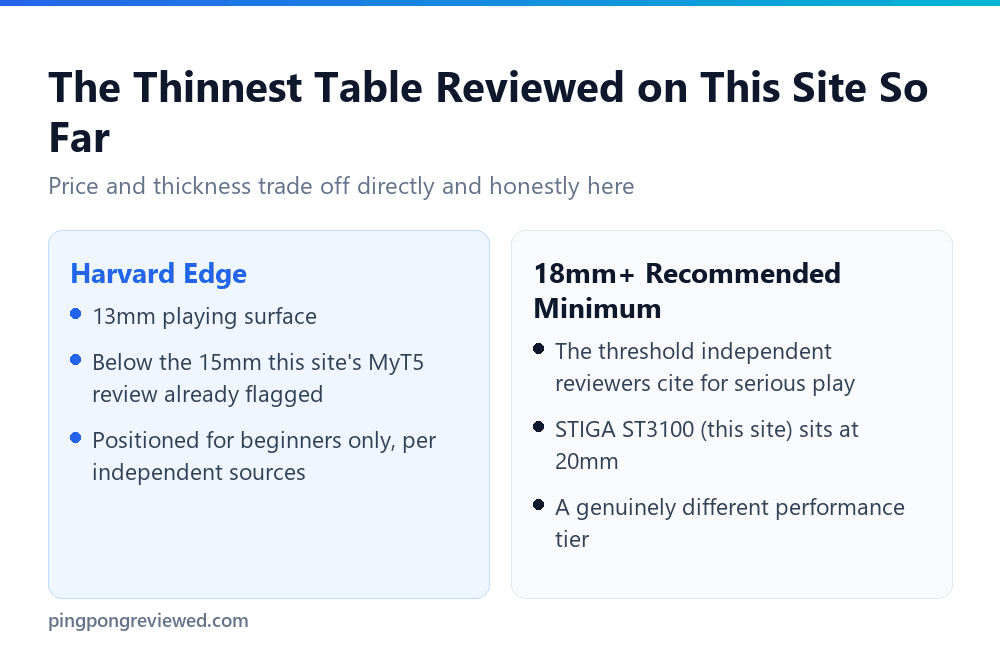
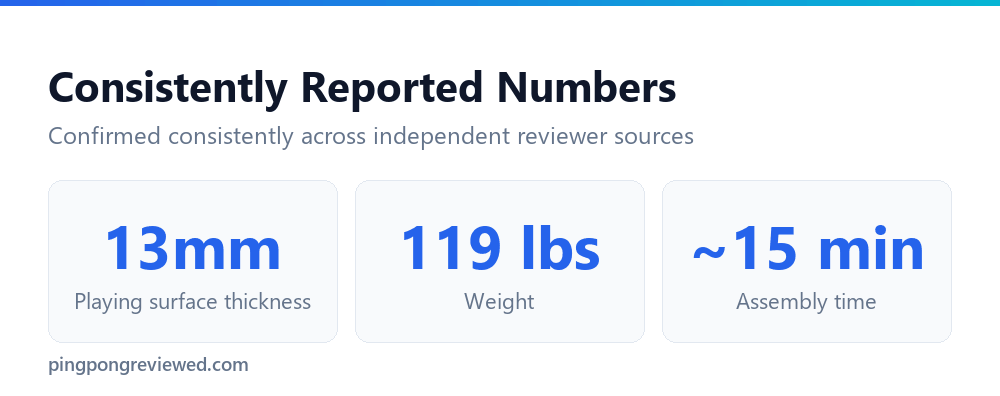
13mm is thinner than any other table this site has reviewed so far, including Killerspin MyT5’s already-flagged 15mm. Independent sources are direct and consistent about the consequence: 13mm doesn’t provide good bounce, and multiple reviewers position Harvard Edge as suitable specifically for beginners, not intermediate or advanced players.
📊 Note: Reviewer consensus for Harvard Edge draws on multiple independent sources, with pingpongruler.com’s apparently 2022-originated review still being referenced consistently by other sources, suggesting the product’s core specifications have remained stable over time rather than changing across production runs.
Why the Price Is the Whole Story Here
Every independent source checked frames Harvard Edge’s value proposition around price specifically, described consistently as one of the cheapest tables available, at less than half the cost of most competitors. That framing only makes sense alongside the thickness trade-off documented above: Harvard Edge isn’t positioned as a value pick that happens to also be thin, it’s positioned as a budget-first table where the thin surface is the direct, honest cost of that low price.
That’s a coherent, defensible product position, worth taking on its own terms rather than judging Harvard Edge against a thickness standard it was never trying to meet. A buyer who wants the cheapest possible way to introduce table tennis to a household, without expecting tournament-grade bounce, is exactly who this table is built for.
That kind of specification stability over several years is worth weighing as a small, positive signal about the product’s own consistency, even without a confirmed current retail listing to point to.
Who Harvard Edge Is Actually For
- ✓You want the lowest possible entry cost into owning a table
- ✓You’re a genuine beginner or buying for a household just trying the sport
- ✓You value fast, ~15-minute assembly over maximum bounce quality
- ✓You want a solo-play practice option at a budget price point
- ✕You want a table that provides good, competitive-level bounce
- ✕You’re an intermediate or advanced player
- ✕You’re comparing this against thicker tables on performance grounds
- ✕You need a confirmed current price before deciding, search directly first
💡 Pro tip: If 13mm sounds too thin once you understand the trade-off, this site’s JOOLA Tour 1800 review covers a table at a real step up in thickness (18mm) while still offering fast assembly, worth comparing before committing to the absolute lowest price point.
The Missing Purchase Link, Explained
Unlike every other table this site has reviewed, no verified current retailer listing specifically for “Harvard Edge” could be located in this session, searches for Harvard-brand table tennis products consistently surfaced multi-game combination tables instead of this specific, dedicated model. That doesn’t mean Harvard Edge doesn’t exist or isn’t real; multiple independent, apparently detailed reviews document it consistently with matching specifications. It means this specific review couldn’t confirm where to buy it right now with the same confidence this site applies to its other reviews.
⚠️ Watch out: Search current retailers directly for “Harvard Edge table tennis” and verify any listing’s specifications match what’s documented here (13mm surface, 119 lbs, solo play) before buying, this review cannot confirm a specific, current, verified purchase link.
Why a Missing Retailer Link Doesn’t Mean a Fake Product
It’s worth being direct about the distinction between “this product doesn’t exist” and “this review couldn’t confirm a current retail listing for it,” since those are different findings. Multiple independent, apparently detailed review sites document Harvard Edge with consistent, matching specifications, 13mm surface, 119 lbs weight, solo-play design, which is strong evidence the product is real and was reviewed by people who had access to it. What’s missing specifically is a confirmed, current, primary retailer listing this review could point to with confidence.
Budget-tier products from smaller or less digitally prominent brands sometimes have less consistent, less searchable retail presence than major brands like Stiga or Joola, particularly if they’re sold primarily through regional sporting goods retailers, warehouse clubs, or smaller e-commerce platforms not well indexed by the search tools available in this session. That’s a plausible, ordinary explanation, not evidence the product itself is fabricated or unavailable everywhere.
What 15-Minute Assembly Actually Buys You
Harvard Edge’s roughly 15-minute assembly time, arriving 95% pre-assembled, is a genuine, meaningful advantage worth weighing seriously alongside the thickness trade-off, not dismissed simply because the tabletop itself is thin. Compare this to this site’s STIGA ST3100 review, documenting 2-4 hours of assembly with many parts to manage, for a buyer prioritizing convenience and quick setup over bounce quality specifically, that’s a real, substantial difference in the actual ownership experience, not a minor footnote.
This is worth naming directly because a table’s total value isn’t reducible to tabletop thickness alone, even though thickness is the single figure most directly tied to bounce quality specifically. Assembly time, weight, mobility, and included features like solo-play mode all factor into whether a specific table actually suits a specific buyer’s situation, and Harvard Edge’s fast setup is a genuine point in its favor within its own budget-tier category.
How Thin Is Too Thin, Really?
It’s worth being precise about what “doesn’t provide good bounce” actually means in practice, since it’s easy to read that phrase as harsher than the reality for a genuine beginner. A thinner surface generally produces a lower, less lively bounce with less consistent height across different spots on the table, which matters increasingly as a player’s shots carry more spin and pace, exactly the skills a genuine beginner hasn’t developed yet. For two people just learning basic rallying and scoring, a 13mm surface’s bounce inconsistency is far less likely to be noticed or to matter than it would for two intermediate players already relying on consistent bounce to execute developed strokes.
That’s not a defense of 13mm as objectively fine, independent sources are consistent that it’s a real limitation, but it is useful context for calibrating how much that limitation should actually weigh in a specific buyer’s decision, rather than treating every thickness shortfall as equally disqualifying regardless of who’s actually going to be playing on the table.
A Worked Example
Picture a family buying their first table specifically to see whether table tennis is something the household will actually stick with, rather than committing significant money to a sport that might turn out to be a passing interest. Harvard Edge’s low price, fast assembly, and adequate-for-beginners bounce make it a sensible way to test that interest with limited financial risk, exactly the coherent product position independent sources describe.
Contrast that with a player who already knows they’re serious about the sport and is buying a first “real” table specifically to develop competitive-level skills. That player is better served spending more upfront on a thicker table from the start, since outgrowing Harvard Edge’s bounce limitations quickly would mean paying for a second table sooner than a thicker initial purchase would have required.
Comparing Across This Site’s Table Reviews
With this review, this site has now covered four tables spanning a wide thickness range: Harvard Edge at 13mm, Killerspin MyT5 at 15mm, JOOLA Tour 1800 at 18mm, and STIGA ST3100 at 20mm. That spread gives a concrete, verified reference scale for judging any other table’s thickness claim, an useful byproduct of reviewing multiple tables in the same batch with the same verification discipline applied consistently across all of them.
None of that scale exists to declare one thickness objectively correct. It exists so a buyer can place any specific table, this one included, against a real, verified range rather than judging it in isolation against a vague sense of what a table tennis table ‘should’ feel like.
Common Questions
What is Harvard Edge’s playing surface thickness?
13mm, per multiple consistent independent sources, thinner than most other tables this site has reviewed.
Is Harvard Edge good for serious or competitive play?
No. Independent sources consistently position it for beginners specifically, since 13mm doesn’t provide the bounce serious players need.
How much does Harvard Edge cost?
Consistently described as one of the cheapest tables available, at less than half the cost of most competitors, but no specific, current dollar figure could be confirmed.
Where can I buy Harvard Edge?
This review could not locate a verified current retailer listing. Search current retailers directly and confirm specifications match before buying.
Does Harvard Edge have a solo-play mode?
Yes, per independent sources, one side raises for solo practice, the same general feature this site’s MyT5 and Tour 1800 reviews cover.
That’s the honest transaction this review offers in place of a purchase link: real specifications, real context, and a clear next step, rather than a confident-sounding recommendation this site couldn’t actually stand behind.
The Verdict
The short version: Harvard Edge is consistently documented as one of the cheapest table tennis tables available, with a thin 13mm surface that independent sources agree limits it to beginner-level play. Fast assembly and a solo-play mode are real, positive features at this price point. This review could not confirm a current, verified purchase link or exact price, search directly before buying. Verified across multiple independent sources on 6 September 2026.
- →13mm playing surface, the thinnest table reviewed on this site so far.
- →Weight of 119 lbs, ~15-minute assembly, per consistent independent sources.
- →Positioned specifically for beginners, not intermediate or advanced play.
- →No verified current retailer listing or price could be confirmed.
- →Its entire value proposition is low price, honestly earned by the trade-off.
- →It’s the thinnest of four tables reviewed on this site (13-20mm range).
So the closing question is about honest expectations: if the lowest possible entry price is what you’re optimizing for, Harvard Edge’s documented trade-off is a coherent, defensible one, just confirm current pricing and specifications directly before buying, since this review couldn’t do that step for you.
A table doesn’t need a confirmed purchase link to be worth understanding accurately. Read the documented trade-off honestly, then go verify the current listing and price yourself before committing any money.

Benjamin Fink is the Lead Equipment Analyst and Senior Contributor at Ping Pong Reviewed. A competitive USATT tournament player and table tennis technician with over 12 years of testing experience, Benjamin specializes in blade carbon composite physics, rubber sponge durometer hardness testing, ITTF equipment compliance, and table tennis robotics mechanics.