Best Chinese Ping Pong Rubber: 4 Genuine Picks for 2026
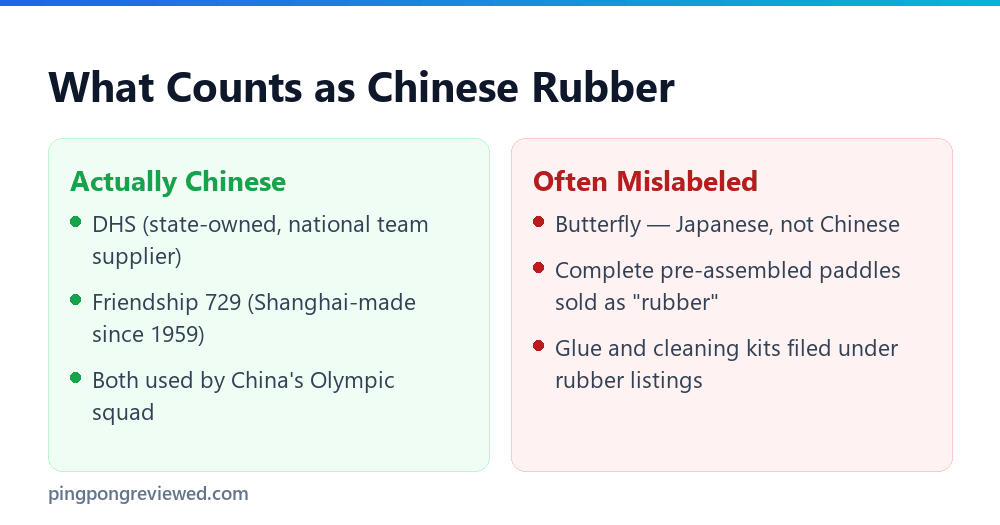
China has dominated world table tennis for decades, and its rubber brands are a big reason why. But search “Chinese ping pong rubber” on Amazon and you’ll find plenty of listings that mix in Japanese, German, and no-name brands under the same label. We checked every product against its actual country of origin and kept only the genuine article: DHS and Friendship 729, the two brands that supply China’s own national team.
Both are ITTF-approved and both are the real rubber Chinese provincial and national players train on, not tourist-market knockoffs with a Chinese-sounding name slapped on the packaging.
Table of Contents
How We Checked Each Product
The original version of this list included ten products under a “Chinese rubber” title, but only some were actually rubber sheets and only some of those were actually made by a Chinese company. We went through every listing individually: confirmed each product page against the manufacturer’s real country of origin, dropped anything that was a complete pre-assembled paddle rather than a bare rubber sheet, dropped glue and racket listings that had been filed under the same category, and verified every remaining ASIN was still live and in stock before publishing this update. What’s left is four sheets, each one genuinely manufactured by a Chinese table tennis company.
Why Brand Origin Actually Matters Here
This isn’t nationalism for its own sake. DHS and 729 rubber is formulated specifically to pair with the tackier, harder poly balls used in Chinese domestic competition, which is also what the ITTF’s current 40mm poly ball plays like worldwide since the 2014 material switch. That’s a real technical reason to reach for these two brands over a generic western tensor sheet, not just a marketing angle.
A Short History of DHS and 729
DHS was founded in Shanghai in 1959 and has been the Chinese national team’s official equipment supplier for decades, which means every DHS sheet sold on Amazon is built to the same formula elite Chinese players actually train on, not a retail-only version. Friendship 729, also Shanghai-based and also dating back to 1959, occupies a similar role for club and provincial-level players — a step below DHS’s flagship national-team lineup on price, but still built by the same domestic manufacturing base that supplies Chinese competitive play. Both brands survived China’s transition from sponge-only rubber in the 1950s through the pips-in tacky-surface era that still defines their rubber today.
The 4 Genuine Chinese Rubber Sheets
1. DHS Hurricane 3-NEO — Best Overall
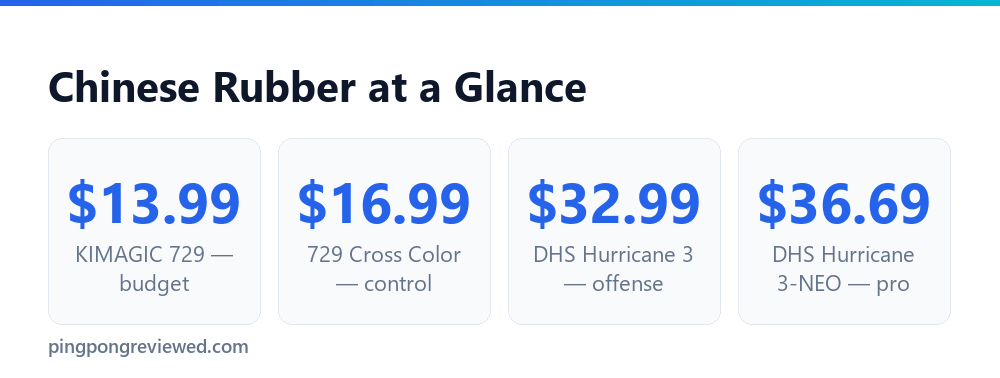
DHS Hurricane 3-NEO Table Tennis Rubber Sheet, $36.69, is the rubber the men’s national team actually trains on. It’s a tacky, high-tension sheet built for heavy forehand loops and it plays noticeably different from any European tensor rubber — more grip at contact, less rebound off the sponge. It rewards a fast, committed swing and punishes a passive one, so it’s not a beginner’s first rubber.
2. DHS Hurricane 3 — Best Classic Offensive Pick
DHS Hurricane 3 Table Tennis Rubber, $32.99, is the older, cheaper sibling to the NEO version. Slightly less tacky and a bit more forgiving, it’s the rubber most intermediate Chinese-style loopers start on before moving up to the NEO. Good forehand loop-drive pick if you want the DHS feel without the steepest price.
3. Friendship 729 Cross Color Series — Best All-Round
Friendship 729 Cross Color Series Table Tennis Rubber, $16.99, is a softer, more control-oriented sheet than either DHS pick. Friendship 729 has supplied Chinese clubs since 1959 and this pimples-in sheet is built for all-round play rather than pure attack — a better fit if your game leans more control-and-placement than full-power looping.
4. KIMAGIC Friendship 729 — Best Budget Pick
KIMAGIC Friendship 729 Table Tennis Rubber, $13.99, is a licensed budget line under the same 729 name, aimed at training and beginners rather than competition. It won’t out-spin the Cross Color sheet, but it’s a legitimate way to try authentic Chinese rubber’s tackier feel before spending $30+ on the DHS picks.
Across all four, expect a break-in period of two to three sessions before the tackiness settles into its normal playing feel — this is standard for Chinese rubber and isn’t a sign of a bad sheet. New DHS and 729 rubber often feels slightly stiffer and grippier straight out of the packaging than it will after regular use.
Pairing Chinese Rubber With Your Blade
DHS and 729 rubber is noticeably tackier than most European tensor sheets, which means it also mounts and behaves a little differently. A few things worth knowing before you buy:
- Pair with a slower blade first. Chinese tacky rubber on an already-fast carbon blade can feel uncontrollable for anyone below advanced level.
- Expect a break-in period. DHS Hurricane sheets play stiffer out of the packet and loosen up after a few sessions.
- Use water-based glue only. Speed glue is banned under current ITTF rules — see our rubber-glue guide for compliant options.
- Clean after every session. Tacky surfaces pick up dust fast, which kills the grip that makes this rubber worth buying in the first place.
One more thing worth knowing: Chinese tacky rubber is generally harder to control on the backhand than a softer European sheet, which is why a lot of players run a Chinese tacky sheet on the forehand and something softer and more control-oriented — even a non-Chinese rubber — on the backhand. That’s not cheating on the “authenticity” of your setup; it’s exactly how a lot of intermediate Chinese-style players actually configure their own paddles, forehand power paired with backhand control.
Keeping Chinese Rubber Playing Like New
Tacky Chinese rubber loses grip faster than smoother tensor sheets if it isn’t cared for, mostly from dust and skin oil building up on the surface between sessions. Wipe the sheet down with a dedicated rubber cleaner and a soft sponge after every session, not just when it visibly looks dirty — the grip loss happens well before the surface looks dull. Store your paddle in a rubber-protecting case rather than a bare bag pocket, since direct sunlight and heat degrade the sponge underneath faster than normal wear does. A well-maintained DHS or 729 sheet can hold most of its tackiness for four to six months of regular club play; a neglected one can lose noticeable grip within a few weeks.
Chinese vs. European Rubber: The Real Trade-Off
The defining difference is tackiness. Chinese rubbers are characteristically tacky, the topsheet is genuinely sticky to the touch, and they pair that with a comparatively hard sponge. European and Japanese tensor rubbers go the other way: a grippier but non-tacky topsheet over a softer, springier sponge that stores and returns more energy on its own.
That difference produces two genuinely distinct playing characters. A tacky Chinese sheet grips the ball longer at contact and generates enormous spin on a slow, brushing stroke, but it gives you less free speed, you supply the power. A European tensor supplies more of the speed itself through sponge catapult, which makes it more forgiving on a less-than-perfect stroke but harder to control on touch shots near the net.
- Chinese rubber suits players with well-developed stroke mechanics who generate their own power and want maximum spin control, and anyone playing a close-to-table looping game.
- European/Japanese tensors suit players who want the equipment to contribute speed, and anyone still building consistent stroke mechanics.
- The common hybrid is Chinese tacky rubber on the forehand for spin and a European tensor on the backhand for speed and ease, which is genuinely widespread rather than a compromise.
Worth stating plainly: Chinese rubber is harder to use well, not simply better. A player who hasn’t built the stroke speed to activate a hard sponge will find a tacky Chinese sheet slow and dead compared to a tensor, and will reasonably conclude it’s a worse rubber. It isn’t, it’s a rubber asking for something they aren’t supplying yet.
Tackiness, Humidity, and Upkeep
Tacky rubber has a practical downside worth knowing before you buy: the tack is a surface property, and surface properties degrade. Dust, humidity, and body oils all dull tackiness, and a Chinese sheet that has lost its tack has lost the specific thing you chose it for, more so than a tensor losing a little grip.
That makes cleaning less optional with Chinese rubber than with European. Players using tacky sheets typically clean after every session and often use a protective film between sessions, since film keeps dust off the tacky surface where it clings most readily. Our rubber cleaner guide covers products suited to tacky surfaces specifically, and it’s worth noting there that alcohol-based cleaners are the wrong choice on tacky rubber, they degrade exactly the surface layer you’re maintaining.
Humidity affects tacky rubber more noticeably too. In a humid hall a tacky sheet can feel slower and less grippy than the same rubber felt the week before, which surprises players who assume equipment performs identically everywhere. It isn’t a fault; it’s a known characteristic of the category and part of why some players in consistently humid climates prefer tensors.
Break-In and What a New Sheet Should Feel Like
Chinese rubber has a reputation for feeling wrong out of the packet, and that reputation is largely earned. A new tacky sheet often plays stiffer and deader than it will after a few sessions, as the sponge settles and the topsheet loses its factory finish. Judging a Chinese rubber on day one is genuinely misleading in a way that judging a tensor on day one usually isn’t.
Give a new sheet several sessions before forming a verdict, and be particularly wary of concluding it’s too slow early on. The speed of a hard-sponge rubber comes from your stroke acceleration, so the first sessions with one are as much about recalibrating your own stroke as about the rubber bedding in. Players switching from a springy tensor frequently under-hit for a week or two simply because the equipment stopped doing part of the work for them.
Longevity runs the other way from the break-in impression. Tacky Chinese topsheets tend to lose their defining tack before the sponge is meaningfully worn, so the practical end of life is usually ‘the tack has gone’ rather than ‘the sponge is dead’. That is worth knowing because it means diligent cleaning genuinely extends usable life here more than it does on a non-tacky European sheet. A player who wipes the sheet after every session can reasonably expect to get materially more playing life from the same rubber than one who does not, which is simply not a claim you could make nearly as strongly about a European tensor sheet.
A Note on Boosting
Any honest discussion of Chinese rubber has to mention boosting, the practice of applying oils to the sponge to increase its springiness and extend the rubber’s lively period. It’s widely discussed in the context of Chinese rubbers specifically because their hard sponges benefit most from it.
The important point for anyone reading this as a buying guide: boosters using volatile organic compounds have been banned in sanctioned ITTF competition for many years, and equipment is subject to testing at that level. If you play only recreationally it’s a non-issue, but if you have any intention of entering sanctioned events, treat boosting as something to understand rather than something to adopt, and check current rules with your governing body rather than relying on forum consensus.
Practically, none of the rubbers on this page require boosting to work as intended. They’re sold and reviewed unboosted, and that’s how they’re assessed here.
There’s a related point worth separating out, because the two get confused: some modern Chinese rubbers are sold as factory-tuned versions, where the manufacturer has already treated the sponge before sale. That is a different thing from a player boosting a sheet themselves, and factory-tuned sheets sold as ITTF-approved are legal for sanctioned play. If you want the livelier feel without any of the compliance questions, buying a factory-tuned version is the straightforward route rather than treating a standard sheet yourself.
For a recreational or club player with no tournament ambitions, the honest summary is that this whole topic matters far less than it appears to from online discussion. An unboosted sheet from any of the options on this page will comfortably outlast your ability to notice the difference, and time spent on stroke mechanics returns considerably more than time spent on sponge chemistry. If you are genuinely unsure whether any of this applies to you, that itself is a reliable indication that it does not yet, and that a standard unboosted sheet is the right purchase.
Frequently Asked Questions
Is DHS or Butterfly better for spin?
DHS Hurricane rubber generates more raw tackiness-driven spin on a committed loop, but Butterfly’s Tenergy line is more forgiving and easier to control for players who haven’t built a full loop swing yet. Neither is objectively “better” — they suit different styles.
Why do some “Chinese rubber” listings include Butterfly products?
Butterfly is a Japanese company, not Chinese. Some Amazon listings group Asian table tennis brands together loosely, which is how Japanese and German rubber ends up mislabeled as Chinese in generic roundup posts.
Do I need a special glue for DHS or 729 rubber?
No — any current water-based table tennis glue works. Older high-VOC speed glues that were once paired with Chinese rubber for extra spin are banned under ITTF rules and shouldn’t be used.
Is Chinese rubber legal in ITTF competition?
Yes. Both DHS and Friendship 729 sheets used in this guide are ITTF-approved, the same certification every tournament-legal rubber carries regardless of country of origin.
What sponge thickness should a beginner choose?
Start around 1.8-2.0mm. Chinese tacky rubber already plays faster than most beginners expect, and a thinner sponge keeps the ball more controllable while you build a proper loop stroke.
Can I mount Chinese rubber on any blade?
Yes, standard rubber sheets fit any blade sized for regulation paddles. The bigger question is whether your blade’s speed rating suits a tackier, higher-tension sheet — pair it with an all-round or control blade if you’re new to this rubber style.
How long does Chinese rubber last before it needs replacing?
Most club-level players replace tacky Chinese rubber every three to six months of regular play, sooner if you notice the surface getting shiny or losing its grip on serves. Dust buildup speeds up the decline, which is why cleaning after every session matters more with tacky sheets than with smoother tensor rubber.
Should a beginner start with DHS or 729?
729 is the gentler entry point. The Cross Color and KIMAGIC sheets in this guide are both softer and more forgiving than either DHS pick, which makes them easier to control while you’re still building a consistent loop stroke. Move to DHS Hurricane once your technique catches up to the rubber.
As an Amazon Associate, we earn from qualifying purchases through links on this page.

Ping Pong Reviewed is an equipment review site covering table tennis and baseball gear. Specifications are checked against manufacturer listings, and prices against live retail pages, before publication.