Yasaka Rakza 7 Review: Real Specs, Prices and the Listing Error
Yasaka Rakza 7 is the rubber people reach for when Tenergy costs too much. It sits in the same offensive category. But it lands at roughly half the price, and it has been a standing recommendation for well over a decade.
But there is a wrinkle worth knowing first. Yasaka’s own specifications and the ones printed on Amazon listings do not match. So this review starts with the maker’s numbers. Then it explains where the other set came from, and who the rubber actually suits.
Short answer: Rakza 7 is a well-balanced offensive rubber with high spin, medium arc and a medium-hard sponge. Yasaka rates it 87 for speed and 88 for spin out of 100. Prices run from about $37.69 for red in max up to around $50 for other colour and thickness combinations. If you want more dwell time and a higher arc, the Soft version is the better pick.
Table of Contents
Yasaka Rakza 7 Specifications
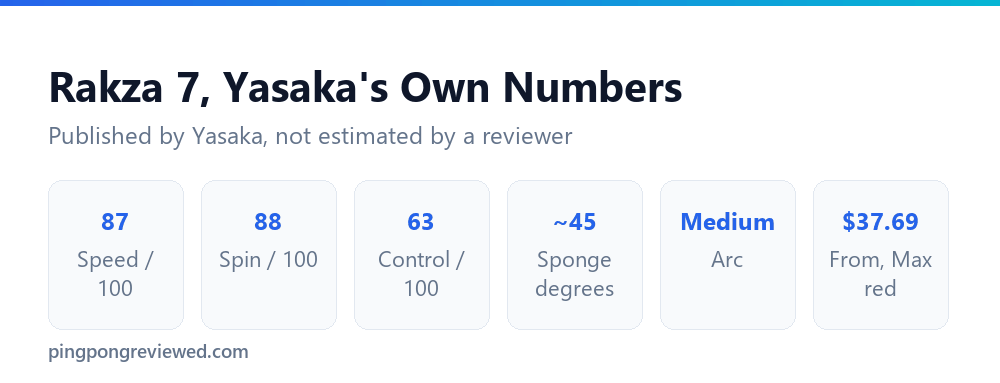
These are Yasaka’s published figures, taken from their product page. But they rate on a scale of 100 rather than 10. So the numbers look larger than ratings you may know from other brands.
Yasaka calls it a well-balanced offensive rubber that blends spin, speed and control. The topsheet is high in natural rubber, and that is what produces grip. Then the medium-hard sponge underneath keeps the ball from flying off on softer contacts.
Why Rakza 7 Has Two Different Spec Sheets
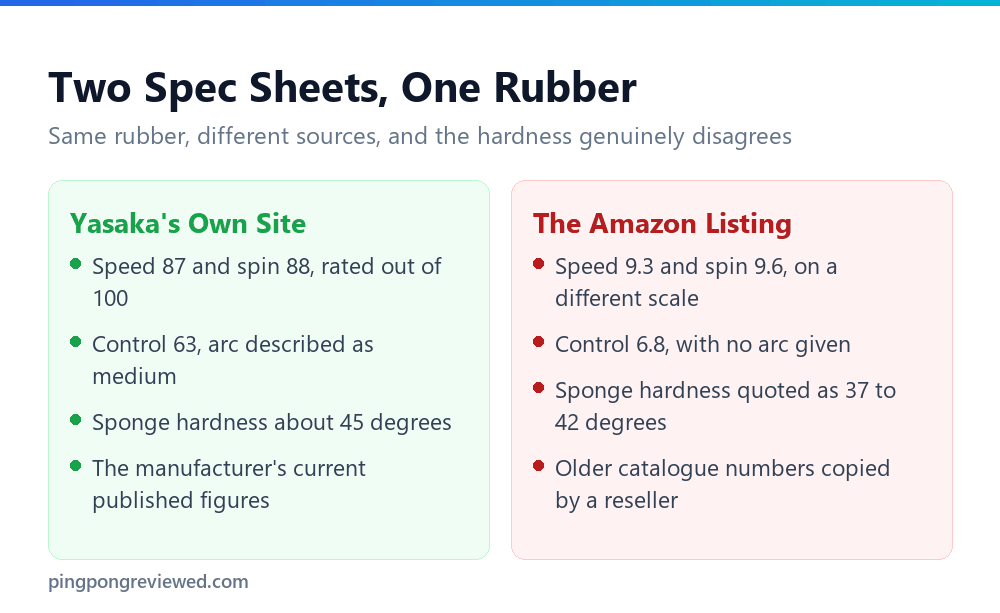
Open the Amazon listing for Rakza 7 and you will find a different set of numbers printed in the product bullets. Speed 9.3. Spin 9.6. Control 6.8. Sponge hardness 37 to 42 degrees.
Two of those are just a scale difference. Yasaka now rates out of 100. But the listing rates out of 10. So 9.3 and 87 describe the same speed on different scales, even if they do not convert neatly.
The hardness figure is a genuine disagreement, though. Yasaka currently says about 45 degrees. The listing says 37 to 42. Those describe meaningfully different sponges, and the gap is too large to be a rounding difference.
⚠️ Watch out: The most likely explanation is age. Rakza 7 has been in production since around 2010, and resellers frequently copy specification text from an old catalogue and never revisit it. When a marketplace listing and the manufacturer disagree, trust the manufacturer, and treat the listing bullets as marketing copy rather than data.
This matters more than it sounds. Sponge hardness is the number players use to judge whether a rubber suits them. Also, a 40 degree sponge and a 45 degree sponge feel different in the hand. So buying on the listing figure and receiving the real product is a recipe for disappointment.
What Yasaka Rakza 7 Costs
Rakza 7 is sold by colour and thickness as separate items, and the prices vary more than you might expect between them. These were the figures at the time of writing.
The red max sheet was clearly the cheapest. Also, stock was thin at four units when checked. So the spread is worth a minute of your time. Because buying red rather than black on one wing can save over ten dollars for the identical rubber.
For context, a sheet of Butterfly Tenergy 05 costs $79.99 direct from the manufacturer. That makes Rakza 7 roughly half the price, which is the whole reason it appears on so many shortlists.
What the 45 Degree Sponge Rating Actually Tells You
Yasaka quotes sponge hardness in degrees. That is genuinely useful, because it is the same style of measurement German makers use. So a Rakza 7 at about 45 degrees compares sensibly against a Tibhar or andro rubber quoted the same way.
Roughly speaking, sponges below 40 degrees are soft, the mid-40s are medium-hard, and anything approaching 50 is hard. At about 45, Rakza 7 sits in the middle of the offensive range. It is firm enough to hold up under a fast loop. But it is not so firm that a slower contact simply skids.
Rakza 7 Against Rakza 7 Soft
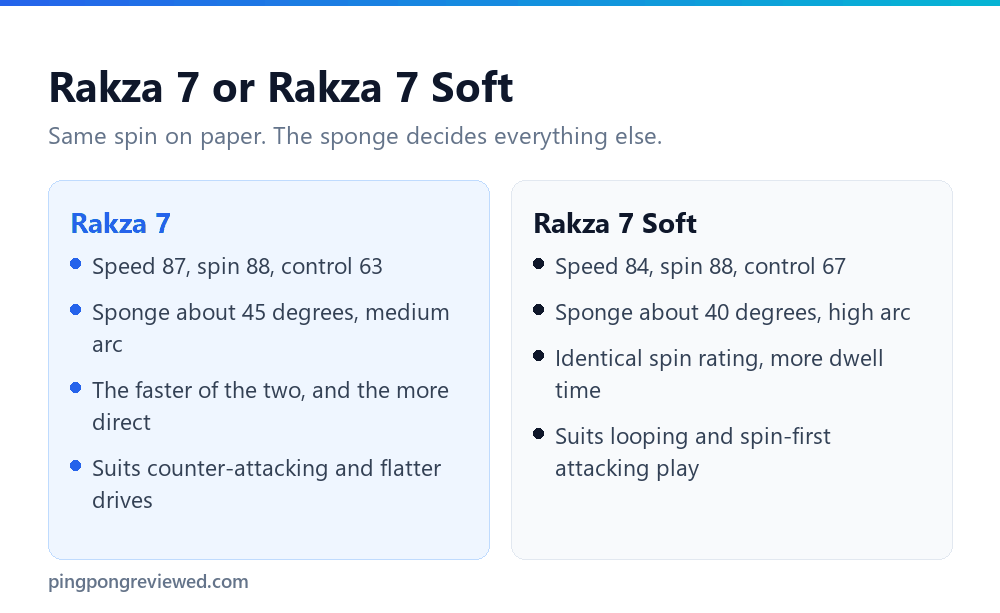
The Soft version is the other rubber most buyers end up weighing, and Yasaka’s own numbers make the trade unusually clear.
The spin rating is identical at 88. So the choice is not about which rubber spins more. Rather, it is about how the sponge behaves while you produce that spin.
The softer sponge gives more dwell time. So the ball sits on the rubber fractionally longer before leaving. That produces the higher arc and the extra four points of control. But it costs three points of speed. So Soft suits players who brush and loop, while the standard version suits players who drive through the ball.
💡 Pro tip: A common setup is the harder sheet on the forehand and the softer one on the backhand. The forehand usually wants power and the backhand usually wants control, and there is no rule requiring both sides to match.
Which Rakza 7 Thickness to Choose
Rakza 7 comes in 1.8mm, 2.0mm and max. Most offensive rubbers offer only two options, so the extra choice is genuinely useful.
- Max gives the most sponge, so the most speed and the most spin potential. It is the standard pick for an attacking forehand.
- 2.0mm trades a little of that for a more controlled feel. A sensible middle option, and a common backhand choice.
- 1.8mm is the most controllable and the least explosive. Worth considering on the backhand if you block more than you attack.
Thinner sponge also means a lighter sheet. That matters if your blade is already heavy. Because total bat weight is what you feel when changing between wings.
Who Yasaka Rakza 7 Suits
Yasaka positions this as a rubber for players moving from all-round equipment to something more offensive. That is a fair description, and it explains the control rating of 63.
- ✓You are stepping up from a beginner or all-round rubber
- ✓You want high spin without paying premium-tier prices
- ✓You play a looping or counter-attacking game
- ✓You want a rubber that behaves predictably rather than dramatically
- ✕You are still learning basic strokes, where something slower is better
- ✕You want maximum speed above all, since faster sheets exist
- ✕You need the very highest spin ceiling for advanced play
- ✕You want a tacky Chinese-style topsheet, which this is not
Reviewers consistently call it linear. What you put in is what comes out. But that is a real virtue for an improving player. Because a rubber that behaves the same way every time teaches you more than one that occasionally does something spectacular.
Getting the Most Out of a Rakza 7 Sheet
Tensor rubbers lose tension over time whatever you do. But the topsheet is what you can actually protect, and grip is what produces the spin you paid for.
- ✓Clean it with a proper rubber cleaner and a sponge after sessions
- ✓Use protective film on both sides between sessions
- ✓Store the bat in a case, away from heat and direct sun
- ✓Let it dry fully before applying film
- ✕Use household cleaners or alcohol, which strip the surface
- ✕Leave the bat in a hot car, which kills a topsheet quickly
- ✕Use boosters or tuners, which remain prohibited under ITTF rules
- ✕Peel and reglue the same sheet repeatedly
What Inverted Tensor Actually Means
Yasaka lists the surface type as inverted tensor. Both halves of that phrase matter, and neither is obvious.
Inverted describes which way the pimples face. On an inverted rubber the pimples point inward, against the sponge, so the smooth side faces the ball. That smooth face is what grips and produces spin. Pimples-out rubbers do the reverse, and they behave completely differently.
Tensor describes how the sheet is built. The topsheet is held under tension during manufacture, so it stretches and snaps back harder on contact. That built-in tension is what generates speed without the player adding anything.
This matters for a practical reason. Tensor rubbers lose tension slowly from the day they are made. That happens whether you play with them or not. So an old sheet in a drawer is not a fresh sheet. Buy tensor rubber when you intend to use it, rather than stocking up.
📊 Note: Tension is also why boosters exist and why they are banned. A booster artificially restores or increases that tension, which the ITTF prohibits. If a seller offers a pre-boosted sheet, that bat will not pass racket control.
Pairing Rakza 7 With a Blade
Yasaka does not prescribe a blade for this rubber, which is normal outside the Butterfly ecosystem. But the sponge hardness gives you a reasonable steer.
At about 45 degrees, Rakza 7 is medium-hard. So it pairs comfortably with an all-round or offensive wood blade, where the blade supplies some flex and the rubber supplies the speed. That is the combination most players stepping up from all-round equipment already own.
Putting it on a very stiff carbon blade is possible. But it changes the character. A stiff blade plus a medium-hard sponge gives a fast, direct setup with less feel at slow speeds. Some players want exactly that. Still, if you are developing touch around the net, it is the harder road.
💡 Pro tip: If you already own a blade and are changing only the rubber, change one side at a time. Swapping both at once makes it impossible to tell which change caused what, and you learn nothing about your own preferences.
Gluing a Rakza 7 Sheet
Rakza 7 is sold as a bare sheet, so you glue it yourself. Water-based glue is the standard now, and it is what tournament rules expect.
- Spread thin on both surfaces. One thin layer on the sponge and one on the blade. Thick glue adds weight and dries unevenly.
- Wait until touch-dry. The glue should feel dry to a fingertip rather than tacky. Rushing this is the most common mistake.
- Roll it down from one edge. Lay the sheet from one side to the other rather than dropping it flat, which traps air bubbles.
- Trim after it has set, not before, using the blade edge as your guide and a fresh blade rather than scissors.
Take your time on the trim. A ragged edge catches on bat cases and starts the peeling that eventually lifts a corner mid-match.
Knowing When a Rakza 7 Sheet Is Finished
Rubber does not fail suddenly. It fades, and the fade is gradual enough that players routinely keep using a dead sheet without noticing.
The clearest sign is the topsheet going matte where you contact the ball most. A fresh sheet has an even sheen across the face. But a worn one develops a duller patch. It usually sits slightly off-centre, toward your natural contact point.
The second sign shows up on serve return. Heavy backspin is the shot with the least margin, so it is where a tired topsheet fails first. If serves you used to handle are suddenly dropping into the net, check the rubber before you rebuild your technique.
At under $50 a sheet, replacing Rakza 7 is not the financial decision a premium rubber is. So that is part of its appeal. A player who trains several times a week can run fresh rubber year-round without much thought about cost.
Yasaka Rakza 7 Questions, Answered
How much does Yasaka Rakza 7 cost?
It varies by colour and thickness. Red in max thickness was the cheapest at $37.69, while black in max was $49.98 and 1.8mm red was $46.17. The identical rubber can differ by more than ten dollars between variants, so it is worth comparing.
What is the sponge hardness of Rakza 7?
Yasaka publishes it as about 45 degrees, which is medium-hard. Some Amazon listings state 37 to 42 degrees, which appears to be older catalogue data. The manufacturer’s current figure is the one to trust.
Is Rakza 7 better than Tenergy 05?
They are hard to compare directly because each manufacturer uses its own rating scale. What is comparable is price: Rakza 7 runs under $50 while Tenergy 05 is $79.99 per sheet from Butterfly. Rakza 7 is widely treated as the value alternative in the same offensive category.
What is the difference between Rakza 7 and Rakza 7 Soft?
Both are rated 88 for spin. The Soft has a roughly 40 degree sponge against about 45, giving a higher arc, more dwell time and four more points of control, at the cost of three points of speed.
Is Rakza 7 good for beginners?
It is better suited to players stepping up from all-round equipment than to complete beginners. With a control rating of 63 it is an offensive rubber, and a slower sheet teaches basic strokes more effectively.
Which thickness of Rakza 7 should I buy?
Max for an attacking forehand, 2.0mm as a balanced middle option, and 1.8mm if you block more than you attack or want to keep the bat light.
Is Rakza 7 ITTF approved?
Yes, it is a standard inverted rubber used in competition. As with any sheet, check that the one you receive carries the ITTF logo, and remember that one side of the bat must be black while the other is red, pink, purple, green or blue.
Is Rakza 7 tacky?
No. It is a grippy tensor rubber with a high natural rubber content, not a tacky Chinese-style topsheet. It generates spin through friction and sponge action rather than through stickiness.
The Verdict on Yasaka Rakza 7
- →Yasaka rates it 87 speed, 88 spin and 63 control out of 100, with a medium-hard sponge around 45 degrees.
- →Prices run from about $37.69 to $49.98 depending on colour and thickness, which is roughly half what a sheet of Tenergy 05 costs.
- →The Amazon listing specs disagree with Yasaka’s. Trust the manufacturer.
- →Rakza 7 Soft has the same spin rating with a softer sponge, a higher arc and more control.
- →It suits players moving up from all-round equipment, not complete beginners.
Rakza 7 has stayed on recommendation lists for over a decade. That is because it does the unglamorous thing well. It spins heavily, behaves the same way every time, and costs about half what premium sheets do. So for a player whose technique is improving faster than their budget, that combination is hard to argue with.
As an Amazon Associate, we earn from qualifying purchases through links on this page.

Ping Pong Reviewed is an equipment review site covering table tennis and baseball gear. Specifications are checked against manufacturer listings, and prices against live retail pages, before publication.