Butterfly Tenergy 05 Review: The Real Cost and Official Specs

Butterfly Tenergy 05 has been the reference topspin rubber since 2008. It is still the sheet almost every other rubber gets measured against. But the question most people arrive with is not whether it is good. It is whether it is worth eighty dollars a side.
That is the number most Tenergy 05 reviews leave out. So this page starts there. Then it works through Butterfly’s own specifications, the hardness figure that gets misquoted everywhere, and the honest case for buying something else.
📊 Note: What this review is. We have not played 500 hours on this sheet, and we are not going to describe a feel we have not felt. What follows is verified pricing and stock, Butterfly’s own specification numbers, the full Tenergy lineup compared on those same numbers, and the buying decisions that follow from them. For subjective playtesting impressions, coaching sites that have genuinely hit with it for months are the better source, and we link one below.
Table of Contents
What Butterfly Tenergy 05 Costs Right Now
Butterfly sells Tenergy 05 through its own shop at $79.99 per sheet under SKU TN05. At the time of writing it showed as in stock with 329 units available, in black or red, in 1.7mm, 1.9mm and 2.1mm thicknesses.
One sheet covers one side of a bat. So a full Tenergy 05 setup means buying two. That puts the rubber alone at roughly $160, before you have spent anything on a blade. Sit with that figure before reading any performance description. Because it changes who this rubber is aimed at.
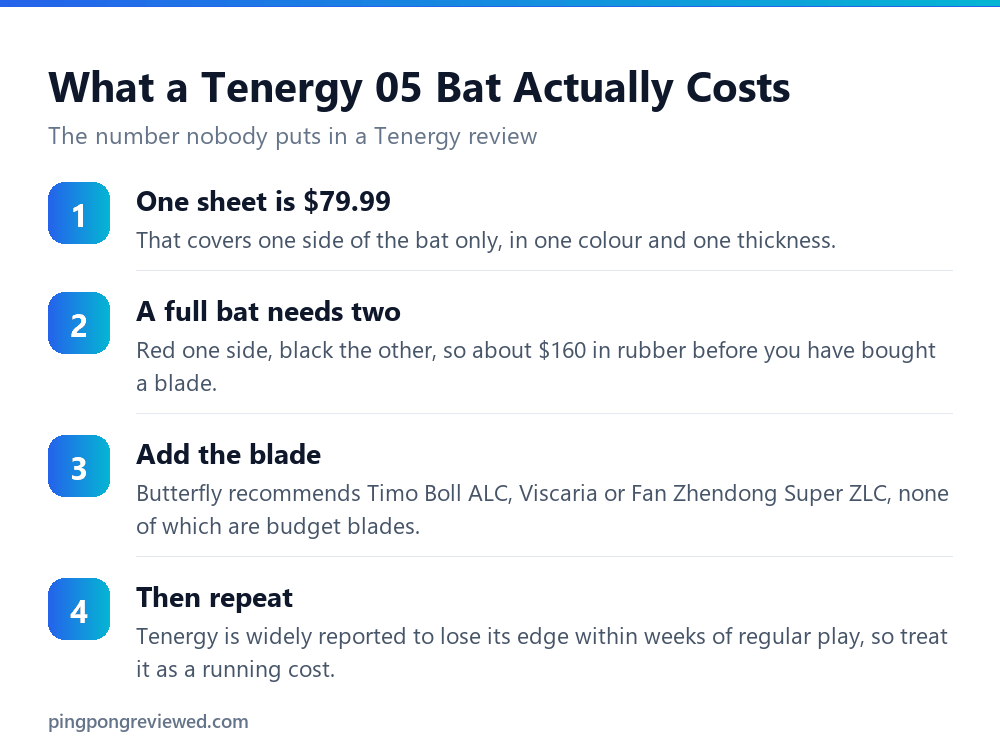
It is also a running cost rather than a one-off. Tenergy is widely reported to play fastest straight out of the packet. Then it loses some of that speed within the first few weeks. After that it settles and holds steady until it dies. So players who train several times a week replace sheets far more often than casual players expect.
⚠️ Watch out: Tenergy is one of the most counterfeited rubbers in table tennis, precisely because it is expensive and in demand. Buy from Butterfly directly, from an established table tennis retailer, or from a seller with a long rating history. A Tenergy 05 sheet priced well under the going rate is the clearest warning sign there is.
The Official Butterfly Tenergy 05 Specifications
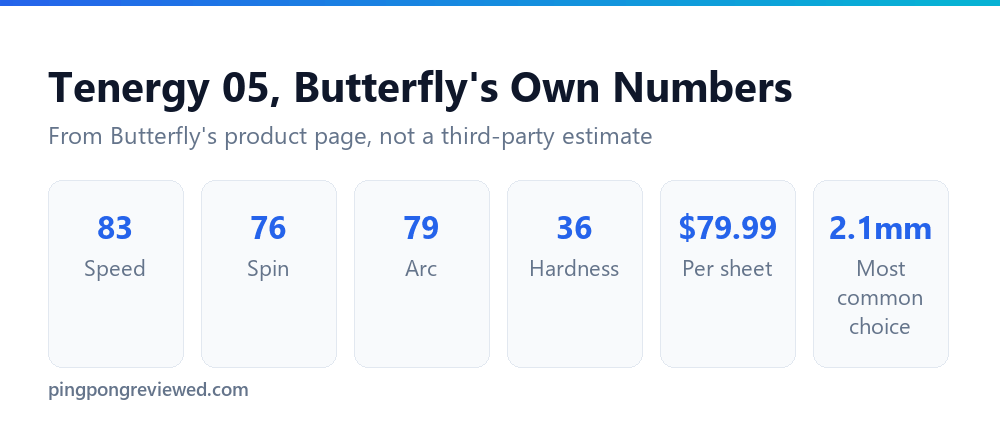
Butterfly publishes four numbers for every rubber it makes. These are theirs for Tenergy 05, taken from their own product page rather than from a reviewer’s estimate.
The spin figure of 76 is the whole story of this rubber. It is the highest Butterfly publishes across the Tenergy family. Every other trait follows from the design choices that produce it. Also, the arc rating of 79 is unusually high. So the ball loops over the net with room to spare rather than travelling flat.
The Tenergy 05 Hardness Number Everyone Misquotes
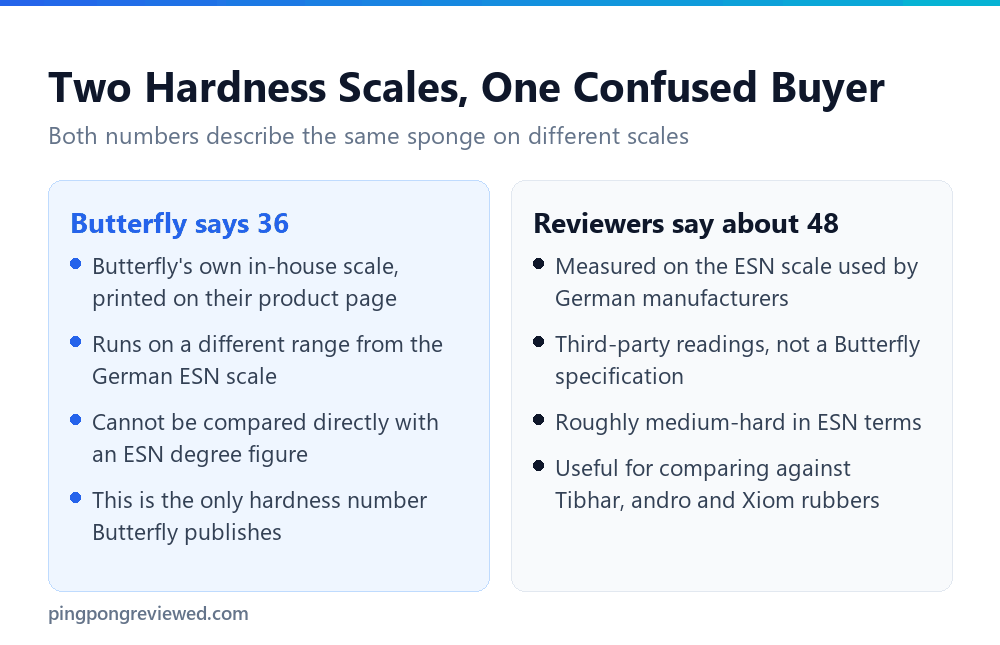
Search for Tenergy 05 hardness and you will find two different answers. Butterfly’s own page says 36. Review sites routinely say around 48 degrees. Both are describing the same sponge, and neither is wrong.
The reason is that they use different scales. Butterfly publishes hardness on its own in-house scale. That runs on a different range from the ESN scale German makers use. Tibhar, andro and Xiom rubbers are quoted in ESN degrees. So a reviewer comparing Tenergy against them converts to ESN to make the comparison mean something. But that converted figure is a third-party reading, not a Butterfly specification.
The takeaway is simple. Use Butterfly’s numbers to compare Butterfly rubbers against each other. That is what they are for. Then use ESN figures when weighing a Tenergy against a Tibhar or an andro. Mixing the two scales in one comparison is where most of the confusion online starts.
Tenergy 05 Against the Rest of the Tenergy Line
Butterfly sells several Tenergy variants and they are easy to mix up, particularly since the names differ by only a digit or two. Every figure in this table comes from Butterfly’s own published specifications, so the numbers are directly comparable.
Two things stand out. First, Tenergy 64 is the faster rubber. So anyone buying 05 expecting the quickest sheet in the range has picked the wrong one. Second, the FX version is not simply a softer 05. Butterfly’s own numbers put its spin at 64 against 05’s 76. That is a big drop rather than a minor trade.
Rozena deserves a mention. It is the sheet many players should look at instead. It uses the same Spring Sponge technology and posts the same speed rating of 83. But it gives up six points of spin. It also costs far less than Tenergy. So it is the obvious first step for anyone curious about the Butterfly feel without committing $160 to a bat.
Who Butterfly Tenergy 05 Is Actually For
Butterfly’s own positioning is specific: offensive all-round play, near and far from the table, aimed at loopers who want easy power and spin. That matches how the rubber is generally described by people who play with it.
- ✓You already loop consistently and want more spin from the same stroke
- ✓You play an attacking game built on topspin rather than flat hitting
- ✓Your technique is settled enough that equipment is the limiting factor
- ✓You can absorb replacing sheets as a running cost, not a one-time purchase
- ✕You are a beginner still building a consistent stroke
- ✕You want the fastest possible rubber, which is Tenergy 64 in this line
- ✕You mostly block and push rather than attack
- ✕The $160 for a full bat would be most of your equipment budget
The honest warning for improvers is simple. A high-arc, bouncy rubber is unforgiving of a stroke that is not yet grooved. It amplifies whatever you do, including the mistakes. So a player whose technique is still moving around improves faster on something slower. Then they can move to Tenergy later, having wasted nothing.
The short version: Tenergy 05 is a genuinely excellent topspin rubber and an expensive one. If you loop well and spin is the thing you want more of, it earns its price. If you are still learning to loop, it will cost you $160 to make your bat harder to control.
Which Tenergy 05 Thickness to Buy
Butterfly offers Tenergy 05 in 1.7mm, 1.9mm and 2.1mm. The thickness refers to the sponge under the topsheet, and it changes the character of the sheet more than most buyers expect.
- 2.1mm is the standard choice for attacking play. More sponge means more of the springy effect the rubber is built around, so it is the thickness most offensive players use.
- 1.9mm trades a little of that for a slightly more controlled feel. A reasonable middle option if the maximum thickness feels like too much.
- 1.7mm is the most controllable and the least explosive. Worth considering on the backhand if you block more than you attack on that wing.
💡 Pro tip: Many attacking players run 2.1mm on the forehand and something thinner on the backhand, because the two wings are doing different jobs. There is no rule that both sides have to match, and buying one sheet of each is also how you try a thickness without committing to it twice.
Blades and Glue for Tenergy 05
Butterfly names three of its own blades as the recommended pairings: Timo Boll ALC, Viscaria, and Fan Zhendong Super ZLC. All three are offensive composite blades, which is consistent with the kind of player the rubber is aimed at. None of them is cheap, which is worth factoring into the total.
You are not obliged to buy Butterfly wood to use Butterfly rubber. Any offensive blade of similar stiffness will work. The recommendation reflects what the rubber was designed around rather than a compatibility requirement, and our guide to choosing a blade and rubber together covers how to judge that pairing yourself.
For gluing, Butterfly specifies Free Chack II, its own water-based glue. Water-based glues are the standard now and are what tournament rules expect. Spread thin, let both surfaces go touch-dry rather than tacky, and roll the sheet down from one edge to avoid trapping air.
Cheaper Alternatives Worth Considering First
If the price is the sticking point, three routes are worth weighing before spending $160 on rubber.
- Butterfly Rozena. Same Spring Sponge technology, same published speed of 83, spin of 70 against Tenergy’s 76, at a much lower price. The most direct way to find out whether the Butterfly feel suits you.
- One sheet instead of two. Put Tenergy on the forehand where the spin matters most and something cheaper on the backhand. Plenty of serious players do exactly this.
- A thinner sheet. 1.7mm costs the same but is more forgiving, which makes it a gentler introduction if you are not sure your stroke is ready.
There is also the question of whether to skip Tenergy entirely and look at Dignics 05, Butterfly’s newer and more expensive line. Dignics is the successor technology rather than a replacement, and Tenergy 05 remains in production and widely used. Going straight to Dignics makes the budget problem larger, not smaller.
Why Tenergy 05 Exists: The Speed Glue Ban
Tenergy makes far more sense once you know what it replaced. For decades, serious players used speed glue, solvent-based adhesive that soaked into the sponge and made it expand. The effect was dramatic: more speed, more spin, and the distinctive high-pitched sound of a freshly glued bat. Players reglued before matches, sometimes between matches.
The solvents were volatile organic compounds. The health case against breathing them in a closed sports hall was strong. So the ITTF banned them, effective 1 January 2008 for junior events and 1 September 2008 for all other ITTF events. A zero tolerance racket testing programme came with it. Overnight, the effect every attacking player had built their game around was illegal.
Tenergy arrived in that same period. High Tension is the answer to exactly that problem. Rather than the player adding tension with glue before a match, the tension is built into the sheet during manufacture. Then it stays there. So that is what you are paying for. It is also why Tenergy was received as a real change rather than another incremental rubber.
It also explains the price. A rubber built to hold permanent tension is a more involved product. The alternative expects the player to supply the effect with a brush and a tin. Still, whether that engineering is worth $79.99 to you is a fair question. But the cost is not arbitrary.
📊 Note: Boosters and tuners, which do something similar to speed glue, remain prohibited under ITTF rules. If you compete, treat any product that claims to restore or increase a rubber’s tension as something that could get your bat failed at control.
Spring Sponge and High Tension, Explained
Butterfly puts both terms on the Tenergy 05 packaging and neither is self-explanatory. They describe two separate parts of the sheet.
High Tension refers to the topsheet, and how the rubber is held under tension during manufacture. A tensioned topsheet stretches and snaps back harder on contact. So it generates the extra speed and spin that speed glue used to provide. This is the part that replaced the glue effect.
Spring Sponge is the layer underneath. It is a large-celled sponge designed to compress on impact and release that energy back into the ball. The sensation players describe as the ball sinking into the sheet before being thrown forward comes from this layer rather than from the topsheet.
The two work together. This is where the pimple geometry matters. The pimples on the underside of the topsheet are numbered. Code 05 is the arrangement Butterfly chose for maximum spin. So change the geometry and you get a different rubber with the same technologies. That is precisely what Tenergy 64 and Tenergy 80 are.
Does Red or Black Tenergy 05 Play Differently?
This question comes up constantly. The honest answer is that the difference is small enough to argue about rather than measure easily. The pigments in the two colours are not identical. So players have claimed for years that black sheets play a little faster or harder than red ones across various brands.
Butterfly publishes one set of specifications for Tenergy 05 covering both colours. Speed 83, spin 76, arc 79, hardness 36 apply whichever you buy. If there is a difference, it is not one the manufacturer considers worth quantifying.
But you do have to get the rule right. One side of a legal bat must be black. The other can be red, and since 1 October 2021 it can also be pink, purple, green or blue. So if you are covering both wings, you need black plus one of those. Buying two sheets of the same colour leaves you with an illegal bat for competition.
Making a $79.99 Sheet Last
Given the price, care is worth more attention here than on a cheap sheet. The enemy is oxidation and dirt. A topsheet loses grip as it picks up dust, and as the surface ages in contact with air. But grip is exactly the property you paid for.
- ✓Wipe the sheet with a dedicated rubber cleaner and a sponge after sessions
- ✓Use a protective film on both sides between sessions to slow oxidation
- ✓Store the bat in a case, out of direct sun and away from radiators
- ✓Let the sheet dry fully before applying a protective film
- ✕Clean it with household detergents or alcohol, which strip the surface
- ✕Leave the bat in a hot car, which is one of the fastest ways to kill a topsheet
- ✕Use boosters or tuners, which are prohibited under ITTF rules
- ✕Peel and reuse a sheet repeatedly, since each removal stresses the sponge
Knowing when to replace it is the harder call. Look for a topsheet gone visibly matte where you contact the ball most. Then for spin that no longer bites on serve return, and a duller sound at contact. Many players notice the drop first on heavy backspin serves. Because that is the shot with the least margin for a tired topsheet.
💡 Pro tip: Rotate the bat’s orientation slightly between sessions if you always contact the ball in the same spot. Wear on an inverted rubber is concentrated in a surprisingly small area, and spreading it out buys real time on an expensive sheet.
How to Spot a Counterfeit Tenergy 05
Tenergy is expensive, widely wanted and instantly recognisable. So it is a frequent target for counterfeiting. A fake usually plays like an ordinary mid-price rubber. That means the loss is the money rather than anything dangerous. But eighty dollars is a meaningful loss.
- Price is the loudest signal. Butterfly’s own shop sells it at $79.99. A sheet offered at a fraction of that is either fake, very old stock, or not what the listing says.
- Check the ITTF logo and the Butterfly branding on the sheet itself. Counterfeits frequently get the logo placement, font weight or spacing subtly wrong.
- Buy from the manufacturer or an established table tennis retailer. Specialist shops have a reputation to protect and buy through official distribution.
- Be wary of sellers with no rating history on marketplaces, particularly where the listing photo is a generic product shot rather than the actual packaging.
Sheet Weight and What It Does to Your Bat
Tenergy 05 is not a light rubber. Reviewers commonly report an uncut sheet at around 49 grams, and two sheets plus a composite blade produces a bat that is noticeably head-heavy compared with a beginner setup.
That weight is not automatically a problem. A heavier bat carries more momentum through the ball. So it suits a looping game played away from the table. But it is a problem close to the table, where you rely on fast hand changes between wings. There the extra mass shows up as slower recovery.
If total weight is the concern, there are two usual fixes. Either a thinner sponge on the backhand, or a lighter blade. Neither means abandoning the rubber. Blade weights vary by ten grams or more between models. That is roughly the difference a thickness change makes on one side.
Butterfly Tenergy 05 Questions, Answered
How much does Butterfly Tenergy 05 cost?
Butterfly’s own shop lists it at $79.99 per sheet under SKU TN05. Since one sheet covers one side of the bat, a full Tenergy 05 setup costs roughly $160 in rubber before you add a blade.
What is the hardness of Tenergy 05?
Butterfly publishes it as 36 on their own in-house scale. Review sites commonly quote around 48 degrees, which is the ESN scale used by German manufacturers. Both describe the same sponge, and the two numbers are not interchangeable.
Is Tenergy 05 good for beginners?
Generally no. It is fast, bouncy and has a high arc, which amplifies whatever your stroke does, including errors. A beginner usually improves faster on a slower, more controllable rubber and can move to Tenergy once the technique is settled.
What is the difference between Tenergy 05 and Tenergy 05 FX?
FX has a softer sponge and, by Butterfly’s own numbers, notably less spin: 64 against 05’s 76, with arc dropping from 79 to 65. It is more forgiving, but it is not simply a softer version of the same rubber.
Is Tenergy 64 faster than Tenergy 05?
Yes. Butterfly rates Tenergy 64 at 87 for speed against 83 for Tenergy 05, with a flatter trajectory. Tenergy 05 wins on spin, at 76 against 64’s 70.
What thickness of Tenergy 05 should I buy?
2.1mm is the standard choice for attacking play and the most common. 1.9mm is slightly more controlled, and 1.7mm is the most forgiving, which some players use on the backhand while running 2.1mm on the forehand.
How long does Tenergy 05 last?
It plays fastest out of the packet and is widely reported to lose some speed within the first few weeks, then hold steady until it wears out. Players training several times a week replace sheets considerably more often than casual players do.
Which blade should I use with Tenergy 05?
Butterfly recommends the Timo Boll ALC, Viscaria, or Fan Zhendong Super ZLC. Any offensive blade of similar stiffness will work, since the recommendation reflects the design intent rather than a compatibility requirement.
Is Tenergy 05 ITTF approved?
Yes. It is a standard inverted rubber used at the highest levels of the sport and is legal for sanctioned competition, provided the sheet carries the ITTF logo and the bat has one black side and one clearly different side, which since October 2021 may be red, pink, purple, green or blue.
The Verdict on Butterfly Tenergy 05
- →It is the highest-spin rubber in the Tenergy line by Butterfly’s own numbers, at 76, and the high arc rating of 79 is what makes looping feel easy on it.
- →At $79.99 a sheet, a full bat is about $160 in rubber alone, and it is a repeating cost rather than a one-off.
- →It is not the fastest Tenergy. Tenergy 64 is, at 87 against 83.
- →Hardness 36 is Butterfly’s scale. The roughly 48 you see quoted is ESN, and the two cannot be compared directly.
- →Rozena is the sensible first stop for anyone who wants the Butterfly feel without the Tenergy price.
Tenergy 05 has held its position for well over a decade. That is because it does one thing better than almost anything else. It turns a good loop into a better one. So the claim is narrow, and it is real. But whether it is worth $160 depends on whether your loop is already good enough to notice.
As an Amazon Associate, we earn from qualifying purchases through links on this page.

Ping Pong Reviewed is an equipment review site covering table tennis and baseball gear. Specifications are checked against manufacturer listings, and prices against live retail pages, before publication.