Are Rubber Cleaners Legal in Table Tennis? What’s Allowed
Short version: yes, rubber cleaners are legal products, and no, you can’t use one at the table once a match has started. Those two facts don’t contradict each other, but they get run together constantly, which is where most of the confusion around this question actually comes from.
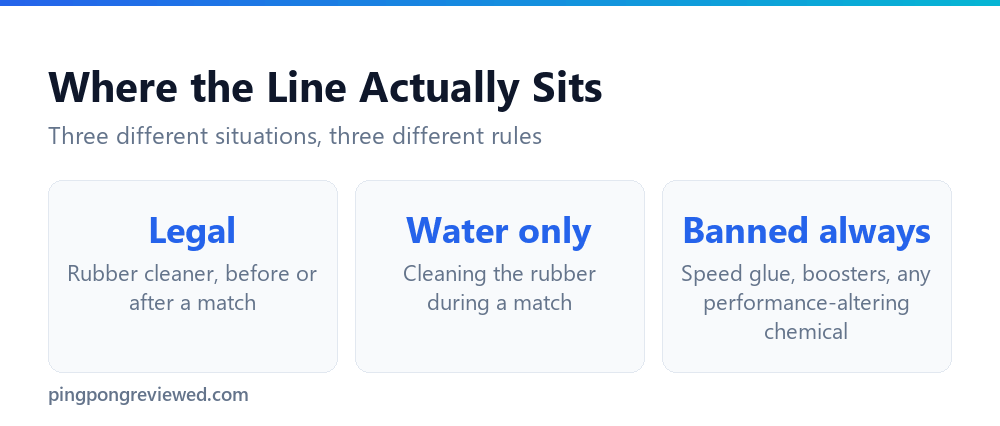
Short answer: Rubber cleaners themselves are not banned. You can use one whenever you want outside of an actual match — before a session, after practice, at home. During a sanctioned match, the rule tightens: rubber may only be cleaned with water, nothing else, once play has started. This is a different, narrower rule than the outright ban on speed glue and boosters, which apply at all times because they change what the rubber physically is, not just when you’re allowed to wipe it down. Verified against independent sources on 5 September 2026.
Table of Contents
The Question Behind the Question
Almost nobody asks this out of pure curiosity. Usually it’s a player who just bought a proper rubber cleaner, or is about to, and wants to know if they’ve bought something that’s going to get them disqualified. The honest answer is that the product itself was never the issue — when you use it is.
A rubber cleaner, in the specific sense the question means, is an aqueous solution built around mild detergents. Its job is removing dirt, sweat, and the fine grime that builds up on the surface of a rubber sheet after repeated use, restoring some of the tack and grip that grime otherwise dulls. That’s maintenance, not modification, and maintenance products aren’t what equipment rules are written to stop.
What the Rule Actually Restricts
The restriction that exists is specific and narrower than most people expect: during an actual match, a player may not clean their rubber with anything other than water. Not a spray, not a solution, not a wipe-on cleaner, however mild. Once play has started, water is the only substance allowed to touch the rubber between points, games, or the end changes built into the format.
Outside of that window, the rule doesn’t apply at all. Cleaning your rubber with a dedicated cleaner before you arrive at the table, between matches at a tournament in the practice area rather than at the table itself, or as routine maintenance at home, is completely normal and not restricted in any way. The rule is about the moment of use, not the product.
- ✓Clean rubber with a proper cleaner before a session or match
- ✓Use it as routine maintenance between tournaments
- ✓Wipe with water only once you’re actually at the table mid-match
- ✓Check your own event’s specific referee guidance if unsure
- ✕Apply any cleaner other than water once a match has started
- ✕Assume ‘gentle’ or ‘natural’ products are automatically exempt
- ✕Confuse a cleaning restriction with the separate glue/booster ban
- ✕Wait until you’re at the table to clean for the first time that day
Why This Gets Confused With the Speed Glue Ban
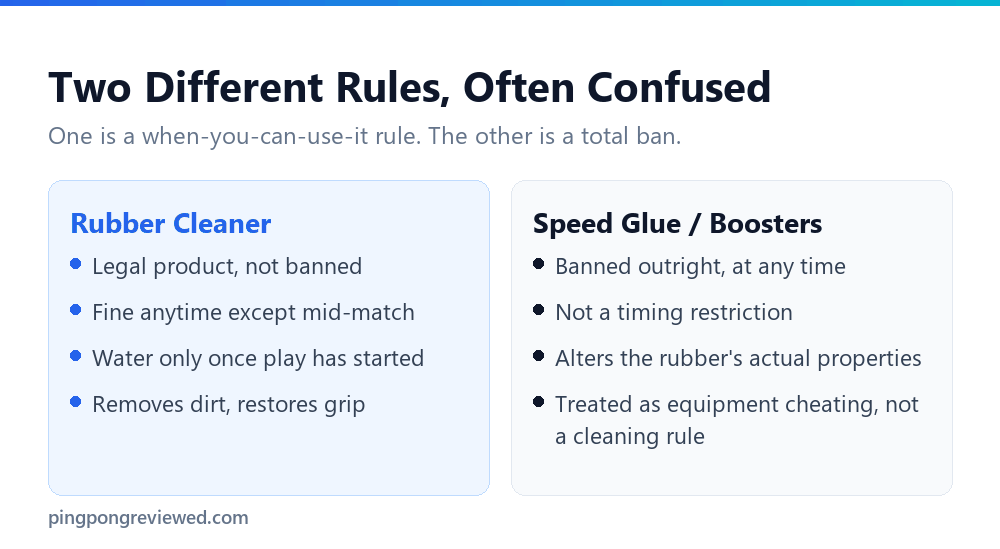
The other rule that comes up in the same breath is the ban on speed gluing and boosting — treating the sponge or rubber with a chemical that changes its actual playing properties, typically adding speed, tack, or elasticity beyond what the rubber has out of the box. That ban is total. It doesn’t matter when you do it, at the table or a week before a tournament; if the treatment alters the rubber’s properties, it’s banned, full stop.
A rubber cleaner is built to do the opposite of that: restore the rubber closer to its original, unmodified state by removing dirt, not add anything to it. That’s the real distinction, and it’s why the two rules land so differently — one is a timing restriction on an otherwise legal product, and the other is a permanent ban on a category of chemical treatment regardless of when it’s applied.
A Worked Example
Say you arrive at a tournament, and between your first and second matches you notice your rubber has picked up dust from the venue floor. Wiping it down with your usual cleaner in the practice area or warm-up hall, before you walk back to your assigned table, is fine. If instead you’re mid-match, between games, and you reach for that same bottle at the table, that’s the moment the rule stops you — a splash of water on a towel is what’s allowed there instead.
The product in the bottle never changes. What changes is whether play is currently underway, which is a cleaner and easier line to track than trying to remember a list of approved versus banned cleaning brands, because there isn’t one, the rule isn’t about brand, it’s about timing.
⚠️ Watch out: Referees at sanctioned events enforce this at the table specifically. If you’re unsure what your local event allows, ask before the match rather than assuming a favorite cleaner is automatically fine to use courtside.
Why Rubber Condition Matters Enough to Have a Rule at All
Grip and tack directly affect how much spin a rubber can generate and hold onto through a rally, which is a large part of why players care about keeping a rubber clean in the first place. A dirty rubber performs differently from a clean one, which is also exactly why the rules bother drawing a line at all instead of leaving cleaning completely unregulated, otherwise mid-match cleaning could shade into a form of in-competition equipment modification, which is the same underlying concern the speed-glue ban addresses in a more extreme form.
Reading it that way makes both rules easier to remember together: the sport wants a rubber’s playing characteristics settled before a match starts, not adjustable mid-match through chemical treatment, whether that’s a full booster application or simply reaching for the wrong bottle between games.
How Cleaning Actually Fits Into Rubber Care
Rubber cleaning isn’t just a rules footnote, it’s routine gear maintenance that most players underdo rather than overdo. Sweat, skin oils, and airborne dust build up on a rubber’s surface every time it’s used, and that buildup measurably dulls the tack that makes spin possible in the first place. A rubber that feels ‘slower’ after a few months of regular play often just needs cleaning, not replacing.
The usual routine looks like this: a small amount of cleaner applied to the rubber surface, worked in gently with a soft sponge or the cleaner’s own applicator, then wiped off with a clean, dry cloth before the rubber is covered again for storage or transport. None of that happens at the table during a match, it’s a between-sessions habit, which is exactly why the mid-match water-only rule doesn’t actually get in the way of normal maintenance for most players.
💡 Pro tip: Clean a rubber after use, not just before. Grime sits on the surface between sessions either way, and cleaning right after play, before sweat and dust have time to dry into the surface, tends to work better than a rushed wipe-down right before your next match.
Common Mistakes That Aren’t Actually About the Cleaner
A lot of players who ask whether rubber cleaners are legal are actually running into a different problem: their rubber cleaner use is fine, but they’re storing the rubber incorrectly between cleanings, which undoes a lot of the benefit. Leaving a racket exposed to direct sunlight, heat, or open air without its factory sheet or a proper case degrades the rubber’s surface regardless of how well or how often it’s cleaned.
Another common mix-up is assuming a product marketed as an all-purpose cleaner or a household surface spray is a safe substitute for a dedicated rubber cleaner. It isn’t, both because it risks damaging the rubber itself and because, again, none of that matters once you’re at the table mid-match anyway, where water is the only thing that’s allowed regardless of what’s in the bottle.
The Short Version, Restated
Rubber cleaners are not banned equipment. They’re a legal, normal maintenance product, and the only restriction that exists is a timing one: water only, once a match is underway. Everything else, when, where, and how often you clean your rubber outside of actual play, is entirely up to you.
Keep that boundary separate from the speed glue and booster ban, which is a completely different, much stricter rule about permanently altering what the rubber is rather than temporarily cleaning what it’s covered in, and the two rules stop being confusing at all.
What About Casual and Club Play?
Everything above describes the rule as it applies at a refereed, sanctioned match, which is where it’s actually enforced. In a casual club session or a friendly game with no umpire, nobody is checking what’s in your cleaning bottle between games, and the practical stakes of a mid-match wipe-down are close to zero.
That doesn’t mean the rule is meaningless outside competition, though. Players who only ever clean their rubber at the table, out of habit, are the ones most likely to get caught out the first time they play in an actual tournament and reach for the wrong bottle without thinking. Building the habit of cleaning before you arrive, rather than once you’re sitting at the table, is the simplest way to avoid the question ever coming up when it actually matters.
📊 Note: If you play mostly casual or club-level table tennis and rarely enter refereed tournaments, this rule will almost never affect you directly. It’s worth knowing anyway, the first time you do step into a sanctioned event where it’s enforced.
Rubber Cleaner Rules, Answered
Are rubber cleaners banned in table tennis?
No. Rubber cleaners are legal products. The only restriction is that during an actual match, rubber may only be cleaned with water, not with a cleaner or any other substance.
Can I use a rubber cleaner before a tournament match?
Yes. Cleaning your rubber with a dedicated cleaner before a match starts, or between matches away from the table, is completely allowed.
What can I use to clean my rubber during a match?
Water only. No cleaning spray, solution, or other substance may be applied to the rubber once play has started.
Is a rubber cleaner the same thing as a speed glue or booster?
No. A rubber cleaner removes dirt and restores grip without changing the rubber’s properties. Speed glue and boosters alter the rubber’s actual playing characteristics and are banned outright, at any time, not just during a match.
Will a referee check what I clean my rubber with?
Referees at sanctioned events can and do enforce the water-only rule at the table. If you’re unsure what a specific event allows, ask before your match rather than assuming.
None of this needs to be complicated in practice. Buy a proper rubber cleaner if you don’t already have one, use it on your own schedule away from the table, and switch to plain water the moment you sit down for an actual match. That single habit clears every version of this question at once.
The Short Version
- →Rubber cleaners are legal products, not a banned substance.
- →During an actual match, only water may be used to clean the rubber.
- →Cleaning with a proper cleaner before or between matches is fine.
- →Speed glue and boosters are a separate, total ban at any time.
- →The line is about timing and substance, not brand.

Ping Pong Reviewed is an equipment review site covering table tennis and baseball gear. Specifications are checked against manufacturer listings, and prices against live retail pages, before publication.