Can a Flick Replace the Loop? No, Here’s Why Not

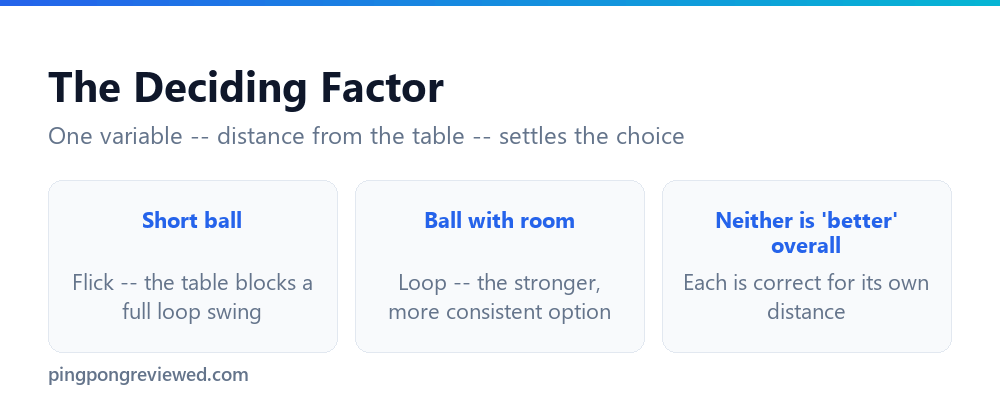
No, a flick can’t replace the loop, because the two shots exist to solve completely different problems. Asking which one to use is really asking how far the ball is from the table, since that single factor decides which shot is even physically available.
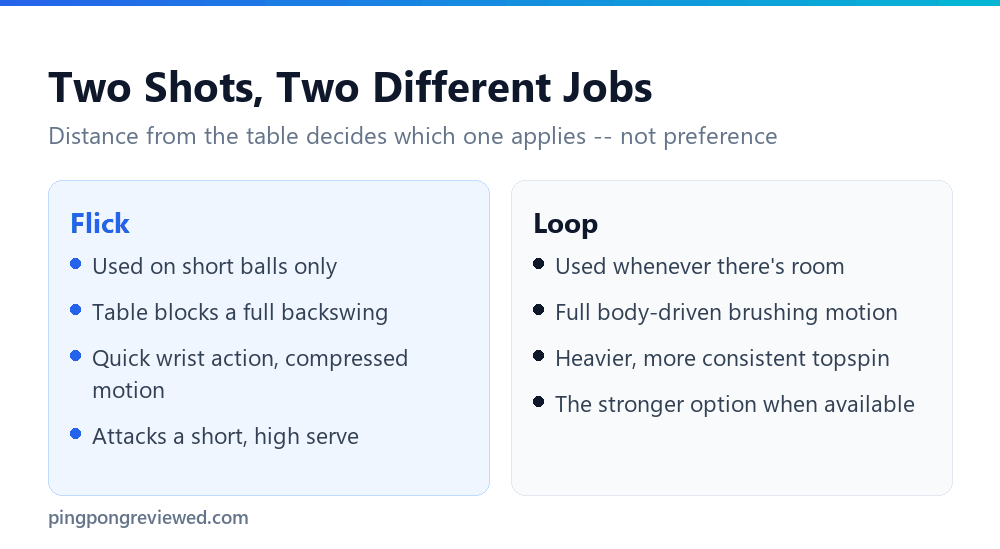
Short answer: A flick and a loop aren’t interchangeable, the flick is specifically for short balls, where the table itself blocks a full backswing, compressing the stroke into a quick wrist action instead. A loop is for anything with more room, using a full body-driven brushing motion to generate heavier, more consistent topspin. In the modern game, the loop is generally the stronger option whenever it’s available; the flick exists specifically for the situations where a loop simply isn’t. Verified against independent coaching sources on 5 September 2026.
Table of Contents
Why This Isn’t Really a Competition
Framing this as flick versus loop suggests a player picks one as their preferred style, the way someone might favor one grip over another. That’s not how coaching sources describe the relationship at all. The two shots are triggered by a specific physical condition, how much room exists between the ball and the table, rather than by a player’s general technical preference. A strong loop player still flicks short balls, and a player who flicks well doesn’t get to loop a ball that’s still sitting over the table.
Why the Table Itself Decides
A loop needs room. Generating heavy topspin through a full brushing motion, legs rotating, hips turning, the arm and wrist accelerating through contact, requires enough backswing space to build that motion before the racket meets the ball. A short ball, one that would bounce twice on the receiver’s side if left alone, sits close enough to the net that the table itself is physically in the way of that full swing. There’s nowhere to wind up.
The flick exists precisely to solve that specific problem. By compressing the stroke into a fast wrist action rather than a full body motion, a flick generates real topspin and pace on a ball that a loop simply can’t reach mechanically, given the table’s physical presence in the way of a longer swing.
Why the Loop Wins When Both Are Available
On any ball where both shots are technically possible, meaning there’s at least some room for a backswing, coaching sources are consistent that the loop is generally the stronger choice. It produces heavier, more consistent topspin, generated through a much larger, more powerful kinetic chain than a wrist-driven flick can match. Modern attacking table tennis is built around looping as close to universally as possible, precisely because it’s the shot that lets a player attack aggressively while staying consistent.
The flick isn’t a compact substitute for the loop on these longer balls, using a flick when a loop is actually available generally trades away power and consistency for no real benefit, since the table isn’t forcing that trade-off the way it does on a short ball.
- ✓Flick short balls that sit too close to the table to loop
- ✓Loop anything with enough room for a full backswing
- ✓Practice both shots, since each covers a distance the other can’t
- ✓Treat distance from the table as the deciding factor, not preference
- ✕Try to loop a short ball sitting over the table
- ✕Default to flicking on balls that have real room to swing
- ✕Treat the flick as a lower-effort loop substitute
- ✕Assume one shot is simply better than the other in general
The Wrist-Versus-Body Distinction
It’s worth being specific about what actually changes between the two strokes mechanically, since it explains why one can’t simply substitute for the other. A loop draws power from a long kinetic chain, legs, hips, shoulders, arm, and finally the wrist, each adding to the acceleration built by the one before it. A flick skips almost all of that chain by necessity, relying heavily on wrist action alone because there simply isn’t time or space to involve the rest of the body before contact.
That’s not a matter of a flick being an inferior, scaled-down loop, it’s a different stroke built around a completely different source of power, suited to a situation where the loop’s normal power source physically can’t be used in time.
⚠️ Watch out: Trying to add a full body motion to a shot on a short ball usually results in either late contact or a mishit, since there isn’t time to complete a loop’s longer swing before the ball has already passed the ideal contact point.
Backhand vs Forehand Flicks
The flick itself isn’t a single uniform stroke, backhand and forehand flicks differ in exactly how they generate their topspin, which is worth knowing since the two get grouped together under one name. A backhand flick relies especially heavily on wrist snap to produce topspin, since the backhand side offers even less room for arm and shoulder involvement than the forehand does at the same short distance. A forehand flick can draw on slightly more arm and shoulder rotation than its backhand counterpart, while still falling well short of a full loop’s kinetic chain.
That distinction matters practically: a player developing their flick often finds the backhand version demands more dedicated wrist training specifically, since there’s less of the rest of the body available to compensate for a weak wrist snap on that side. Coaching sources treat backhand and forehand flicks as related but separately trained skills for exactly this reason.
Why Modern Coaching Emphasizes Looping So Heavily
It’s worth understanding why coaching sources lean so strongly toward looping whenever it’s available, since that emphasis is part of why the flick-versus-loop question gets asked in the first place. Before the sponge-rubber era of the sport, table tennis was a much more patient game built around pushing and blocking rather than heavy topspin attack. Once players learned to brush the ball for topspin using sponge rubber, the loop became the stroke that defined the modern, faster, spinnier version of the sport almost entirely.
Every serious attacking player’s game is now built around the loop as the primary offensive stroke specifically because of how much more spin and power it generates compared to the alternatives available on the same ball. That historical and technical context is exactly why coaching sources treat the loop as the default whenever it’s mechanically available, with the flick positioned clearly as the specialist tool for the one situation the loop can’t reach.
💡 Pro tip: If you’re still developing your loop, resist the temptation to flick balls that actually have enough room for a real loop attempt, even if the flick feels easier or more reliable in the short term. Building loop repetitions on borderline balls is part of how the stroke actually develops.
How This Plays Out at Different Skill Levels
Beginners often flick more balls than necessary, not because the flick is the right shot for those balls, but because the loop hasn’t been developed enough yet to feel reliable on anything but the clearest, longest opportunities. That’s a reasonable stage to pass through, but it’s worth recognizing as a developmental limitation rather than a deliberate tactical choice, the underlying rule, that distance decides the shot, doesn’t change just because the loop isn’t fully trained yet.
As a player’s loop becomes more reliable across a wider range of distances, the range of balls that require a flick actually shrinks, not because short balls become rarer, but because the borderline, half-long cases that a beginner might flick out of caution become loopable once the stroke is developed enough to handle less ideal setups.
📊 Note: A well-developed flick remains valuable at every skill level, including the highest, it doesn’t get “outgrown” the way over-flicking on loopable balls does. What changes with skill is which balls actually require it, not whether it stays useful at all.
A Worked Example
Picture two serves landing in the same match: one a short, slightly high serve sitting just over the net, the other a half-long serve with real depth. Against the short serve, reaching in with a full loop swing either mishits the ball or arrives too late, since the table is physically in the way of the backswing needed. A quick wrist flick, generating topspin through a much shorter motion, handles that same ball cleanly and aggressively.
Against the deeper serve, the opposite holds. There’s enough room to load a full loop, and doing so produces a heavier, more dangerous attacking shot than a flick could generate on a ball that never actually required the compressed, wrist-only motion in the first place.
The Short Version, Restated
A flick doesn’t replace the loop, and it was never meant to. The two strokes divide the court by distance from the table: flick for short balls where a loop is mechanically unavailable, loop for everything else, where its larger kinetic chain makes it the stronger option whenever there’s room to use it.
Learning both, and learning to recognize which situation calls for which one, matters far more than picking a favorite between them.
Neither shot ever fully replaces the other, at any skill level. They’re two answers to two different distances, and the goal is always having both available, not picking one to specialize in at the other’s expense.
That’s the whole comparison, once the false choice is set aside: not which one wins, but which one the ball in front of you actually calls for.
Flick vs Loop Questions, Answered
Can a flick replace the loop entirely?
No. A flick is used specifically on short balls where a full loop swing isn’t physically possible. On any ball with room for a backswing, the loop is generally the stronger option.
Why can’t you loop a short ball?
The ball sits close enough to the net that the table itself blocks the full backswing a loop stroke needs, forcing a compressed wrist action instead.
Is a flick a weaker version of a loop?
Not exactly, it’s a different stroke built around wrist action rather than a full-body kinetic chain, suited to a situation where a loop’s power source can’t be used in time.
Should I use a flick on a ball I could loop instead?
No. If there’s enough room for a full backswing, the loop generally produces heavier, more consistent topspin than a flick would on the same ball.
What’s the main factor that decides flick versus loop?
Distance from the table. A short ball calls for a flick; a ball with real room for a backswing calls for a loop.
Train both, recognize the distance each one belongs to, and the question of which is ‘better’ stops being one worth asking at all.
The Short Version
- →A flick and a loop solve different problems, not the same one.
- →Flicks are for short balls where a full backswing isn’t possible.
- →Loops are for anything with room, using a full-body kinetic chain.
- →The loop is generally stronger whenever both shots are available.
- →Distance from the table, not preference, decides which one applies.
- →Backhand and forehand flicks are related but separately trained skills.
One table, two distances, two strokes, and a clear rule for which one belongs where.

Ping Pong Reviewed is an equipment review site covering table tennis and baseball gear. Specifications are checked against manufacturer listings, and prices against live retail pages, before publication.