What Is Ping Pong? Rules, History, and How It’s Played
What is ping pong? Ping pong — officially called table tennis — is a racket sport played on a table divided by a low net, where two or four players hit a lightweight ball back and forth until one side fails to make a legal return. One point worth settling early, since it is stated wrongly on a number of sites: table tennis has been a continuous Olympic sport since 1988 and remains one, with an event lineup that has expanded rather than shrunk. Claims that it was an Olympic event only “till 2004” are simply false.
Table of Contents
How the Game Actually Works
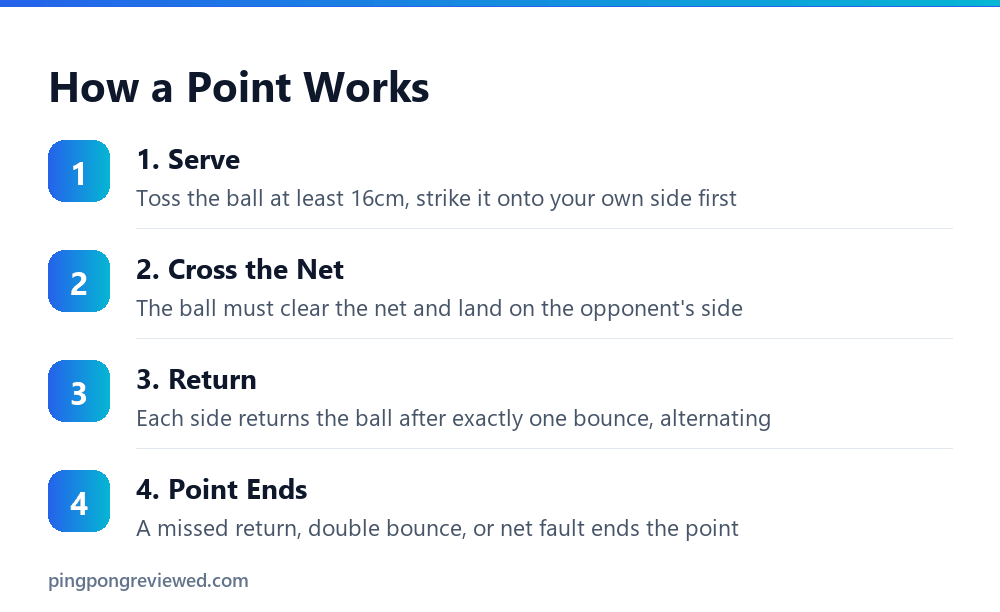
A rally starts with a serve — the ball must bounce once on the server’s own side of the table, clear the net, then bounce once on the receiver’s side. See our full serving rules guide for the exact toss-height and visibility requirements. After the serve, players alternate hitting the ball back over the net, with each side allowed exactly one bounce on their side before returning. A point ends when the ball is hit into the net or off the table, bounces twice on one side, or lands outside the legal playing area.
Matches are played to 11 points, win by 2, across a set number of games (typically best of 5 or best of 7 in competitive play). Games move fast compared to most racket sports — the table is small and the ball is light, so rallies are often decided in well under a second of actual reaction time per shot.
Ping Pong vs. Table Tennis: Same Game, Different Name
“Ping pong” and “table tennis” describe the same sport. The name split traces back to 1901, when English manufacturer J. Jaques & Son trademarked “Ping Pong” for their branded equipment set. Because the name was trademarked, the sport’s governing bodies and competitive scene adopted “table tennis” as the neutral, non-branded name instead — which is why the official international federation is the International Table Tennis Federation (ITTF), not a “ping pong” federation, even though most casual players still say “ping pong” day to day.
There’s one narrow exception where the names genuinely refer to slightly different things: some recreational “ping pong” variants, like sandpaper-paddle backyard play, use different equipment than regulation table tennis. But for the sport played at the club, school, and Olympic level, the two names are interchangeable.
A Short History
Table tennis originated in England in the 1880s as an after-dinner parlor game, played with improvised equipment — books stacked as a net, a wine cork or rounded champagne cork as a ball. The sport formalized quickly: J. Jaques & Son trademarked the “Ping Pong” name in 1901, and the International Table Tennis Federation was founded in 1926 to govern the sport internationally, a body that today counts over 220 member associations.
The sport’s biggest technical turning point came in 1952, when Japanese player Hiroji Satoh won the World Championships using a sponge-covered paddle instead of the hard pips-only rubber that had been standard — sponge rubber generates dramatically more spin and speed, and its adoption reshaped competitive technique within a few years. Table tennis joined the Olympic program at the 1988 Seoul Games and has remained an Olympic sport in every Summer Games since, with mixed doubles added as a new Olympic event starting in 2020 — expansion, not reduction, of its Olympic presence over time.
What You Need to Play
- A regulation table: 9 feet by 5 feet, with a 6-inch net dividing it in half.
- Paddles (rackets): a wood blade covered in rubber on one or both sides, in either the shakehand or penhold grip style.
- A ball: a 40mm plastic ball weighing 2.7 grams, rated 1 to 3 stars for quality and roundness consistency.
- A net and posts: 15.25cm (6 inches) high, spanning the full width of the table.
That’s the full equipment list — unlike many racket sports, table tennis doesn’t require significant protective gear or specialized court surfacing, which is part of why it’s playable almost anywhere a table and a small amount of space can fit.
Scoring, In More Detail
Games are played to 11 points, but a game can’t end on a single-point lead if the score gets close — a player must win by at least 2 points, so a game tied at 10-10 continues until one side pulls 2 points ahead (12-10, 15-13, and so on). This deuce rule is identical in spirit to tennis’s deuce, just applied to a different base score.
A full match is typically the best of 5 games in casual and club competition, or the best of 7 at the highest professional and Olympic level. Serve alternates every 2 points during normal play, but switches to alternating every single point once a game reaches 10-10, which keeps the serving advantage balanced during the most contested part of a close game.
Common Playing Styles
Not every player approaches table tennis the same way, and recognizing the basic styles helps make sense of what you’re watching or who you’re playing against:
- Offensive/looping style: built around heavy topspin and aggressive attacking shots, the dominant style at the elite level today.
- All-round style: balances offense and defense depending on the situation, common at intermediate and advanced club level.
- Defensive/chopping style: relies on backspin and consistency to wear down attacking opponents, less common but still effective, especially against players unused to facing it.
- Blocking style: uses quick, close-to-table blocks to redirect an opponent’s pace back at them rather than generating power independently.
Most players develop a blend rather than fitting neatly into one category, but understanding these baseline styles makes it easier to recognize what a particular opponent or professional match is actually doing tactically.
Frequently Asked Questions
Is ping pong the same as table tennis?
Yes — they’re the same sport under two different names. “Table tennis” is the official, non-trademarked name used by governing bodies and competitive play; “ping pong” is the casual, trademarked name from the sport’s early history that’s still widely used today.
Is ping pong still an Olympic sport?
Yes — continuously since 1988, with no gap. Mixed doubles was added as a new Olympic event in 2020, meaning the sport’s Olympic presence has grown over time rather than ending at any point.
How many players can play at once?
Two players (singles) or four players (doubles), the same structure as tennis. Doubles adds a diagonal serving restriction that singles doesn’t have — see our doubles rules guide for the full breakdown.
What’s the difference between ping pong and other racket sports?
Table tennis is played on a table rather than a court, with a much lighter ball and paddle, and rallies happen at a significantly faster relative pace than tennis, badminton, or squash. It’s also one of the only racket sports playable indoors in a relatively small footprint.
When did table tennis start using sponge paddles?
1952, when Hiroji Satoh won the World Championships using a sponge-covered paddle. Sponge rubber’s dramatically higher spin and speed potential compared to the earlier pips-only rubber reshaped competitive technique within just a few years of its introduction.
How fast does the ball actually travel?
Elite offensive shots can exceed 60 mph over a table roughly 9 feet long, which is what makes the sport’s reaction demands so genuinely unusual — the ball crosses the entire playing distance in a fraction of a second at that speed, far less time than a comparably fast shot in most other racket sports allows.
What does ‘star rating’ mean on a ping pong ball?
It’s a manufacturing quality grade — 1 to 3 stars — measuring roundness and bounce consistency, not weight or player safety. A 3-star ball is the tournament-standard, most consistent grade; 1-star balls are typically sold for casual or training use at a noticeably lower price point.
Do you need special shoes to play ping pong?
Not strictly required, but dedicated court shoes with non-marking soles and good lateral support genuinely help given the sport’s quick side-to-side movement pattern. Most table tennis facilities require non-marking soles specifically to protect the playing surface, even if a specific shoe brand isn’t mandated.
Is ping pong a good workout?
Yes, more than most people expect from a game often seen as purely casual. Competitive rallies demand real cardiovascular effort, quick lateral movement, and sustained reaction speed, and the sport’s low-impact nature makes it accessible across a wide range of ages and fitness levels compared to many higher-impact sports.

Ping Pong Reviewed is an equipment review site covering table tennis and baseball gear. Specifications are checked against manufacturer listings, and prices against live retail pages, before publication.