Table Tennis Racket Ratings Explained: Speed, Spin and Control
Table tennis racket ratings explained in one line: they are each maker’s own numbers, not a shared standard. Butterfly says its values are relative and come from its own tests, STIGA uses stars and unlabeled numeric scores, Killerspin rates from 1 to 10, and the same JOOLA paddle shows 75, 75 and 97 on one site and 4, 7 and 8 on another. We found no maker that says its scale matches anyone else’s.
Every listing seems to carry three numbers, usually speed, spin and control. They look scientific. They are really each brand’s way of describing its own range.
This guide goes through what the makers say their numbers mean, shows the same paddle on two different scales, and lists the published figures for products we checked on October 1, 2026. We haven’t measured or tested any racket, so we don’t add numbers of our own. For the broader buying picture, see our beginner paddle guide.
- →There is no shared scale. The ITTF Laws have none that we could find, and each maker uses its own.
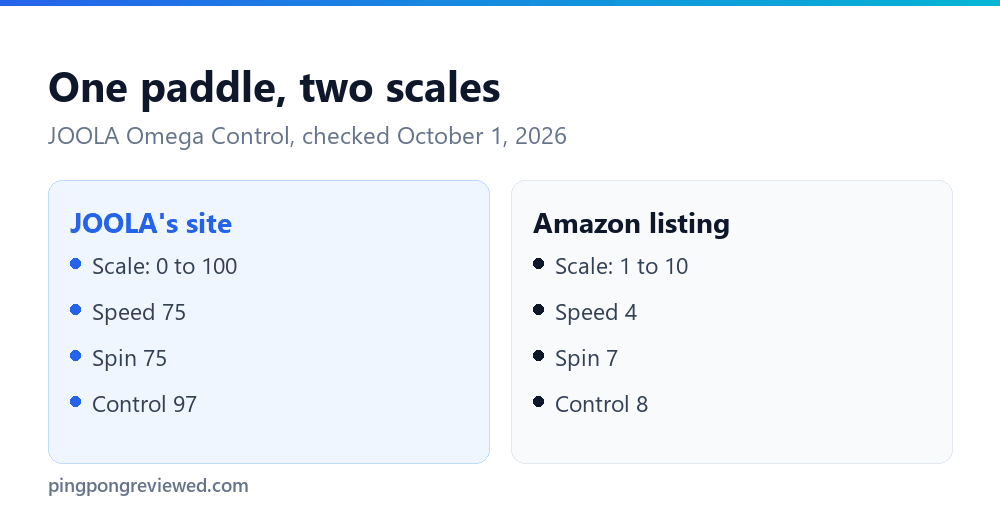
- →The same JOOLA paddle reads 75/75/97 on JOOLA’s site (0 to 100) and 4/7/8 on Amazon (1 to 10).
- →Butterfly calls its speed and arc values relative and says the control of a blade cannot be measured.
- →Faster usually comes with less control, according to both STIGA and Butterfly.
- →Use ratings to compare two paddles from the same brand, not across brands.
Table of Contents
Table tennis racket ratings explained: what speed, spin and control describe
Speed is how fast the ball leaves the racket. Spin is how much rotation the racket can put on it. Control is how forgiving the racket is. Those are the everyday meanings. What the makers publish is narrower.
Butterfly describes its rubber index as the effect on ball speed in a relative manner, measured by its own tests, and defines arc as how easily the ball takes a high trajectory in the direction of the swing. It says its rackets’ speed rating shows the integrated pace of the ball relative to other rackets in its line. Of control it says the amount a blade has cannot be measured and is different for each individual, that it rates each blade’s control in relation to its speed to help you choose, and that generally the faster the blade, the more difficult it is to control. See Butterfly’s rubber performance page and its equipment FAQ.
STIGA’s blade guide says its speed and control figures are estimated and depend on many factors, including weight and rubber combinations. See STIGA’s blade guide.
The word relative matters. A relative score tells you how one product sits against others in the same line. It doesn’t tell you how fast the ball will go in your hands.
How each maker rates its rackets
Here is how the makers we checked present their numbers, as we found them on October 1, 2026.
Look at the spread. One brand uses stars, one uses 0 to 100, two use 1 to 10, two use words and classes. Even where two makers both use numbers, nothing we read says the numbers line up.
The same paddle on two scales
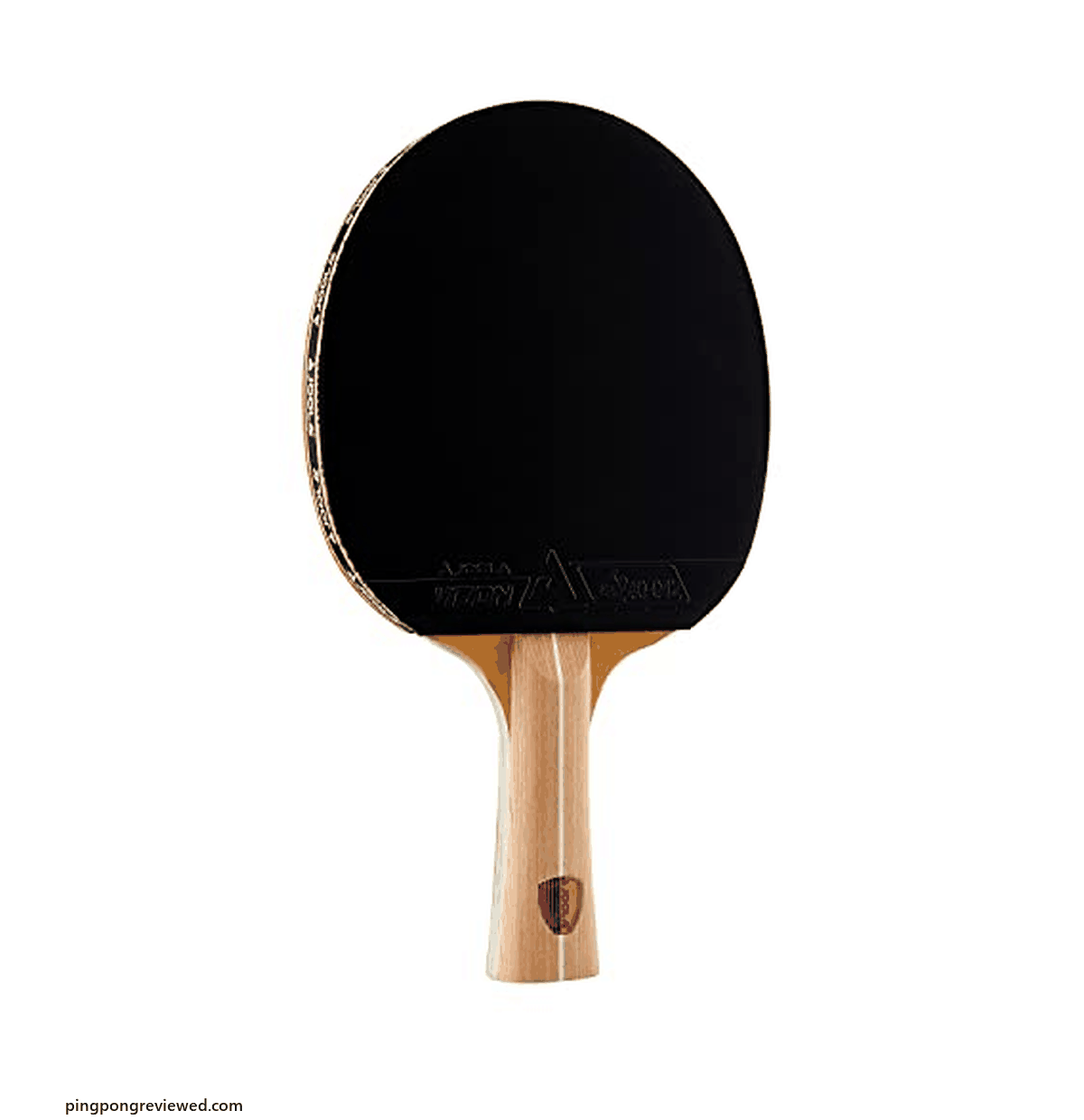
The clearest example is the JOOLA Omega Control. JOOLA’s own page lists performance ratings on a 0 to 100 scale: speed 75, spin 75 and control 97. The Amazon listing for the same paddle states a scale of 1 to 10 and lists speed 4, spin 7 and control 8.
Scaled to a common range, 75 out of 100 is not 4 out of 10, and 97 is not 8. Neither source explains how its numbers were produced, so we can’t convert one into the other. That is the whole problem with comparing ratings: a number only makes sense next to the scale it came with.
Price and stock for this paddle changed over time, so check the listing. It was $19.95 on Amazon on October 1, 2026.
Stars versus scores: how STIGA does it
STIGA is a good case study because it uses two systems. Its European guide grades rackets from one to five stars. Its US product pages add speed, spin and control scores.
The guide describes five stars as the very best and one star as an easier racket, and says more stars means a more advanced and faster racket with less control. It describes the one-star racket as having good control without being too fast or giving too much spin. See STIGA’s star-system guide.
On STIGA’s US pages the scores climb quickly with the level of the racket. The table shows STIGA’s published figures for four products.
Don’t expect one tidy rule in these figures. Control is 53 for the entry set, 89 for the Nitro, 80 for the Pro Carbon and 75 for the Carbon+. The Pro Carbon has the highest speed score of the four and a higher control score than the Carbon+. So the idea that faster means less control, which STIGA states in words, doesn’t map onto the scores as a formula. They read as separate marketing scores, not the output of one equation, and we haven’t tested a racket to say otherwise.
Published ratings for products we checked
This table collects the numbers that makers or their listings published for products we’ve covered. Read each row with its own scale in mind.
Notice that a complete racket and a rubber are in the same table but not the same category. Butterfly’s Tenergy 05 is a rubber sheet. The Omega Control is a finished paddle. Numbers describe each product on its own terms.
Rubber ratings, blade ratings and complete-racket ratings
A rating can describe three different things, and listings rarely say which. A rubber rating describes a sheet of rubber. A blade rating describes the wooden base. A complete racket rating describes a blade and two rubbers glued together.
Butterfly’s rubber index is a rubber rating: speed, spin and arc, plus a sponge hardness figure. Butterfly’s racket speed rating is something else, the pace of the ball relative to other rackets in its line. STIGA’s blade guide gives estimated speed and control for blades and says both depend on factors such as weight and rubber combinations. Table Tennis England puts the boundary plainly: the blade is the bat without the rubber.
That is why the numbers on a finished recreational racket are hard to read. They include whatever rubber the maker glued on, and the maker’s scale may be built from either of the other two. For rubbers, our blade and rubber guide explains the parts.
Classes and labels instead of numbers
Not every maker leads with numbers. Tibhar’s Evolution MX-P page shows numbers and also a strategy label of OFF+. Donic’s Bluestorm Z1 page uses the labels OFF and OFF+ with words for hardness, spin, speed and control. DHS’s Hurricane 3 Neo page shows a strategy label of OFF with a sponge description.
Butterfly’s equipment FAQ spells out its own blade classes: OFF+ is for all-out offensive play, and OFF is for direct offensive play with much spin, speed and power. Tibhar, Donic and DHS use similar labels, but the pages we read didn’t define them, so treat each as that maker’s class and not a shared standard. What the labels do show is that makers group products by style of play as well as by number. When a listing has a class and no numbers, the class is the maker’s whole message.
Reading three listings, step by step
Here is how the advice above works on real listings. These are readings of the published figures, not performance judgments.
Notice that the safe reading is always relative. The JOOLA paddle puts its weight on control within JOOLA’s system. The STIGA set sits far below the Pro Carbon within STIGA’s system. Neither tells you how either would play in your hands.
How to use ratings without being misled
Sponge matters too. Table Tennis England says the combination of sponge and playing surface affects the spin, speed and control of a rubber, and that soft sponge rubbers are generally slower than hard ones. Butterfly lists a sponge hardness figure next to its speed and spin values. A harder or softer sponge changes how a rubber plays, and the numbers on a finished racket include whatever rubber it came with. See Table Tennis England’s equipment guidance.
What ratings cannot tell you
Ratings can’t tell you how a racket feels in your hand, how it suits your stroke, or how it behaves on a humid day. The ITTF Statutes contain no rating scale for speed, spin or control. The Laws set rules for size, shape and weight, the flatness and rigidity of the blade, the share of natural wood, and the coverings, and the regulations require a covering used in competition to be authorized. See the ITTF Statutes 2026.
Makers also tell you where the numbers stop. Butterfly says the control a blade has can’t be measured and rates each blade’s control in relation to its speed, and STIGA calls its speed and control figures estimates. A number can start a conversation about a racket. It can’t finish one.
If you want help narrowing options, our blade and rubber guide goes through the parts, and our blade guide covers what a blade does.

How we checked these ratings
We read each maker’s own product page or guide on October 1, 2026, and the Amazon listing where we quote one. We searched the ITTF Laws for a rating scale and found none. We did not measure or test any racket, so every number in this guide is one a maker or listing published.
Frequently asked questions
What do speed, spin and control mean on a table tennis racket?
They are the three numbers makers use to describe a racket or rubber. Butterfly defines its speed and arc values as relative ratings from its own tests, and says the control of a blade cannot be measured. Each maker sets its own scale, so a number from one brand does not carry over to another.
Is a higher rating better?
Not for everyone. STIGA says more stars means a more advanced and faster racket with less control, and Butterfly says the faster a blade is, the harder it generally is to control. A high speed number can mean a racket that is harder to handle.
What do the stars on a STIGA racket mean?
STIGA grades its rackets on a 1 to 5 star system. It describes 5 as the best and 1 as an easier racket with good control that is not too fast and doesn’t give too much spin.
Why does the same paddle show different numbers on different sites?
Because sellers can use different scales. The JOOLA Omega Control shows Speed 75, Spin 75 and Control 97 on JOOLA’s site on a 0 to 100 scale, and Speed 4, Spin 7 and Control 8 on Amazon on a 1 to 10 scale.
Does the ITTF rate rackets for speed, spin or control?
We found no rating scale in the ITTF Laws. The racket rules deal with size, shape, weight, flatness, wood content and coverings, and the covering has to be authorized.
Which rating should a beginner look at?
Compare control first, within one brand. Killerspin says beginner paddles prioritize control over speed, and STIGA describes its one-star racket as one with good control that isn’t too fast. Those are maker statements, not tests we ran.
Is a Control rating of 90 or more a sign of a good beginner paddle?
That figure is a benchmark some sellers use, but we found no maker or federation source for it. A control number only means something inside that brand’s scale.
What does sponge hardness have to do with ratings?
Table Tennis England says the combination of sponge and playing surface affects the spin, speed and control of a rubber, and that soft sponge rubbers are generally slower than hard ones. Butterfly lists sponge hardness alongside its speed and spin values for rubbers.
Do ratings change over time?
They can. Butterfly says it revised its rubber performance index from February 2023 to match improved measurement methods, so an older number may not match a newer one.
Sources
Rating systems come from STIGA’s star guide, STIGA’s blade guide, Butterfly’s rubber page, Butterfly’s equipment FAQ, Killerspin’s guide, Tibhar, Donic, DHS, Palio and Table Tennis England. The rules are in the ITTF Statutes 2026.
As an Amazon Associate, we earn from qualifying purchases through links on this page.

Ping Pong Reviewed is an equipment review site covering table tennis and baseball gear. Specifications are checked against manufacturer listings, and prices against live retail pages, before publication.