How Does Ping Pong Help Your Brain? The Actual Science (2026)

How does ping pong help your brain, specifically, beyond generic “it’s good exercise” claims? This page goes deeper into the neuroscience than our general health benefits guide, which covers the broader fitness, balance and social side. If you are here for the mechanism — why an open, reactive sport engages the brain differently from steady-state cardio — this is that page, and every claim on it is tied to named research rather than to the vague attributions this topic usually attracts.
Table of Contents
Why Open-Skill Exercise Is Different
Exercise scientists split activity into two broad categories: closed-skill exercise, like running on a treadmill or cycling at a steady pace, follows a predictable, self-paced pattern, while open-skill exercise, like table tennis, responds to an unpredictable external stimulus, your opponent’s shot, that changes speed, spin, and placement every single point. That unpredictability is the actual mechanism behind most of the brain-specific research on table tennis: your brain has to process new visual and spatial information and generate a fast motor response continuously, rather than repeating a learned, automatic movement pattern the way steady cardio does.
This distinction shows up across a broader body of sports science research beyond table tennis specifically, comparative studies of open-skill versus closed-skill athletes have generally found the open-skill group performs better on tasks measuring attention control, reaction time, and cognitive flexibility. Table tennis sits toward the extreme end of the open-skill spectrum, given how little time separates one shot from the next and how much information, spin, speed, placement, angle, has to be read and responded to almost instantly, which is part of why researchers have specifically chosen it as a study activity rather than a more moderate open-skill sport.
What the Actual Research Found
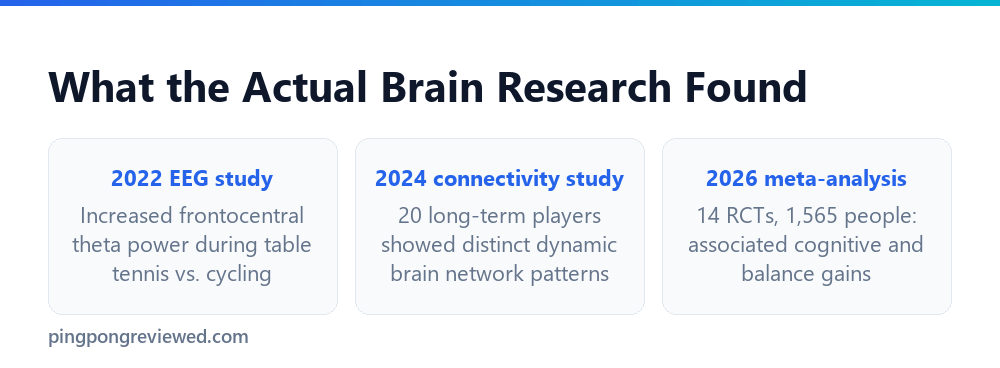
A 2022 EEG study by Visser, Büchel, Lehmann and colleagues, published in Experimental Brain Research, compared frontal brain activity during table tennis, cycling, and a seated cognitive task. Table tennis produced measurably increased activation in frontocentral clusters, specifically increased theta power, an EEG signature generally associated with active cognitive processing, compared to both cycling and the cognitive task alone. That’s a genuinely notable finding: table tennis outperformed a task specifically designed to engage cognition, not just a passive comparison activity.
A separate 2024 study compared brain imaging between 20 long-term table tennis players and non-players, finding distinct patterns of dynamic functional network connectivity in the players’ brains. This is a different kind of evidence than the 2022 EEG study, it looks at lasting structural and functional differences associated with sustained practice, rather than what happens during a single session, and points toward table tennis potentially producing measurable long-term brain changes in regular players, not just a temporary activity-related spike.
It’s worth being precise about what “distinct connectivity patterns” actually means rather than letting it sound more dramatic than it is. The study identified measurable differences in how different brain regions communicate dynamically over time between the two groups, not evidence that players have fundamentally different or superior brain structure in some general sense. Correlational studies like this one also can’t fully separate cause from effect: it’s possible sustained table tennis practice shapes these connectivity patterns over time, and it’s also possible people with certain baseline neural characteristics are more drawn to and successful at a sport this demanding in the first place. The study itself is careful about this limitation, and any honest summary of it should be too.
A 2026 meta-analysis synthesizing 14 randomized controlled trials across 1,565 participants, covered in more depth in our general health benefits guide, found table tennis interventions associated with improved balance and cognitive function, particularly in older adults. Combined, these three pieces of research point in a consistent direction without any one of them proving a strong causal guarantee on its own.
Which Sport Is Actually Best for Your Brain?
There’s no single sport with definitive proof of being objectively best for brain health, and any source claiming otherwise is overstating what the research actually supports. What the comparative literature does support is that open-skill, reactive sports, table tennis, badminton, squash, tend to show stronger associations with cognitive benefits than closed-skill, repetitive exercise in studies that compare the two categories directly, which is consistent with the mechanism described above rather than a claim specific to table tennis alone among that group.
Where table tennis has a genuine practical edge within that open-skill category is accessibility. Squash and badminton both demand more physical intensity and larger dedicated court space, which raises the entry barrier for older adults or anyone managing joint sensitivity. Table tennis delivers the same open-skill cognitive demand in a lower-impact, smaller-footprint format, which is part of why it shows up disproportionately often in healthy-aging research specifically compared to other open-skill sports with similar cognitive profiles but steeper physical demands.
Does Ping Pong Actually Help With Dementia?
Here’s the honest, careful answer: the research shows associations between table tennis and better cognitive function and balance, particularly in older adults, not proof that it prevents or treats dementia. That’s an important distinction. Associated improvements in a randomized trial are genuinely meaningful evidence, but they’re not the same standard of proof as a clinical treatment claim would require, and no legitimate source should present table tennis as a proven dementia prevention method. What’s fair to say: it’s a genuinely promising, low-cost, accessible activity worth including as part of a broader active lifestyle for older adults, alongside medical guidance, not instead of it.
It’s also worth noting that dementia has multiple genuinely distinct underlying causes, and no single lifestyle intervention, exercise included, has been shown to prevent or reverse the disease process across all of them. The research on physical and cognitive activity generally, table tennis specifically included within that broader category, points toward reduced risk factors and better functional outcomes on average across populations studied, which is meaningfully different from a guarantee for any individual person. Anyone with specific concerns about cognitive decline in themselves or a family member should talk to a doctor rather than relying on an equipment review site’s summary of the research, ours included.
How We Sourced This Page
Every specific research claim here ties to a named, findable study rather than a vague “studies show” attribution. Where the evidence is genuinely preliminary — and in cognitive-benefit research a good deal of it is — that is stated in the relevant section rather than smoothed over.
Frequently Asked Questions
Why is the brain worked out when you play table tennis?
Because it’s an open-skill sport requiring continuous, unpredictable visual processing and fast motor response, unlike closed-skill exercise that follows a repeated, predictable pattern.
Is there real research on table tennis and brain health?
Yes — a 2022 EEG study found increased frontal brain activation during play, a 2024 study found distinct brain network patterns in long-term players, and a 2026 meta-analysis of 14 trials found associated cognitive and balance improvements.
Does playing ping pong actually help with dementia?
The research shows associations with improved cognitive function and balance, not proof of dementia prevention or treatment. It’s a promising part of an active lifestyle, not a substitute for medical guidance.
Which sport is actually best for your brain?
No single sport has definitive proof of being objectively best. Open-skill, reactive sports like table tennis tend to show stronger cognitive associations than closed-skill, repetitive exercise in comparative research.
What are the actual downsides of table tennis as a brain-health activity?
It requires access to a table and reasonable indoor space, which is a real practical barrier for some people compared to activities needing no equipment at all, like walking.
How is table tennis different from other cognitive exercises like puzzles?
Puzzles engage cognition in a static, seated context; table tennis combines cognitive processing with physical activity simultaneously, which the research suggests may compound rather than simply add the benefits of each separately.
Do you need to be an advanced player to get the brain benefits?
No — the cognitive demand comes from the open-skill, reactive nature of the game itself, tracking an unpredictable ball and responding quickly, which applies at a beginner’s pace just as much as at a competitive one, even if the specific skills being trained differ.
Can kids benefit from table tennis’s brain effects too?
The open-skill mechanism described above isn’t age-specific, and hand-eye coordination and reaction-time development are genuinely relevant to kids as well as older adults, though most of the specific published research so far has focused on adult and older-adult populations rather than children directly.
Is the brain benefit specific to competitive play, or does casual play count too?
The mechanism, unpredictable, reactive processing, applies to casual rallies too, just at a lower intensity than competitive match play. Regular casual play still counts as genuine open-skill exercise, even without formal competition.
As an Amazon Associate, we earn from qualifying purchases through links on this page.

Ping Pong Reviewed is an equipment review site covering table tennis and baseball gear. Specifications are checked against manufacturer listings, and prices against live retail pages, before publication.