Best Practice Ping Pong Balls: Bulk Value Picks for 2026
The best practice ping pong balls aren’t the same thing as competition balls, and shopping for them the same way wastes money. Practice and competition balls solve different problems, which is why we cover them as separate guides on this site rather than one combined list — see our competition ball guide if you’re specifically shopping for tournament-grade 3-star balls. This page is about a different priority: cost-per-ball and bulk quantity for the kind of repetitive drilling that eats through balls fast, where losing a few under the couch or cracking one on a hard smash shouldn’t sting.
One warning before the picks: bulk ball listings are unusually prone to describing one thing and shipping another, with pack counts and star ratings in the title that do not match the product detail below it. Every ASIN linked here was opened and read individually for that reason, and it is worth doing the same on any bulk listing you are considering elsewhere.
Table of Contents
Why Practice Balls Are a Different Buying Decision
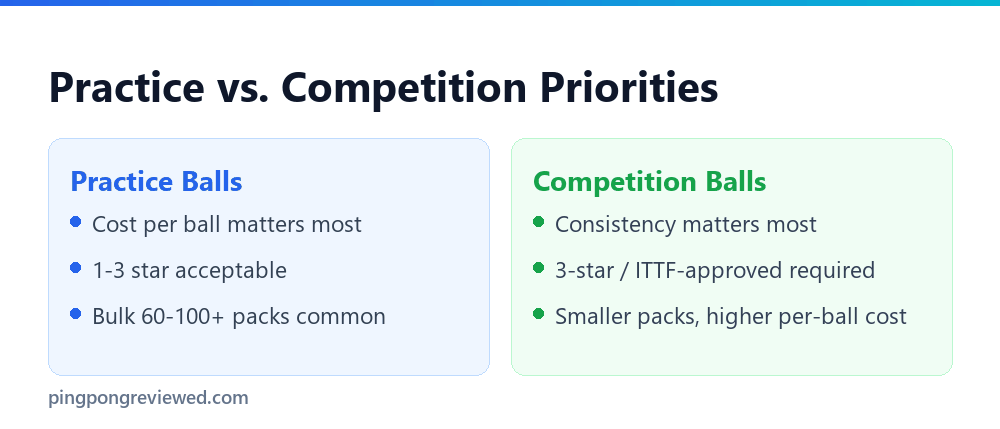
A serious drilling session — multiball feeding, footwork patterns, repetitive serve practice — burns through balls at a rate that makes tournament-grade pricing impractical. The smart tradeoff for practice is buying in bulk at a lower per-ball cost, accepting a looser star-rating tolerance that genuinely doesn’t matter when you’re drilling your own stroke rather than playing a scored, contested match against someone else.
The 4 Best Bulk Practice Picks
1. JOOLA Training 3-Star — Best Balance of Quality and Bulk
JOOLA Training 3-Star Table Tennis Balls, $10.49, is genuinely 3-star despite the practice-focused branding, giving you tournament-tier bounce consistency at a bulk training price. A reasonable middle-ground pick if you want to practice with balls that behave like the ones you’ll actually compete with.
2. Guirnd 20-Pack — Best Everyday Value
Guirnd 20 Pack Ping Pong Balls, 3-Star, roughly $7 for 20 balls, is the cheapest genuinely 3-star option we found — about $0.35 per ball. Good for a player who wants real bounce consistency without paying competition pricing for balls that’ll get scuffed and dented through regular drilling.
3. D-Xam 1-Star Bulk — Best for High-Volume Multiball Drilling
D-Xam Ping Pong Balls, 1-Star, 40mm, around $5, is a straightforward 1-star bulk option honestly labeled as such — a mismatch we caught and corrected from the old listing, which described this exact product as a different, higher-tier JOOLA ball. For high-volume multiball feeding drills where balls take real punishment, 1-star quality is genuinely fine and the price reflects it.
4. PRO-SPIN Multi-Pack — Best Flexible Pack Size
PRO-SPIN High-Performance Ping Pong Balls (12/24/60 Pack), roughly $14.99 depending on pack size chosen, lets you scale quantity to your actual practice frequency rather than committing to one fixed bulk count — useful if you’re not yet sure how many balls a regular practice routine will actually go through.
Practice Formats That Actually Use This Many Balls
Multiball Feeding
A coach or partner feeds balls one after another from a bucket at a controlled pace, letting a player focus purely on one shot or footwork pattern without needing to reset for a full rally between each individual rep. This is the single biggest ball-consumption practice format — a focused 20-minute session can easily go through 60-100+ balls, which is exactly why bulk pricing matters far more here than fine-grained star rating precision ever does.
Solo Wall Rallying
Bouncing the ball against a wall repeatedly builds ball control and reaction speed without needing a partner, but balls regularly go astray, roll under furniture, or crack against a hard wall surface faster than in normal table play. A bulk, genuinely inexpensive stash makes this kind of solo practice much less stressful than constantly worrying about losing or damaging premium tournament-grade balls.
Serve Practice Reps
Repeating the same serve 20-30 times in a row to groove toss height, spin, and placement is one of the most valuable solo drills a player can realistically do, and it also burns through balls quickly since each individual serve typically ends the rep rather than continuing into a longer full rally.
Keeping Bulk Balls Organized
A large bulk order of practice balls creates its own small logistics problem — loose balls scattered across a bag or storage bin are annoying to manage during an actual session. A cheap mesh laundry bag or a dedicated ball bucket keeps a 60-100 ball stash organized and easy to grab from mid-drill, which matters more than it sounds once you’re actually running a multiball session and don’t want to stop and hunt for loose balls rolling across the floor mid-session. A simple wire collection basket also works well for gathering stray balls back up quickly once a drilling session has finished.
Frequently Asked Questions
What are the actual best practice ping pong balls to buy?
JOOLA’s Training 3-Star balls offer the best balance of quality and bulk value, while the Guirnd 20-pack is the cheapest genuinely 3-star option if cost per ball is the top priority.
Do I actually need 3-star balls for practice at all?
No — for solo drilling, multiball feeding, and footwork practice, 1-star balls perform perfectly well and cost significantly less money overall. Save 3-star quality for match play or specific drills where realistic bounce consistency genuinely matters most.
How many balls do I actually need for a regular practice routine?
For multiball feeding drills specifically, 60-100+ balls is typical so you’re not constantly stopping to collect and refeed — buying in bulk genuinely changes the practical drilling experience, not just the price.
What’s special about the 20 Pack Ping Pong Balls option?
It’s a genuinely verified 3-star product at one of the lowest per-ball costs we found — roughly $0.35 per ball for tournament-tier bounce consistency, a real value if you want match-realistic practice without competition pricing.
Are bulk practice balls as durable as premium competition balls?
Generally somewhat less durable, since bulk-focused manufacturing prioritizes cost over premium material consistency, but the difference is rarely dramatic enough to matter for practice purposes — a bulk ball that cracks after heavy use is exactly the tradeoff a lower price point is meant to cover.
Can I use practice balls for actual match play?
You can, but it’s not ideal — the looser manufacturing tolerance on 1-star bulk balls can produce inconsistent bounce that feels unfair in a genuinely competitive point. For casual games among friends it rarely matters; for anything resembling serious competitive play, switch to the 3-star picks in our competition guide instead.
How much should a bulk pack of practice balls cost?
Reasonable bulk pricing lands somewhere between $0.20 and $0.50 per ball depending on star rating and pack size — anything significantly above that starts approaching competition-ball pricing without the corresponding quality tier to justify it.
What’s the actual difference between 1-star and unrated bulk balls?
Unrated balls typically haven’t been graded at all rather than failing a quality tier — many generic bulk balls simply skip the star-rating process entirely since it isn’t required for casual or training sale. This doesn’t necessarily mean lower quality than a 1-star ball, just that no formal grading was applied.
Should I buy different balls for different drill types?
It can help but isn’t strictly necessary. Some players keep a cheaper 1-star bulk stash specifically for high-volume multiball feeding, where balls take the most punishment, and a separate small stock of 3-star balls for rally-based drills where realistic bounce behavior matters more than sheer quantity.
Do practice balls come in different colors for a reason?
Mostly visibility preference rather than a performance difference — orange balls are often easier to track against a light-colored table or background, while white balls are traditional and generally easier to see against a darker table surface. Neither color affects bounce or spin characteristics.
As an Amazon Associate, we earn from qualifying purchases through links on this page.

Ping Pong Reviewed is an equipment review site covering table tennis and baseball gear. Specifications are checked against manufacturer listings, and prices against live retail pages, before publication.