Best Ping Pong Balls to Buy: Which Guide Actually Fits Your Need
“Best ping pong balls to buy” does not have one answer, and any single ranked list that claims otherwise is quietly compromising between three different buyers. What you should buy depends on whether you are playing tournaments, drilling in bulk, or starting out from scratch — and the right ball for one of those is a poor choice for the others. This page sorts you to the right answer rather than averaging the three.
Table of Contents
Which Guide Do You Actually Need?
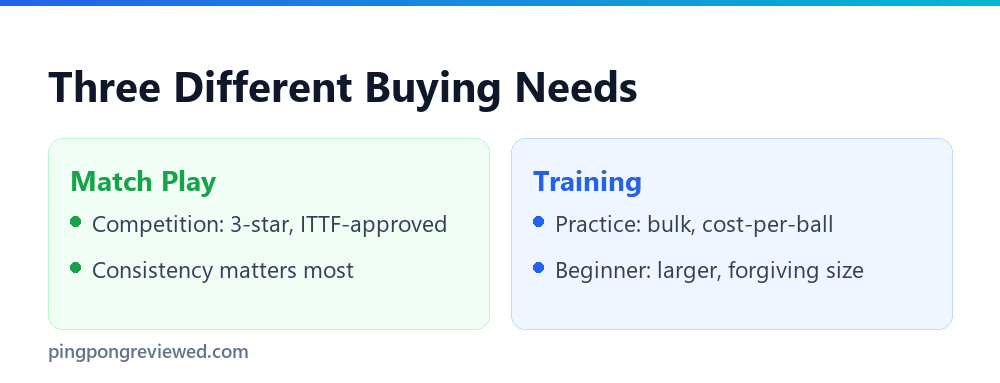
Playing Competitive or Club Matches
You need genuinely 3-star, ITTF-approved balls where consistency in roundness and bounce actually matters for fair play. See our competition ball guide for 4 individually verified picks from Nittaku, DHS, STIGA, and JOOLA.
Regular Solo or Multiball Practice
You need bulk quantity at a low cost-per-ball, since drilling burns through balls fast and tournament-tier pricing doesn’t make sense for balls that’ll take real punishment. See our practice ball guide for bulk value picks, including one product we caught with a description that didn’t match its actual live listing.
Just Starting Out
You need larger, more forgiving balls that are easier to track and contact before moving to regulation size, rather than premium quality. Our beginner ball guide covers the oversized options that most beginner lists skip entirely.
Why We Split This Into Separate Guides
A single “best ping pong balls” list forces an awkward compromise: either it skews toward premium competition balls (overkill and overpriced for someone just drilling solo), or it skews toward cheap bulk options (the wrong call for anyone actually playing sanctioned matches). Splitting the topic by actual use case, the same approach we’ve taken across other categories on this site with genuine cannibalization risk — nets, robots, and blade guides among them — gives a more useful, specific answer than any single compromise list could realistically provide to every different type of reader.
This also matters because of a pattern we’ve confirmed repeatedly across the Balls Reviews category this week: generic “best of” posts covering broad categories are exactly where mislabeled products (a net set claimed as balls, an ASIN linking to the wrong item entirely) tend to slip through. Narrower, use-case-specific guides make it easier to verify every single pick actually belongs on the list, since there’s a clearer, more specific standard to check each product against rather than a vague, catch-all category.
Two Specs Worth Understanding Before You Buy Anything
Star Rating
A manufacturing quality grade from 1 to 3 stars, measuring roundness and bounce consistency — not weight, not safety, a distinction this site has corrected before after finding it misrepresented elsewhere. Higher star rating matters for competitive play; it matters much less for casual practice.
Size
Regulation balls are 40mm, a size that’s been standard since a 2000 ITTF rule change from the original 38mm. Non-regulation jumbo balls (55mm+) exist specifically as a beginner training aid — easier to see and contact, but not legal or appropriate for actual regulation play once you’re past the earliest learning stage. Confusing the two, buying jumbo balls for match play or regulation balls for a total beginner still building basic contact skills, is a common and easily avoided mismatch.
If You Just Want One Reasonable All-Around Pick
If none of the above quite fits and you want a single, reasonable general-purpose ball without reading three separate guides, this is the honest middle-ground answer. It won’t be the single best option for any one specific use case — a dedicated competition ball beats it for tournament play, and a dedicated bulk practice ball beats it on pure cost-per-ball — but it’s a sensible default that performs reasonably well across all three use cases without requiring you to make a precise decision upfront.
Guirnd 20-Pack 3-Star — Best General-Purpose Pick
Guirnd 20 Pack Ping Pong Balls, 3-Star, roughly $7, is genuinely 3-star (verified live, not just claimed) at a bulk price low enough that it works reasonably well whether you’re practicing, playing casual matches, or just want a sensible default without optimizing for a specific use case. It’s also the exact same product we independently verified and recommended in both our competition and beginner ball guides, for whatever consistency reassurance that offers.
Quick Navigation Summary
- Tournament or league matches: our competition ball guide — Nittaku, DHS, STIGA, and JOOLA 3-star picks, individually verified.
- Regular solo drilling or multiball feeding: our practice ball guide — bulk value picks prioritizing cost-per-ball over premium quality.
- Complete beginner just starting out: our beginner ball guide — jumbo, forgiving balls plus a progression to regulation size.
- Actual ball-launching training machine, not just balls: our ball launcher guide — genuine practice machines, not the toy blasters covered in our separate ball gun guide.
Bookmark whichever of these fits your actual situation rather than trying to extract a single universal answer from a page that’s honestly better used as a signpost than a standalone ranked list.
Frequently Asked Questions
What are the actual best ping pong balls overall to buy?
There isn’t one single universal answer — it depends on whether you’re playing competitively, practicing regularly, or just starting out. See the routing section above for the specific guide that matches your actual use case best.
Are colored ping pong balls actually good to play with?
Yes — color is a visibility preference, not a performance difference. Orange is often easier to see against lighter tables or backgrounds; white is traditional and works well against darker surfaces. Neither affects bounce or spin.
Are 3-star ping pong balls genuinely better than 1-star?
For competitive play, yes — 3-star balls have tighter manufacturing tolerance for roundness and bounce consistency. For casual practice, the difference matters much less, which is why our practice ball guide recommends mixing in cheaper 1-star bulk options for high-volume drilling.
Can I use ping pong balls outdoors?
Technically yes, though wind and uneven surfaces undermine precise play regardless of ball quality, and outdoor conditions tend to scuff and wear balls faster than indoor use.
What is the best ping pong ball for beginners specifically?
Larger, non-regulation jumbo balls (55mm+) are genuinely easier for a true beginner to track and contact than standard 40mm balls — see our dedicated beginner ball guide for verified picks and a suggested progression to regulation size.
How many balls should I buy at once?
It depends heavily on use case: a 12-pack covers occasional casual play, while regular practice or multiball drilling typically needs 60-100+ to avoid constant reordering. Our practice ball guide covers this in more depth for high-volume training specifically.
Do professional players use different balls than club players?
Not fundamentally different in size or basic construction, but professionals and serious competitive players consistently use genuinely 3-star, ITTF-approved balls, while club and casual play often mixes in lower-tier balls without much practical consequence for the level of play involved.
Is it worth buying balls in bulk to save money?
Yes, for anyone who plays or practices regularly — per-ball cost drops significantly at higher pack sizes, and running out mid-session is a common and avoidable annoyance that bulk buying solves directly.
Why do net sets and paddle sets turn up on “best balls” lists?
Because many of those lists are assembled from a product feed without checking that each item matches the stated topic. The sets do contain balls, so the listing is not quite false, but you end up buying equipment you may not need. Check that the product is sold as balls before ordering.
Should I trust star ratings printed on generic bulk packaging?
Verify independently where possible — check the actual live product listing states both the star rating and ITTF approval explicitly, rather than trusting a product title or generic packaging claim at face value. This site’s own posts have found genuine mismatches between claimed and actual product identity more than once this week alone, which is exactly why we now individually verify every product before publishing a recommendation.
As an Amazon Associate, we earn from qualifying purchases through links on this page.

Ping Pong Reviewed is an equipment review site covering table tennis and baseball gear. Specifications are checked against manufacturer listings, and prices against live retail pages, before publication.